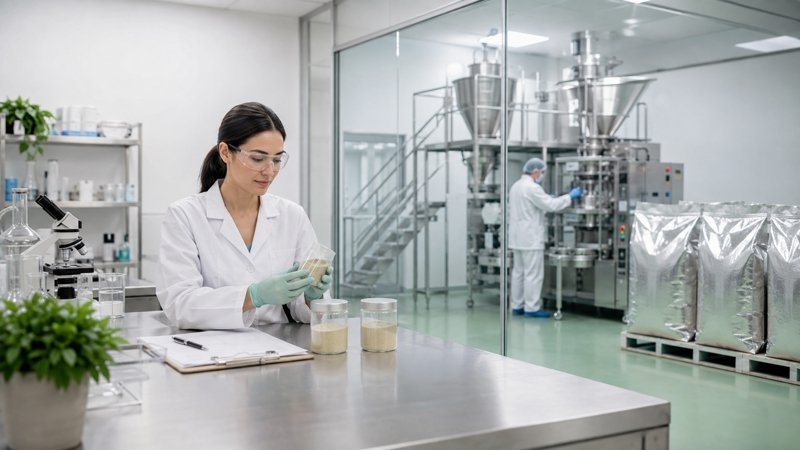
Reliable earthworm extract quality control is not created by one laboratory result at the end of production. It depends on a connected pathway covering research support, raw material management, processing decisions, product-specific testing, batch documentation and bulk-order coordination.
This pathway is especially important because Earthworm Protein Powder, Earthworm Peptide Powder and Lumbrokinase have different product identities and quality criteria. A protein result cannot confirm peptide characteristics, and neither protein nor peptide testing can demonstrate lumbrokinase activity.
For supplement brands, nutraceutical companies, ingredient distributors, contract manufacturers and purchasing teams, supplier evaluation should therefore examine how information moves from the raw material stage to the actual commercial batch—not simply whether a supplier can provide one COA.
Quick Answer
Earthworm extract quality control is not limited to final powder testing. For B2B buyers, reliable quality depends on a connected system that includes research support, earthworm raw material control, purification and selection, controlled production, laboratory testing, COA documentation, batch control and bulk supply management.
This pathway helps buyers evaluate whether Earthworm Protein Powder, Earthworm Peptide Powder and Lumbrokinase are supported by a practical supplier-side quality system. Final suitability must still be confirmed through the specification sheet, batch-specific COA, sample evaluation and purchasing requirements.
The Earthworm Extract Quality Control Pathway
A practical quality pathway can be viewed as:
R&D → Raw Material → Purification and Selection → Production Process → Laboratory Testing → COA → Batch Control → Bulk Supply
Each stage answers a different procurement question:
- Has the product and process been defined clearly?
- Is the incoming earthworm material managed before processing?
- Is the production route appropriate for the intended ingredient?
- Are the laboratory tests relevant to that specific product?
- Does the documentation describe the actual batch?
- Can the approved requirements be carried into the bulk order?
A weakness at one stage may not always be visible in the final appearance of the powder. This is why buyers should evaluate the entire chain instead of relying on color, odor, price or one analytical result.
Why Earthworm Extract Quality Control Starts Before Production
Quality management begins with decisions made before a production batch enters the manufacturing process. These include product positioning, raw material acceptance, process design, key parameter selection and the definition of testing requirements.
Upstream controls may cover the managed breeding source, earthworm collection, pre-processing, purification, screening, cleaning, handling and raw material batch identification. These steps help provide a more controlled production input, but they do not by themselves guarantee finished-product quality.
The finished ingredient must still be evaluated against its agreed specification. Buyers should review the relevant specification sheet, actual batch COA, sample results and any supporting batch information required for their application.
For more detail on the upstream stage, buyers can refer to Earthworm Breeding and Raw Material Control for Earthworm-Derived Ingredients. That subject forms one part of the quality pathway; this article follows the material further through production, testing and bulk-order approval.
R&D Support: Turning Raw Material into Defined Ingredients
Earthworm ingredient R&D helps convert variable biological raw material into products with defined identities, processing routes and evaluation criteria. Its role is not limited to discovering possible applications. It also supports practical manufacturing decisions.
Depending on the product, research and development may contribute to:
- Selecting an appropriate processing or extraction route
- Defining hydrolysis logic for peptide production
- Establishing enzyme-related process controls for lumbrokinase
- Selecting meaningful quality parameters
- Evaluating suitable test methods
- Developing product specifications
- Comparing batches and investigating variation
- Improving processes when production or buyer feedback identifies a recurring issue
Academic research may use separation, identification or analytical methods to understand earthworm proteins, peptides or enzymes. Commercial quality control, however, must translate relevant knowledge into repeatable production requirements and buyer-readable documents. Research findings should not be treated automatically as specifications or performance claims for a commercial batch.
A useful buyer question is therefore not merely, “Does the supplier have R&D support?” It is: “How is technical knowledge reflected in the process, specification, test method and batch documentation for the product I am purchasing?”
Raw Material Control: Building a More Consistent Production Input
The characteristics of earthworm-derived ingredients depend partly on the material entering production. A managed raw material source gives the supplier greater visibility into collection, handling, screening and batch input than an entirely unidentified source.
Supplier-side raw material control may include:
- Management of the breeding source
- Collection and handling procedures
- Purification or pre-processing before production
- Removal of unsuitable material
- Cleaning and selection
- Identification of raw material inputs
- Traceability records connecting raw material and production planning
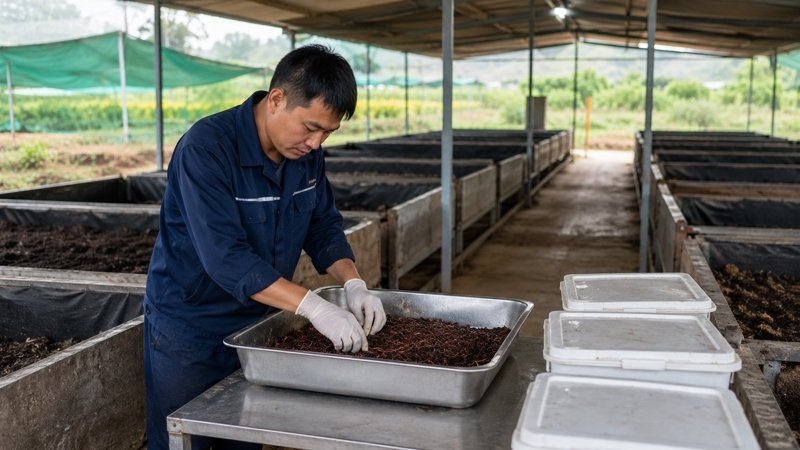
Raw material screening is particularly important because biological inputs may vary. Buyers should ask how unsuitable raw material is identified and whether input batches can be connected to manufacturing records.
This control reduces avoidable variation, but it cannot replace finished-product testing. Laboratory results and batch documents remain necessary because production conditions can also affect moisture, composition, microbiology, enzyme activity and other finished-product characteristics.
Different Products Require Different Processing Logic
The three Allworms earthworm-derived ingredients should not be grouped under one generic manufacturing or testing framework.
Earthworm Protein Powder
Earthworm Protein Powder is a protein-rich ingredient intended for nutritional, functional, animal nutrition and ingredient-development applications. Its production logic focuses on obtaining a controlled protein-rich powder while managing cleanliness, moisture and other relevant quality characteristics.
Buyers reviewing the Earthworm Protein Powder product page should consider protein content, amino acid information where available, moisture, ash, heavy metals, microbiology, appearance, odor, the specification sheet and the batch COA.
Protein percentage is an important identity and purchasing parameter, but a higher number does not automatically mean better suitability. Intended use, sensory characteristics, safety-related testing, processing needs and formulation requirements also matter.
Earthworm Peptide Powder
Earthworm Peptide Powder is produced through enzymatic hydrolysis followed by downstream processing such as filtration, concentration, spray drying and pulverization. The process is designed to create a stable peptide ingredient.
It is not positioned as an active enzyme ingredient. Enzymatic hydrolysis describes how proteins are broken down during manufacturing; it does not prove that the finished powder has lumbrokinase activity.
For the Earthworm Peptide Powder product page, relevant buyer considerations may include peptide content, protein content as a supporting parameter, molecular weight information if available, solubility or dispersibility for the intended formulation, moisture, ash, heavy metals, microbiology, the COA and specification sheet.
Molecular weight distribution may be useful for some formulation decisions, but buyers should not assume a range that is not supported by available technical information. Solubility should also be tested under the buyer’s actual processing conditions rather than treated as universally identical across beverages, tablets, capsules or dry blends.
Lumbrokinase
Lumbrokinase is an earthworm-derived fibrinolytic enzyme ingredient used in dietary supplement, nutraceutical, enzyme-formulation and research-related applications.
Buyers reviewing the Lumbrokinase product page should focus on activity grade, activity unit, assay method, specification sheet, batch COA, sample testing and assay basis. Fibrin plate testing may be relevant depending on the specification and method used.
Activity units such as U, IU/mg, FU/g or LKU should only be discussed for lumbrokinase. They should not be applied to Earthworm Protein Powder or Earthworm Peptide Powder. Results reported under different assay systems or laboratory conditions are not necessarily directly interchangeable, and no fixed conversion should be assumed without an appropriate analytical basis.
Laboratory Testing Must Match Product Identity
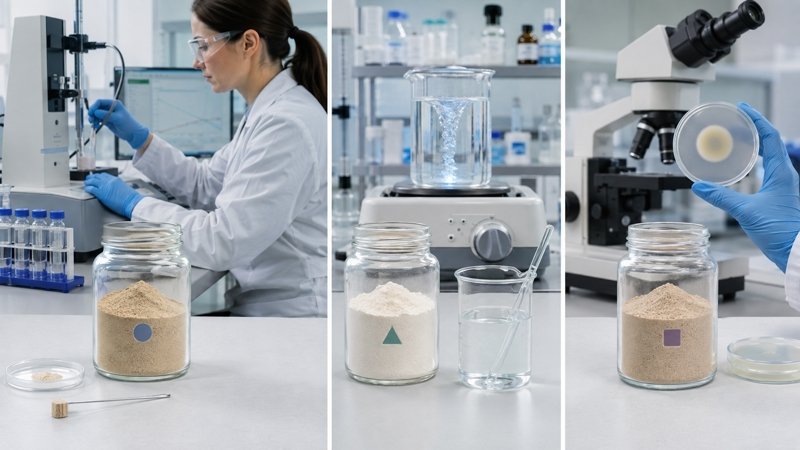
Testing should answer whether a batch meets the requirements of the product being purchased. Applying the same test panel to all earthworm-derived ingredients can create misleading conclusions.
| Product | Primary evaluation focus | Supporting considerations |
|---|---|---|
| Earthworm Protein Powder | Protein content | Amino acid profile if available, moisture, ash, heavy metals and microbiology |
| Earthworm Peptide Powder | Peptide content and product identity | Protein content, molecular weight information if available, dispersibility, moisture, ash, heavy metals and microbiology |
| Lumbrokinase | Enzyme activity result, unit and assay method | Moisture, microbiology, batch documentation and specification alignment |
Protein content testing does not replace peptide content evaluation. Likewise, peptide content cannot demonstrate lumbrokinase activity. An enzymatically hydrolyzed material is not automatically an active enzyme product.
Buyers should also record the test method or method reference when a result is sensitive to analytical conditions. This is particularly important for lumbrokinase, because an activity number without its unit and assay basis provides insufficient information for technical comparison.
COA and Specification Sheet: Two Different Documents
A specification sheet defines the target requirements for a product. A COA reports the actual results obtained for a specific production batch.
During supplier evaluation, buyers should confirm that the COA:
- Identifies the correct product
- Shows the actual batch number
- Covers the requested specification
- Reports the key quality items for that product type
- Corresponds with the quotation, sample or available commercial batch
- Provides information relevant to the intended application
One practical improvement is to establish a document hierarchy before placing the order: the agreed purchasing specification should guide approval, while the batch COA provides evidence for the batch being shipped. This reduces confusion when general marketing information, sample documents and purchasing requirements contain different levels of detail.
From Sample Approval to Bulk Batch Control
Sample testing is valuable, but it is one checkpoint rather than a permanent approval of all future production.
The sample and bulk shipment may have different batch numbers, particularly when there is a long interval between evaluation and purchase. If the sampled batch is no longer available, the buyer should obtain the COA for the actual bulk batch and confirm that it meets the agreed specification.
This creates sample-to-bulk specification consistency: the requirement remains consistent even when the batch number changes. For lumbrokinase, confirmation may also include activity grade, activity unit and assay basis.
Three useful controls at this stage are:
- Pre-shipment document confirmation: Review the COA and batch identity before dispatch rather than after arrival.
- Change review: Ask whether the product specification, test method, production route or packaging has changed since sample approval.
- Reference retention: Buyers may retain part of the approved sample and incoming bulk material under suitable storage conditions for later comparison or investigation.
Sample approval does not replace incoming inspection. The buyer should still examine packaging integrity, labels, batch details, documents and any agreed incoming quality tests.
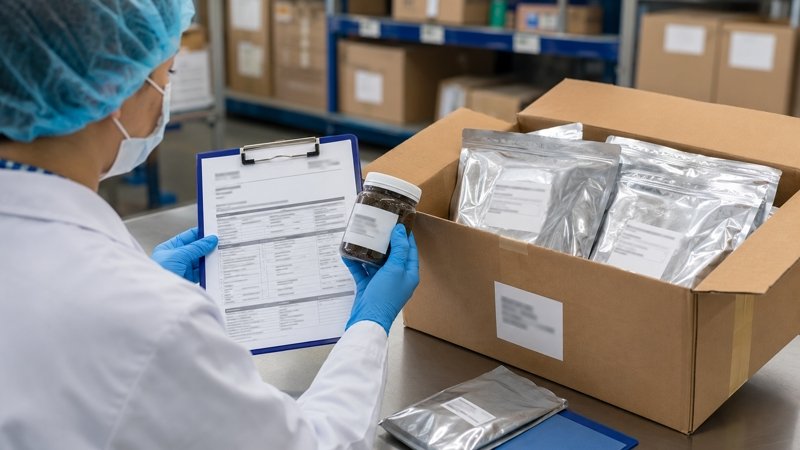
Why Quality Control Continues into Bulk Supply
For repeat purchases and 10–25 kg small bulk orders, supply reliability depends on more than whether the first sample passed evaluation.
Before each order, the buyer may need to confirm:
- Available batch and batch-specific COA
- Specification alignment
- Packaging format and moisture protection
- Stock availability or production schedule
- Lead time
- Storage guidance
- Shipping arrangement
- Destination and customs requirements
- Required commercial and quality documents
- Expectations for future supply
Sealed packaging, cool and dry storage, warehouse handling and transportation planning help protect ingredient quality after production. Exact arrangements depend on product type, specification, quantity, packaging and destination.
MOQ, lead time and shipping options should be discussed at the inquiry stage because they affect batch availability and planning. A buyer requesting an existing stock batch may follow a different approval timeline from one requiring new production or a customized specification.
R&D-to-Bulk-Supply Quality Control Table
| Quality Control Stage | What It Controls | Why B2B Buyers Should Care | Related Product or Document |
|---|---|---|---|
| R&D support | Product identity, process route and quality parameters | Shows whether technical requirements are built into production and testing | Product specification |
| Raw material control | Source, handling and production input | Helps reduce unidentified upstream variation | Raw material and traceability records |
| Purification and selection | Removal of unsuitable material and preparation for processing | Supports a more controlled manufacturing input | Raw material acceptance information |
| Production process | Product-specific processing conditions | Confirms that protein, peptide and enzyme products follow different logic | Process description |
| Laboratory testing | Relevant chemical, physical, microbiological or activity results | Provides evidence related to the actual product identity | Test report or COA |
| Specification sheet | Target acceptance requirements | Establishes what the buyer expects to purchase | Approved specification |
| COA | Results for one actual batch | Supports batch-specific review before shipment or receipt | Batch COA |
| Batch control | Connection between sample, specification and bulk lot | Reduces sample-to-bulk approval gaps | Batch number and purchasing records |
| Packaging | Protection, identification and handling | Helps preserve quality and supports traceability | Label and packaging details |
| Bulk supply | Availability, scheduling, documents and transport | Connects quality approval with practical delivery | PO, shipping and batch documents |
Buyer Checklist: Evaluating Earthworm Extract Quality Control
| Buyer question | Evidence to request or confirm |
|---|---|
| Is raw material controlled before production? | Source, screening, handling and traceability explanation |
| Is each product supported by a defined processing route? | Product-specific process description |
| Are the three ingredients evaluated differently? | Relevant specification and test items for each product |
| Can the available batch be documented? | Batch number, COA and specification sheet |
| Does the test method support the reported result? | Method name or assay basis where relevant |
| Is sample approval connected to the bulk requirement? | Agreed purchasing specification and actual bulk-batch COA |
| Are changes reviewed before repeat orders? | Confirmation of specification, method, process or packaging changes |
| Is pre-shipment batch review possible? | Available COA and batch information |
| Are packaging and logistics defined? | Packaging format, storage guidance, lead time and shipping plan |
| Are enzyme units limited to lumbrokinase? | Correct product-specific documentation |
Common Mistakes When Reviewing Earthworm-Derived Ingredients
Common procurement errors include:
- Judging quality mainly by the lowest quotation
- Reading a COA without confirming the product and batch number
- Applying one testing standard to all three ingredients
- Confusing Earthworm Peptide Powder with lumbrokinase
- Assuming enzymatic hydrolysis proves finished-product enzyme activity
- Comparing protein and peptide powders only by protein percentage
- Requesting lumbrokinase activity units for non-enzyme products
- Ignoring raw material and production-input controls
- Approving a bulk shipment based only on an older sample COA
- Assuming one approved sample guarantees every future batch
- Focusing on one analytical number instead of the complete quality pathway
How Allworms Supports Research-Based Quality Control
Allworms is part of the manufacturer-side earthworm-derived ingredient supply system and supports overseas market development and international sales. The supply system is connected with earthworm raw material supply, product development, production support, quality documentation and export coordination.
Allworms supplies Earthworm Protein Powder, Earthworm Peptide Powder and Lumbrokinase to global B2B buyers. COAs and specification sheets can be provided for available batches.
Product information, samples, packaging, MOQ, lead time and shipping options can be discussed according to the product type, specification, quantity, destination and purchasing stage. Buyers can also visit the FAQ page for general sourcing and order information.
This product range is supplied as B2B ingredients. Final formulation suitability, dosage, labeling, claims and regulatory compliance should be evaluated by the buyer according to the target market and finished-product use.
FAQ
What does earthworm extract quality control include?
It includes research and process design, raw material management, purification and selection, production monitoring, product-specific laboratory testing, specifications, batch COAs, packaging and bulk-supply coordination.
Why does quality control begin before final powder testing?
Raw material condition, product definition and processing decisions can influence the finished batch. Final testing remains necessary, but it cannot replace control of the earlier production stages.
How does R&D support earthworm-derived ingredient production?
R&D can support process-route selection, hydrolysis or enzyme-processing logic, test-method selection, specification development, batch comparison and process improvement. Buyers should evaluate how this support appears in practical production and documentation.
Why do the three products require different tests?
They have different identities. Earthworm Protein Powder is protein-rich, Earthworm Peptide Powder is a hydrolyzed peptide ingredient, and lumbrokinase is an enzyme ingredient evaluated partly by activity and assay method.
Is Earthworm Peptide Powder the same as lumbrokinase?
No. Earthworm Peptide Powder is produced through enzymatic hydrolysis but is not positioned as an active enzyme ingredient. Lumbrokinase is evaluated as an earthworm-derived fibrinolytic enzyme ingredient.
What is the COA’s role in batch control?
The COA provides actual results for a specified batch. It should be reviewed against the agreed specification, particularly when the sample batch and commercial bulk batch are different.
What should buyers check before approving a bulk order?
Buyers should confirm the actual batch, COA, specification, relevant test methods, sample-to-bulk specification consistency, packaging, lead time, storage, shipping and document requirements. Incoming inspection should still be performed after delivery.
Discuss Your Earthworm Extract Quality Control Requirements With Allworms
Share your product specifications, testing concerns, document needs and purchasing plan to evaluate samples and bulk supply