
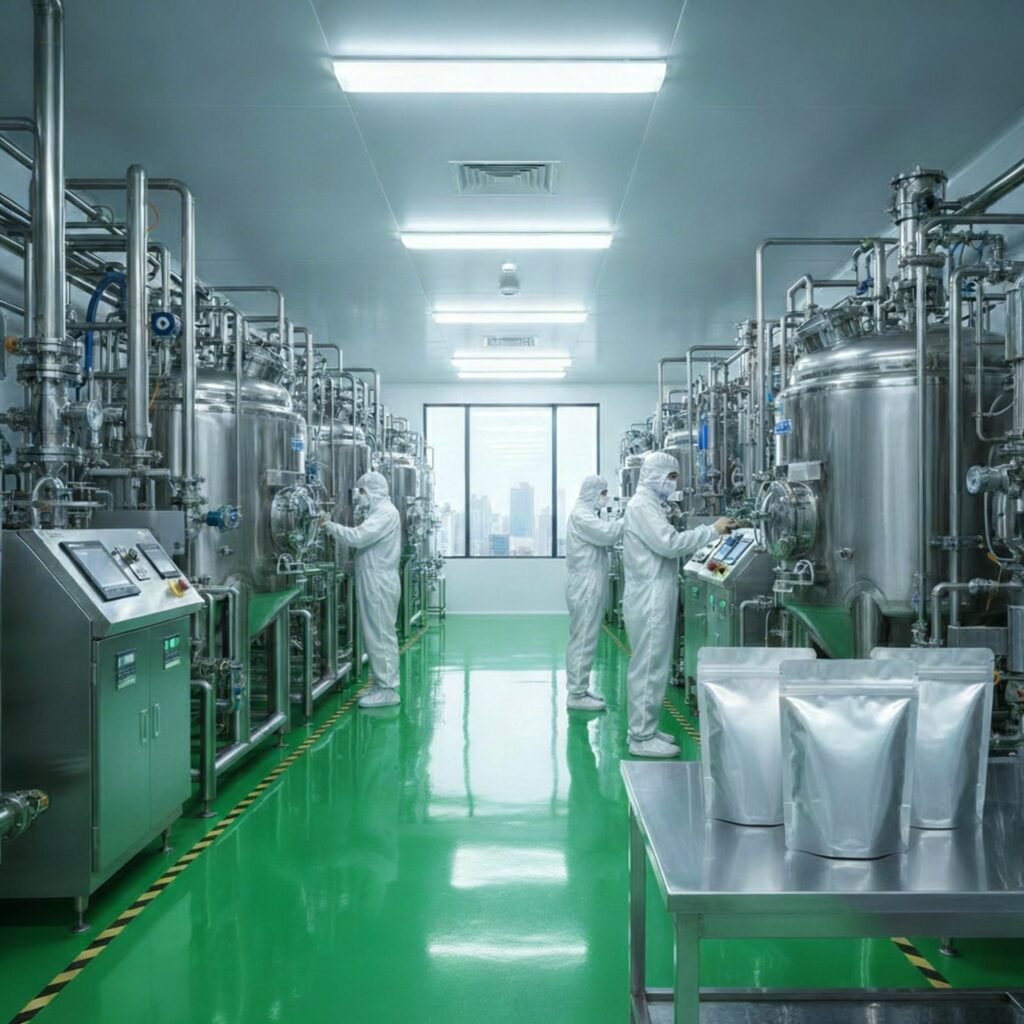
When ingredient buyers talk about “high-value,” they usually mean more than price per kilo. They mean market pull, technical credibility, formulation potential, margin room, and a story that sales teams can actually tell without sounding like they’re reading a spec sheet.
That’s where lumbrokinase gets interesting.
Lumbrokinase is a group of fibrinolytic enzymes derived from earthworms, and its commercial appeal comes from a very specific mix of science and positioning. Research reviews describe it as having strong anticoagulant and thrombolytic properties, with fibrin specificity and a lower tendency toward bleeding linked to hyperfibrinolysis compared with less targeted fibrinolytic approaches. For buyers, that matters. It means the ingredient is not floating in the vague “natural wellness” zone. It has a sharper mechanism story.
And honestly, that changes everything.
A recent Food Chemistry paper on earthworm-derived antioxidant peptides also shows the broader scientific interest in earthworm protein fractions as functional ingredients, which helps frame lumbrokinase inside a larger bioactive platform rather than as a one-off curiosity.
Why lumbrokinase feels premium — because it is
Some ingredients are cheap to explain and hard to sell. Others are hard to explain and easy to sell. Lumbrokinase sits in the middle. It needs context, yes, but once buyers understand the category, the value proposition becomes much clearer.
First, lumbrokinase is tied to a well-known physiological target: fibrin. The 2024 review in Animal Models and Experimental Medicine notes that lumbrokinase is fibrin-specific, shows thrombolytic activity in the presence of fibrin, and can work by directly lysing fibrin or by inducing endogenous t-PA activity. The same review also notes that oral lumbrokinase formulations have reached phase III clinical trials. That combination — targeted activity plus translational progress — is exactly the kind of signal global buyers watch for.
Second, lumbrokinase does not sit alone. It comes from an ingredient family with broader pharmacological interest. Reviews of earthworm extract describe antithrombotic, antioxidant, antimicrobial, anti-inflammatory, antifibrotic, and even glucose-related research angles. For a manufacturer, that opens up portfolio logic. One raw-material ecosystem can support multiple product lines, educational assets, and future SKU development.
That’s a big deal for wholesalers and brand owners. One ingredient that leads to three product concepts is a lot more attractive than one ingredient that does only one job.
Not just efficacy — market fit matters too
Here’s the thing: high-value ingredients win because they fit market demand, not because they merely look good in a paper.
Lumbrokinase sits at the intersection of several long-running market currents:
Cardiovascular support keeps attracting attention. Aging populations, sedentary routines, and rising consumer awareness around circulation and vascular wellness keep this category commercially relevant. At the same time, brands are still searching for differentiated actives that feel more specialized than generic botanicals or commodity enzymes.
Lumbrokinase answers that need rather neatly.
It has a mechanism-based story. It has research continuity. It has traditional-use context in East Asia, where earthworm-derived materials have long been used as antithrombotic agents. And it has enough technical depth to interest pharmaceutical and nutraceutical buyers who need more than a trendy label claim.
That is why it travels well across markets.
In Asia, it benefits from historical familiarity. In North America and Europe, it is more often positioned through science, enzyme functionality, and premium cardiovascular support. In emerging supplement markets, it can serve as a “hero ingredient” that helps a brand stand apart from lookalike circulation formulas.
So yes, it is niche. But niche is not a weakness when the margins are better and the audience is serious.
The earthworm protein story gives lumbrokinase extra commercial weight
One reason lumbrokinase attracts attention is that it belongs to a source material already being studied for food and functional applications.
Research on earthworm protein reports protein levels commonly ranging from about 54.6% to 71% in dry matter, and another study notes earthworm protein content ranging from 60% to above 70%, along with essential amino acids and functional potential. The same paper states that earthworm protein has been recognized as a new food resource in China since 2009 and points to higher protein conversion efficiency and lower greenhouse gas production than traditional animal husbandry.
That broader source story matters in sales.
Why? Because modern buyers do not only ask, “Does it work?” They also ask, “Can I build a future-facing product line around it?” A source material linked to alternative protein, bioactive peptides, and functional-food research gives lumbrokinase more staying power in strategic discussions.
It stops being just an enzyme. It becomes part of a platform.
A quiet advantage: it supports premium positioning
Some ingredients are hard to price up because they are too easy to copy. Lumbrokinase is different.
Its premium potential usually comes from five things:
A stronger technical story.
The fibrin-focused mechanism gives product managers something concrete to work with.
A more specialized buyer base.
This is not a mass commodity ingredient bought on impulse. It usually attracts informed brands, targeted formulation teams, and serious importers.
Formulation scarcity.
There are still fewer suppliers, fewer polished education assets, and fewer well-built market narratives compared with mainstream enzyme categories.
Regulatory and quality barriers.
The more technical an ingredient becomes, the more buyers care about activity standards, extraction methods, purity, contaminants, and documentation. That tends to favor suppliers who are organized.
Cross-category potential.
Even when the lead application is cardiovascular support, the wider earthworm bioactive story can support future expansion into adjacent categories.
In plain English: it is harder to sell than vitamin C, but that is exactly why it can be worth more.

Where global buyers see real opportunity
For dietary supplement brands, lumbrokinase works best as a premium active in circulation or cardiovascular support formulas. It can sit alone as a specialist SKU or be combined with complementary ingredients, depending on local compliance strategy and brand style.
For nutraceutical ingredient distributors, the opportunity is educational. Many downstream buyers have heard the name but do not fully understand the mechanism, source, or sourcing risks. The distributor who explains it well often wins the business.
For pharmaceutical ingredient buyers, the attraction is more technical. Research describes oral formulations progressing to phase III clinical trials and highlights the need for continued work on extraction methods, in vivo antithrombotic studies, molecular mechanisms, and bleeding-related evaluation. That does not mean every market is ready for the same development path, of course, but it does mean the ingredient has more depth than a typical wellness raw material.
For manufacturers and wholesalers, lumbrokinase can also function as a catalog anchor. It signals that the company can handle specialized bioactive ingredients, not just standard powders. That kind of signal helps in export markets. Buyers notice it.
But let’s not over-romanticize it
Lumbrokinase is promising. It is not effortless.
This category still needs careful handling around standardization, source transparency, processing method, enzyme activity, and compliance language. The 2024 review is quite clear that more work is needed on in vivo antithrombotic studies, molecular mechanisms, and bleeding-complication analysis for broader clinical feasibility. So the smart commercial approach is not hype. It is disciplined positioning.
That means suppliers should avoid fluffy claims and focus on what buyers actually want:
consistent raw material sourcing,
clear activity specifications,
manufacturing controls,
testing documentation,
traceability,
and a realistic application narrative.
You know what? In this market, boring documents often close more deals than exciting slogans.
What makes a lumbrokinase supplier more attractive
If you are selling lumbrokinase into global markets, buyers usually respond best when you can show three things at once:
You understand the science.
Not just the name, but the fibrinolytic mechanism and why the ingredient is distinct.
You understand the commercial use case.
A supplement brand, a contract manufacturer, and a pharmaceutical buyer are not looking for the same conversation.
You understand risk control.
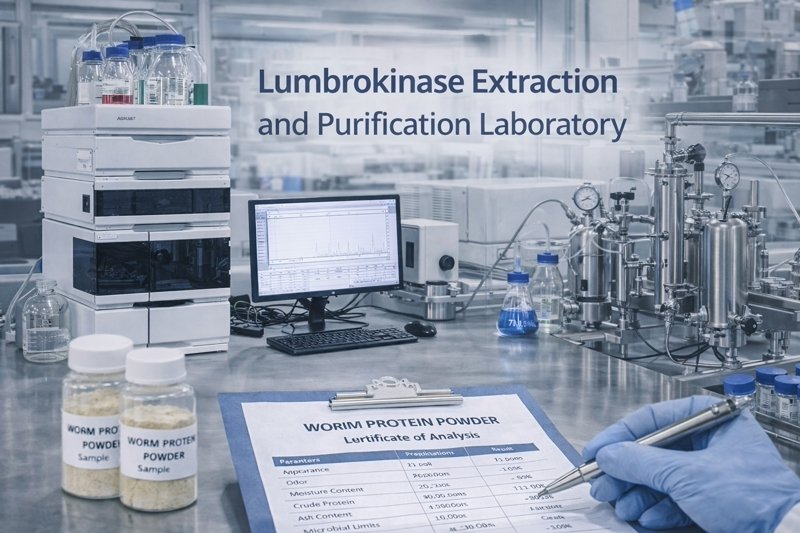
This includes raw-material origin, processing, microbial limits, heavy metals, enzyme activity consistency, and export documentation.
That last point is easy to underestimate. But when an ingredient comes from a specialized biological source, trust becomes part of the product.
The bigger picture — why global markets will keep watching
Lumbrokinase fits a pattern that is becoming more common in functional ingredients: buyers want molecules with a real mechanism, a clean story, and enough differentiation to escape price wars.
That is why this ingredient keeps showing up in serious sourcing conversations.
It has a specific functional identity.
It comes from a source with broader bioactive interest.
It speaks to cardiovascular-health demand.
And it offers enough technical complexity to support premium pricing when supplied well.
So, is lumbrokinase a mass-market ingredient? Not really.
Is that the point? Also no.
Its real value lies in being specialized, science-backed, and commercially meaningful for buyers who need more than another generic active. For global markets, that is often exactly what “high-value” means.
FAQs
1. Why is lumbrokinase considered a high-value nutraceutical ingredient?
Lumbrokinase is considered a high-value nutraceutical ingredient because it has a targeted fibrinolytic mechanism, premium cardiovascular positioning, and stronger technical differentiation than many common wellness actives. Research also describes oral lumbrokinase formulations reaching phase III clinical-trial status, which adds commercial credibility.
2. What industries are most interested in bulk lumbrokinase supply?
Bulk lumbrokinase supply is most relevant to dietary supplement brands, nutraceutical formulators, pharmaceutical ingredient buyers, contract manufacturers, and specialized distributors looking for advanced cardiovascular-support ingredients.
3. How does lumbrokinase differ from general enzyme ingredients?
Lumbrokinase differs from general enzyme ingredients because it is associated with fibrin-focused thrombolytic activity rather than broad digestive or metabolic use. That gives it a more specialized application story and often supports premium product positioning.
4. What should buyers check when sourcing lumbrokinase from a manufacturer?
When sourcing lumbrokinase from a manufacturer, buyers should check enzyme activity specifications, source traceability, manufacturing controls, purity, contaminant testing, and export-ready documentation. For specialized bioactive enzymes, consistency matters just as much as price.
5. Is lumbrokinase suitable for global health supplement market development?
Lumbrokinase is suitable for global health supplement market development when suppliers support it with solid technical files, careful positioning, and compliant market education. Its value is strongest in premium circulation and cardiovascular product lines rather than low-cost mass-market formulas.
Upgrade your supplement formulation today
Contact us for immediate availability