
Let’s be honest—functional food teams are under pressure from both sides. Consumers want more from every serving. Buyers want a cleaner story, stronger differentiation, and ingredients that can do more than sit on a spec sheet looking pretty. At the same time, R&D, regulatory, and procurement teams need something practical: stable supply, workable processing behavior, and a scientific basis that won’t fall apart under scrutiny.
That’s exactly why earthworm peptide powder is starting to get serious attention.
Not because it’s flashy. Not because it sounds familiar. In fact, it’s the opposite. It’s unusual enough to stand out, yet grounded enough in protein and peptide science to interest formulators who are looking beyond the usual marine collagen, whey hydrolysates, and plant peptide blends. Research in the uploaded materials shows that earthworm proteins are rich in protein, can be converted into bioactive peptides after gastrointestinal digestion, and have been studied for antioxidant, ACE-inhibitory, and immunomodulatory potential.
And here’s the thing: for functional food formulation, peptide form is where the story gets interesting.
So, why peptides instead of just earthworm protein?
Because peptides are not merely “smaller protein.” In formulation work, that size difference changes everything—solubility behavior, digestibility, sensory handling, speed of absorption, and how you position the ingredient in a finished product.
In the relevant research, earthworm protein was processed into hydrolysates that generated a high proportion of soluble peptide material after simulated gastrointestinal digestion. In the antioxidant study, purified earthworm protein reached 96.03% protein purity, and its gastrointestinal hydrolysate showed a degree of hydrolysis of 22.91% with 79.19% soluble peptide content. In the antihypertensive study, the earthworm sample itself contained 70.05% protein on a dry-weight basis, supporting its value as a peptide raw material.
That matters for product developers. A raw protein can be nutritionally useful, sure. But a peptide ingredient gives you more room to formulate toward a function-led concept—especially in powders, drink mixes, nutrition shots, or compressed functional foods where “bioactive protein-derived ingredient” carries more weight than plain protein fortification.
So yes, it’s protein. But commercially, it’s better understood as a peptide platform.
What does the science support right now?
This is where a lot of ingredient marketing gets sloppy. We don’t need that.
What the current materials support is promising, but mostly preclinical and in vitro. That is still valuable for B2B positioning—as long as you present it correctly.
1) Antioxidant potential is one of the strongest formulation angles
A 2024 Food Chemistry paper identified antioxidant peptides generated from earthworm proteins after gastrointestinal digestion. The researchers found 6,030 peptide sequences, screened 11 candidates, and reported that AFWYGLPCKL, WPWQMSLY, and GCFRYACGAFY showed the strongest antioxidant activity. The paper explicitly says these findings contribute to the application of earthworm proteins as antioxidants in health foods and functional foods.
That does not mean a finished beverage can claim disease treatment. It does mean formulators have a credible basis for exploring earthworm peptide powder in antioxidant-oriented concepts such as wellness powders, recovery beverages, or active nutrition blends.
And from a product storytelling angle, that’s useful. Antioxidant is familiar. Buyers understand it. Consumers recognize it. R&D teams can work with it.
2) Cardiovascular-support positioning has a real peptide story behind it
The ACE-inhibitory research is another important piece. The 2023 Food Bioscience study isolated seven novel ACE-inhibitory peptides from earthworm protein digestion products: SSPLWER, RFFGP, LERWP, MFPGIADR, FPGIADR, SADRISHGF, and ADRYSSWP. Among them, SSPLWER and RFFGP showed the strongest activity, with reported IC50 values of 14.30 ± 0.81 μM and 117.63 ± 0.36 μM, and both acted as competitive inhibitors. The authors concluded that earthworms are a natural source of ACE-inhibitory peptides and a promising functional food targeted at hypertension management.
For formulators, that opens a practical lane: structure your concept around cardiovascular wellness support rather than drug-like blood pressure claims. There’s a big difference, and it matters.
Done well, the ingredient story becomes: peptide-rich functional food ingredient studied for ACE-inhibitory potential after digestion. That’s grounded. That’s defensible. And that sounds a lot better in a buyer meeting than vague talk about “miracle circulation benefits.”
3) There may be broader bioactivity value, but that’s not your first claim
The 2024 comprehensive review on earthworm extract summarizes a wide range of reported activities, including antithrombotic, antioxidant, anti-inflammatory, wound-healing, and antimicrobial effects, linked to components such as lumbrokinase, lysenin, antimicrobial peptides, G-90, and other bioactive agents.
Interesting? Absolutely.
But for functional food formulation, not all of those belong in your primary positioning. Some fit pharma better. Some fit topical or medical directions. Some may raise unnecessary regulatory friction.
A smart buyer usually starts narrower: antioxidant support, peptide nutrition, and carefully framed cardiovascular-wellness concepts. Then, if the supply chain, dossier, and compliance path look solid, they expand.
That’s how ingredients win. Not by saying everything at once.
Why this ingredient can help products stand out
There’s a commercial reality here. Plenty of brands want differentiation, but most product concepts still sound like cousins of each other.
Another plant protein? Fine. Another collagen sachet? Also fine. Another generic “active peptide blend”? You’ve seen it before.
Earthworm peptide powder gives manufacturers something rarer: a story that combines unusual origin, high-protein biology, and early-stage bioactive peptide science. The literature notes that earthworm proteins can serve as a food resource, and that large-scale cultivation has already been discussed in the context of edible protein and functional food development.
For buyers, that creates three kinds of differentiation:
1. Ingredient-story differentiation
It’s novel enough to start a conversation. In crowded export markets, that matters more than people admit.
2. Function-story differentiation
Antioxidant peptides and ACE-inhibitory peptides give a much sharper narrative than “contains protein.”
3. Format differentiation
Because peptide powders can move across dosage forms and food systems more flexibly than many bulky raw proteins.
That last point is easy to overlook. But it’s often what separates a good ingredient from a commercially useful one.
Where earthworm peptide powder fits best in functional foods
The related internal application draft points to several food directions already being considered: functional beverages, dairy-type applications, meat products, protein bars, biscuits, cereals, and grain-based foods.
That’s a helpful starting map. If I were writing this from a formulator’s desk, I’d break the best-fit formats into four buckets.
Functional beverage powders and sachets
This is probably the cleanest commercial entry point.
Why? Because peptide ingredients work well in “mix, shake, dissolve, consume” logic. Sachets also help with premium positioning, dosage consistency, and export-friendly pack formats. They suit antioxidant-support, daily vitality, and active-aging concepts.
There’s also a psychological advantage. Consumers are more open to novel bioactives in a powder stick or wellness drink than in a mainstream snack they expect to taste familiar.
Protein bars, biscuits, and compressed nutrition foods
The related food-application file specifically mentions protein bars and biscuits as realistic formats. These are attractive for manufacturers because they allow blending with other proteins, fibers, grains, cocoa, nut profiles, and masking systems.
That said, here’s the small contradiction worth explaining: just because an ingredient can go into a bar doesn’t mean the bar is the best first launch. Solid foods often make flavor and aroma issues harder, not easier. Still, once a supplier has decent sensory work and a strong premix strategy, bars and functional biscuits become very interesting.
Grain, cereal, and meal-replacement concepts
The same internal draft suggests cereals and grain-based foods as a direction. That makes sense for brands targeting heart-health or active lifestyle consumers.
But let me explain the catch. In grain systems, peptide powders need to work with heat, moisture, bulk density, and flavor carry-through. You’ll want pilot tests, not wishful thinking.
Hybrid nutraceutical-food formats
This is where earthworm peptide powder may shine most: chewables, nutrition tablets, jellies, gel sticks, shots, and “food with supplement behavior.” The reason is simple. The science base points to peptide functionality, and hybrid formats are better at carrying that message than conventional foods are.
Honestly, not every ingredient needs to be a cookie.
What should formulators evaluate before buying?
A lot, actually.
And this is where experienced buyers start asking the right questions.
Raw material and process consistency
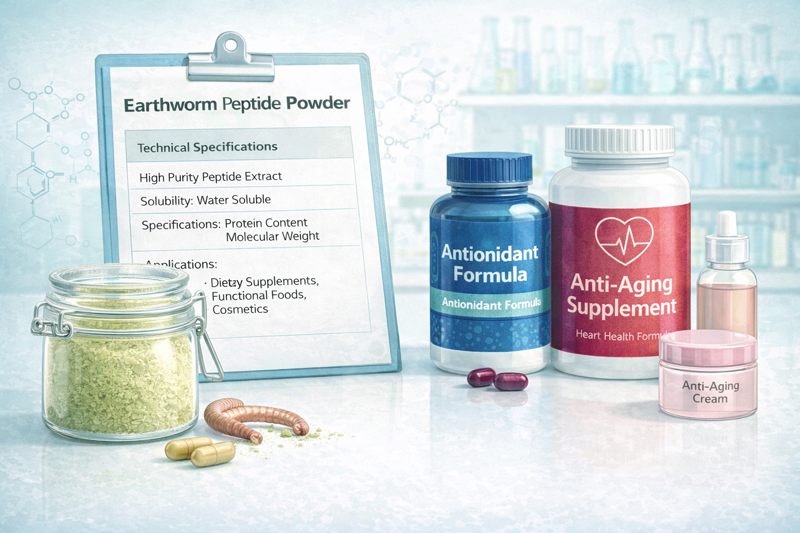
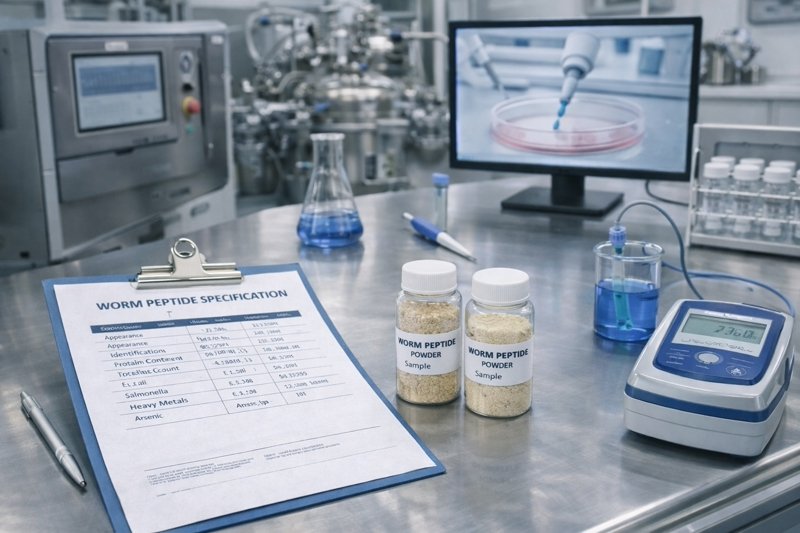
The relevant file describes a process that includes selection, mechanical separation from soil impurities, second-stage cleaning, mechanical washing and hydrolysis, centrifugal filtration, low-temperature drying, milling, sterilization, and packaging. It also lists earthworm, corn starch, and maltodextrin as production materials.
That tells buyers two important things.
First, process control matters because the ingredient starts with a biologically complex raw material. Second, some commercial powders may be standardized or carried with excipients rather than offered as ultra-pure peptide isolates. That is not automatically a problem—but procurement and formulation teams need to know exactly what they are buying.
Ask about:
- peptide content
- protein content
- carrier use
- ash and moisture
- microbial specs
- heavy metals
- batch-to-batch sensory consistency
That’s the grown-up version of ingredient sourcing.
Solubility and dispersion
Peptides usually offer formulation advantages over intact proteins, but real-world performance still depends on hydrolysis profile, particle size, drying method, and carrier system. The science shows high soluble peptide proportions after digestion or hydrolysis, which is encouraging for product development.
Still, bench testing is non-negotiable. No one wants a premium functional powder that clumps like wet flour.
Sensory impact
This is the question everyone thinks and few say aloud: what does it taste like?
That answer depends on hydrolysis level, purification depth, carrier system, flavor matrix, and serving format. Peptides can bring bitterness or savory notes. Some brands can work with that. Others will need masking, co-formulation, or smaller inclusion levels.
A smart supplier helps you formulate around sensory reality instead of pretending it doesn’t exist.
Regulatory positioning
This part is not glamorous, but it can save a product launch.
The literature clearly supports research interest in functional food application. It does not automatically grant permission for aggressive disease claims in every market. The antioxidant and ACE-related findings are useful for substantiation strategy, but market-specific compliance will depend on local food law, novel food status, acceptable structure-function wording, and dossier depth.
That’s not bad news. It just means the best commercial message is usually careful and specific:
peptide ingredient, protein-derived bioactive, studied for antioxidant or ACE-inhibitory activity, intended for functional food development.
Clean. Serious. Credible.
A practical formulation mindset
If you’re a supplement brand, nutraceutical manufacturer, or ingredient distributor, the opportunity with earthworm peptide powder is not to sell fantasy. It’s to sell relevance.
A good positioning framework might look like this:
Origin: animal-derived peptide ingredient from earthworm protein
Function story: studied for antioxidant and ACE-inhibitory peptide activity after digestion
Format story: suitable for powders, drinks, tablets, bars, and hybrid functional foods
Commercial story: novel ingredient for product differentiation in specialized wellness categories
That’s a solid four-part pitch.
And you know what? It also leaves room to grow. As more work accumulates around immunomodulatory or other peptide functions, suppliers can expand the story carefully. The immunomodulatory study in your files, for example, reported that earthworm protein autolysates produced peptide-rich material and showed activity in a cyclophosphamide-induced immunosuppressed mouse model, with one peptide, WNWLLPLMLG, highlighted for strong activity in macrophage validation. Useful? Yes. Ready for broad consumer claims? Not yet.
That’s how credible ingredient marketing should work. Promise less. Prove more.
The real opportunity
Earthworm peptide powder is not a mass-market commodity ingredient. That may be its advantage.
It fits best where brands want technical differentiation, unusual sourcing stories, and a peptide-focused health platform that can support premium positioning. The published research already gives it more than a vague “natural protein” narrative. It gives it identified antioxidant peptides, identified ACE-inhibitory peptides, hydrolysis data, and a reasonable scientific basis for functional food exploration.
For brands and manufacturers, that’s the sweet spot.
Not overhyped. Not empty. Just early enough to be interesting, and developed enough to be useful.
FAQs
1) What is earthworm peptide powder used for in functional food formulation?
Earthworm peptide powder is mainly used as a protein-derived bioactive ingredient for product concepts focused on antioxidant support, cardiovascular wellness positioning, and premium functional nutrition formats such as powders, sachets, drinks, bars, and hybrid nutraceutical-food products.
2) Is earthworm peptide powder the same as earthworm protein powder?
Not exactly. Earthworm protein powder is the broader protein ingredient, while earthworm peptide powder usually refers to hydrolyzed or enzyme-processed fractions made of smaller peptides. Those smaller peptides are the fractions most often linked to identified bioactive activity in the studies.
3) Which health areas are most relevant for earthworm peptide powder ingredients?
Based on the current studies in your files, the most relevant areas are antioxidant applications and blood-pressure-related functional food concepts tied to ACE-inhibitory peptides. Broader pharmacological activities are discussed in the review literature, but those are not always the best first claims for food products.
4) What product formats work best for earthworm peptide powder?
The most practical formats are functional drink powders, sachets, tablets, bars, biscuits, grain products, and other compact nutrition formats where a peptide ingredient can be dosed consistently and positioned clearly.
5) What should buyers ask suppliers before purchasing earthworm peptide powder?
Buyers should ask for peptide or protein content, carrier details, production process, microbial and heavy metal specifications, moisture and ash data, batch consistency, and sensory behavior in their target format. Your internal production file also shows that some commercial products may include corn starch or maltodextrin, so specification review is important.
Upgrade Your Formula With Small-Molecule Peptides
Ask about low MOQ supply options