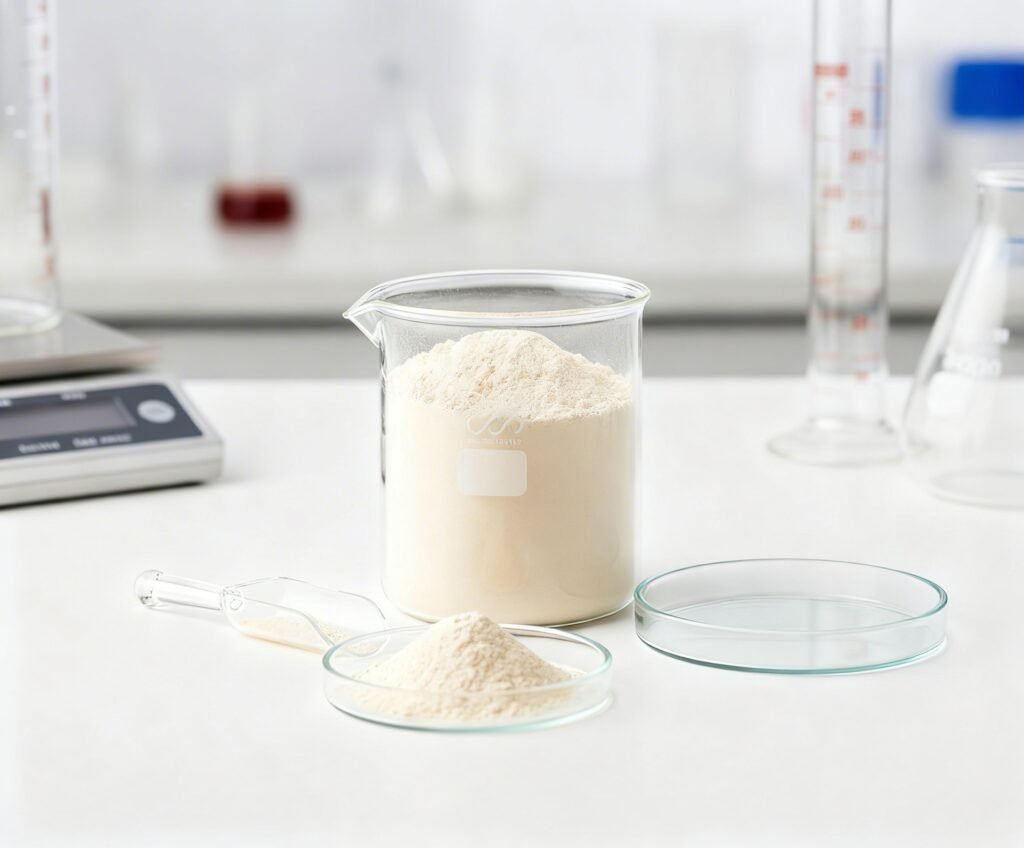
If you ask whether earthworm peptide powder is suitable for global markets, the honest answer is: yes, potentially — but not automatically.
That “but” matters.
The ingredient has real commercial appeal. Earthworm-derived proteins are reported as high-protein materials, often in the roughly 54.6% to 71% dry-matter range in the literature, and research on earthworm protein hydrolysates has identified antioxidant, ACE-inhibitory, and immunomodulatory peptide activity. Earthworm protein has also been described in the literature as a new food resource in China, with interest linked to functional-food development and alternative protein demand.
Still, being scientifically interesting is not the same thing as being globally market-ready. Plenty of ingredients look brilliant in a paper and then stumble in real trade because of regulation, sensory issues, documentation gaps, or simple buyer hesitation. Earthworm peptide powder sits right in that tension. It has promise. It also needs careful positioning.
Why this ingredient gets attention in the first place
Let’s start with the obvious question: why would any buyer even look at earthworm peptide powder?
Because it checks several boxes that global ingredient markets care about.
First, the raw material is protein-rich. One study reported dried earthworm raw material at 60.34% protein, and another paper notes that earthworm protein content in the literature commonly ranges from 60% to more than 70%.
Second, hydrolyzed earthworm protein can produce a high proportion of small peptides. In one ACE-focused study, the proportion of components under 1 kDa rose from 44.80% to 80.19% after simulated gastrointestinal digestion, which is exactly the kind of detail formulators like to see when they’re thinking about peptide ingredients rather than just crude protein powders.
Third, there is functional-interest data. Research has identified:
- antioxidant peptides from earthworm protein digestion products
- novel ACE-inhibitory peptides such as SSPLWER and RFFGP from earthworm protein digestion products
- immunomodulatory peptide candidates from earthworm protein autolysates, with WNWLLPLMLG highlighted in macrophage validation work
For a B2B buyer, that combination is attractive. High protein, peptide-rich fractions, and multiple functional directions? That’s not nothing. That’s the start of a category story.
So, is it suitable for global markets? Yes — especially in these segments
Here’s the thing: earthworm peptide powder is more suitable for some global channels than others.
It fits best where buyers already understand niche bioactive ingredients and where the story is about formulation value, not mass-market familiarity.
1. Dietary supplements and nutraceuticals
This is probably the strongest fit.
Why? Because the supplement industry is already comfortable with specialized proteins, enzyme systems, hydrolysates, and condition-specific positioning. A peptide ingredient does not need to look familiar on a dinner plate to work in a capsule, sachet, stick pack, or blended powder. It just needs a clean dossier, stable specs, and a believable reason to exist.
Earthworm-derived peptides have been studied for antioxidant, antihypertensive, and immunomodulatory potential, which gives supplement developers several positioning routes — though any finished-product claims still have to match local rules and evidence thresholds.
That makes the ingredient especially interesting for:
- cardiovascular support concepts
- healthy aging formulas
- recovery and wellness blends
- specialized functional nutrition products
Not mainstream supermarket stuff, maybe not yet. But premium supplement channels? Much more realistic.
2. Functional food and health-food innovation
There is also a case for functional foods, though it’s a trickier road.
The research itself frames earthworm protein as an emerging edible animal protein resource and links it to functional-food potential. One paper even notes existing commercial production and trade interest in several countries, while positioning earthworm proteins as interesting food sources because of protein conversion efficiency and lower greenhouse-gas production compared with traditional animal husbandry.
That sounds promising. And it is. But food is more emotional than supplements. Consumers ask weirdly human questions: “Will this taste odd?” “What exactly is it?” “Do I want to tell anyone I eat this?”
That means the best route is usually embedded formulation rather than front-label shock value. Think functional blends, protein-plus-bioactive systems, or ingredient use where the performance story carries more weight than the novelty story.
3. Pharmaceutical and adjacent medical-nutrition opportunities
This segment is more demanding, but it’s also where technical differentiation can matter most.
The broader earthworm-extract literature discusses multiple bioactive classes, including lumbrokinase, antimicrobial peptides, and other pharmacologically active fractions. That does not mean earthworm peptide powder itself can be treated like a drug ingredient by default — far from it — but it does show that earthworm-derived actives are being taken seriously as research materials.
For pharma-adjacent buyers, the appeal is less about trendiness and more about whether the supplier can provide:
- reproducible peptide profiles
- validated production controls
- impurity management
- batch-to-batch consistency
- suitable safety and technical documentation
Honestly, that’s where deals are won or lost.
What makes it commercially promising — beyond the science
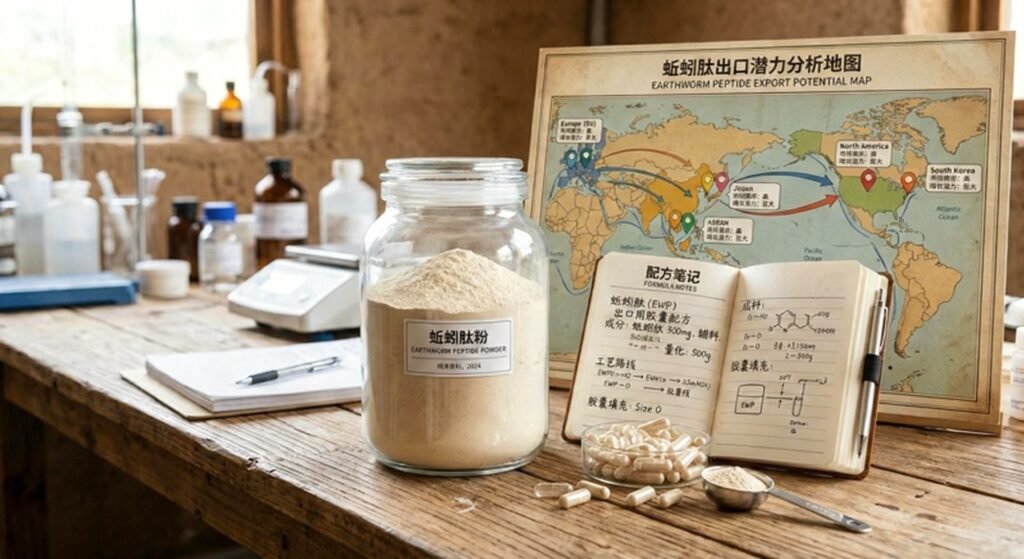
This part gets overlooked. Buyers do not purchase papers. They purchase risk-managed opportunity.
Earthworm peptide powder has several commercial angles working in its favor.
A protein-source story with a sustainability tailwind
One study specifically notes that earthworm cultures can offer higher protein conversion efficiency and lower greenhouse-gas production than traditional animal husbandry. In a market that keeps talking about alternative proteins, circular systems, and lower-footprint sourcing, that matters.
It won’t sell the ingredient by itself, of course. But it helps.
A bioactive story with room to specialize
Some ingredients are stuck being generic. Earthworm peptide powder is not.
Because published work has pointed toward antioxidant peptides, ACE-inhibitory peptides, and immunomodulatory peptides, a supplier can shape different commercial narratives depending on buyer type.
That flexibility is useful in export markets where one region may care more about heart-health positioning while another cares more about wellness or active nutrition.
Processing can be framed in a technical, buyer-friendly way
The related process describes earthworm protein powder production from selected raw material through separation, cleaning, washing/hydrolysis, centrifugation/filtration, low-temperature drying, grinding, sterilization, and packaging.
That matters because global buyers love a process they can picture. They want to know the ingredient is not some vague “extract,” but a controlled material made through a repeatable workflow.
Now the uncomfortable part: what could hold it back
This is where the real conversation starts.
Regulatory acceptance will vary a lot
Just because earthworm protein is recognized as a new food resource in China does not mean every market will treat earthworm peptide powder the same way.
That’s the first big hurdle.
Global markets are not one market. They’re a patchwork of approval systems, novel food rules, ingredient histories, import documentation needs, contaminant expectations, and labeling standards. A supplier may have a perfectly fine domestic position and still face friction abroad.
So yes, the ingredient may be suitable globally in principle. In practice, suitability depends on where you are trying to sell it, in what dosage form, and under what regulatory category.
Consumer acceptance is not evenly distributed
Let’s be real. “Earthworm peptide” is not an easy first impression in every market.
In some regions, alternative animal proteins are becoming normal. In others, they still trigger hesitation, even when the technical case is sound. This doesn’t kill the opportunity, but it changes the marketing strategy. The product story has to lean into performance, purity, and formulation sophistication rather than novelty for novelty’s sake.
A niche ingredient can travel globally. It just usually travels first through specialist channels.
Standardization is essential — and buyers will ask hard questions
The science shows activity, but commercial buyers need something more basic and more brutal:
What exactly is your product specification?
Not “it contains peptides.”
Not “it comes from earthworms.”
Not “we have research.”
They’ll ask for peptide content, protein content, moisture, ash, heavy metals, microbiology, solvent status, allergens, raw-material species identity, processing aids, and stability data. If your answer is fuzzy, the conversation cools fast.
The research papers themselves underline that processing choices matter. Different hydrolysis methods, digestion patterns, and preparation routes can change the resulting peptide mix and bioactivity.
That means one supplier’s “earthworm peptide powder” may not really match another’s in practical performance.
What global buyers will want to see before they say yes
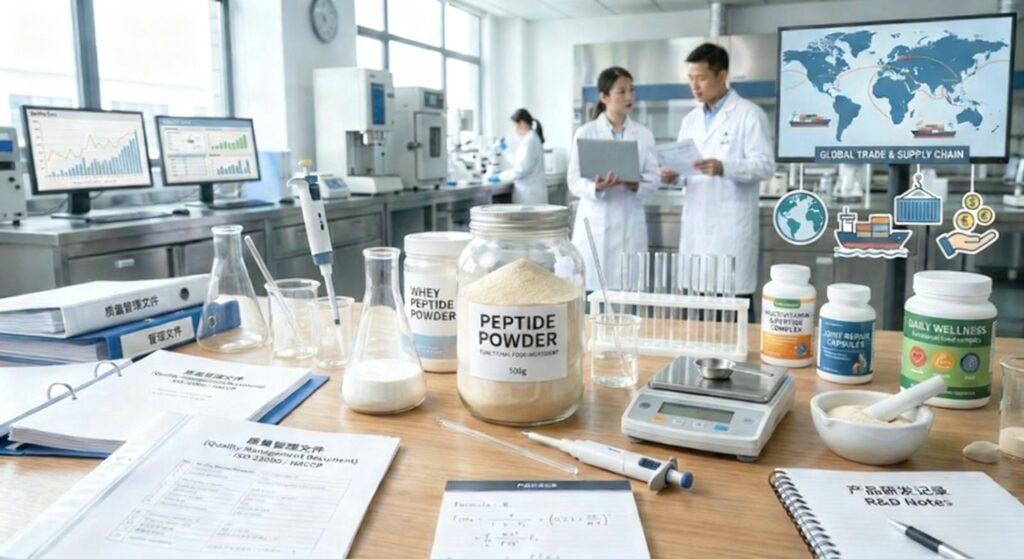
If a manufacturer wants earthworm peptide powder to work in international trade, a few things need to be in order.
1. A clean technical identity
Spell out:
- source species
- manufacturing method
- peptide or protein range
- physical characteristics
- solubility and dispersion behavior
- microbiological standards
- contaminant controls
The research record already gives you a helpful base: earthworm proteins can be prepared, hydrolyzed, fractionated, and characterized with standard analytical approaches such as chromatography, molecular-weight distribution testing, and peptide identification workflows.
2. A sensible formulation story
Not every buyer needs the same format.
Some may want a bulk peptide powder for capsules. Others may want a blend-ready ingredient for sachets, sticks, or functional drinks. Some may ask for granulation support, masking help, or flowability improvement. A raw material can be good on paper and still fail in the plant if it cakes, smells too strong, or behaves poorly in blending.
That’s why “market suitability” is partly a formulation question, not just a demand question.
3. A restrained but useful science package
The best dossiers don’t oversell. They connect evidence to application.
For example:
- antioxidant-potential discussion can draw from the identified peptide work and hydrolysate activity data
- cardiovascular-support discussions can reference ACE-inhibitory peptide findings, while still avoiding disease-treatment language for inappropriate categories
- immune-wellness positioning can mention early immunomodulatory peptide work carefully and accurately
That kind of balance builds trust.
Where the strongest international opportunity probably sits
If I were looking at this as a supplier, wholesaler, or private-label partner, I’d say the strongest near-term opportunity is not broad consumer retail. It’s specialized export.
More specifically:
- nutraceutical brands looking for differentiated peptide ingredients
- manufacturers building cardiovascular or wellness formulas
- ingredient distributors serving niche functional categories
- R&D-led buyers who want a novel animal-derived peptide source
That’s where earthworm peptide powder can make the most sense. The buyers are more technical, the channels are more tolerant of specialized ingredients, and the value story is clearer.
Mass appeal may come later. Maybe. But that’s not the first win to chase.
The bottom line
So, is earthworm peptide powder suitable for global markets?
Yes — as a specialized, science-led ingredient with export potential.
But it is suitable when the supplier has the right documentation, the right positioning, and the right expectations.
The ingredient already has several things going for it: high protein background, peptide-rich hydrolysates, published work on antioxidant and ACE-inhibitory peptides, and broader interest in earthworm-derived bioactives. Research also points to earthworm protein as a potentially interesting functional-food resource, with sustainability and alternative-protein arguments in its favor.
Still, global success will depend less on novelty and more on execution.
That means:
- tighter specifications
- cleaner compliance language
- better formulation support
- smarter market selection
- and a sales story that feels credible, not breathless
Honestly, that’s the difference between an ingredient that gets sampled and an ingredient that gets reordered.
FAQs
1. Is earthworm peptide powder better suited to supplements than conventional foods?
Usually, yes. Earthworm peptide powder tends to fit dietary supplements and specialized nutraceutical formulations more naturally because buyers in those categories already understand peptide ingredients and functional positioning.
2. What makes earthworm peptide powder attractive to international buyers?
The main appeal is its combination of high-protein raw material background, small-peptide potential after hydrolysis, and published research around antioxidant, ACE-inhibitory, and immunomodulatory peptide activity.
3. Can earthworm peptide powder be marketed globally with the same claims everywhere?
No. Global compliance for earthworm peptide powder will vary by country and product category, so marketing claims, labeling, and regulatory pathways need to be adapted market by market.
4. What technical documents do buyers expect for earthworm peptide powder export?
Most serious buyers will want a specification sheet, manufacturing summary, microbiological and heavy metal data, identity information, stability details, and batch consistency records before considering a global supply agreement.
5. Is earthworm peptide powder a realistic ingredient for long-term global market growth?
Yes, but mainly as a niche functional ingredient first. The long-term outlook for earthworm peptide powder in global markets improves when suppliers focus on standardization, formulation usability, and evidence-backed positioning instead of hype.