
When buyers search for pharmaceutical grade lumbrokinase, they are often looking for more than a standard product description. They may expect tighter specifications, clearer activity data, stronger batch control, a defined purity basis, and more complete technical documentation.
However, “pharmaceutical-grade” should not be accepted as a standalone quality claim. Its meaning can vary between suppliers, buyers, applications, and target markets. A purchasing or QA team should ask what specification, testing method, quality standard, and batch documentation support the term.
The practical question is therefore not simply, “Is this pharmaceutical-grade lumbrokinase?” It is: “What technical specifications and quality documents can be verified for the material, and are they suitable for our intended product category?”
Quick Answer: What Does Pharmaceutical Grade Lumbrokinase Mean?
In B2B sourcing, pharmaceutical grade lumbrokinase is often a buyer search term for material expected to have higher technical control, clearer specifications, tighter documentation, or a more thoroughly reviewed impurity profile. It should not be treated as a sufficient marketing label.
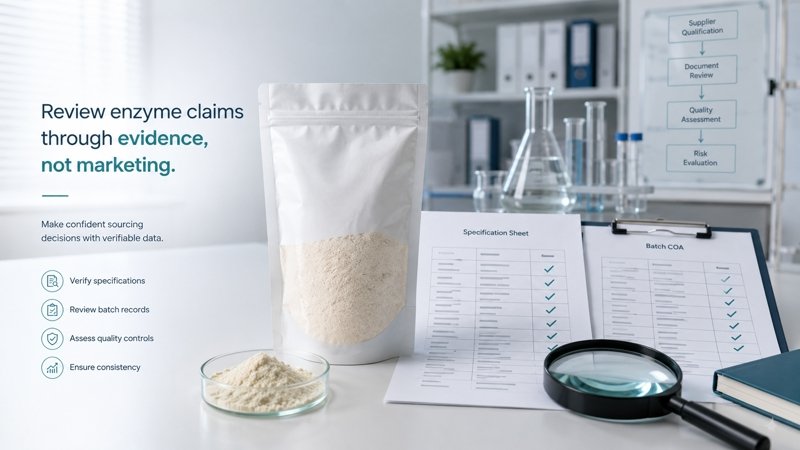
Buyers should verify the activity specification, activity unit, assay method, purity basis, specification sheet, batch-specific COA, contaminant testing, packaging, storage conditions, and intended application. A supplier’s product description or ingredient documents do not replace the buyer’s regulatory review of the intended market and finished product.
Why the Term “Pharmaceutical-Grade” Needs Careful Review
“Pharmaceutical-grade” may have different meanings in different purchasing conversations. A buyer may use the term to indicate:
- A higher purity expectation
- A stricter technical specification
- More detailed quality documentation
- Tighter control between production batches
- A cleaner or more clearly defined impurity profile
- A comparison with general supplement-grade material
- An internal supplier-qualification category
- A possible pharmaceutical or drug-development review
These expectations are not necessarily equivalent.
For example, one purchasing team may use “pharmaceutical-grade” to request more comprehensive contaminant testing. Another may be looking for a particular activity grade supported by a recognized internal assay. A third may require documentation compatible with its own pharmaceutical supplier-approval system.
The phrase alone does not establish that the material is API-grade, medicine-grade, manufactured under a pharmaceutical GMP system, approved for clinical use, or accepted for a regulated drug application.
Buyers should ask a more precise question:
What standard, specification, document, or test method supports the use of the term “pharmaceutical-grade” for this particular material?
If the supplier cannot identify a technical basis, buyers should evaluate the product according to its actual specification rather than the label.
Technical Specification Is More Important Than the Label
A technical specification translates broad quality language into measurable purchasing requirements. When reviewing pharmaceutical grade lumbrokinase, buyers should examine at least the following information:
- Product name and product category
- Intended application or market positioning
- Fibrinolytic activity specification
- Activity unit and reporting basis
- Activity assay method
- Purity or composition basis, if declared
- Appearance
- Moisture
- Ash, if included
- Heavy metals and other relevant contaminants
- Microbiological limits
- Packaging configuration
- Storage requirements
- Shelf-life or retest information, if available
These items do not need to appear in the same format for every supplier. They must, however, be sufficiently clear for the purchasing, QA, and formulation teams to determine what is being offered.
Buyers evaluating Allworms’ current ingredient positioning and technical information can review the Lumbrokinase product page. Product-page information should still be checked against the specification sheet and COA for the available batch.
Activity and Assay Method Review
Activity is a central technical specification for lumbrokinase, but an activity number has limited meaning without its assay context.
Lumbrokinase activity may be expressed as IU/mg, FU/g, LKU, U, U/g, or another method-dependent unit. These expressions should not be ranked solely by the size of the reported number. Buyers should review:
- The assay method
- The substrate used
- The reference standard
- Sample preparation and dilution
- Incubation time
- Incubation temperature
- Other relevant reaction conditions
- The calculation method
- Whether the result is reported per gram, per milligram, or on another basis
- The laboratory protocol used for third-party testing
A result generated through one fibrin-related test system may not be directly comparable with a result generated through another protocol. Buyers should not apply a fixed FU/g-to-IU/mg conversion unless the relevant methods, standards, test conditions, and calculation rules have been established as comparable.
The most useful activity grade is not automatically the highest number. It is the grade supported by a defined method and suitable for the buyer’s specification, formulation, testing system, and commercial requirements.
For additional unit-specific context, see Lumbrokinase Activity Units: IU/mg, FU/g, LKU and U Explained.
Purity as a Technical Evaluation Indicator
Purity can contribute to lumbrokinase quality evaluation, but it should not function as an unsupported promotional percentage.
Before comparing purity claims, buyers should determine:
- Whether purity is stated on the specification sheet or batch COA.
- What component or fraction the percentage represents.
- Whether the analytical method or calculation basis is identified.
- Whether results from different suppliers were obtained using comparable methods.
- Whether the stated purity is connected to an appropriate activity result.
A purity figure based on total protein, a selected enzyme fraction, chromatographic analysis, or another compositional basis may represent different technical information. Two percentages should not be treated as equivalent unless their definitions and methods are comparable.
Purity also does not replace activity testing. A higher purity percentage does not automatically establish higher fibrinolytic activity, better formulation performance, stronger health effects, or suitability for a pharmaceutical application.
For a focused discussion of this distinction, buyers may consult How Purity Levels Affect Lumbrokinase Performance.
COA and Specification Sheet Review
The specification sheet and COA perform different procurement functions:
- The specification sheet defines the expected or agreed product requirements.
- The COA reports the actual test results for a particular batch.
Buyers asking for pharmaceutical grade lumbrokinase should confirm:
- Whether the COA represents an available batch
- Which batch number the document covers
- Whether it applies to the sample or proposed bulk material
- Whether activity and purity statements are supported
- Whether the activity unit and assay basis are consistent across documents
- Whether actual COA results meet the specification limits
- Whether further test reports or supplier-approval documents are required
A generic sample COA can help buyers understand document format, but it should not be mistaken for confirmation of the batch that will ultimately be shipped.
For a more detailed comparison of the two documents, see Lumbrokinase COA vs Specification Sheet: What B2B Buyers Should Compare.
Batch Documentation and Sample-to-Bulk Specification Consistency
Technical evaluation must become batch-specific before bulk approval.
A buyer may test a sample successfully and place a purchase order several weeks or months later. During that interval, the original sample batch may have been sold or may no longer be available. This does not automatically make the proposed bulk batch unacceptable, nor must the sample and bulk material always carry the same batch number.
Instead, the buyer should assess sample-to-bulk specification consistency.
If a different bulk batch will be supplied, the purchasing or QA team should review its COA and confirm that it meets:
- The agreed product specification
- The required activity grade
- The agreed activity unit and assay basis
- The applicable purity or quality requirement
- Contaminant and microbiological limits
- Packaging requirements
- Storage conditions
- Other agreed purchasing conditions
Numerical results do not need to be identical across biological production batches. They should remain within the agreed specification and be supported by the appropriate batch documents.
An approved sample does not guarantee every future batch. Repeat orders should therefore remain subject to the buyer’s defined document-review and release procedures.
Intended Application and Regulatory Responsibility
Buyers should state their intended use before asking a supplier for “pharmaceutical-grade” material. Possible contexts include:
- Dietary supplement ingredients
- Nutraceutical formulations
- Enzyme formulations
- Research-related ingredient use
- Pharmaceutical or drug-development evaluation, where applicable
The documentation and controls required for one category may not satisfy another. A detailed COA prepared for ingredient procurement does not by itself establish suitability for a pharmaceutical product.
If a buyer intends to use lumbrokinase in a pharmaceutical, drug, clinical, or regulated medical product context, the buyer must conduct its own regulatory, quality, and compliance review according to the target market and finished-product category.
Supplier documents support ingredient evaluation; they do not guarantee finished-product registration, permitted dosage, labeling, claims, clinical suitability, or regulatory acceptance.
Packaging, Storage, and Stability Review
Technical quality does not end when production testing is completed. Lumbrokinase is an enzyme-sensitive material, so packaging, transport, warehouse conditions, and post-delivery handling can affect quality risk.
Buyers should confirm:
- Whether the primary packaging is sealed
- How the material is protected from moisture
- Recommended cool and dry storage conditions
- Protection from direct sunlight
- How prolonged heat and humidity exposure should be minimized
- Shelf-life or retest information, if available
- Warehouse procedures after receipt
- Whether opened packages require additional handling controls
A short temperature fluctuation does not necessarily mean that the material has been damaged. However, prolonged or uncontrolled exposure to heat, humidity, moisture, or unsuitable storage conditions may increase the risk of activity loss. Suitable packaging, transport planning, and warehouse controls should therefore form part of technical supplier evaluation.
What Buyers Should Ask Instead of Only “Is It Pharmaceutical Grade?”
More useful questions include:
- What technical specification does the product meet?
- What standard supports the term “pharmaceutical-grade”?
- Which activity unit is used?
- What assay method supports the activity result?
- What substrate, standard, test conditions, and reporting basis are used?
- Is purity listed on the COA or specification sheet?
- How is purity defined and measured?
- Can you provide the COA for the available batch?
- Which batch does the COA represent?
- Can you provide the specification sheet and product information?
- What contaminant and microbiological tests are included?
- What packaging and storage guidance is available?
- How will sample-to-bulk specification consistency be confirmed?
- Is the ingredient positioned for supplement, nutraceutical, enzyme formulation, research-related, or pharmaceutical evaluation?
- What documents are available to support supplier approval?
Technical Specification Checklist for Buyers Asking About Pharmaceutical-Grade Lumbrokinase
| Evaluation Area | What Buyers Should Check | Why It Matters |
|---|---|---|
| Product positioning | Actual ingredient category and intended applications | Prevents a marketing term from being mistaken for a regulatory classification |
| Activity specification | Required limit, range, or minimum value | Defines the measurable activity requirement |
| Activity unit | IU/mg, FU/g, LKU, U, U/g, or another expression | Establishes how the result is reported |
| Assay method | Substrate, standard, preparation, incubation, calculation, and reporting basis | Determines whether activity results are technically comparable |
| Purity basis | Definition, method, component measured, and calculation basis | Prevents unsupported percentage comparisons |
| COA | Actual results, batch number, test date, and compliance status | Connects technical claims to a specific batch |
| Specification sheet | Expected limits and agreed requirements | Establishes the purchasing standard |
| Batch number | Batch represented by the sample, COA, and proposed shipment | Supports traceability and correct document review |
| Sample-to-bulk specification consistency | Whether the actual bulk batch meets the approved specification and assay basis | Controls the transition from evaluation to commercial purchasing |
| Contaminant testing | Heavy metals, microbiology, and other market-relevant items | Supports ingredient risk assessment |
| Packaging | Seal integrity, pack size, barrier protection, and labeling | Helps protect the enzyme during handling |
| Storage | Temperature guidance, moisture control, sunlight protection, and warehouse procedures | Reduces avoidable stability risk |
| Intended application | Supplement, nutraceutical, enzyme formulation, research, or pharmaceutical review | Determines the depth of documentation and compliance review needed |
| Regulatory responsibility | Buyer’s finished-product and target-market obligations | Separates ingredient documents from finished-product approval |
Common Buyer Mistakes
Common errors during pharmaceutical grade lumbrokinase sourcing include:
- Assuming “pharmaceutical-grade” has one universal definition
- Accepting the term without asking what standard supports it
- Choosing a product by quality label instead of measurable specification
- Assuming higher purity automatically means better performance
- Comparing purity percentages based on different definitions or methods
- Comparing activity numbers without assay-method context
- Assuming FU/g and IU/mg can be directly converted
- Treating the highest activity number as the best purchasing choice
- Reviewing a general COA instead of the available batch COA
- Treating sample approval as approval for every future production batch
- Assuming sample and bulk material must always have the same batch number
- Ignoring sample-to-bulk specification consistency
- Using pharmaceutical terminology for supplement sourcing without reviewing regulatory requirements
- Assuming supplier documentation guarantees finished-product compliance
Allworms Supply Notes
Allworms supplies lumbrokinase as an earthworm-derived fibrinolytic enzyme ingredient for B2B dietary supplement, nutraceutical, enzyme formulation, and research-related evaluation. It should not be interpreted as an API-grade, approved medicine-grade, or pharmaceutical-use claim.
A specification sheet and COA can be provided for available batches. A 100 g sample may be available for qualified B2B buyers, with international freight normally paid by the buyer. The standard MOQ is usually around 1.5 kg, depending on specification, packaging, and destination, while 10–25 kg orders may also be discussed.
Standard lead time is generally 7–15 days after payment. DHL or DDP shipping may be available for suitable destinations, subject to order details and customs arrangements. Final requirements should be confirmed according to the activity specification, assay basis, applicable purity or quality requirement, quantity, packaging, documentation, and intended use.
Additional answers covering documentation, samples, MOQ, logistics, and product distinctions are available on the Allworms FAQ page.
FAQ
1. Is “pharmaceutical-grade lumbrokinase” a universally defined grade?
No. The term may reflect a buyer’s expectation for tighter specifications, cleaner composition, stronger documentation, or a particular intended application. Buyers should ask what technical standard, quality system, test method, and documentation support the description.
2. Does higher lumbrokinase purity mean higher activity?
Not necessarily. Purity and activity are related technical indicators, but one does not replace the other. Buyers must review how purity is defined and measured, then evaluate activity using the stated assay method and reporting basis.
3. Can IU/mg, FU/g, LKU, and U be directly compared?
Not automatically. These activity expressions may follow different substrates, standards, sample-preparation procedures, incubation conditions, calculations, and laboratory protocols. No fixed conversion should be assumed without a confirmed common assay basis.
4. Must the sample and bulk order use the same batch number?
No. The original sample batch may no longer be available when the purchase order is placed. If the bulk material comes from another batch, the buyer should review its COA and verify sample-to-bulk specification consistency against the agreed activity, assay, quality, packaging, and purchasing requirements.
5. Does a supplier’s COA prove suitability for pharmaceutical use?
No. A COA reports test results for a particular ingredient batch. It does not establish pharmaceutical approval or guarantee finished-product compliance. Pharmaceutical, drug-development, clinical, or regulated medical applications require buyer-side quality and regulatory review for the intended market.
Short B2B CTA
Verify Pharmaceutical Grade Lumbrokinase Through Specifications, Not Labels.
Contact Allworms to request the available-batch COA, specification sheet, assay information, sample terms, MOQ, lead time, packaging, and shipping details for your technical review.
One comment on “What “Pharmaceutical-Grade Lumbrokinase” Means in Technical Specification Review”
Comments are closed.