
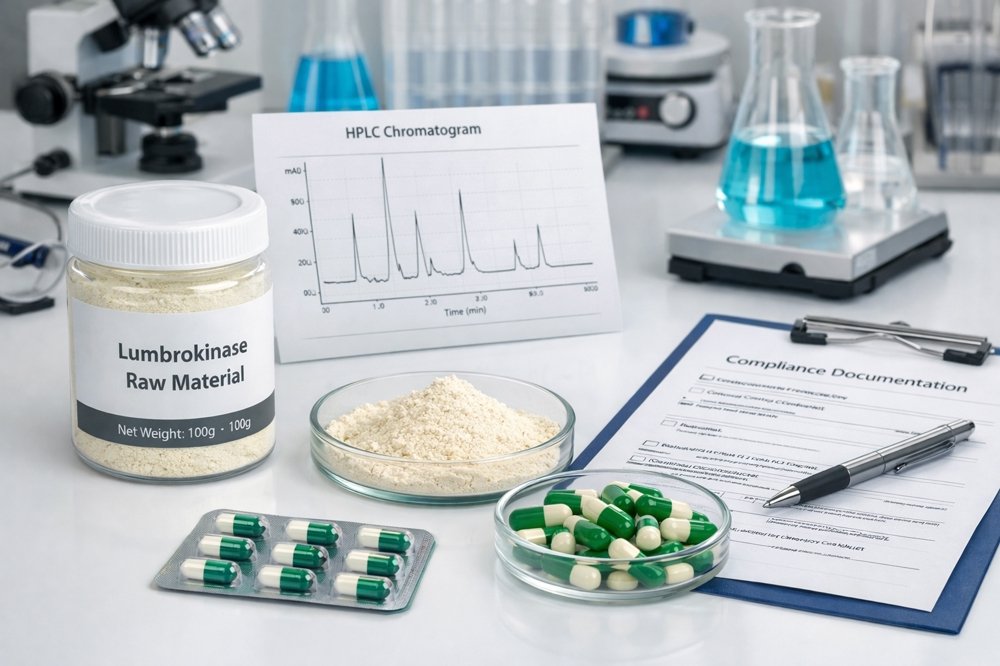
Not all “custom manufacturing” means the same thing
When buyers first ask about lumbrokinase product development, they often use OEM and private label like they’re interchangeable. They’re related, sure, but they are not the same thing.
A private label lumbrokinase product usually starts with an existing formula, an existing dosage form, and a fairly fixed production setup. Your logo goes on it, your packaging changes, and maybe the carton copy gets adjusted. It is faster. It is simpler. It is usually cheaper to launch.
An OEM lumbrokinase product is more involved. You may request a custom activity specification, a custom excipient system, a specific capsule size, blister instead of bottle packaging, or a different flavor profile if the product is made as a powder or sachet. Sometimes you also need custom documentation, market-specific labeling, or stability support for a target climate zone. That’s where OEM becomes more than “put my brand on your stock product.”
And honestly, that distinction matters a lot with lumbrokinase. This is not a casual commodity ingredient. It sits in a category where buyers tend to ask tougher questions about activity consistency, source control, testing, positioning, and intended market use.
Why lumbrokinase gets extra scrutiny
Lumbrokinase is widely discussed as a fibrinolytic enzyme complex derived from earthworms, and research around earthworm extracts has repeatedly highlighted antithrombotic and fibrinolytic activity as one of the better-known functional areas. The same body of literature also shows that earthworm-derived materials contain multiple bioactive substances, which is exactly why buyers tend to focus on standardization and manufacturing control, not just price.
That creates a very practical sourcing reality: two suppliers may both say “lumbrokinase,” but the buyer experience can be wildly different. One supplier may mainly offer a house formula for private labeling. Another may support deeper OEM work with specification setting, packaging adaptation, batch documents, and better coordination between raw material handling and finished-product release.
So the real question is not “Do you offer OEM?” Almost everyone says yes.
The better question is: How much can you actually customize without losing control of quality, timing, or compliance?
Let’s break it down: private label first
Private label is usually the better fit when speed matters more than originality.
A typical private label lumbrokinase program may include:
- a ready-made capsule or tablet formula
- standard bottle counts such as 30, 60, or 90 count
- basic packaging choices like HDPE bottle, label, carton, and shipper
- standard documentation such as COA, specification sheet, and sometimes a test report package
- brand artwork placement on an existing dieline
For a distributor, dealer, or regional wholesaler, this can be a smart entry point. You don’t have to spend months building a custom product from scratch. You can test your market, validate demand, and protect cash flow.
There’s another quiet advantage too. With private label, the manufacturer already knows how the product runs on its line. That reduces surprises. Fewer surprises usually means smoother production scheduling and fewer awkward emails later.
Still, private label has limits. You may not get much freedom on excipients, capsule shell type, fill weight, or target activity presentation. If you need halal adaptation, vegetarian capsules, low-allergen positioning, or market-specific pack language beyond minor edits, the “simple” option can stop being simple pretty fast.
OEM is where customization starts to earn its keep
OEM makes more sense when your product strategy is tied to differentiation.
That could mean you want:
- a different lumbrokinase activity level or dosage strength
- a combined formula with other functional ingredients
- a specific dosage form, such as capsules, tablets, sachets, or stick packs
- a cleaner excipient profile
- a moisture-control packaging setup for shelf-life protection
- multilingual packaging for export markets
- a more premium presentation for clinics, pharmacies, or practitioner channels
This is where the supplier’s real capability shows.
A credible OEM partner should be able to talk clearly about formula review, pilot sampling, raw material sourcing, specification confirmation, artwork coordination, label compliance boundaries, batch scheduling, in-process control, finished-product testing, and shipment release. Not vaguely. Clearly.
If the answer to every technical question is “yes, we can do that,” but nobody can explain the sequence, the documents, or the risks, that is usually a red flag.
The packaging question is bigger than it looks
A lot of buyers focus on formula first and packaging second. Reasonable, but with enzyme-based products, packaging is not just decoration.
For lumbrokinase products, packaging choices can affect:
- moisture exposure
- transport stability
- shelf presentation
- count accuracy
- regulatory labeling space
- unit economics at different order sizes
Bottles are usually the easiest for private label. Blisters often look more premium and may support certain markets better, but they can raise tooling, packing time, and MOQ. Sachets and stick packs can work for powder-based systems, though that depends on the formulation approach and how the ingredient behaves.
A supplier that treats packaging as an afterthought probably isn’t thinking like a long-term OEM partner.
Compliance is where many “good deals” fall apart
Here’s the thing. A lumbrokinase product can look commercial-ready on paper and still create headaches later if the manufacturing, labeling, or documentation side is weak.
For dietary supplements sold into the U.S., firms that manufacture, package, label, or hold supplements must follow the dietary supplement CGMP rule in 21 CFR Part 111, and that applies to foreign firms as well if the product is imported into the U.S. FDA also states that dietary supplement labels require core elements such as identity, net quantity, Supplement Facts, ingredient listing, and the name and place of business of the manufacturer, packer, or distributor.
That matters for OEM and private label buyers because labeling is not just a design job. It is part of market readiness.
On the manufacturing side, GMP systems are the baseline expectation, and third-party GMP programs such as NSF/ANSI 455-2 are often used in the supplement industry as additional assurance.
So when comparing suppliers, ask a blunt question:
Are you offering a product, or are you offering a product plus a usable compliance package?
Those are not the same.
What buyers should ask before choosing OEM or private label
This is the part people rush. They shouldn’t.
Ask about the ingredient first:
Is the lumbrokinase source standardized? What activity system is being used? What test method supports that claim? Is the raw material traceable by batch? Can the supplier explain how they control consistency from lot to lot?
Then ask about the finished product:
What dosage forms are already validated? What excipients are standard? Can the formula be adjusted? Is there pilot sampling? Are there retained samples? What is the release workflow?
Then ask about paperwork:
Can they provide COA, specification sheet, microbiological data, heavy metal data, and any market-relevant support files? If export is involved, what documents are routine and what documents are special-request items?
Then ask about execution:
What is the MOQ for stock private label? What is the MOQ for custom OEM? What changes reset the MOQ—formula, packaging, carton, blister, label language, or print method? What is the lead time for samples versus first commercial order versus repeat order?
And yes, ask about stability and storage. Enzyme products tend to make serious buyers cautious for a reason.
So which model is better?
It depends on where you are in the product cycle.
Choose private label when you want to:
- enter the market fast
- test distributor response
- reduce development work
- keep artwork and packaging relatively simple
- start with a lower operational burden
Choose OEM when you want to:
- build a stronger brand position
- tailor the formula or dosage form
- fit a specific regional market
- support clinic, pharmacy, or premium channels
- create something harder to compare line-by-line
There is also a middle road, and it’s often the smartest one. Start with a semi-custom program: keep the base product stable, but customize packaging, count size, capsule shell, and outward branding. That gives you more control than standard private label without the full drag of a ground-up OEM project.
For many wholesalers and brand owners, that’s the sweet spot.
One more practical point: MOQ and lead time are strategy tools, not just purchasing terms
A lot of buyers talk about MOQ like it’s only a price issue. It isn’t.
MOQ affects how many SKUs you can test, how much packaging you can afford to customize, how much warehouse pressure you create, and how fast you can react if the market shifts. Lead time affects launch timing, cash conversion, distributor confidence, and how safely you can promise delivery.
A flexible supplier usually offers a clearer ladder:
- lower MOQ for stock private label
- mid-range MOQ for packaging customization
- higher MOQ for full OEM formula work
That ladder is healthy. It means the supplier understands different buyer stages.
If every option starts at a very high commercial volume, small and mid-sized brands may get boxed in. On the other hand, if a supplier promises tiny MOQs for highly customized work, you should ask how they make that operationally realistic. Sometimes the math simply doesn’t hold.
Final thought
Lumbrokinase product development is not just a branding exercise. It is a coordination exercise—between ingredient standardization, dosage form, packaging, compliance, documentation, and production planning.
Private label works well when you want speed and lower complexity. OEM works well when you want more control and stronger market positioning. Neither is automatically better. The right choice depends on your sales channel, your regulatory target, your budget, and how much differentiation your market actually rewards.
And maybe that’s the simplest way to put it:
If you only need a product, private label is often enough.
If you need a product strategy, OEM usually earns its place.
FAQs
1. What is the difference between OEM and private label lumbrokinase products?
Private label lumbrokinase products usually use an existing formula and packaging structure with your branding added. OEM lumbrokinase products allow deeper customization, such as dosage strength, excipients, dosage form, packaging configuration, and export documentation.
2. Is private label lumbrokinase better for new supplement brands?
For many new brands, yes. Private label lumbrokinase supplements usually require less development time, lower setup complexity, and faster launch preparation, which makes them useful for early market testing.
3. What should I ask a lumbrokinase OEM manufacturer before placing an order?
Ask about activity standardization, testing method, batch consistency, dosage forms, excipients, MOQ, lead time, packaging choices, COA availability, and support for market-specific labeling and export paperwork.
4. Can a lumbrokinase manufacturer help with custom packaging for overseas markets?
Many can, but the level of support varies. A stronger lumbrokinase OEM supplier should be able to coordinate bottle or blister options, carton printing, multilingual labeling, and documentation needed for different B2B channels.
5. What affects MOQ for custom lumbrokinase private label products?
MOQ for custom lumbrokinase private label products is usually shaped by dosage form, packaging type, print method, carton design, formula changes, and whether the order uses stock materials or custom components.
Request Your Lumbrokinase Sample Today
Ask for a COA and specification sheet now