
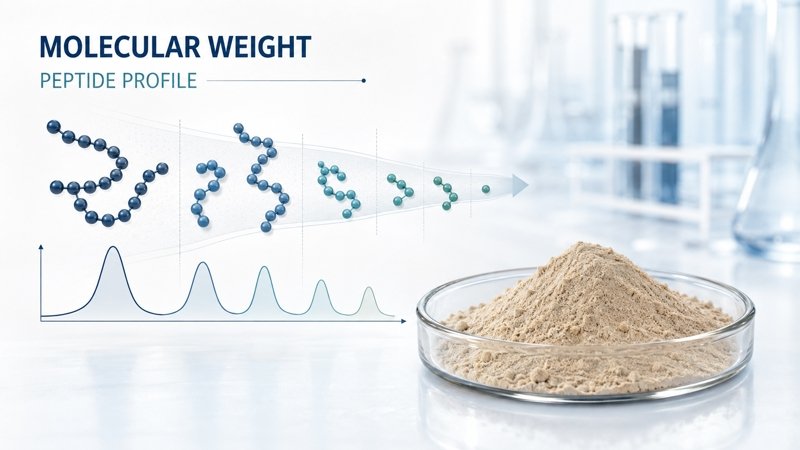
When evaluating a peptide ingredient, B2B buyers often compare peptide content and protein content first. However, molecular weight in earthworm peptide powder can provide another useful technical reference—especially when formulation teams need to understand the peptide profile created through enzymatic hydrolysis.
Molecular weight information can help purchasing and R&D teams ask better questions about hydrolysis, peptide distribution, specification consistency and formulation suitability. But it should never be interpreted in isolation.
A lower molecular weight does not automatically mean higher quality, better absorption or stronger performance. For practical sourcing decisions, buyers should review molecular weight information together with peptide content, protein content, COA, specification sheet, solubility, sensory characteristics, sample results and the requirements of the intended finished product.
Quick Answer: Why Is Molecular Weight in Earthworm Peptide Powder Important?
Molecular weight in earthworm peptide powder can help B2B buyers understand peptide profile characteristics, the results of enzymatic hydrolysis and whether an ingredient may fit specific formulation requirements.
It is a useful technical reference for specification and sample evaluation, but it is not standalone proof of ingredient quality or finished-product performance. Buyers should interpret it alongside peptide content, protein content, COA data, solubility and actual formulation testing.
Why Molecular Weight Matters for B2B Buyers
For a supplement brand or ingredient distributor, molecular weight information becomes useful when it helps answer a procurement question.
For example, a formulation team may want to know whether two suppliers offering similar peptide content actually provide comparable peptide profiles. A buyer evaluating a new batch may need to determine whether its technical characteristics remain within agreed requirements. An R&D team may also want more information before testing the ingredient in a beverage, powder blend, capsule or other formulation.
This means molecular weight information may support:
- specification comparison;
- formulation development;
- sample-to-sample comparison;
- technical communication with suppliers;
- quality documentation review;
- purchasing specification development;
- batch approval when molecular weight is a defined requirement.
Buyers who need broader product and supply information can also review the Earthworm Peptide Powder product page.
The key point is purpose: do not request a molecular weight number simply because it sounds technically advanced. First determine whether molecular weight distribution is actually relevant to your formulation or internal quality standard.
Molecular Weight and Enzymatic Hydrolysis
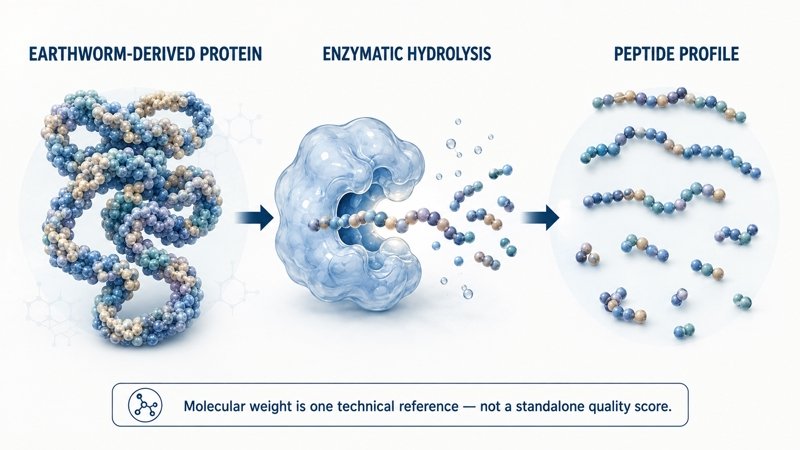
Earthworm Peptide Powder is produced through enzymatic hydrolysis of earthworm-derived protein material. During hydrolysis, enzymes break peptide bonds in larger protein structures, producing smaller peptide fractions.
Therefore, molecular weight distribution can provide information about the resulting peptide profile.
Degree of hydrolysis and molecular weight distribution are related concepts, but they are not interchangeable measurements. Hydrolysis conditions—including enzyme system, processing time, temperature, pH and subsequent separation steps—can influence the final peptide composition.
This is why buyers comparing supplier data should ask how molecular weight information was obtained instead of comparing numbers without understanding their basis.
Importantly, Earthworm Peptide Powder is a peptide ingredient, not an active enzyme product. Although enzymatic hydrolysis is used during production, the finished powder is not positioned as lumbrokinase or as a fibrinolytic enzyme ingredient.
Buyers unfamiliar with this distinction can refer to What Is Earthworm Peptide Powder before developing a purchasing specification.
Molecular Weight vs. Peptide Content vs. Protein Content
These parameters describe different aspects of the ingredient.
| Parameter | What It Tells the Buyer | What It Does Not Tell the Buyer Alone |
|---|---|---|
| Molecular weight information | Peptide size distribution or related peptide-profile characteristics, depending on the test method | Overall quality, efficacy or finished-product performance |
| Peptide content | Proportion of peptide material according to the stated testing/specification basis | Distribution of peptide sizes |
| Protein content | Supporting compositional or nutritional information | Specific peptide profile or molecular weight distribution |
A material with a specified peptide content should not automatically be assumed to have a particular molecular weight distribution.
Similarly, two powders with similar protein or peptide percentages may still differ in hydrolysis profile, solubility, taste, color or behavior in a formulation.
This is why experienced buyers evaluate a group of related parameters rather than selecting an earthworm peptide supplier based on one number.
For a broader quality-control perspective, see How to Evaluate Earthworm Peptide Powder Quality.
How Molecular Weight May Affect Formulation Review
Molecular weight information becomes commercially useful when it is connected to a real application.
Depending on the peptide profile and overall formulation system, buyers may investigate its relationship with:
- water solubility or dispersibility;
- taste and sensory characteristics;
- blending behavior with other ingredients;
- powder handling;
- beverage or powder-system compatibility;
- processing conditions;
- the intended dosage form.
However, molecular weight alone cannot predict all these properties.
For example, a buyer developing a beverage should not approve an ingredient simply because a supplier reports a particular molecular weight profile. Actual sample testing under the buyer’s target pH, concentration, processing conditions and other formulation parameters provides much more useful evidence.
This creates an important sourcing distinction:
Molecular weight information helps define what to investigate; formulation testing helps determine whether the actual material works in the intended product.
What Should Buyers Ask Suppliers About Molecular Weight?
Before requesting a sample or approving an earthworm peptide powder bulk order, consider asking:
- Is molecular weight information available for this product?
- How is the molecular weight information expressed?
- What testing method or technical basis is used?
- Is the information a general product characteristic or a batch-specific result?
- Does it appear on the specification sheet, COA or a separate technical document?
- Does the purchasing specification require a defined molecular weight profile?
- Can the supplier provide the COA and specification for the currently available batch?
- Should formulation testing be completed before bulk approval?
One additional question is particularly useful when comparing suppliers: Are we comparing the same type of data?
A single value, a distribution, a fraction percentage and a general product description are not necessarily equivalent. Buyers should clarify the reporting basis before making a side-by-side comparison.
Molecular Weight in COA and Specification Review
Molecular weight does not necessarily need to appear on every standard Earthworm Peptide Powder COA.
A specification sheet normally defines the target requirements for the product, whereas a COA reports actual results for a particular batch based on the testing items included.
If molecular weight is critical to the buyer’s formulation, it should therefore be discussed explicitly with the supplier. Ask whether the information is available through the specification sheet, batch COA, separate testing data or technical communication.
The more important purchasing question is not “Does every COA contain molecular weight?” but “Is the information required for our application clearly defined, documented and understood by both parties?”
General document terminology and batch-document questions are also covered on the Allworms FAQ page.

Sample Evaluation Before Bulk Order
When molecular weight profile, solubility, sensory characteristics or formulation compatibility matter, sample testing should form part of supplier approval.
A practical sample review can include:
- appearance and odor;
- solubility or dispersibility;
- blending behavior;
- formulation trial;
- peptide and protein specifications;
- COA review;
- molecular weight information when required;
- moisture and ash;
- heavy metals and microbiology;
- compatibility with the buyer’s internal quality requirements.
An approved sample should not be interpreted as a guarantee that every future batch will be identical.
There is also an important timing issue. If several months pass between sample evaluation and purchase-order placement, the original sample batch may no longer be available. Buyers should then request the COA for the actual available bulk batch and confirm that it meets the agreed purchasing specification before approval.
The distinction between peptide, protein and enzyme ingredients can be reviewed further in Earthworm-Derived Ingredients: How to Choose Between Protein Powder, Peptide Powder and Lumbrokinase.
Molecular Weight Review Checklist for Earthworm Peptide Powder Buyers
| Review Item | What Buyers Should Ask | Why It Matters |
|---|---|---|
| Molecular weight information | Is data available, and on what testing basis? | Helps characterize the peptide profile |
| Peptide content | What is the stated specification and method? | Confirms a key peptide-related parameter |
| Protein content | Is protein included in the specification? | Adds compositional context |
| COA | Is it for the relevant available batch? | Supports batch-level review |
| Specification sheet | What requirements define acceptable material? | Establishes purchasing criteria |
| Solubility | Has the material been tested under relevant conditions? | Supports formulation screening |
| Sample evaluation | Can material be tested before purchasing? | Provides application-specific evidence |
| Formulation requirement | Does the buyer actually require a molecular weight target? | Prevents unnecessary specification restrictions |
| Batch documentation | Which data are batch-specific? | Helps distinguish general claims from actual results |
| Moisture | Is it within agreed limits? | Relevant to powder quality and storage |
| Ash | Is it included in compositional review? | Provides additional quality context |
| Heavy metals | Are required limits documented? | Supports safety and market evaluation |
| Microbiology | Are relevant microbial parameters tested? | Supports ingredient quality review |
| Packaging | What pack format protects the material? | Matters for transport and handling |
| Storage | What conditions are recommended? | Supports quality management after receipt |
| Bulk order confirmation | Have actual-batch documents been reviewed? | Reduces sample-to-order misunderstandings |
Common Buyer Mistakes
Several purchasing shortcuts can create misleading conclusions.
Assuming lower molecular weight is always better. The appropriate profile depends on the ingredient specification and intended application.
Focusing only on peptide content. Peptide percentage does not describe every characteristic of the peptide profile.
Ignoring protein content and supporting quality parameters. Molecular weight should sit within a broader specification review.
Treating molecular weight as proof of performance. It is technical characterization—not a guarantee of absorption, efficacy or health outcomes.
Comparing supplier numbers without comparing methods. Different reporting bases may make apparently similar data unsuitable for direct comparison.
Skipping sample testing. Documentation cannot replace formulation evaluation when solubility, taste or processing behavior is important.
Confusing Earthworm Peptide Powder with Lumbrokinase. Earthworm Peptide Powder is produced using enzymatic hydrolysis but is positioned as a peptide ingredient. It is not an active lumbrokinase ingredient.
Expecting enzyme activity specifications. IU/mg, FU/g, LKU and fibrinolytic activity testing belong to lumbrokinase evaluation, not routine Earthworm Peptide Powder purchasing.
Ignoring the actual bulk batch. Previously approved sample data should not replace review of the documents associated with the material currently offered for purchase.
Allworms Supply Notes
Allworms is part of the manufacturer-side earthworm-derived ingredient supply system and supports overseas market development and international sales.
For available Earthworm Peptide Powder batches, COA and specification information can be provided for B2B evaluation. Buyers can discuss sample requirements, MOQ, bulk quantity, packaging, lead time and international shipping according to their target specification, application and destination.
Where molecular weight information is important to a project, buyers should state the requirement during technical communication rather than assuming it is a standard COA parameter.
FAQ
1. Why does molecular weight matter in Earthworm Peptide Powder?
It can provide useful information about peptide profile characteristics resulting from hydrolysis and can support specification comparison, formulation evaluation and supplier communication.
2. Is lower molecular weight always better?
No. Lower molecular weight should not automatically be interpreted as better quality, absorption, efficacy or performance. The appropriate profile depends on the buyer’s technical and formulation requirements.
3. Is molecular weight the same as peptide content?
No. Molecular weight relates to peptide size or distribution, while peptide content indicates the amount of peptide material according to the specified testing basis.
4. Should buyers check protein content too?
Yes. Protein content provides additional compositional information and should be considered together with peptide content, molecular weight information and other quality parameters.
5. Does Earthworm Peptide Powder have lumbrokinase activity?
Earthworm Peptide Powder is not positioned as an active lumbrokinase ingredient. It is produced through enzymatic hydrolysis but supplied as a peptide ingredient rather than a fibrinolytic enzyme product.
6. What documents should buyers request?
Depending on the project, buyers should request the specification sheet, COA for the relevant batch and any available molecular weight or technical information needed for their application.
7. Should buyers test a sample before a bulk order?
Yes, particularly when solubility, sensory characteristics, blending or formulation compatibility matter. If the eventual bulk batch differs from the original sample batch, review the actual bulk-batch COA before approval.
8. Can molecular weight affect formulation suitability?
It may be relevant to characteristics such as peptide profile and formulation behavior, but molecular weight alone cannot establish suitability. Buyers should confirm performance through actual formulation testing.
Request Earthworm Peptide Powder Technical Information
Get COA, Specifications & Sample Support
This product is supplied as a B2B ingredient. Final formulation suitability, dosage, labeling, health claims, and regulatory compliance should be evaluated by the buyer according to the intended market and finished product use.