
Stability and Shelf Life of Earthworm Peptide Powder
Earthworm Peptide Powder shelf life should not be evaluated only by reading an expiry date on a specification sheet or package label. Formulators, QA teams and purchasing departments also need to understand the storage conditions, packaging configuration and handling assumptions connected with that period.
A stated shelf life indicates the period assigned to the ingredient under specified conditions. It does not, by itself, demonstrate that every characteristic remains unchanged throughout that period. Buyers should therefore distinguish between the stated shelf life and the information supporting it.
For commercial qualification, the practical question is whether the powder can remain suitable while moving through receiving, warehousing, sampling and production under the buyer’s actual operating conditions.
Allworms currently states a two-year shelf life and storage in a cool, dry place for its Earthworm Peptide Powder. Buyers should confirm that the applicable specification, batch information, packaging and storage instructions are aligned before approving material for their own inventory system.
Quick Answer
Earthworm Peptide Powder stability depends on more than the passage of time. Moisture exposure, packaging integrity, storage conditions, repeated opening and warehouse handling can all affect the practical condition of the powder.
Before commercial purchasing, buyers should verify:
- The shelf life stated for the offered product
- Manufacturing and expiry or retest information, where applicable
- Recommended storage conditions
- Packaging type and closure integrity
- Moisture-related specification information
- The batch COA and batch identification
- Procedures for handling partially used packages
- The remaining shelf life expected when the material is received
Additional stability information should be requested when the declared shelf life, intended inventory duration or buyer’s storage conditions cannot be evaluated adequately from the available documents.
What Shelf Life Means for Earthworm Peptide Powder Buyers
A shelf-life statement defines a period during which the supplier represents that the ingredient remains suitable when stored under the stated conditions. It should always be interpreted together with those conditions and the original packaging.
Shelf life does not mean that the powder is unaffected by its environment. It also does not automatically confirm stability in a finished capsule, tablet, beverage powder or other formulation. Raw-material shelf life and finished-product stability are separate questions.
Buyers should establish:
- Which Earthworm Peptide Powder specification the shelf life applies to
- Whether the period starts from the manufacturing date
- Whether the document uses an expiry date, retest date or another convention
- Which storage and packaging conditions apply
- Whether the offered batch has enough remaining shelf life for planned use
This matters commercially. A two-year shelf life may be adequate for one company that uses the material within several months but unsuitable for another company expecting long warehouse residence, multiple production campaigns or slow inventory turnover.
The date therefore needs to be assessed against the buyer’s production plan rather than accepted as an isolated product feature.
What Documentation Should Support Shelf-Life Evaluation?

Shelf-life evaluation normally involves several documents and information sources. No single document necessarily answers every storage-related question.
| Information | What It Helps the Buyer Confirm |
|---|---|
| Product specification | Stated shelf life, storage instructions and relevant quality limits |
| Batch COA | Results associated with the particular batch |
| Manufacturing date | Starting point for calculating batch age |
| Expiry or retest information | Remaining usable or review period, where applicable |
| Packaging information | Barrier and closure system used to protect the powder |
| Storage instructions | Conditions assumed for maintaining the product |
| Stability information, where available | Evidence or observations supporting the stated period |
A batch COA is important, but it is not automatically a stability report. It normally shows whether the batch met specified requirements when tested. It may not describe how the product was evaluated over time.
Similarly, a specification can state a shelf life without presenting the underlying stability evidence. If that evidence is important to the buyer’s qualification program, the buyer should ask what stability information is available and what product, batch, packaging and conditions it represents.
For a broader review of composition, physical properties, contaminants and other qualification parameters, refer to Key Specifications to Check When Sourcing Earthworm Peptide Powder. This stability page focuses only on information affecting storage suitability and shelf-life evaluation.
Why Moisture Control Matters During Storage
Moisture is one of the most practical storage concerns for a peptide powder. Exposure to ambient humidity may change the condition of the material even when no immediate specification failure is visible.
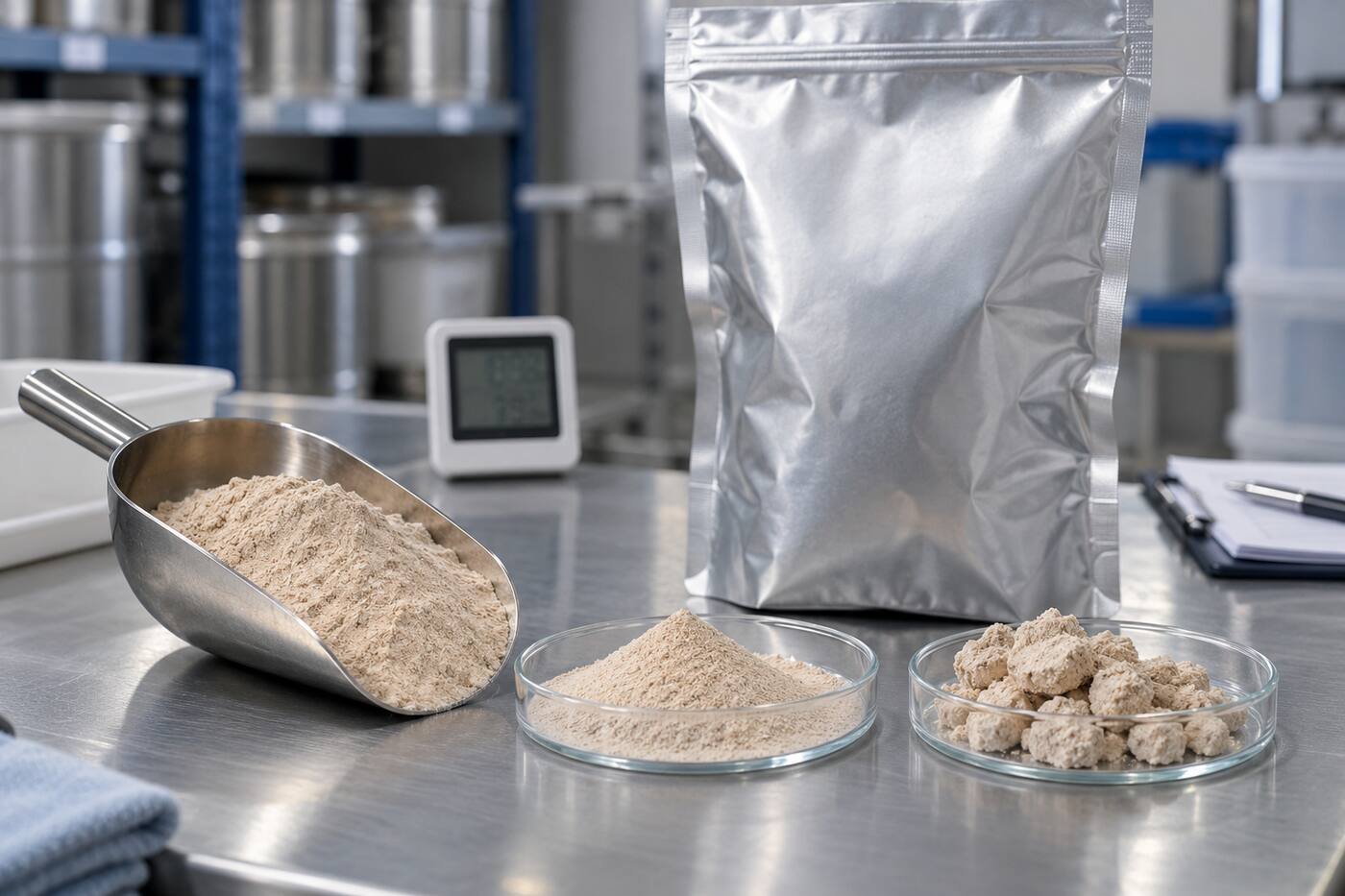
Possible observations include:
- Caking or formation of compacted areas
- Reduced powder flow
- Material adhering to the packaging
- Greater difficulty in weighing or transferring the powder
- Changes in the uniformity of the powder
- Increasing inconsistency between separate handling occasions
These observations do not, on their own, establish a chemical change or prove that the material has failed. However, they can indicate that the package or handling environment deserves further investigation.
QA teams should compare the received powder with its approved description and, where available, with an approved reference or retained sample. If the condition differs materially, the team can review packaging integrity, storage records, batch documentation and relevant test results before releasing the material.
Buyers should not assign an unverified critical humidity limit or assume that one moisture value predicts the entire shelf life. The useful approach is to review the supplier’s moisture specification and storage instructions, then control exposure within the buyer’s warehouse and production procedures.
Packaging and Its Role in Protecting the Powder
Packaging supports Earthworm Peptide Powder stability by separating the material from unnecessary environmental exposure. Its role should be evaluated as part of the shelf-life statement rather than treated only as a shipping or purchasing detail.

Relevant questions include:
- What packaging configuration is used for the ingredient?
- Is the inner package intact and properly sealed on receipt?
- Does the shelf-life statement apply to the unopened original package?
- Can the package be closed securely between uses?
- Is there visible damage, puncturing, leakage or seal failure?
- Are the batch code and date information readable?
- Does the package size suit the expected opening frequency?
Allworms lists aluminum foil bags and fiber-drum packaging options for Earthworm Peptide Powder. The applicable arrangement should be confirmed for the actual order because packaging information may vary with the agreed supply configuration.
A larger package is not automatically better or worse for stability. The important consideration is how it will be used. If one package must be opened repeatedly over an extended period, the buyer should consider whether its internal handling procedure can limit humidity exposure and contamination risk.
Packaging should also remain intact during warehouse movement. Rough handling, damaged closures and transferring material into an unsuitable secondary container may compromise the protection assumed by the supplier’s shelf-life statement.
Storage Conditions Buyers Should Confirm
The verified Allworms product information states that Earthworm Peptide Powder should be stored in a cool, dry place. Exact temperature or relative-humidity ranges should not be assumed unless they are stated in the applicable supplier documentation.
Before approval, buyers should confirm that their warehouse and production practices are consistent with the supplier’s instructions. The review may cover:
- Whether the designated storage area is appropriate for dry ingredients
- How the site limits unnecessary moisture exposure
- Whether packages are protected from damage
- How partially used material is identified and stored
- Whether storage conditions are monitored under the buyer’s procedures
- How deviations or damaged packages are investigated
- Whether outsourced warehouses follow the same requirements
If a buyer requires a defined temperature range, humidity limit or another specific condition for internal compliance, that requirement should be discussed with the supplier rather than inferred from the phrase “cool, dry place.”
Handling Earthworm Peptide Powder After Opening
The stated shelf life usually needs to be interpreted in the context of the original packaging and recommended storage conditions. Opening a package introduces additional handling variables that may not be addressed by the printed expiry date alone.
After opening, operators should:
- Minimize unnecessary exposure to ambient humidity
- Use clean, dry handling equipment
- Keep the package closed between withdrawals
- Avoid leaving the liner open during unrelated production activities
- Protect the remaining material from contamination
- Maintain the batch identity and original label information
- Record opening or handling information when required by internal procedures
- Follow the supplier’s storage instructions
No fixed “use within” period after opening should be assumed without supporting information. Each buyer should establish an internal procedure based on the package design, storage environment, frequency of use and applicable quality system.
Where practical, production scheduling can reduce repeated opening. However, package-size selection and purchasing economics belong to a broader procurement decision; the stability question is simply whether the selected package can be managed without excessive environmental exposure.
What Physical Changes Should QA Teams Watch For?
Incoming and stored-material inspections can help identify changes that require investigation. Useful observations include:
- Caking or unusual compaction
- A change from the approved powder appearance
- Unexpected color variation
- An odor different from the established product description
- Visible moisture or condensation
- Damage to the inner bag or outer container
- Broken or incomplete seals
- Contamination or foreign material
- Missing or unreadable batch identification
A physical change does not automatically prove that the material is unusable. It should trigger a documented assessment based on the nature of the change, the specification, batch records and any testing considered necessary.
Storage-related caking belongs within this stability evaluation. Detailed behavior after the powder is introduced into water or a formulation is a different technical question. Buyers assessing that property can consult Earthworm Peptide Powder Solubility and Dispersibility: What Buyers Should Test.
Shelf Life and Commercial Inventory Planning
Purchasing teams should connect the supplier’s shelf-life information with the time the material will actually spend in their supply chain.

The review should consider:
- Expected shelf life remaining at receipt
- Incoming inspection and release time
- Planned pilot and commercial production dates
- Expected inventory duration
- Frequency of package opening
- Normal usage rate
- Storage arrangements at each location
- Stock-rotation procedures
- Batch traceability through production
First-expired, first-out or another appropriate stock-rotation system can help prevent newer material from being used while older batches remain in inventory. Batch identification should be maintained so that stored material can be connected with its COA, receipt record and subsequent production use.
Buyers should also avoid qualifying a sample solely because it has an acceptable shelf-life statement. The actual commercial batch may have a different manufacturing date. Its remaining shelf life should be checked again before shipment or acceptance.
How to Compare Stability Information Between Suppliers
Supplier comparisons should use the same questions for each candidate. Comparing “24 months” from one supplier with “two years” from another reveals very little when packaging and storage assumptions are unknown.
A useful comparison examines:
| Review Area | Buyer Question |
|---|---|
| Shelf-life period | What period is stated for this exact product? |
| Starting point | Is it calculated from manufacturing or another date? |
| Storage instructions | What conditions are specified? |
| Packaging | What unopened packaging does the statement assume? |
| Batch dating | Are manufacturing and expiry or retest details available? |
| Moisture control | What specification or batch information is provided? |
| Supporting evidence | What stability information is available, if required? |
| Opened-package handling | Does the supplier provide relevant guidance? |
When stability documentation is limited, the buyer should identify the gap and decide whether the available information is sufficient for the intended order size, inventory duration and application. The absence of a particular document should not be filled with assumptions.
Common Mistakes When Evaluating Shelf Life and Storage
Common mistakes include:
- Treating the expiry date as complete proof of stability
- Failing to review the specified storage conditions
- Assuming the COA is a stability study
- Ignoring the manufacturing date and remaining shelf life
- Comparing suppliers without comparing packaging assumptions
- Leaving opened packages exposed during repeated use
- Using visible appearance as the only acceptance criterion
- Assuming raw-material shelf life proves finished-product stability
- Inventing temperature or humidity limits not stated by the supplier
- Approving a sample without reviewing the dates of the commercial batch
Avoiding these errors makes the shelf-life statement more useful within a real QA and inventory system.
Stability and Storage Checklist Before Supplier Approval
Before approving Earthworm Peptide Powder, confirm:
- The shelf life applies to the offered product specification.
- The starting date and expiry or retest convention are understood.
- Storage instructions have been reviewed.
- The offered batch will have adequate remaining shelf life at receipt.
- Packaging configuration and seal integrity requirements are known.
- Moisture-related information has been reviewed.
- The batch COA and batch identification are available.
- Warehouse conditions can follow the supplier’s instructions.
- Opened-package handling procedures have been defined.
- Physical changes that require investigation are established.
- Stock rotation and batch traceability procedures are in place.
- Additional stability information has been requested if necessary.
FAQ
1. What is the stated shelf life of Allworms Earthworm Peptide Powder?
The current Allworms product information states a shelf life of two years when the product is stored according to the stated instructions. Buyers should verify the applicable specification and dates for the offered batch.
2. How should Earthworm Peptide Powder be stored?
Allworms states that it should be kept in a cool, dry place. Buyers requiring exact environmental limits should confirm them through the applicable product documentation.
3. Does a two-year shelf life mean the powder remains completely unchanged?
No. A stated shelf life does not mean every characteristic remains unchanged. It should be interpreted with the relevant acceptance requirements, packaging and storage conditions.
4. Is a batch COA enough to support shelf-life approval?
Not necessarily. A COA reports results for a particular batch but may not explain how the shelf-life period was established. Buyers may also need the specification, dates, storage instructions and packaging information.
5. Why is moisture important during storage?
Moisture exposure may contribute to caking, reduced flow and changes in practical handling. Such observations may require review of the package, storage history and relevant quality information.
6. How should the powder be handled after opening?
Keep the package properly closed between uses, limit exposure to ambient humidity, use clean and dry equipment, preserve batch identification and follow the supplier’s storage instructions.
7. Can raw-material shelf life be applied to a finished supplement?
No. A raw-material shelf-life statement does not establish the stability of a capsule, tablet, beverage or other finished product. The finished formulation requires its own evaluation.
8. When should buyers request additional stability information?
Additional information may be appropriate when the intended inventory period is long, the storage environment differs from the stated conditions, the packaging changes or the available documents do not adequately support internal approval.
Conclusion
Earthworm Peptide Powder shelf life is best evaluated as a connected system of documentation, packaging, moisture control, storage and handling. A date alone cannot show whether an ingredient fits the buyer’s warehouse practices, production schedule and quality requirements.
Before approving commercial material, formulators, QA teams and purchasing departments should confirm the applicable shelf-life statement, batch dates, remaining shelf life, packaging configuration and storage requirements. General answers about product documentation and supply procedures are available on the Allworms FAQ Page.
Review Earthworm Peptide Powder Specifications and Storage Information?
Contact Allworms to Discuss Your Formulation and Supply Requirements.