A practical guide for supplement, nutraceutical, pharmaceutical, and formulation buyers
If you’re sourcing earthworm peptide powder for a new product line, one question shows up pretty quickly: should you go with OEM manufacturing or a private label service?
It sounds like a simple sourcing detail. It isn’t.
For B2B buyers, this choice affects almost everything—formula flexibility, packaging speed, brand control, compliance prep, order planning, and, yes, how fast you can actually get to market. And when the ingredient is a specialized raw material like earthworm peptide powder, the gap between a smooth launch and a frustrating one can get wide, fast.
Here’s the thing: buyers often think OEM is always “more professional,” while private label is “more basic.” That’s not quite right. In real purchasing work, both models can make sense. The better option depends on what you need the product to do, how much differentiation matters, and how much development work you want your supplier to handle.
Before we get into service models, it helps to understand the ingredient itself.
Earthworm peptide powder is a small-molecule peptide ingredient derived from earthworm protein through controlled enzymatic hydrolysis and drying, positioned as a stable, non-enzymatic peptide raw material for advanced formulations. It is typically used in nutraceutical, functional food, and health-product development, with protein content above 65% and good formulation compatibility in powders, capsules, and drink systems.
What exactly are buyers asking for when they request earthworm peptide powder?
Not all buyers are looking for the same thing, even when they use the same product name.
Some want a bulk peptide raw material to blend into capsules or sachets under their own technical control. Others want a finished or near-finished product—with packaging, labeling, and maybe even market-ready branding already handled.
That difference is where OEM and private label start to split.
In most cases:
- OEM service means the manufacturer produces a product to your requested formula, specification, dosage form, or packaging concept.
- Private label service means the manufacturer offers an existing or semi-standard product that can be sold under your brand name with lighter customization.
Simple enough on paper. In practice, the lines blur. And that’s where experienced suppliers become valuable.
A capable earthworm peptide powder supplier should understand not only the ingredient, but also the buyer’s commercial stage. A distributor testing a new region does not need the same setup as a mature supplement brand building a differentiated SKU portfolio.
OEM sounds fancy—but what does it really include?
Let me explain.
When buyers ask for OEM earthworm peptide powder services, they usually expect more than contract filling. They’re asking for a production partner that can adapt the product around commercial requirements.
That may include:
1. Raw material specification matching
Earthworm peptide powder is generally described as a stable peptide ingredient with high protein content, low fat, and no active enzyme content after processing, which matters for formulation stability.
In an OEM setup, buyers may request adjustments such as:
- protein range
- peptide content target
- molecular weight preference
- sensory tolerance
- moisture target
- application-specific flow properties
Not every supplier can support meaningful adjustments here. Some say “customized” when they really mean “we can change the label.” That’s not OEM in any useful sense.
2. Dosage form development
A serious OEM program may support earthworm peptide powder for:
- bulk powder supply
- capsule filling
- solid beverage sachets
- tablet blending systems
- functional blend combinations
This matters because earthworm peptide is often chosen for its small molecular profile, absorption efficiency, and compatibility in complex formulations. If your end format is a powder drink, for example, flowability and dispersibility become part of the sourcing conversation—not just peptide content.
3. Formula combination work
Some buyers don’t want a single-ingredient product. They want a marketable formula.
That could mean combining earthworm peptide powder with vitamins, botanical extracts, mineral systems, or circulation-support ingredients. Of course, exact combinations depend on your market and legal pathway, but from a manufacturing standpoint, OEM is the service model that usually supports this kind of work best.
4. Packaging development
OEM may also cover:
- inner sachets
- bottles
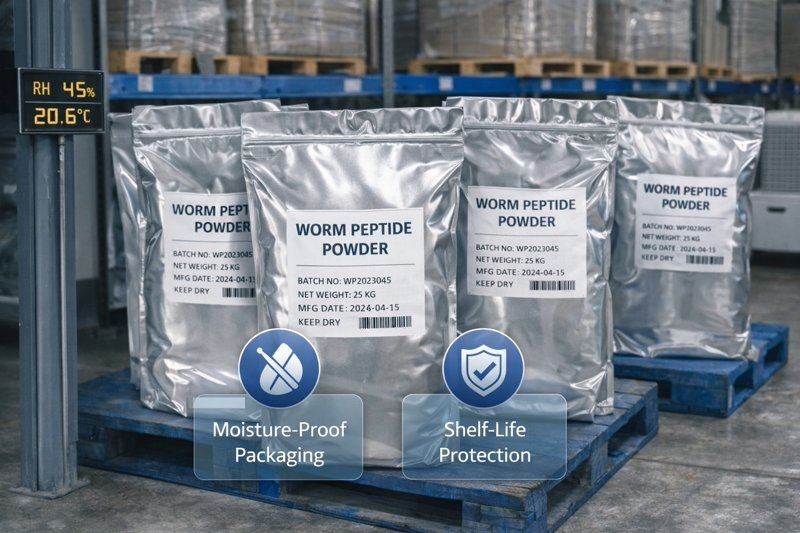
- bulk foil bags
- carton design support
- shipping pack configuration
- master carton labeling for export
If you need packaging to match your channel strategy—clinic sales, cross-border e-commerce, wholesale distribution—OEM gives you more room.
So when does private label make more sense?
Honestly, pretty often.
Private label is sometimes treated like a shortcut. But in B2B trade, a good shortcut is not a bad thing. It can be the smartest route, especially for importers, wholesalers, and regional brands testing demand.
With private label earthworm peptide powder, the supplier usually starts with an established product format and lets you place your own branding on it. That reduces development time and lowers project complexity.
This works well when you want:
- faster market entry
- lower development cost
- simpler approval workflow
- easier MOQ management
- fewer technical decisions upfront
It’s especially useful if the product itself is already commercially sound. Earthworm peptide powder is typically marketed as a stable, non-enzymatic bioactive peptide ingredient suitable for capsules, powders, and beverage systems, which makes it easier to position in ready-brand formats than a fragile enzyme product would be.
In other words, private label can be a practical fit because the ingredient already carries a usable value story: high protein, peptide-based nutrition, formulation stability, and broad compatibility.
The real difference: control versus speed
This is where most buyers end up.
OEM usually gives you more control. Private label usually gives you more speed.
But that’s only half the story.
A better way to compare them is this:
Choose OEM if you need:
- a distinct formula
- a custom spec sheet
- differentiated packaging format
- deeper technical support
- stronger product separation from competitors
Choose private label if you need:
- a proven base product
- simpler launch planning
- shorter development cycle
- smaller first-step commercial testing
- brand ownership without full product development
And yes, some buyers do both.
A brand may start with private label to test market response, then move to OEM once repeat orders justify custom development. That’s actually a very sensible path.
Why earthworm peptide powder needs a supplier who can explain the process clearly
This ingredient is specialized enough that buyers often need more than a price list.
A reliable manufacturer should be able to explain how the product is made in a way that supports buyer confidence. Based on the supplied product documentation, earthworm peptide powder is produced through controlled enzymatic hydrolysis followed by spray drying, with the final material positioned as a stable peptide ingredient without active enzyme content. This point is commercially important because it supports storage stability and helps reduce degradation concerns in downstream formulation.
That technical detail matters in OEM and private label projects alike.
Why?
Because your R&D team, purchasing team, and marketing team may all ask different questions:
- Is the ingredient an enzyme product?
- Will it remain stable in finished dosage forms?
- Can it be used in drink powders?
- Does it fit high-protein positioning?
- Is it easier to formulate than active enzyme materials?
The supplier should be able to answer those questions clearly and consistently. If they can’t, you may have trouble later—with documentation, formulation work, or customer-facing claims.
What buyers should ask before choosing OEM or private label services
You know what? This is where many projects go sideways—not in production, but in the first supplier conversation.
Before moving forward, ask these questions.
Can you supply the product as bulk raw material and as branded finished goods?
This tells you whether the supplier is only a raw-material seller or can support more complete commercial service.
What parts of the formula or specification are actually customizable?
A lot of sellers say “customized” very casually. Ask what can truly change: peptide content, packaging, filling format, MOQ, flavor masking, label language, or just artwork.
Is the final powder non-enzymatic?
For earthworm peptide powder, this is a key positioning point. The supplied product file clearly states that the product does not contain active enzymes and is intended as a non-enzymatic peptide ingredient.
What packaging options are available for B2B export?
Bulk foil bags, OEM retail bottles, sachets, and cartons all affect shipping cost and warehouse handling.
What documentation comes with each batch?
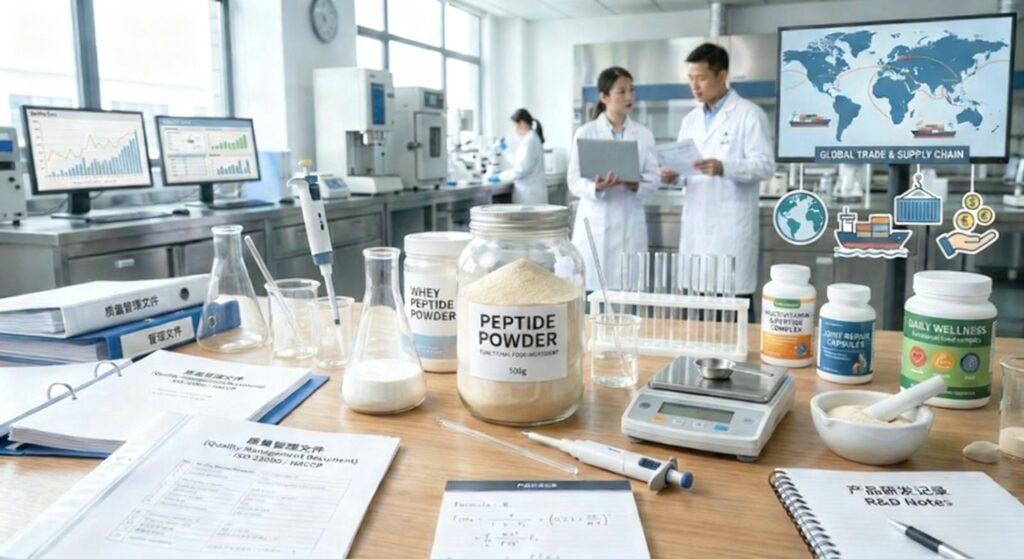
You’ll likely need at least a specification sheet, COA, and microbiological or heavy metal data, depending on market requirements.
What is the MOQ for each service model?
Usually, OEM projects require higher commitment than private label or bulk neutral-pack supply. Not always—but usually.
A quick reality check on formulation expectations
There’s a mild contradiction here worth clearing up.
Earthworm peptide powder is often promoted as a highly versatile peptide ingredient. And that’s fair. The product information emphasizes good compatibility in beverages, powders, and capsules.
But “versatile” doesn’t mean “effortless.”
Formulation still matters. Taste profile, aroma handling, blend interactions, filling accuracy, and local compliance all need attention. A good OEM supplier helps with that. A good private label supplier reduces how much of that you need to worry about.
That’s why service selection is not just a purchasing issue. It’s really a product-management choice.
Who usually chooses OEM earthworm peptide powder services?
In the market, OEM is often the better fit for:
Supplement brands building a differentiated SKU
They may want a custom blend, special dosage format, or formula structure that isn’t already on the shelf.
Pharmaceutical or advanced health product developers
These buyers tend to care more about specification control, traceability, and consistency across batches.
Large distributors creating exclusive lines
They want something harder for competitors to copy.
Buyers targeting specific application stories
Earthworm peptides have been studied in relation to antioxidant activity, ACE inhibitory peptides, and immunomodulatory potential in research settings.
That doesn’t automatically translate into finished-product positioning in every market, of course, but it does mean some buyers want tighter control over how the ingredient is incorporated and presented.
And who usually chooses private label?
Private label tends to fit:
Wholesalers and traders entering a new category
They want speed and manageable risk.
Regional distributors testing customer response
They need a branded product, but not a full product development cycle.
E-commerce health brands
They may want faster turnaround and less operational complexity.
Buyers with limited technical staff
Private label helps when you don’t want to manage every formulation detail yourself.
Sometimes the smartest commercial move is not the most customized one. It’s the one that gets a solid product into the market without draining time and budget.
What a strong supplier partnership should look like
Whether you choose OEM or private label, the supplier should offer more than manufacturing capacity.
For earthworm peptide powder, a dependable partner should bring together:
- stable raw material handling
- controlled peptide processing
- clear enzyme-activity explanation
- flexible packaging support
- batch consistency
- realistic lead time communication
Earthworm peptide powder as suitable for advanced nutrition systems, nutraceutical formulations, and functional foods and beverages, while also emphasizing stable composition and consistent batch quality as buying advantages.
That’s exactly the kind of language a supplier should be able to support with actual production discipline—not just brochures.
Because in B2B sourcing, trust is built less by slogans and more by repeatability.
Which service model is better for your business?
Let’s make it plain.
OEM is better when product differentiation is central to your strategy.
Private label is better when launch speed and lower complexity matter more.
Neither is automatically superior. The right choice depends on where you are in the buying cycle.
If you’re still validating the market, private label may save you time and cash.
If you already know your channel, volume, and product angle, OEM may give you the control you need to build a stronger brand asset.
And for many buyers, the best route is phased:
- start with private label or bulk standard material
- gather market feedback
- move into OEM once demand is proven
That path is practical. It’s commercial. And frankly, it avoids a lot of expensive guesswork.
FAQs
What is the difference between OEM and private label earthworm peptide powder?
OEM earthworm peptide powder usually allows deeper customization in formula, dosage form, or packaging, while private label earthworm peptide powder uses a more standard product that is sold under your brand for faster launch.
Is earthworm peptide powder an active enzyme product?
No. The supplied product documentation describes earthworm peptide powder as a non-enzymatic peptide ingredient with no active enzyme content in the final powder.
Can I order bulk earthworm peptide powder for capsule or beverage formulations?
Yes. Earthworm peptide powder is generally positioned for use in powders, capsules, and beverage-compatible systems because of its small-molecule peptide profile and formulation stability.
Which service is better for a new supplement brand: OEM or private label?
For a new supplement brand, private label earthworm peptide powder is often the easier first step because it reduces development time and setup complexity. OEM is usually better once you need stronger product differentiation.
What should I check before choosing an earthworm peptide powder OEM supplier?
You should check whether the supplier can provide stable batch quality, clear product specifications, documentation support, realistic MOQ terms, packaging options, and genuine customization for your earthworm peptide powder project.

Explore Innovative Peptide Applications
Contact us for immediate stock availability