
Quick outline
- What each ingredient actually is
- How they’re made and why that matters
- Functional differences: broad-spectrum peptides vs targeted fibrinolytic enzyme
- Application differences in supplements, pharma, and formulation work
- How buyers can choose the better fit
- FAQs

Earthworm-derived ingredients are getting a lot more attention in B2B health markets, and honestly, that makes sense. Buyers are no longer looking for “interesting raw materials” alone. They want ingredients with a clearer mechanism, cleaner positioning, and a better fit for specific formulas.
That’s where the comparison between earthworm peptide powder and lumbrokinase becomes important.
They both come from earthworm raw material. They can both show up in cardiovascular-health discussions. And from a distance, they may even sound interchangeable. But they’re not. Not even close.
One is a complex mixture of small peptides and nutritional components, often positioned for broader functional-food and nutraceutical use. The other is a specific fibrinolytic enzyme complex, valued for targeted thrombolytic and fibrin-related applications. Put simply: earthworm peptide powder is the wider toolbox; lumbrokinase is the precision tool.
Let me explain.
What is earthworm peptide powder, really?
Earthworm peptide powder is generally produced by breaking down earthworm proteins into smaller peptide fractions through enzymatic hydrolysis, gastrointestinal simulation, or autolysis-style processing. That matters because small peptides behave differently from intact proteins: they’re usually easier to formulate around, easier to absorb conceptually in product positioning, and more flexible across food, supplement, and even cosmetic narratives. Research in your materials also shows earthworm protein hydrolysates can yield bioactive peptide fractions linked to antioxidant, ACE-inhibitory, and immunomodulatory activity.
In other words, earthworm peptide powder is not one single active. It’s a multi-component peptide ingredient.
That’s part of its appeal. It can be positioned more broadly. But it also means its profile depends a lot on the raw material, hydrolysis route, molecular-weight range, and drying process.
For B2B buyers, that’s a familiar story: a peptide powder is a platform ingredient, not a one-note compound.
And what is lumbrokinase?
Lumbrokinase is different from the start. It is not a general peptide mixture. It refers to a group of fibrinolytic enzymes isolated from earthworms and associated mainly with fibrin degradation and thrombolytic activity. The review material you uploaded describes lumbrokinase as an earthworm-derived fibrinolytic system with strong anticoagulant and thrombolytic properties, and importantly, with specificity that may reduce bleeding phenomena linked to hyperfibrinolysis in some contexts.
That’s why lumbrokinase is usually discussed with terms like:
- activity units
- fibrinolysis
- thrombus-related pathways
- enzyme stability
- clinical or pharmaceutical relevance
So while earthworm peptide powder often enters the conversation as a functional peptide raw material, lumbrokinase enters as a high-value enzyme active.
Same biological source. Very different commercial logic.
Same origin, different personality
Here’s the simplest way to frame it.
Earthworm peptide powder is like a broad nutritional and bioactive extract system.
Lumbrokinase is like a specialist technician with a very specific job.
That difference affects almost everything: manufacturing controls, testing methods, dosage language, marketing claims, regulatory pathway, pricing, and final product positioning.
And yes, this is where many buyers get tripped up. They assume “peptide” automatically means “enzyme-rich,” or that “earthworm extract” automatically means “lumbrokinase.” It doesn’t.
Production method: where the split begins
The gap between these two ingredients starts in manufacturing.
Earthworm peptide powder is generally made by taking earthworm protein and converting it into smaller peptides through enzymatic hydrolysis, gastrointestinal digestion simulation, or autolysis-based processing. Research in your files shows hydrolysis can produce high levels of soluble peptides and enrich low-molecular-weight fractions associated with antioxidant, ACE-inhibitory, and immunomodulatory activities.
Lumbrokinase, by contrast, requires processing that preserves and standardizes enzyme activity, not just peptide presence. That means the production focus shifts from “how many small peptides do we have?” to “how much fibrinolytic activity is retained, how stable is it, and how is it measured?”
That’s a huge operational difference.
For peptide powder, buyers often care about:
- protein or peptide content
- molecular weight distribution
- appearance and solubility
- odor and color consistency
- heavy metals and microbiology
- drying process and carrier use
For lumbrokinase, buyers usually care about:
- activity units
- specific activity
- assay method
- enzyme preservation during processing
- batch-to-batch potency
- storage and transport stability
So even if two products start from the same earthworm biomass, they end up in very different value chains.
Functional profile: broad bioactivity vs targeted fibrinolysis
Now to the heart of the comparison.
Earthworm peptide powder: broader functional story
Research from the uploaded papers shows that earthworm protein hydrolysates can generate peptides with antioxidant, ACE-inhibitory, and immunomodulatory potential.
One paper identified antioxidant peptides released after gastrointestinal digestion and reported strong activity in selected sequences such as AFWYGLPCKL, WPWQMSLY, and GCFRYACGAFY.
Another identified novel ACE-inhibitory peptides, including SSPLWER and RFFGP, with the two strongest peptides acting as competitive ACE inhibitors.
A separate study found earthworm protein autolysates could yield peptides with immunomodulatory effects in a CTX-induced immunosuppressed mouse model.
So earthworm peptide powder has a wider “health-support” narrative. That makes it useful for brands developing products around:
- circulation support
- healthy aging concepts
- antioxidant blends
- recovery formulas
- functional nutrition
- peptide-based premium supplements
It’s not as narrow. That’s the advantage.
Lumbrokinase: narrower, stronger, more specific
Lumbrokinase sits in a much tighter lane: fibrinolytic and antithrombotic relevance.
The comprehensive review in your files explains that lumbrokinase can contribute to thrombolysis by directly lysing fibrin and by supporting endogenous fibrinolytic pathways. It also notes its value as an orally relevant thrombolytic agent explored in several countries.
That specificity is what makes lumbrokinase commercially powerful. When a buyer wants a focused enzyme active for advanced cardiovascular-support positioning or research-oriented applications, lumbrokinase tends to be the more direct answer.
But there’s a trade-off. A narrow mechanism can be a strength, yet it also means:
- tighter testing expectations
- more demanding quality control
- more sensitive formulation handling
- a more careful regulatory and claims strategy
So yes, it can be more impressive. It can also be less forgiving.
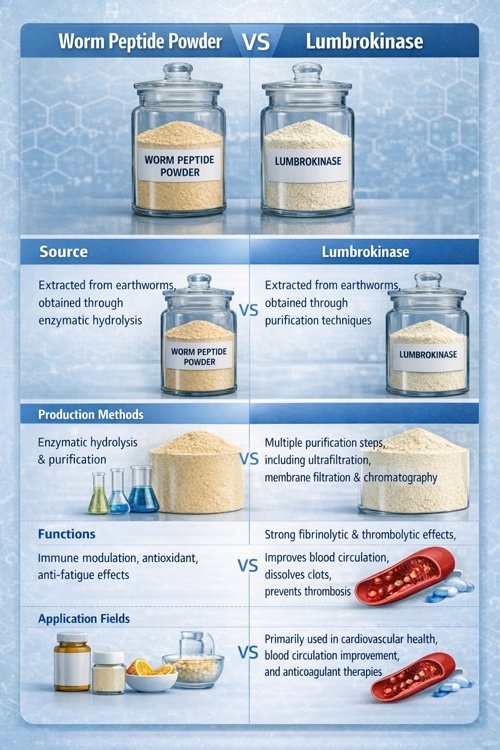
Which one is “stronger”?
This is the wrong question — but it comes up all the time.
Lumbrokinase is usually “stronger” for fibrinolytic targeting.
Earthworm peptide powder is usually “broader” for multi-functional formulation potential.
That’s why comparing them as if they’re substitutes can miss the point. It’s a bit like asking whether a surgical scalpel is better than a chef’s knife. Better for what?
If your product concept is built around precision enzyme activity, lumbrokinase is the clearer fit.
If your product concept needs a wider ingredient story — peptides, nutrition, antioxidant support, possible blood-pressure-support positioning, and flexible formulation use — earthworm peptide powder may be the smarter route.
Application differences in real B2B markets
Here’s where the comparison becomes practical.
1. Dietary supplements and nutraceuticals
Earthworm peptide powder usually fits more naturally into:
- peptide nutrition capsules
- circulation-support blends
- antioxidant formulas
- premium functional powders
- multi-ingredient healthy-aging products
Its commercial appeal comes from being easier to position in broader wellness language.
Lumbrokinase is more often used where the product concept wants a specialized enzyme identity. It has stronger recognition in certain cardiovascular-support segments, especially among buyers already familiar with fibrinolytic actives. The ingredient carries more technical weight, which can be a big plus in serious formulations.
2. Pharmaceutical and research-oriented ingredients
This is where lumbrokinase often takes the lead.
Because it is associated with well-defined fibrinolytic function, it tends to align better with pharma-style or clinically adjacent ingredient discussions. The review file specifically highlights its antithrombotic significance and oral formulation interest.
Earthworm peptide powder can still matter here, especially in exploratory work on antihypertensive, antioxidant, or immunomodulatory peptide fractions, but it is usually less “single-mechanism” than lumbrokinase.
3. Functional foods and beverage concepts
Earthworm peptide powder is usually more adaptable here.
Why? Because enzyme actives like lumbrokinase often need tighter control around stability, process conditions, and activity retention. Peptide powders, while still requiring careful formulation, are generally easier to imagine in food-adjacent formats, especially in powder blends, tablets, and specialty nutrition products.
Your own product materials also frame earthworm protein and peptide ingredients as food and health-food candidates, which supports that broader application logic.
4. Cosmetics and cross-category innovation
This is more of a peptide-friendly zone than an enzyme-first zone.
Earthworm peptide powder can support a broader story around bioactive peptides, antioxidant potential, and innovation in active ingredient sourcing. Lumbrokinase is much less likely to be the lead ingredient in cosmetic positioning because its value is tied more tightly to fibrinolytic function.
Spec sheet differences buyers should expect
If you’re sourcing either ingredient, the spec sheet should tell you a lot.
For earthworm peptide powder, check:
- peptide or protein content
- hydrolysis method
- molecular weight profile
- solubility
- color and sensory consistency
- carrier presence
- microbiological limits
- heavy metals
- drying method
For lumbrokinase, check:
- activity units and test method
- enzyme source and extraction description
- stability data
- storage conditions
- moisture limits
- microbial control
- heavy metals
- batch consistency in potency
This is one of those quiet but important differences. Peptide powder buyers are often managing a composition profile. Lumbrokinase buyers are managing a performance profile.
That changes procurement behavior fast.
Pricing logic: why lumbrokinase usually sits higher
Generally speaking, lumbrokinase tends to command a higher value because it is:
- more activity-sensitive
- more standardized around function
- more demanding to test
- more specialized in market positioning
Earthworm peptide powder can still be premium, especially when produced with strong peptide control and supported by credible research, but it often has more room for flexible market entry.
For wholesalers, dealers, and manufacturers, this affects margin strategy. A peptide powder can sometimes scale more easily across multiple SKUs. Lumbrokinase may fit fewer products, but often with higher technical and commercial value per kilo.
Marketing language: don’t blur them
This part matters more than many suppliers think.
Do not market earthworm peptide powder as if it were simply “low-activity lumbrokinase.” That weakens both products.
And do not market lumbrokinase as if it were just “a kind of peptide powder.” That undersells its technical identity.
A cleaner distinction looks like this:
Earthworm peptide powder
- hydrolyzed earthworm protein ingredient
- peptide-rich functional raw material
- broad bioactive positioning
- flexible use in nutraceutical and functional formulations
Lumbrokinase
- earthworm-derived fibrinolytic enzyme complex
- activity-standardized specialty ingredient
- targeted use in advanced circulation-focused formulations
- stronger enzyme-centric technical positioning
The more clearly a supplier separates these stories, the more credible the catalog feels.
So, which one should a buyer choose?
Here’s the practical answer.
Choose earthworm peptide powder when you need:
- a broader peptide ingredient
- flexible formulation potential
- wider nutraceutical storytelling
- antioxidant or ACE-related research support
- easier extension into functional-food style concepts
Choose lumbrokinase when you need:
- targeted fibrinolytic positioning
- activity-standardized enzyme value
- stronger technical differentiation
- a more specialized cardiovascular-support active
And yes, in some product strategies, the answer may be both — but not in the same role.
One can serve as the broad base. The other can serve as the precision active. That kind of tiered formulation logic can be very compelling for premium B2B development.
Final thoughts
Earthworm peptide powder and lumbrokinase are related, but they are not twins. They’re more like cousins with very different careers.
Earthworm peptide powder offers range.
Lumbrokinase offers focus.
One is better suited to brands that want formulation flexibility and a broader functional narrative. The other is better suited to buyers who want a sharper mechanism and a stronger enzyme identity.
For suppliers, the lesson is simple: explain the difference clearly.
For buyers, it’s even simpler: match the ingredient to the job.
That’s how better products get built.
If interested please continue reading:
- Earthworm Peptide Powder Product Page
- Lumbrokinase Product Page
- How to Evaluate the Quality of Earthworm Peptide Powder
- What Makes Pharmaceutical-Grade Lumbrokinase Different?
FAQs
1. Is earthworm peptide powder the same as lumbrokinase?
No. Earthworm peptide powder is a hydrolyzed peptide-rich ingredient, while lumbrokinase is a fibrinolytic enzyme complex with a more targeted functional role.
2. Which is better for cardiovascular health product development?
It depends on the formula goal. For broader circulation-support or peptide-based wellness products, earthworm peptide powder may fit better. For targeted fibrinolytic enzyme positioning, lumbrokinase is usually the stronger choice.
3. Can earthworm peptide powder contain bioactive antihypertensive peptides?
Yes. Research in the uploaded materials identified novel ACE-inhibitory peptides from earthworm protein digestion products, including SSPLWER and RFFGP.
4. Why is lumbrokinase usually more technically demanding to source?
Because buyers must verify enzyme activity, assay method, potency consistency, and stability — not just composition. That makes lumbrokinase sourcing more performance-driven than ordinary peptide powder procurement.
5. Is earthworm peptide powder suitable for functional food and nutraceutical brands?
In many cases, yes. Earthworm peptide powder is generally easier to position as a multi-functional bioactive ingredient for nutraceutical and functional-food concepts than a highly specialized enzyme ingredient. Research also supports antioxidant, ACE-inhibitory, and immunomodulatory peptide potential.
Looking For A Reliable Earthworm Extract Supplier?
Contact us now to discuss your project requirements.