

Outline
Why this matters for brands now
What lumbrokinase really adds to a product line
The easiest product families to extend first
Formulation and positioning choices that make sense
Where brands usually get it wrong
A practical integration roadmap
Final thoughts
FAQs
Adding a new ingredient to an existing product line sounds simple on paper. In real life, it rarely is.
For supplement brands, nutraceutical manufacturers, and health ingredient suppliers, every line extension has to earn its place. It has to fit the brand story, work in formulation, make sense for the target buyer, and avoid creating a product that feels awkward or forced. That last part matters more than people think. A clever ingredient can still become a poor product if the brand bolts it onto the wrong platform.
That is exactly why lumbrokinase gets so much attention—and also why it needs careful handling.
Lumbrokinase is a fibrinolytic enzyme complex derived from earthworms and has been widely studied for antithrombotic and thrombolytic activity. The literature also notes fibrin specificity, potential support for blood flow, and oral absorption through the intestinal epithelium, which helps explain why oral dosage formats are often discussed in commercial development.
So where does it belong in a brand portfolio? Not everywhere. But in the right places, it fits surprisingly well.
The first truth: lumbrokinase is not a “sprinkle it everywhere” ingredient
Some ingredients are broad lifestyle ingredients. You can place them in gummies, powders, beauty blends, stick packs, maybe even coffee creamers, and the market will at least understand the logic.
Lumbrokinase is different.
It carries a more targeted, mechanism-driven identity. That can be a strength. Honestly, it’s often a strength. But it also means brands have to integrate it with discipline. When buyers see lumbrokinase, they expect a focused cardiovascular or circulation-related concept—not a vague wellness promise dressed up in technical language.
That makes lumbrokinase better suited to product families already associated with:
- circulation support
- cardiovascular health positioning
- active aging formulas
- vascular wellness concepts
- post-sedentary lifestyle support
- professional practitioner lines
If a brand already sells heart health, vascular support, enzyme complexes, or healthy aging products, lumbrokinase can slide in naturally. If the brand mainly sells beauty gummies and collagen drinks, the fit is much weaker.
That’s the real starting point. Not “Can we use lumbrokinase?” but “Which shelf in our own catalog can carry it without confusing the customer?”
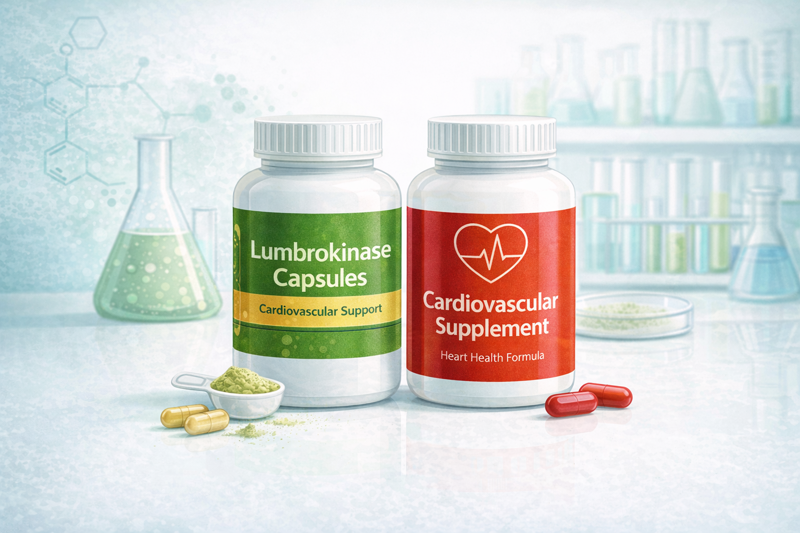
What lumbrokinase actually adds to an existing line
Here’s the thing: brands do not integrate lumbrokinase just to have a new SKU. They use it because it changes the profile of an existing category.
It can help a line feel more specialized, more clinical, and more differentiated.
The review literature describes lumbrokinase as a potent fibrinolytic component with thrombolytic and anticoagulant relevance, and notes that oral formulations have already been explored in clinical development. That gives product developers a useful bridge between traditional circulation-support concepts and more advanced enzyme-based positioning.
In practice, that means lumbrokinase tends to add one or more of these commercial benefits:
1. It upgrades a standard circulation formula
Many brands already have a circulation or cardio support product that looks familiar—maybe too familiar. Think common vitamins, botanical extracts, and generic positioning. Adding lumbrokinase can move that formula from “basic support” toward a more technical enzyme-based concept.
2. It creates a premium tier within an existing range
A brand may keep its entry-level heart health formula unchanged, then launch a “plus,” “advanced,” or practitioner-grade version featuring lumbrokinase. That is often smarter than replacing a bestselling base SKU.
3. It gives older brands a way to modernize legacy categories
Some traditional cardiovascular products feel dated. Lumbrokinase offers a way to refresh them without abandoning the category the brand is already known for.
4. It supports B2B differentiation
For raw material suppliers and contract manufacturers, lumbrokinase is not only an ingredient—it is a conversation starter. It helps position a portfolio as more specialized, science-aware, and less commodity-driven.
That matters. In a crowded market, “another circulation softgel” is forgettable. A well-positioned enzyme-based vascular support concept is harder to ignore.
So, where do brands place it? The most natural product families
Not every extension path is equal. Some are smooth. Some are clunky. Some, frankly, are marketing gymnastics.
Capsule-based cardiovascular support lines
This is the most obvious and usually the cleanest route.
Capsules fit lumbrokinase well because the ingredient already carries a technical, professional feel. Buyers in this category are less focused on trendy delivery formats and more focused on function, standardization, and trust.
A brand with existing capsule SKUs for heart health, blood flow, vascular comfort, or healthy aging can add lumbrokinase as:
- an advanced circulation capsule
- a stand-alone enzyme SKU
- a premium add-on to an existing heart health system
If the company already sells practitioner-oriented products, this path is even more natural.
Combination enzyme formulas
This route is popular because it gives formulators a story they can tell without stretching too far.
Lumbrokinase can be integrated into broader enzyme concepts aimed at circulation, metabolic wellness, or active aging—provided the formula remains coherent. The key is not to crowd it with random extras. A tight formula usually sells the concept better than a kitchen-sink blend.
The ingredient’s fibrin-related activity and circulation relevance make it a stronger fit in targeted enzyme complexes than in generic multi-benefit blends.
Active aging portfolios
This is where strategy gets interesting.
Aging consumers are often not looking for flashy innovation. They want support that feels serious, credible, and worth paying for. Lumbrokinase can fit into that mindset when the product is framed around healthy circulation, mobility-support lifestyle needs, and vitality for older adults.
Not anti-aging magic. Not miracle language. Just a smarter active-aging extension.
Practitioner and pharmacy-adjacent lines
Some ingredients feel more comfortable in professional channels than mass retail. Lumbrokinase is one of them.
Brands working with clinics, functional medicine channels, or pharmacy-oriented buyers often integrate lumbrokinase more easily because the audience is already used to specialized actives and more technical education.
That does not mean the product must be dull. It just means the sales argument can be more precise.
Delivery format matters more than brands sometimes admit
A common mistake is forcing a strong ingredient into a trendy format.
Could a brand try to put lumbrokinase into a gummy? Maybe. Should it? Usually no.
Because the format sends a message. A gummy says casual, lifestyle, easygoing. Lumbrokinase says targeted, technical, purpose-built. Those signals can clash.
The review literature specifically discusses oral lumbrokinase and its intestinal absorption, which helps support the logic of oral solid dosage formats. For most brands, that means capsules remain the most sensible commercial choice, followed by tablets in some markets.
And that is okay. Not every winning product has to look trendy on social media.
Sometimes the best formulation decision is the least theatrical one.
Brand architecture: extend, don’t distort
When brands integrate lumbrokinase well, they usually follow one quiet rule: they extend what customers already trust.
For example:
A cardiovascular brand may add an advanced enzyme-support SKU under its existing heart-health umbrella.
A healthy aging brand may add a vascular vitality sub-line.
A practitioner brand may introduce a more targeted circulation protocol product.
Notice the pattern? The new SKU still belongs to the same family.
Poor integration usually happens when a brand tries to make lumbrokinase perform outside its natural lane. That is when product naming gets strange, the copy becomes vague, and sales teams start overexplaining. Never a good sign.
If the product needs five minutes of verbal rescue, the positioning probably needs work.
The formulation conversation brands cannot skip
Let me explain. With lumbrokinase, the ingredient itself is only half the story. The rest is formulation discipline.
A few questions matter right away:
Is the formula meant to be stand-alone or part of a system?
Will the brand emphasize enzyme identity or broader cardiovascular support?
How much complexity can the label carry before the value proposition gets muddy?
Will the dosage form preserve the ingredient’s serious, technical image?
That last point is not trivial. Enzyme products often sell partly on perceived precision. Clean positioning, clear specs, and an uncluttered formula can do more for commercial success than adding three fashionable actives.
For B2B buyers, this is where supplier credibility starts to matter too. Raw material consistency, assay transparency, documentation, and manufacturing fit are not side issues. They shape whether a brand can integrate lumbrokinase with confidence at all.
Where brands usually get it wrong
A little bluntness helps here.
They overpromise
Lumbrokinase may be promising, but serious ingredients need serious claims discipline. Overhyped marketing can damage trust fast.
They under-educate
On the flip side, some brands launch the SKU and assume the ingredient will sell itself. It won’t. Buyers need a simple explanation of what makes the product different.
They pick the wrong neighbors
A formula packed with unrelated beauty, detox, immunity, and circulation signals feels messy. Buyers sense that.
They ignore channel fit
A technically positioned ingredient may work beautifully in professional, B2B, or specialty channels—and only modestly in broad lifestyle retail. That is not failure. That is fit.
They treat it like a commodity
This one stings a bit. Lumbrokinase is not the sort of ingredient that should be handled like a low-cost generic add-on. Brands that win with it usually treat it as a flagship differentiator, not filler.
A practical roadmap for integrating lumbrokinase
For brands thinking commercially, the simplest path usually looks like this:
Start with the nearest existing category.
That is often cardiovascular support, circulation support, or active aging.
Choose one flagship format.
Usually capsules. Keep the launch focused.
Decide whether it is a hero ingredient or part of a concept blend.
Both can work, but indecision creates weak products.
Build education around mechanism and audience fit.
Not dense science. Clear buyer logic.
Use it to create a premium branch, not necessarily a portfolio overhaul.
That approach lowers risk and preserves brand continuity.
You know what? That last point is probably the most important. Brands do not need to rebuild their business around lumbrokinase. They just need to place it where it already makes strategic sense.
Final thoughts
Lumbrokinase works best when brands respect what it is.
It is not a mass-market novelty ingredient. It is not a casual wellness add-on. And it is definitely not something to squeeze into every trend-led format just because the market likes shiny things.
But for brands already active in cardiovascular health, circulation support, active aging, or practitioner-focused categories, it can be a sharp and valuable extension. It adds specialization. It adds technical depth. It can help a mature product line feel more current without losing credibility.
That is the sweet spot.
Not expansion for the sake of expansion. Smart integration, with a clear audience and a product that feels like it belongs.
FAQs
1. What type of brands are best suited to launch lumbrokinase products?
Brands already selling cardiovascular health, circulation support, enzyme-based supplements, or active aging products are usually the best fit. Lumbrokinase works best when it extends an existing technical or wellness category rather than creating a completely unrelated new direction.
2. Is lumbrokinase better as a stand-alone product or in a blend?
Both approaches can work. A stand-alone lumbrokinase supplement can highlight ingredient purity and specialization, while a blend can support a broader vascular wellness or circulation support concept. The better choice depends on the brand’s channel, target audience, and current portfolio.
3. Why do many lumbrokinase products use capsules instead of gummies or drink mixes?
Capsules usually match the ingredient’s technical and professional identity better. They also suit enzyme-focused positioning more naturally. For many brands, a lumbrokinase capsule feels more credible than a lifestyle-style delivery format.
4. Can lumbrokinase be used in healthy aging supplement lines?
Yes, especially when the product is positioned around circulation support, vascular wellness, or daily vitality for older adults. A healthy aging line with a stronger cardiovascular angle is often a natural home for lumbrokinase.
5. What should B2B buyers check before adding lumbrokinase to a formula?
B2B buyers should review ingredient standardization, manufacturing compatibility, documentation quality, assay consistency, dosage-form suitability, and the overall positioning logic of the finished product. A good lumbrokinase formula needs both technical support and a clear market fit.