
A quiet revolution beneath our feet
Let’s be honest. When most people hear “earthworm,” they think soil, gardens, maybe fishing bait. Not high-value functional ingredients.
And yet, beneath that humble image sits a protein source that’s been studied for antihypertensive peptides, fibrinolytic enzymes, antioxidant fragments, and immunomodulatory compounds. Not theory—peer-reviewed research.
For dietary supplement formulators, nutraceutical ingredient distributors, pharmaceutical R&D teams, and even cosmetic raw material suppliers, earthworm peptide powder is moving from novelty to serious contender.
So where does it fit in the future of functional ingredients?
Let me explain.
From Earthworm Protein to Bioactive Peptides: Why Size Matters
Before we talk about markets and positioning, we need to talk about structure.
Proteins are large, complex molecules. Peptides are smaller fragments—short chains of amino acids. And smaller, in this case, often means more bioavailable, faster absorbed, and more functionally active.
Research published in Food Bioscience identified novel ACE inhibitory peptides derived from earthworm protein following simulated gastrointestinal digestion . Peptides such as SSPLWER and RFFGP demonstrated measurable ACE inhibitory activity in vitro.
Why does that matter?
Because ACE (angiotensin-converting enzyme) plays a central role in blood pressure regulation. Synthetic ACE inhibitors are widely used—but they often carry side effects. Food-derived peptides, by contrast, are viewed as gentler and more consumer-friendly alternatives.
For formulators targeting cardiovascular health, this is a real opportunity:
- Natural-source antihypertensive peptides
- Competitive inhibition mechanism
- Structure–activity validation
And here’s the interesting part: it’s not just about blood pressure.
Beyond One Function: Multi-Pathway Potential
Earthworm-derived peptides and enzymes have been associated with:
- Fibrinolytic activity (via lumbrokinase)
- Antioxidant properties
- Immunomodulatory effects
- Anti-inflammatory mechanisms
A 2023 study on earthworm protein autolysates demonstrated immunomodulatory effects in cyclophosphamide-induced immunosuppressed mice . Peptides such as WNWLLPLMLG were screened using molecular docking and validated in macrophage models.
For the health supplement sector, this signals something important:
We’re not looking at a single-claim ingredient.
We’re looking at a platform ingredient.
And in functional ingredient strategy, platform ingredients are gold.
Production Matters: Can It Scale?
Let’s talk manufacturing—because innovation without scalability is just academic.
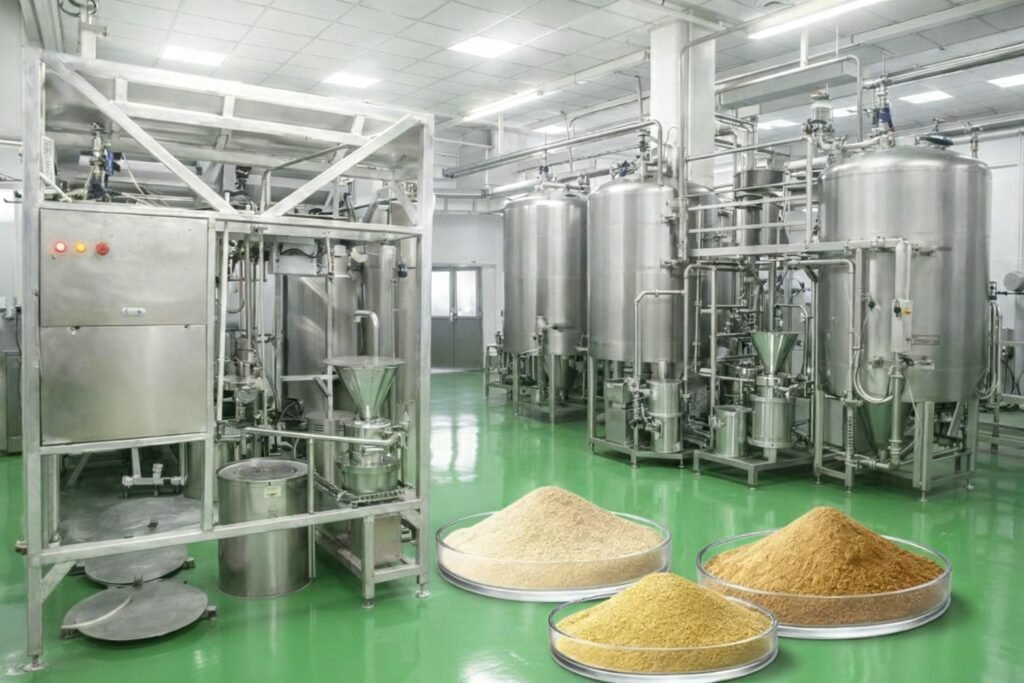
According to documented production processes , earthworm protein powder is produced through:
- Mechanical separation
- Cleaning and enzymatic hydrolysis
- Centrifugal filtration
- Low-temperature drying / spray drying
- Pulverization and sterilization
That means:
- Controlled processing
- Enzyme-assisted hydrolysis
- Stable powdered format
- Compatibility with capsule, tablet, sachet, and beverage applications
For B2B buyers, the real question isn’t “Is it interesting?”
It’s “Can I get consistent batches at industrial volume?”
With standardized cultivation (e.g., Eisenia species), and hydrolysis-based peptide preparation, supply chain stability is increasingly feasible.
And that changes the game.
Functional Food Innovation: Where It Fits Naturally
The food application space is particularly promising.
Documentation on innovative food applications highlights potential inclusion in:
- Functional beverages
- Lipid-regulating health foods
- High-protein formulations
- Anti-thrombotic functional cereals
- Protein bars
Here’s the thing.
Consumers are shifting toward:
- Clean-label ingredients
- Naturally derived actives
- Bioactive peptides over synthetic compounds
- Sustainable protein sources
Earthworm peptide powder sits right at the intersection of all four.
It sounds unconventional—but so did collagen peptides twenty years ago.
Sustainability: The Silent Advantage
We can’t ignore sustainability.
Earthworms convert organic matter into high-quality protein with remarkable efficiency. Compared to traditional livestock:
- Lower greenhouse gas emissions
- High protein conversion rate
- Minimal land footprint
- Organic waste recycling capability
Research notes that earthworm protein content can exceed 60% of dry matter . From an alternative protein standpoint, that’s significant.
And here’s a subtle but powerful positioning angle:
Not plant-based.
Not animal-based.
Invertebrate-based functional protein.
It’s different. And sometimes, different is exactly what markets are looking for.
Pharmaceutical & Medical Ingredient Potential
Let’s pivot slightly.
Lumbrokinase—derived from earthworms—has long been associated with fibrinolytic activity. While peptide powders and enzyme extracts are distinct, the broader biological profile strengthens category credibility.
Traditional and modern research discussions highlight applications in thrombosis management, circulatory health, and inflammatory modulation .
For pharmaceutical ingredient suppliers:
- Peptide fractions for R&D pipelines
- Enzyme–peptide combination strategies
- Adjunct therapy exploration
- Cardiovascular supportive formulations
And importantly, structure–activity relationship studies are already underway in academic settings .
This is not early speculation.
It’s emerging translational science.
Cosmetics? Yes, Surprisingly.
You might wonder—does this really cross into cosmetics?
Actually, yes.
Bioactive peptides in cosmetics are valued for:
- Antioxidant activity
- Anti-inflammatory properties
- Skin barrier support
- Microcirculation improvement
Given documented antioxidant and immune-regulatory findings , earthworm peptide fractions could potentially enter:
- Nutricosmetic formulations
- Functional skin-support supplements
- Topical peptide research lines
Is it mainstream yet? No.
But neither were marine collagen peptides when they first appeared.
The Science Is Getting Smarter
What makes earthworm peptide research particularly compelling is the methodology.
We’re not just extracting crude powders and hoping for the best.
Researchers are using:
- UPLC-MS/MS identification
- In silico screening
- Molecular docking
- ADMET prediction models
- Enzyme kinetics analysis
The ACE inhibitory peptide study explicitly combined purification, mass spectrometry, docking simulations, and synthesis validation .
That level of scientific rigor increases industry confidence.
And confidence is what moves markets.
Market Positioning: Where Does It Sit Strategically?
Earthworm peptide powder could be positioned as:
- A cardiovascular-support peptide source
- A functional immune-modulating protein hydrolysate
- A sustainable alternative protein ingredient
- A high-bioavailability peptide blend
- A differentiated innovation ingredient for premium SKUs
It’s unlikely to replace mainstream whey or soy. That’s not the point.
It’s a specialty bioactive peptide ingredient.
High value. Lower volume. Function-focused.
That’s where margins live.
A Mild Contradiction (That Makes Sense)
Here’s something interesting.
Earthworm peptides feel ancient. They’ve been referenced in traditional medicine for centuries.
Yet the science validating specific peptide sequences and molecular mechanisms is modern—very modern.
Ancient origin. Modern validation.
That dual identity is commercially powerful.
Consumers increasingly want ingredients with:
- Historical use credibility
- Backing by molecular science
- Sustainable production
Earthworm peptide powder ticks those boxes.
What Needs Work?
Let’s stay realistic.
Challenges remain:
- Regulatory pathways differ across regions
- Consumer education is necessary
- Sensory optimization for food applications
- Standardization of peptide fractions
- More human clinical trials
But honestly? That’s true for almost every emerging functional ingredient category.
What matters is trajectory.
And the trajectory is upward.
The Bigger Picture: The Future of Functional Ingredients
Functional ingredients are shifting from:
Single vitamin claims → Multi-pathway bioactive compounds
Bulk proteins → Targeted peptide fractions
Synthetic solutions → Natural bio-derived molecules
Commodity ingredients → Story-driven science ingredients
Earthworm peptide powder fits this evolution almost perfectly.
It’s bioactive.
It’s researched.
It’s sustainable.
It’s different.
And in a saturated supplement market, different—when supported by data—wins attention.
FAQs About Earthworm Peptide Powder
1. What makes earthworm peptide powder different from earthworm protein powder?
Earthworm peptide powder consists of hydrolyzed small molecular peptides, which are more easily absorbed and may exhibit targeted bioactivities such as ACE inhibition or immune modulation. Earthworm protein powder contains larger intact proteins that require digestion before absorption.
2. Is earthworm peptide powder suitable for cardiovascular health formulations?
Research has identified ACE inhibitory peptides derived from earthworm protein digestion , suggesting potential application in blood pressure support and cardiovascular-focused nutraceutical formulations.
3. Can earthworm peptide powder be used in functional foods?
Yes. Studies and application discussions show potential incorporation into functional beverages, high-protein foods, lipid-regulating products, and health cereals .
4. How is earthworm peptide powder produced at industrial scale?
It typically involves mechanical separation, enzymatic hydrolysis, centrifugation, low-temperature drying, sterilization, and powder processing , ensuring stable and standardized B2B supply.
5. Does earthworm peptide powder have immune-support potential?
Animal studies on earthworm protein autolysates indicate immunomodulatory activity in immunosuppressed models , supporting exploration in immune-support dietary supplement development.
If the functional ingredient market is heading toward scientifically validated, bioactive, sustainable peptide solutions, then earthworm peptide powder isn’t on the sidelines.
It’s quietly positioning itself at the front of the next wave.
And for forward-thinking suppliers and manufacturers, that’s worth paying attention to.