Brief outline
- Why earthworm peptide powder is getting serious B2B attention
- Where Southeast Asia offers the clearest openings
- Why the Middle East, especially the Gulf, is worth watching
- The formats and claims that make commercial sense
- What can slow a launch down
- A practical market-entry angle for suppliers and brands

Earthworm peptide powder is not a mass-market ingredient. Not yet, anyway. It sits in that interesting space where science, tradition, and market timing meet. For some buyers, that makes it a hard sell. For others, that is exactly the point.
Here’s the thing: this ingredient is not being noticed because it sounds exotic. It is being noticed because the underlying science is getting more specific. Recent research on earthworm-derived proteins and peptides has identified antioxidant peptides, ACE-inhibitory peptides, and immunomodulatory peptides, which gives manufacturers a more concrete story to tell than the old vague “natural health” pitch. At the same time, several Southeast Asian and Middle Eastern markets are seeing steady growth in supplements, preventive health products, and premium functional nutrition. That combination matters. A lot. (研究市场)
Still, opportunity does not mean easy approval or instant shelf success. Earthworm peptide powder is better viewed as a strategic niche ingredient than a broad commodity protein. Suppliers who treat it like whey or soy will probably hit a wall. Suppliers who treat it like a high-value, dossier-driven, science-backed specialty ingredient have a much better shot.
Why this ingredient is getting a second look
The science is stronger than many buyers expect. In one recent study, earthworm protein digestion products yielded 6,030 peptide sequences, with AFWYGLPCKL, WPWQMSLY, and GCFRYACGAFY showing strong antioxidant activity, and the authors said the findings help support the application of earthworm proteins in health foods and functional foods.
Another study identified seven novel ACE-inhibitory peptides from earthworm protein digestion products, including SSPLWER and RFFGP, and concluded that earthworm-derived peptides may be the active ingredients behind antihypertensive effects and may support the use of earthworm proteins as functional food resources.
A third study found that earthworm protein autolysates showed immunomodulatory activity in a cyclophosphamide-induced mouse model, with WNWLLPLMLG standing out among the screened peptides. The paper explicitly positioned earthworm protein as a potential source of immunomodulatory peptides and functional food ingredients.
That does not mean brands should make drug claims. Absolutely not. But it does mean the ingredient story is moving from folklore to mechanism-based positioning. For B2B buyers, that changes the conversation. Suddenly it is not only “What is this?” but also “How can we format it, document it, and place it?”
Southeast Asia: not one market, but several very different doors
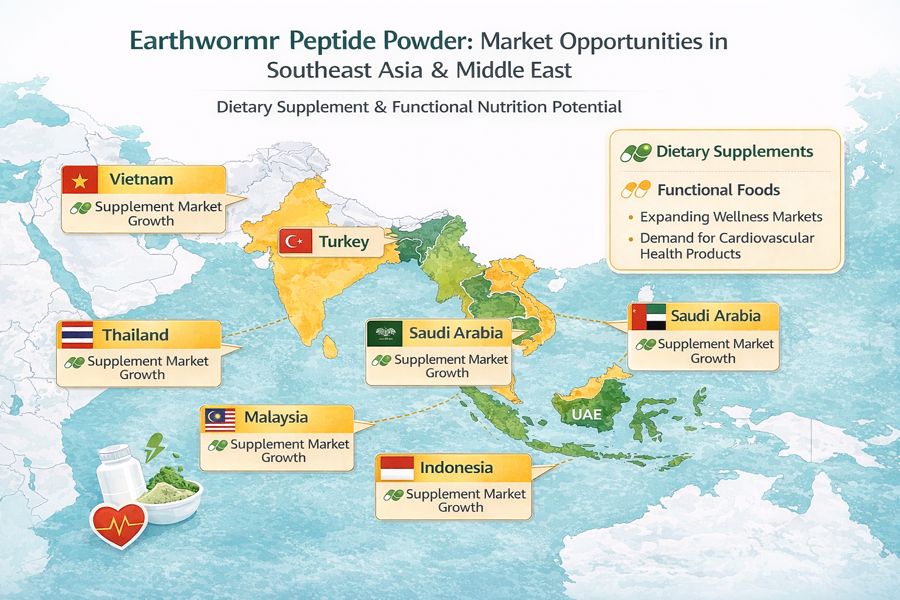
Southeast Asia often gets treated as one neat block. It is not. It is more like a busy trade hall with different doors, different buyers, and different rules behind each one.
The first commercial advantage is simple: the supplements category is growing. External market trackers estimate Southeast Asia’s dietary supplements market will expand at a solid pace through the next decade, driven by preventive health, lifestyle changes, and rising consumer interest in wellness products. (研究市场)
But growth alone is not the real story. The real story is market fit.
Singapore: the cleanest test market
Singapore is probably the most practical place to test premium positioning, especially for finished supplements rather than raw bulk ingredient storytelling. The Health Sciences Authority says health supplements are not subject to pre-market approval and are not evaluated before sale, although dealers remain responsible for safety and compliance. That makes Singapore comparatively useful as a launch, validation, and distributor-facing market, especially for capsule, tablet, and sachet formats with disciplined claims. (HSA)
Why does that matter? Because novel animal-derived ingredients often need a place where commercial learning can happen faster. Singapore can serve as that learning lab.
Malaysia and Indonesia: strong upside, but you need paperwork and halal thinking
Malaysia and Indonesia are attractive for a different reason. These are markets where natural-origin products, functional foods, and health-support narratives can resonate well. But they are not “light-touch” from a registration standpoint.
Indonesia’s BPOM has a defined framework for health supplement registration, including criteria and procedures for registration. Malaysia’s NPRA also routes products through formal registration systems for regulated health products. In plain English: these are not markets for casual exporters with a pretty brochure and a COA. You need a real file. (jdih.pom.go.id)
And then there is halal. That point is easy to underestimate. With an ingredient sourced from earthworms, halal assessment is not some optional afterthought. It can shape market access, distributor confidence, and final brand positioning. In Malaysia, JAKIM remains the central halal authority for certified products, and halal status can be commercially decisive even when it is not legally mandatory for every category. (Program Perkhidmatan Farmasi)
So yes, Malaysia and Indonesia are promising. But the opportunity is for prepared suppliers, not hopeful ones.
Thailand and nearby markets: formulation-led opportunities
Thailand’s FDA provides formal laws and regulations for health products, and the broader Thai market remains active in wellness, beauty-from-within, and functional food formats. That makes Thailand, and in some cases Vietnam or the Philippines through local partners, interesting not just for “cardio support” concepts, but also for premium blend products where earthworm peptide powder is one part of a broader formula.
Honestly, this may be one of the smartest ways to enter Southeast Asia. Not by asking consumers to embrace a single unusual ingredient on its own, but by placing it inside a well-built multi-ingredient concept with clear quality documentation and restrained claims.
The Middle East: a smaller conversation, but often a higher-value one
Now let’s move west a bit.
The Middle East, especially the Gulf, is not just about bigger malls and hotter weather. It is a region where premium health products, imported supplements, and halal compliance can all intersect in commercially useful ways. Market trackers estimate continued growth across Middle East and Africa supplements and nutraceuticals, with rising interest in convenient, prevention-focused nutrition. (研究市场)
For earthworm peptide powder, the best openings are probably not broad retail powders. They are premium finished products, practitioner-recommended formats, and distributor-led channels.
UAE: the gateway market
The UAE is especially important because it acts as a regional trade and re-export hub. It also has a structured halal system. The Ministry of Industry and Advanced Technology states that, under the UAE Halal Products Control System, halal products require certification for final products and raw materials from registered halal certification bodies. MOIAT also runs conformity certificate services for regulated products. (工业与先进技术部)
That is a big clue for suppliers. In the UAE, success is not only about the ingredient. It is about whether your ingredient can travel through a formal quality-and-compliance pipeline without raising red flags. If you have traceability, spec sheets, contaminant controls, stability data, and halal readiness, the UAE becomes much more attractive.
Saudi Arabia: scale, but with a firmer rulebook
Saudi Arabia matters because of scale and because the Saudi Food and Drug Authority has an established guide for food supplements and energy drinks. That signals a real framework, not a loose market. It is a place for serious registration, serious labeling discipline, and serious local partnerships. (الهيئة العامة للغذاء والدواء)
That may sound like a burden. In some ways, it is. But for a niche ingredient, a structured market can actually help. Why? Because it filters out weaker suppliers. When the bar is higher, a well-prepared manufacturer can stand out more easily.
So where is the real product-market fit?
This is where some brands get it wrong. Earthworm peptide powder is not best positioned as a mainstream sports protein. The fit is much stronger in:
- premium capsules and tablets
- stick packs for functional wellness use
- combination formulas for circulation, active aging, or antioxidant support
- practitioner or pharmacy-adjacent channels where education matters
That approach matches both the science and the market mood. The uploaded research supports antioxidant, ACE-inhibitory, and immunomodulatory potential, but it also points to the need for further validation before broad therapeutic positioning. So the commercial sweet spot is wellness support, not pharmaceutical overreach.
A supplier who offers peptide content data, molecular-weight distribution, heavy metal testing, microbial control, origin traceability, and application support will look far more attractive than one selling a vague “earthworm extract” with dramatic claims. Buyers in these regions are cautious for good reason.
What can slow growth down?
Quite a few things, actually.
First, consumer familiarity is still limited. Earthworm-derived ingredients may work well in B2B conversations, but consumer-facing branding needs tact. Soft scientific language, clean packaging, and benefit-led messaging matter.
Second, regulatory classification can get messy. In some markets, a product may fit as a food supplement. In others, ingredient novelty or intended use may trigger tougher review. That is why claim strategy should be settled early, not late.
Third, halal and source transparency are not negotiable in many target markets. You cannot fix that with better copywriting after the fact.
And fourth, human clinical evidence is still thinner than many premium buyers would like. The science is promising, yes, but much of it remains preclinical or mechanistic. That means responsible commercialization wins trust faster than hype.
A practical playbook for suppliers and manufacturers
If you want to build business in Southeast Asia and the Middle East, the smartest path is not to be the loudest. It is to be the most complete.
Start with a premium ingredient dossier. Build around identity, peptide profile, safety, contaminants, manufacturing controls, and intended regulatory classification. Then develop region-ready finished concepts. Not twenty of them. Two or three strong ones.
For SEO and content clustering, related pages such as Regulatory Considerations for Using Earthworm Protein Powder Globally and Earthworm Peptide Powder in Cardiovascular Health Products can support buyer education without forcing this article to do all the heavy lifting.
You know what really helps? Speaking differently to different buyers. A distributor in Singapore may care about speed to market and premium differentiation. A partner in Malaysia may focus first on compliance and halal suitability. A Saudi importer may care about dossier quality and claim discipline more than anything else.
Same ingredient. Different door.
Final thoughts
So, are there market opportunities for earthworm peptide powder in Southeast Asia and the Middle East?
Yes, there are. Real ones. But they are not wide-open commodity opportunities. They are selective, premium, science-driven opportunities.
Southeast Asia offers room for test launches, functional blends, and nutraceutical storytelling, especially in Singapore, Malaysia, Indonesia, and Thailand. The Middle East, especially the UAE and Saudi Arabia, offers strong upside for compliant, well-documented, halal-aware products that fit premium supplement channels. (HSA)
In other words, this is not a sprint. It is more like building a bridge plank by plank. But for suppliers who do the unglamorous work well, the bridge leads somewhere worth going.
FAQs
1. Can earthworm peptide powder be sold as a dietary supplement in Southeast Asia?
In some Southeast Asian markets, yes, but the route is country-specific. Singapore’s HSA does not require pre-market approval for health supplements, while Indonesia and Malaysia use more formal registration pathways through BPOM and NPRA. That means an earthworm peptide powder dietary supplement strategy must be built market by market. (HSA)
2. Is halal certification important for earthworm peptide powder in the Middle East?
Very much so. For many Gulf buyers, halal readiness is part of commercial credibility, not merely a label exercise. In the UAE, MOIAT states that halal products must obtain certification through registered halal certification bodies under the national halal control system. (工业与先进技术部)
3. What is the best product format for earthworm peptide powder in Saudi Arabia and the UAE?
Capsules, tablets, and premium stick packs are usually the best fit. They are easier to position as high-value wellness products and easier to support with specification documents, dosage consistency, and compliant claims than a bulk drink-mix format.
4. Which health benefits are most commercially relevant for earthworm peptide powder?
The strongest commercial angles are antioxidant support, cardiovascular wellness support, and active-aging or general wellness positioning. That is because recent studies identified antioxidant, ACE-inhibitory, and immunomodulatory peptides from earthworm protein, while still leaving room for more human validation.
5. What documents do distributors usually expect for an export-ready earthworm peptide powder ingredient?
For an export-ready earthworm peptide powder ingredient, buyers usually expect a detailed specification sheet, manufacturing flow, heavy metals and microbiology results, stability information, peptide or protein characterization, origin traceability, and where relevant, halal-related documentation. The more unusual the ingredient, the more important the paperwork becomes.