
Outline
- Why activity units sit at the center of lumbrokinase sourcing
- The real issue: lumbrokinase is an enzyme complex, not a simple raw powder
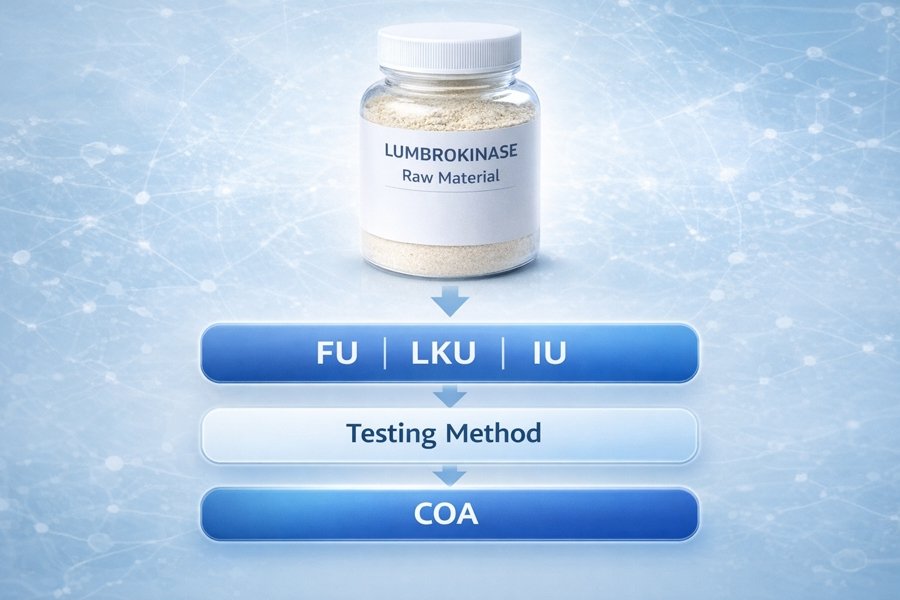
- Which activity units buyers usually see — FU, LKU, IU, and plain “U”
- Why the assay method matters more than the number on the label
- What procurement teams should ask for before comparing suppliers
- A practical buying checklist for supplements, nutraceuticals, and pharma-adjacent projects
- FAQs

If you’re sourcing lumbrokinase, there’s a trap that catches a lot of buyers early: comparing milligrams instead of enzyme activity.
That sounds basic, sure. But it happens all the time.
One supplier offers 40 mg per capsule. Another shows 60 mg. A third talks about 600,000 IU. Someone else quotes FU or LKU. Suddenly you’re not comparing like with like anymore — you’re comparing labels, not real potency. And with lumbrokinase, that can get expensive fast.
Here’s the thing: lumbrokinase is not a single neat molecule. It is a group of fibrinolytic enzymes derived from earthworms, and published research describes earthworm fibrinolytic enzymes as a set of isozymes rather than one isolated uniform substance. That matters because sourcing is not only about how much powder is in the drum or capsule; it is about how much functional enzyme activity survives processing, formulation, and delivery. (PMC)
So, what activity units actually matter?
Honestly, the most useful answer is a little annoying: the unit matters, but the assay behind the unit matters even more. Let me explain.
The first sanity check: mg is not potency
In enzyme buying, weight is only half the story. A heavier material can be weaker, and a lighter material can be stronger if it is more concentrated or better preserved.
One product document on the market even states that a serving could drop from 40 mg to 32 mg while the stated IU potency stayed the same, because the lumbrokinase became more concentrated. In plain English, less powder did not mean less activity.
That is why buyers who only compare mg per serving are flying a bit blind.
For B2B teams, this changes the sourcing conversation right away. The right question is not “How many milligrams are we buying?” It is “How much verified fibrinolytic activity are we buying, under what assay conditions, and how stable is that activity through shelf life and delivery?”
So which activity units will you actually see?
In the market, lumbrokinase is commonly described with FU, LKU, IU, or sometimes a generic U. The trouble is that these do not always mean the same thing, and they are not always directly convertible across suppliers. (Researched Nutritionals)
FU: fibrinolytic units
FU usually refers to fibrin-degrading activity. That sounds useful because fibrin breakdown is the whole commercial point of lumbrokinase. But FU values can still vary in meaning if labs use different substrates, standards, or calculation methods. One recent industry explainer puts it bluntly: FU values are only fairly comparable when the samples are tested with the same methodology. (Researched Nutritionals)
So yes, FU can be helpful. But only when the assay is disclosed clearly.
LKU: lumbrokinase units
LKU is marketed as a lumbrokinase-specific activity unit. A reposted assay-definition sheet attributed to Deerland describes one LKU as the amount of enzyme that liberates 1 μmol of p-nitroaniline per minute under a defined assay using Chromozyme TH at pH 9 and 25°C. The same sheet describes FU under different assay conditions and a different substrate context. That alone tells you the big lesson: different units can come from different test systems. (Studocu)
In other words, a big LKU number and a big FU number are not automatically apples-to-apples.
IU: international units
IU sounds comforting because it suggests wider standardization. And sometimes that is exactly why marketers use it. But in the lumbrokinase trade, IU claims still need context. A current market article notes that IU is a globally standardized style of activity measure in principle, yet lumbrokinase labels still need careful reading because other claimed units on the market are not directly interchangeable. (Researched Nutritionals)
For buyers, IU is not a magic shortcut. It still has to tie back to a documented assay, a certificate of analysis, and a clear specification sheet.
Plain “U” or generic enzyme units
This one deserves extra caution. In research papers on fibrinolytic enzymes, “U” can mean a unit defined for that exact study — sometimes based on tyrosine release, sometimes on fibrin plate clearing, sometimes on comparison with a urokinase standard. Those are legitimate for research, but they are not automatically commercial sourcing units. (PMC)
So if a supplier gives you only “U/g” without the assay description, that is not enough. Not even close.
The part buyers miss: the assay method is the real currency
You know what? Two suppliers can both sound impressive and still be impossible to compare.
Why? Because enzyme activity depends on the test method. Substrate choice, pH, temperature, reaction time, reference standard, endpoint calculation — all of that changes the number. A supplier can hand you a strong-looking potency figure, but if the assay differs from another supplier’s method, the two numbers may tell very different stories. (Researched Nutritionals)
That is why experienced ingredient buyers ask for these five things together:
- activity unit type
- full assay method
- reference standard or calibration basis
- activity per gram and per finished dosage unit
- shelf-life stability under stated storage conditions
Without that set, the headline number is mostly marketing.
Why this matters even more with lumbrokinase
Lumbrokinase is already a complicated ingredient. Published work describes it as a group of fibrinolytic enzymes from earthworm rather than one uniform enzyme, and some papers note that traditional products can contain different fibrinolytic enzymes and other contaminants depending on extraction and purification quality. (PMC)
That means two lots with the “same” claimed activity might still behave differently if:
- the isozyme profile is different
- the raw material species or extraction method differs
- the purification level is inconsistent
- gastric protection is poor
- the stability system is weak
And that last point is a big one. A peer-reviewed pharmaceutical study on a lumbrokinase-containing fraction found that the protein was unstable in low pH and gastric fluid, while enteric coating protected it in stomach-like conditions and improved release in intestinal conditions. (PMC)
So when sourcing, potency on paper is not enough. You also want to know whether that activity is still there after formulation stress, storage, and GI transit. Otherwise, the assay number is just a nice-looking promise.
Which activity units matter most in practice?
For most commercial buyers, the best order of importance looks like this:
1) A disclosed functional activity unit tied to a stated assay
This is the top priority. Whether the supplier uses FU, LKU, or IU, you need the written method. No assay, no fair comparison.
2) Activity per gram of raw material
This tells you how concentrated the ingredient really is. It affects cost-in-use, capsule fill weight, blending room decisions, and freight efficiency. It also helps you spot a classic issue: low-potency filler being sold as premium enzyme.
3) Activity retained in the finished format
Capsule, tablet, sachet, beadlet, pellet — they do not all protect enzymes equally. If your brand is building an enteric product or delayed-release concept, retained activity after processing is a serious sourcing point, not a nice extra. Published work on earthworm-derived fibrinolytic fractions supports the importance of intestinal delivery because gastric conditions can damage activity. (PMC)
4) Lot-to-lot consistency
Enzymes can be a little moody. One good pilot batch proves less than people hope. Ask for several recent COAs, not just one polished sample result.
5) A unit system your downstream market understands
This sounds boring, but it saves headaches. If your target customers, formulators, or regulators are used to FU, selling a raw material quoted only in LKU may slow adoption unless the supplier can explain the assay clearly. Same story the other way around.
A practical buyer’s checklist — the stuff worth asking before you sign
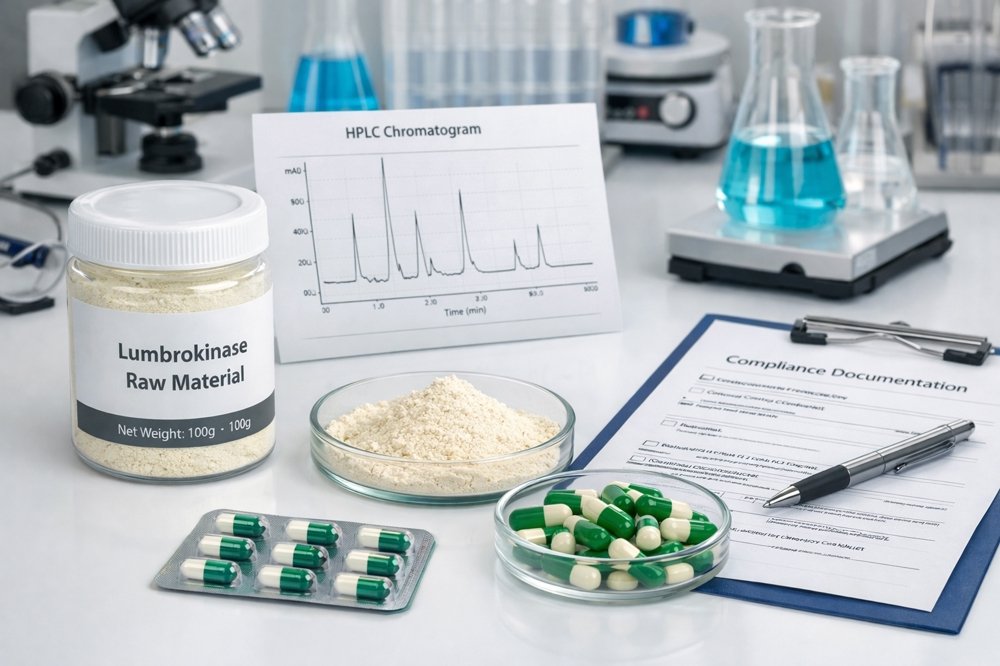
Here’s a clean way to screen suppliers.
Ask for the COA, then keep going
A COA should show activity, microbiology, heavy metals, and basic identity markers. But with lumbrokinase, a COA alone is not the finish line. It is the start.
Ask for:
- the exact activity unit and its definition
- the assay SOP or method summary
- species/source of earthworm raw material
- purification description
- moisture and carrier system
- stability data in bulk and in finished format
- gastric/intestinal release data if enteric positioning is involved
- allergen, solvent, and contaminant controls
- evidence of lot consistency over time
If the supplier gets vague right when you ask about the assay, that tells you something.
Ask how the activity was measured after formulation
This is where strong suppliers separate themselves.
A lumbrokinase ingredient may look fine as a bulk powder but lose value in tableting, aggressive blending, humid storage, or non-protective capsules. Since published data show oral earthworm fibrinolytic enzymes can cross the intestinal epithelium and that gastric conditions can harm certain preparations, delivery design is not just formulation theater. It is tied to whether the ingredient can still do its job. (PMC)
Ask whether the product is really lumbrokinase-rich, or just earthworm protein extract
That sounds blunt, but it matters.
The uploaded manufacturing file in this workspace shows how earthworm protein powder can be produced through selection, washing, hydrolysis, filtration, low-temperature drying, sterilization, and packing, with added carriers such as corn starch and maltodextrin in that process description. That may be perfectly acceptable for an earthworm protein ingredient, but it is not the same thing as a high-potency, tightly characterized lumbrokinase preparation.
Plenty of confusion in the market comes from mixing up these categories:
- earthworm powder
- earthworm protein powder
- earthworm peptide/hydrolysate
- lumbrokinase-enriched enzyme fraction
They are related, yes. They are not interchangeable.
The smartest sourcing question is not “Which unit is best?”
It is:
“Which verified activity unit, measured by which disclosed assay, remains stable in the delivery format we plan to sell?”
That’s the question that protects your margin and your brand.
Because, frankly, a huge unit claim without method detail is just noise. A modest-looking number with a transparent assay, stable delivery, and clean batch history is often the better commercial choice.
The bottom line
When sourcing lumbrokinase, the units that matter are the ones you can actually verify.
FU matters. LKU matters. IU can matter. But none of them should be read in isolation. The real value sits in the method behind the unit, the concentration per gram, the retained activity in the finished dosage form, and the consistency from lot to lot.
That may feel less flashy than chasing the biggest number on a sales sheet. Still, this is ingredient procurement, not speed dating. You want the supplier whose potency data holds up after the first impression.
And that’s usually the supplier that wins in the long run.
FAQs
1) Is FU or LKU better when buying lumbrokinase raw material?
Neither is automatically better. For lumbrokinase raw material sourcing, the better choice is the unit backed by a clear assay method, COA, and stability data. Without the method, FU and LKU are hard to compare fairly. (Researched Nutritionals)
2) Can I compare lumbrokinase by milligrams alone?
No. Milligrams tell you weight, not real enzyme strength. A more concentrated lumbrokinase can deliver the same stated activity with less material, so activity-based comparison is the safer way to evaluate suppliers.
3) Why do lumbrokinase activity units vary between suppliers?
They vary because suppliers may use different assay conditions, substrates, reference materials, and calculation methods. That is why lumbrokinase potency comparison should always include the assay summary, not just the headline unit claim. (Researched Nutritionals)
4) Does enteric delivery matter for lumbrokinase products?
Yes, often it does. Published studies on earthworm-derived fibrinolytic fractions report instability in acidic gastric conditions and better protection with enteric coating, which is why many serious lumbrokinase formulations focus on intestinal release. (PMC)
5) What should a buyer request from a lumbrokinase supplier?
A buyer should ask for the COA, activity unit definition, assay method, activity per gram, stability data, raw material source, purification details, microbiology, heavy metals, and recent batch history. That gives a much better picture of true lumbrokinase ingredient quality than a label claim alone.
One comment on “What Activity Units Matter When Sourcing Lumbrokinase?”