
Outline
- What lumbrokinase is, and why bulk buyers need a different sourcing playbook
- The main places buyers usually source it
- How to tell a serious supplier from a risky one
- The documents, tests, and audit points that matter before you place a PO
- Common buying mistakes, pricing traps, and what a safer buying path looks like
- FAQs for importers, brands, and manufacturers

If you’re buying lumbrokinase for B2B use, the real question isn’t only where to buy it. It’s where to buy it without creating a headache six months later.
That sounds dramatic, sure, but bulk sourcing of enzyme-based ingredients has a way of exposing weak suppliers fast. A nice-looking spec sheet can hide shaky raw material control. A polished sales deck can gloss over inconsistent activity. And with lumbrokinase, that matters more than usual, because you’re not buying a simple commodity powder. You’re buying a fibrinolytic enzyme complex that sits in a more sensitive corner of the supplement and health ingredient market. Lumbrokinase is generally described as a group of fibrinolytic enzymes derived from earthworms, and the literature often links it with anticoagulant and thrombolytic activity.
So, where should a serious buyer look?
Usually, the best bulk sources fall into five lanes: direct specialized manufacturers, audited export suppliers, contract manufacturers with raw material sourcing capability, regional import-distributors, and private-label partners for finished dosage forms. Which one fits depends on whether you need raw enzyme material, encapsulated finished product, or custom formulation support.
Let me explain.
Start with the boring truth: direct factory sourcing is usually the strongest route
For most dietary supplement brands, nutraceutical manufacturers, and ingredient traders, the most dependable place to buy bulk lumbrokinase is directly from a specialized manufacturer or from that factory’s authorized export arm.
Why? Because the closer you are to the production source, the easier it is to verify the things that actually matter:
- raw material origin
- species identification and traceability
- enzyme activity testing
- batch consistency
- drying and stabilization methods
- microbial and heavy metal control
- documentation for customs and regulatory review
That sounds almost too obvious. Still, buyers skip it all the time.
A supplier may say they “produce” lumbrokinase when they’re really a trading office. That is not automatically bad. Some trading companies are excellent. But if you’re buying at scale, you need to know whether the company owns production, manages contract production, or simply sources opportunistically from multiple plants. Those are very different risk profiles.
The earthworm-related literature in your uploaded materials also points to how important the upstream side can be. Earthworm-derived ingredients are tied closely to species, extraction approach, and purification method, and even adjacent earthworm protein processes emphasize sorting, cleaning, separation, low-temperature drying, sterilization, and packaging as key manufacturing steps. That doesn’t prove lumbrokinase quality by itself, of course, but it reinforces the bigger point: upstream control matters a lot.
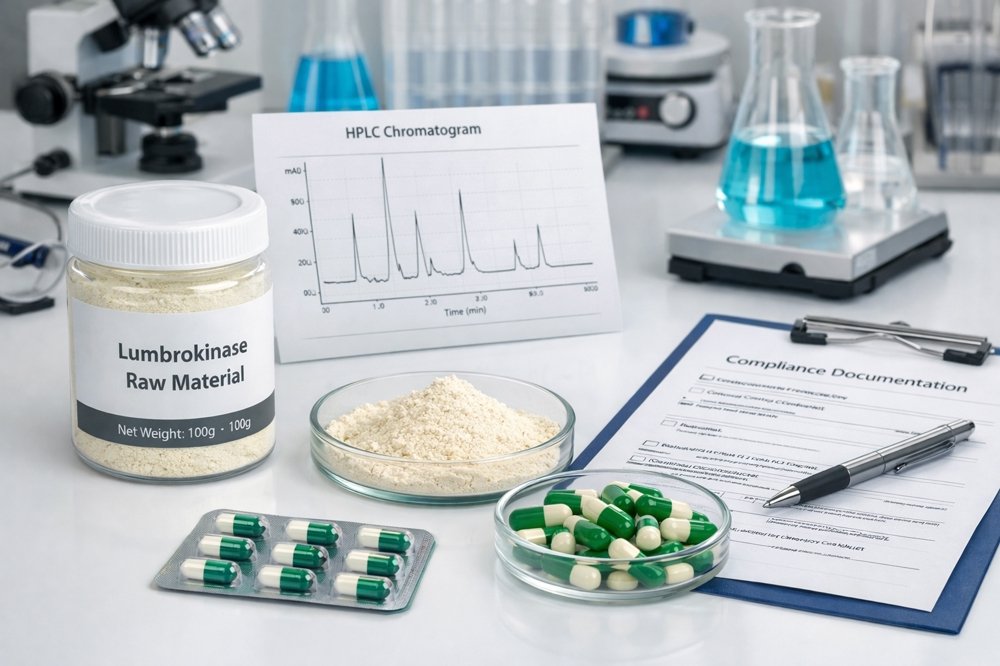
So where do buyers actually buy it?
Here’s the practical breakdown.
1) Direct enzyme manufacturers
This is the cleanest option when you need bulk raw material, semi-finished enzyme powder, or long-term supply.
A real manufacturer should be able to provide:
- a detailed COA for each batch
- manufacturing flow summary
- origin and traceability information
- assay method for activity
- contaminant testing
- storage and shelf-life data
- packaging specs
- sample retention policy
- change control policy
Honestly, this is where the strongest partnerships are usually built. You’re not just buying powder. You’re buying response time, corrective action discipline, and future production predictability.
For larger buyers, direct sourcing also gives room to negotiate around MOQ, lead time, reserved capacity, custom activity ranges, and packaging format. That can make a big difference if you’re supplying multiple markets.
2) Authorized export suppliers or ingredient exporters
This route works well when the manufacturer doesn’t handle international trade smoothly, or when your company wants one export-facing contact who can manage documents, shipping, consolidation, and communication.
A good exporter can be useful. A weak one is a fog machine.
The difference comes down to whether the exporter can answer technical questions without dodging. If they can’t explain assay methods, raw material sourcing, residual solvents, micro limits, or the reason one batch differs from another, they’re probably too far from production.
You want an export partner that behaves like an extension of the factory’s QA and regulatory team, not a relay station for WhatsApp messages.
3) Contract manufacturers with raw material sourcing capability
This is often the smartest path for brands that don’t want to buy loose bulk powder and manage encapsulation themselves.
A good contract manufacturer can source the lumbrokinase, qualify the supplier, test incoming material, produce the finished dosage form, and release the batch under one quality system. That’s attractive because it reduces handoff risk. Fewer handoffs, fewer surprises. Simple.
It also aligns well with U.S. dietary supplement manufacturing expectations. FDA’s dietary supplement CGMP rule in 21 CFR Part 111 requires firms that manufacture, package, label, or hold dietary supplements to establish and follow current good manufacturing practice, with systems in place to ensure identity, purity, strength, and composition.
So if your end market is supplements, a contract manufacturer that already works inside that framework can save a lot of pain.
4) Regional importers and specialized distributors
This is the convenience play.
You pay more, usually, but you may get local warehousing, faster delivery, smaller MOQs, easier payment terms, and regional documents that are already cleaned up for your market.
That can be worth it for pilot runs, small brands, or companies that want to test a formulation before committing to direct-import scale.
Still, convenience has a cost. Sometimes a big one. And distributors are only as good as the factories behind them. So don’t let local stock become a substitute for supplier qualification.
5) Private-label finished product partners
This is not the cheapest route, but it can be the fastest commercial route.
If your actual goal is to launch a lumbrokinase capsule, softgel, or combination formula, buying finished or semi-finished product from a private-label partner may make more sense than sourcing bulk active yourself.
That’s especially true if your team is better at branding, channel sales, and compliance review than at enzyme procurement.
You lose some margin, yes. But you also avoid some ugly operational traps—like activity loss during handling, incorrect excipient pairing, bad fill uniformity, or poor packaging selection.
A little reality check: not every “bulk lumbrokinase” offer is equal
This is where buyers get tripped up.
Two suppliers may both offer “lumbrokinase powder,” but one is selling a carefully standardized enzyme complex with a meaningful activity assay, and the other is basically selling a vague earthworm-derived protease blend with loose language.
That gap is huge.
The literature in your uploaded review notes that lumbrokinase is not a single simple molecule but a set of fibrinolytic enzymes, and it traces commonly cited origins back to earthworm-derived extraction work. That means buyers should not stop at the ingredient name. You need to ask what exactly the supplier is standardizing, and how.
Here’s the thing: the name gets you into the conversation. The assay tells you what you’re really buying.
What to ask before you buy a kilo—let alone a container
A decent supplier should be comfortable with these questions.
Activity specification
Ask for the exact activity unit and test method. Not just “high activity.” Not “premium grade.” Those phrases are fluff.
You need to know:
- activity unit expression
- analytical method used
- whether the method is in-house or based on a recognized standard
- batch-to-batch variation range
- retest policy if your incoming assay differs
If the assay language is slippery, walk carefully.
Source material and traceability
Ask which earthworm species or source material is used, how it is controlled, and how lot traceability works from raw input to final batch.
That may feel like overkill. It isn’t. The underlying earthworm literature shows that species and processing are central to the ingredient family as a whole.
Purity and contaminants
At minimum, ask for:
- heavy metals
- total plate count
- yeast and mold
- pathogens
- solvent status if relevant
- pesticide controls where applicable
- allergen statement
- residual moisture or water activity
- stability data
For buyers serving stricter markets, this is where deals are won or lost.
Manufacturing and quality system
For supplement-market buyers, the supplier or downstream manufacturer should be able to show quality controls aligned with the regulatory framework for dietary supplements. FDA states that firms manufacturing, packaging, labeling, or holding dietary supplements must follow the dietary supplement CGMP rule under 21 CFR Part 111.
That doesn’t mean every overseas supplier will be operating exactly like a U.S. facility. But it does mean your qualified supply chain needs to support that end requirement.

Stability in the intended dosage form
This one gets missed a lot.
Bulk powder that assays fine at release may behave differently in capsules, tablets, stick packs, or blends with botanicals and minerals. Enzymes can be fussy. Temperature, moisture, and excipients matter.
So ask for stability data not only on the bulk ingredient, but also on similar finished formats if the supplier has them.
Packaging and cold-chain expectations
Does the ingredient need desiccant-heavy packaging? Double PE liners? Foil bags? Refrigerated storage? Protection from heat during transit?
A powder can look stable on paper and still show activity drift after a rough shipping route. Nobody enjoys finding that out after import clearance.
The best buying channels by buyer type
Let’s make this practical.
For supplement brands
Your safest route is often a qualified contract manufacturer or a factory-backed export supplier. You want documentation, manageable MOQs, and someone who understands label claims and release testing.
For nutraceutical ingredient traders
Go closer to the factory. Your edge is margin plus supply control. But only do that if your team can audit specs, compare assay methods, and handle import documentation cleanly.
For pharmaceutical-adjacent buyers
You’ll need tighter technical review, tighter documentation, and more disciplined supplier qualification. Don’t buy on brochure language. Buy on data, repeatability, and audit readiness.
For wholesalers and dealers
A regional distributor may be fine for faster turns, but only if you can still trace back to the original producer and verify that the product hasn’t been repacked into mystery powder along the way.
Red flags that should make you pause
Some warning signs are subtle. Some are practically waving at you.
A supplier is risky when they:
- won’t disclose whether they manufacture or trade
- avoid assay-method questions
- cannot provide recent COAs
- offer wildly inconsistent pricing with no technical explanation
- promise very broad health claims instead of talking quality
- refuse third-party testing or sample comparison
- have no clear answer on storage and shelf life
- send polished marketing files but weak QA files
That last one happens more than people admit.
A smarter buying path, step by step
Honestly, the safest B2B buying process for lumbrokinase is a staged one.
First, qualify three to five suppliers on paper.
Then compare their COAs, assay methods, and contaminant panels.
Then test samples side by side.
Then audit—remote or on-site, depending on volume.
Then place a pilot order before moving into annual contracts.
It’s not glamorous. It is effective.
And there’s one more wrinkle worth keeping in mind: if you are buying bulk finished dietary supplements rather than raw dietary ingredients, FDA notes that bulk finished dietary supplements intended to be packaged or repackaged are exempt from the preventive controls rule if they are in compliance with 21 CFR Part 111 and related requirements. (U.S. Food and Drug Administration) That’s a technical point, sure, but for importers and packagers it matters.
Don’t buy a story. Buy a system.
That may be the cleanest summary of the whole topic.
Lumbrokinase sits in a category where technical credibility matters more than sales polish. The science around earthworm-derived bioactives is interesting, and there is real published attention on lumbrokinase’s fibrinolytic profile and broader pharmacological potential. But B2B procurement lives and dies on something less exciting: supplier systems.
Can they make the same thing, the same way, over and over?
Can they prove what they made?
Can they support your market’s compliance needs?
Can they still answer your questions after the invoice is paid?
That’s the supplier worth buying from.
FAQs
1) What is the best place to buy lumbrokinase in bulk for a supplement brand?
For most supplement brands, the best place to buy lumbrokinase in bulk is from a specialized manufacturer, that factory’s export arm, or a qualified contract manufacturer that can source and test the ingredient under a dietary supplement quality system. The right choice depends on whether you need raw powder or finished capsules.
2) How do I verify a bulk lumbrokinase supplier before ordering?
Ask for batch COAs, activity assay details, contaminant testing, traceability records, stability data, and proof of manufacturing quality controls. A trustworthy bulk lumbrokinase supplier should answer technical questions clearly and consistently.
3) Is it better to buy raw lumbrokinase powder or finished private-label capsules?
Raw powder is better if you already have formulation, encapsulation, and QA capability. Finished private-label capsules are often better for brands that want faster launch speed, simpler logistics, and lower operational risk.
4) What documents should a B2B lumbrokinase supplier provide?
A serious supplier should provide a specification sheet, COA, micro and heavy metal panel, storage conditions, shelf-life statement, packaging details, and manufacturing or quality-system information relevant to your target market.
5) What is the biggest mistake when sourcing lumbrokinase in bulk?
The biggest mistake is buying based on price or marketing language alone. For bulk lumbrokinase procurement, the critical factor is not the sales pitch—it’s whether the supplier can prove activity, consistency, traceability, and compliance support.