
When B2B buyers compare lumbrokinase suppliers, activity numbers are often the first detail they notice. One supplier may report IU/mg, another may use FU/g, and others may list LKU or U. These numbers can look easy to compare, but they are not always measured by the same assay method, substrate, reference standard, incubation condition, or reporting basis.
For supplement brands, ingredient distributors, OEM buyers, and formulation developers, supplier comparison should go beyond the highest activity number or lowest price. A practical evaluation should include the lumbrokinase COA, specification sheet, assay method, sample test results, batch consistency, MOQ, lead time, shipping support, and supplier communication quality.
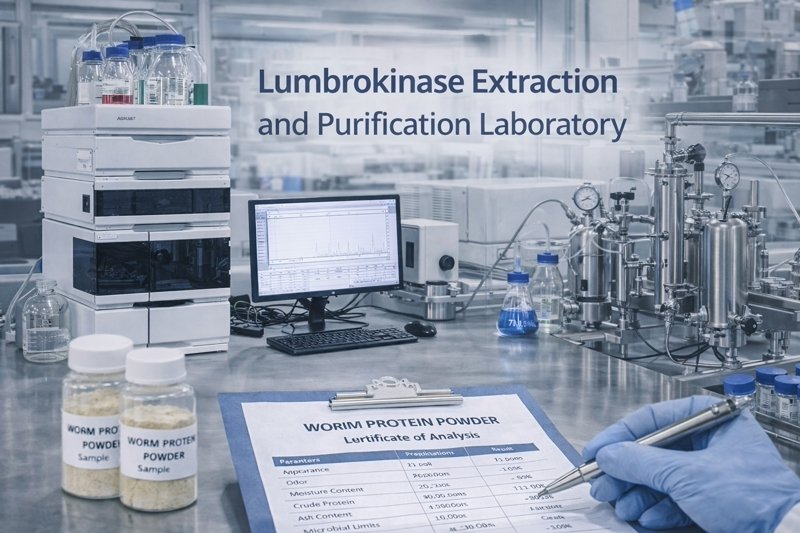
Quick Answer: How Should Buyers Compare Lumbrokinase Suppliers?
To compare lumbrokinase suppliers, buyers should first confirm the activity unit, assay method, and reporting basis before comparing numbers. IU/mg, FU/g, LKU, and U should not be treated as automatically interchangeable.
A reliable comparison should review the COA, specification sheet, fibrin plate assay details, sample performance, bulk batch consistency, MOQ, lead time, and shipping support. The best purchasing decision is not always the supplier with the highest number, but the supplier with clear documentation, consistent batches, and reliable B2B support.
Why This Matters for B2B Buyers
Lumbrokinase is an earthworm-derived fibrinolytic enzyme ingredient used in dietary supplement, nutraceutical, enzyme formulation, and research-related applications. Because it is an enzyme ingredient, activity testing is a key part of quality evaluation.
However, activity values are method-dependent. A buyer may receive several quotations that appear very different:
| Supplier | Reported Activity | Unit Used |
|---|---|---|
| Supplier A | 20,000 | IU/mg |
| Supplier B | 10,000 | FU/g |
| Supplier C | 1,000,000 | U/g |
| Supplier D | 40,000 | LKU/g |
At first glance, one number may look higher or lower. In reality, these values may come from different assay systems and may not support a direct comparison.
For B2B purchasing, this matters because the wrong comparison can lead to poor supplier selection, failed sample approval, unexpected third-party test results, or disagreement before bulk order confirmation.
Buyers should treat activity units as one important evaluation factor, not the only purchasing factor. A practical supplier decision should answer these questions:
Does the supplier explain the activity unit clearly?
Is the assay method stated on the COA?
Does the specification sheet match the COA?
Can the supplier support sample evaluation?
Will the bulk batch follow the same specification as the sample?
Can the supplier provide stable lead time and repeat-order support?
For more background on activity terminology, buyers may also review Lumbrokinase Activity Units and Fibrin Plate Assay for Lumbrokinase Activity.
Technical Explanation: Why IU/mg, FU/g, LKU, and U Are Not Always Directly Comparable
Lumbrokinase activity may be reported in several unit systems, including IU/mg, FU/g, LKU, and U. These units are connected to fibrinolytic or fibrin-related activity, but the exact meaning depends on the test method.
Before comparing suppliers, buyers should ask how the activity was measured.
Important technical factors include:
| Factor | Why It Matters |
|---|---|
| Activity unit | IU/mg, FU/g, LKU, and U may follow different definitions |
| Assay method | Fibrin plate assay and other methods may produce different values |
| Substrate | Fibrinogen, fibrin, or other substrates may affect results |
| Reference standard | Different standards can change calculated activity |
| Incubation time | Longer or shorter incubation can change the lysis area or result |
| Temperature | Enzyme activity is sensitive to test conditions |
| Sample preparation | Dilution, pH, buffer, and solubility may affect the test result |
| Calculation method | Different formulas may generate different activity expressions |
| Reporting basis | Activity may be reported per mg, per g, per protein content, or per powder weight |
This means buyers should avoid asking, “Which number is higher?” before asking, “How was the number measured?”
For example, a product reported as IU/mg under one fibrin plate assay method should not be directly converted into FU/g unless both methods, standards, and calculation rules are fully understood. Even then, conversion may still be unreliable if the two laboratories use different conditions.
This is why a lumbrokinase supplier should be evaluated by both technical documentation and practical order support.
Compare Lumbrokinase Suppliers by Documentation, Not Only Price
Price matters, especially for bulk orders. But for lumbrokinase, a low price without clear assay information may create higher risk.
A strong supplier comparison should include these documents:
COA for the current or available batch
Specification sheet showing standard product requirements
Assay method description, especially for activity testing
Sample information for pre-order evaluation
Batch number, manufacturing date, and expiry date
Testing items such as moisture, ash, heavy metals, and microbiology
Storage and handling instructions
If a supplier only provides a high activity number and price but cannot explain the assay method, the buyer may face difficulty when testing the sample through an internal or third-party lab.
For document comparison, see Lumbrokinase COA vs Specification Sheet.
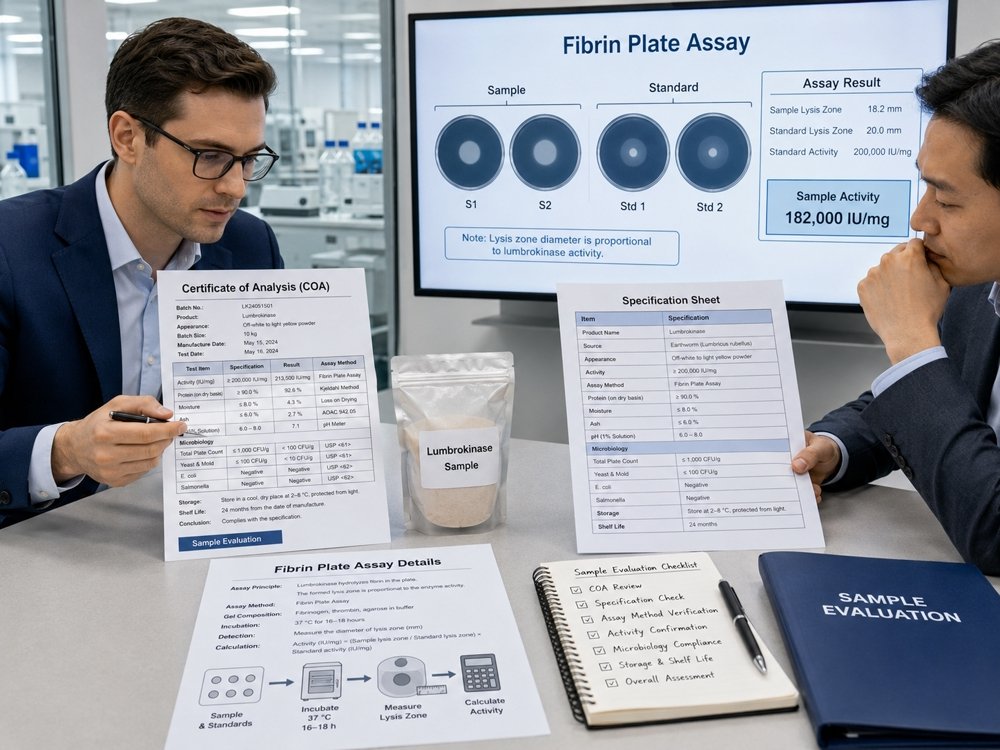
Practical Lumbrokinase Supplier Comparison Table
| Comparison Item | What Buyers Should Check | Why It Matters |
|---|---|---|
| Activity unit used | IU/mg, FU/g, LKU, U, or another system | Prevents false comparison between different unit systems |
| Assay method | Fibrin plate assay or another stated method | Activity results are method-dependent |
| Unit definition | How the supplier defines the reported activity | Helps buyers understand the reporting basis |
| COA completeness | Activity, assay method, moisture, heavy metals, microbiology, batch details | Shows whether the batch is properly documented |
| Specification sheet clarity | Product name, source, appearance, activity range, storage, shelf life | Helps buyers compare supplier standards |
| Sample and bulk match | Whether sample specification matches future bulk order specification | Reduces risk of approval based on a non-representative sample |
| Batch number and test date | Batch code, manufacturing date, expiry date, testing date | Supports traceability and purchasing records |
| Moisture and ash | Moisture limit and residue/ash value | Relevant to storage, stability, and powder quality |
| Heavy metals | Lead, arsenic, cadmium, mercury | Important for ingredient qualification and market compliance |
| Microbiology | Total plate count, coliforms, Salmonella, Staphylococcus aureus, yeast and mold | Important for supplement and nutraceutical raw materials |
| Sample availability | Sample quantity, sample COA, sample shipping method | Supports pre-order evaluation |
| MOQ and lead time | Minimum order quantity and delivery time after payment | Helps buyers plan trial orders and bulk purchasing |
| Shipping methods | Express, air freight, DDP where available | Affects delivery speed, customs process, and landed cost |
| Supplier response quality | Clear answers about COA, assay method, sample, MOQ, and shipping | Shows technical and commercial reliability |
| Repeat order support | Batch consistency, production capacity, and supply continuity | Important for brands and distributors with ongoing demand |
How to Compare Two or More Lumbrokinase Suppliers Before Sample Approval
Before approving a lumbrokinase sample, buyers should compare suppliers using the same evaluation structure.
Step 1: Confirm the Activity Unit
Ask each supplier:
What unit do you use?
Is the result reported as IU/mg, FU/g, LKU, U, or another unit?
Is the value based on powder weight, protein content, or another basis?
Can you provide the assay method?
This step prevents confusion before samples are tested.
Step 2: Review the COA
A lumbrokinase COA should include more than activity. Buyers should check:
Product name
Batch number
Manufacturing date
Expiry date
Activity result
Assay method
Moisture
Ash or residue on ignition
Heavy metals
Microbiology
Conclusion
Storage condition
A COA without assay method information is incomplete for meaningful supplier comparison.
Step 3: Compare the Specification Sheet
The specification sheet shows the supplier’s standard quality range. The COA shows the actual test result for a specific batch.
For example, the specification may state:
Activity: ≥20,000 IU/mg
Moisture: ≤10.0%
Lead: ≤0.5 mg/kg
Salmonella: Not detected
The COA should show whether the tested batch meets these requirements.
For more detail, see Lumbrokinase COA vs Specification Sheet.
Step 4: Ask Whether the Sample Represents the Bulk Batch
Sample approval only has purchasing value if it reflects future bulk supply.
Buyers should ask:
Is this sample from the same batch as the available bulk material?
If not, will the bulk batch follow the same specification?
Can the bulk batch COA be provided before shipment?
Can the supplier reserve the same batch after sample approval?
If the buyer approves one sample but receives a different bulk batch without confirmation, quality disputes may occur.
Step 5: Discuss the Buyer’s Own Testing Method
Some buyers test lumbrokinase through their own lab or a third-party lab. This is reasonable, but the testing method should be discussed before judging the result.
If the buyer’s lab uses a method different from the supplier’s method, the result may look different. That does not always mean the product is unsuitable. It may mean the test system, substrate, incubation condition, or calculation method is different.
Before sample testing, buyers should share:
Target activity unit
Testing method
Reference standard
Sample preparation method
Acceptance criteria
Expected reporting format
This makes sample evaluation more practical and reduces misunderstanding. Buyers can also review Lumbrokinase Sample Evaluation before final approval.
Buyer Checklist: Compare Lumbrokinase Suppliers
| Checklist Question | Supplier A | Supplier B | Supplier C |
|---|---|---|---|
| Does the supplier clearly state the activity unit? | |||
| Is the assay method listed on the COA? | |||
| Does the supplier explain whether IU/mg, FU/g, LKU, or U is used? | |||
| Is the specification sheet available? | |||
| Does the COA include batch number and test date? | |||
| Are moisture and ash listed? | |||
| Are heavy metals tested? | |||
| Are microbiology results included? | |||
| Is the sample from the same or comparable batch as bulk supply? | |||
| Can the supplier explain assay differences if buyer testing differs? | |||
| Is a sample available before bulk order? | |||
| Is MOQ suitable for trial purchasing? | |||
| Is lead time clear? | |||
| Are shipping methods clearly explained? | |||
| Can the supplier support repeat orders? | |||
| Does the supplier respond clearly and professionally? |
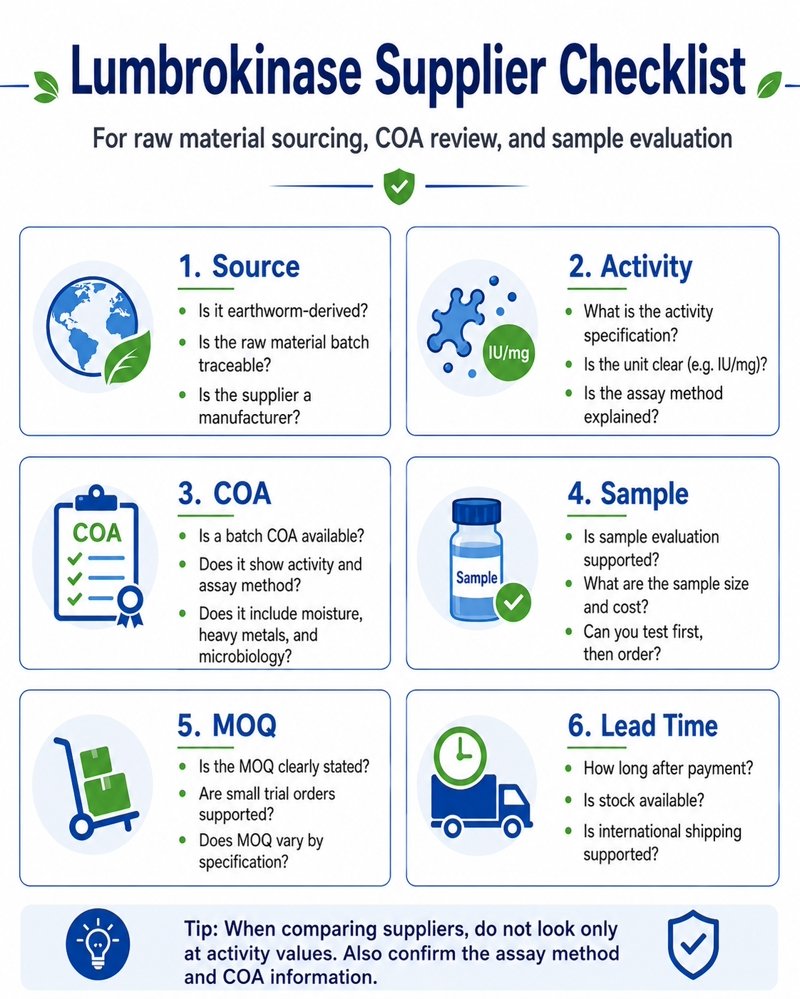
Common Buyer Mistakes or Misunderstandings
Mistake 1: Comparing IU/mg and FU/g as If They Are Automatically Convertible
IU/mg and FU/g should not be treated as automatically interchangeable. They may use different assay methods, reference standards, substrates, and reporting bases.
A direct conversion may be misleading unless both methods are fully defined and technically comparable.
Mistake 2: Choosing the Highest Number Without Assay Context
A higher activity number does not always mean a better lumbrokinase ingredient. The number must be understood together with assay method, unit definition, sample preparation, and COA documentation.
A supplier with a clear method and consistent batch data may be more practical than a supplier offering a high number without explanation.
Mistake 3: Ignoring COA and Specification Differences
The COA and specification sheet serve different purposes. The specification sheet shows the supplier’s standard quality requirements, while the COA shows actual test results for a batch.
Buyers should compare both documents before sample approval or bulk purchasing.
Mistake 4: Testing the Sample by a Different Method Without Discussing Interpretation
Buyer testing is useful, but different methods may produce different-looking results. If the buyer’s lab uses a different method from the supplier’s fibrin plate assay, both parties should discuss interpretation before making a final decision.
This is especially important when the buyer has a target unit such as FU/g while the supplier reports IU/mg.
Mistake 5: Approving a Sample Without Confirming Bulk Order Consistency
Sample approval should be connected to bulk order planning. Buyers should confirm whether the bulk order will use the same specification, similar assay method, and comparable batch quality.
Mistake 6: Focusing Only on Price
Price is important, but lumbrokinase is not a simple commodity powder. Buyers should also consider technical support, COA completeness, assay method clarity, sample availability, MOQ, lead time, shipping reliability, and repeat-order capacity.
Allworms Supply Notes
Allworms Bio-Tech Co., Ltd. is a manufacturer of earthworm-derived ingredients, including lumbrokinase, earthworm protein powder, and earthworm peptide powder. For lumbrokinase, Allworms focuses on earthworm-derived enzyme ingredient supply for dietary supplement, nutraceutical, enzyme formulation, and research-related applications.
Buyers can request COA and specification sheet for available batches. Activity is evaluated according to the stated assay basis, and buyers are encouraged to review the assay method before comparing activity values from different suppliers.
A 100 g sample may be available for qualified B2B buyers for sample evaluation before bulk order approval. Standard MOQ is usually around 1.5 kg, depending on product specification. Standard lead time is usually 7–15 days after payment. DDP door-to-door shipping may be available for selected destinations.
For buyers comparing suppliers, Allworms can support discussion around:
Lumbrokinase activity unit
Fibrin plate assay information
COA and specification sheet review
Sample evaluation
MOQ and trial order planning
Bulk order lead time
International shipping arrangements
For product details, visit the Lumbrokinase product page. Buyers who are new to the ingredient can also read What Is Lumbrokinase? Source, Activity and B2B Supply Guide and the FAQ page.
Supplier Selection Framework for Bulk Orders
Before placing a lumbrokinase bulk order, buyers should evaluate three levels of supplier reliability.
1. Technical Reliability
Can the supplier explain the activity unit, assay method, and COA clearly?
Can the supplier provide a specification sheet?
Can the supplier explain why different units may not be directly comparable?
Can the supplier support sample testing discussion?
2. Quality Reliability
Does the supplier provide batch-level documentation?
Are moisture, ash, heavy metals, and microbiology included?
Does the supplier control raw material sourcing and production?
Can the supplier support batch consistency between sample and bulk order?
3. Commercial Reliability
Is MOQ clear?
Is lead time realistic?
Are shipping methods clear?
Can the supplier support repeat orders?
Does the supplier respond quickly and clearly?
A strong supplier should perform well across all three levels. A high activity number alone is not enough.
FAQ
1. What is the best way to compare lumbrokinase suppliers?
The best way to compare lumbrokinase suppliers is to review activity unit, assay method, COA, specification sheet, sample test results, MOQ, lead time, shipping support, and repeat-order reliability together. Do not compare suppliers only by the highest activity number or lowest price.
2. Can IU/mg, FU/g, LKU, and U be directly converted?
Not automatically. IU/mg, FU/g, LKU, and U may be based on different assay methods, substrates, standards, incubation conditions, sample preparation, calculation methods, and reporting bases. Direct conversion may be misleading unless the methods are clearly defined and comparable.
3. What should be included in a lumbrokinase COA?
A lumbrokinase COA should include product name, batch number, manufacturing date, expiry date, activity result, assay method, moisture, ash or residue on ignition, heavy metals, microbiology, conclusion, and storage condition.
4. Should buyers test a lumbrokinase sample before bulk order?
Yes. Sample evaluation helps buyers review activity, appearance, solubility, documentation, and compatibility with their own quality requirements. Before testing, buyers should confirm whether their lab method is the same as or different from the supplier’s assay method.
5. What should buyers ask before placing a lumbrokinase bulk order?
Buyers should ask for the COA, specification sheet, assay method, available batch details, sample-bulk consistency, MOQ, lead time, packaging, storage condition, shipping method, and repeat-order support. Final formulation suitability, dosage, labeling, claims, and regulatory compliance should be evaluated by the buyer according to the intended market and finished product use.
Short B2B CTA
Need to compare lumbrokinase suppliers with clear COA, specification, assay method, sample, MOQ, lead time, and shipping details?
Contact Allworms Bio-Tech Co., Ltd. to request available lumbrokinase batch information and discuss sample evaluation before bulk purchasing.