
For B2B ingredient buyers, understanding lumbrokinase COA vs specification sheet is essential before sample evaluation or bulk purchasing. These two documents are related, but they are not the same. A lumbrokinase specification sheet defines the target product standard, while a lumbrokinase COA reports the actual test results of a specific batch.
This difference matters when buyers compare suppliers, review sample quality, check assay method details, or confirm whether a future bulk order can match the evaluated sample. For lumbrokinase, which is an earthworm-derived fibrinolytic enzyme ingredient used in dietary supplement, nutraceutical, enzyme formulation, and research-related applications, documentation review is a key part of supplier qualification.
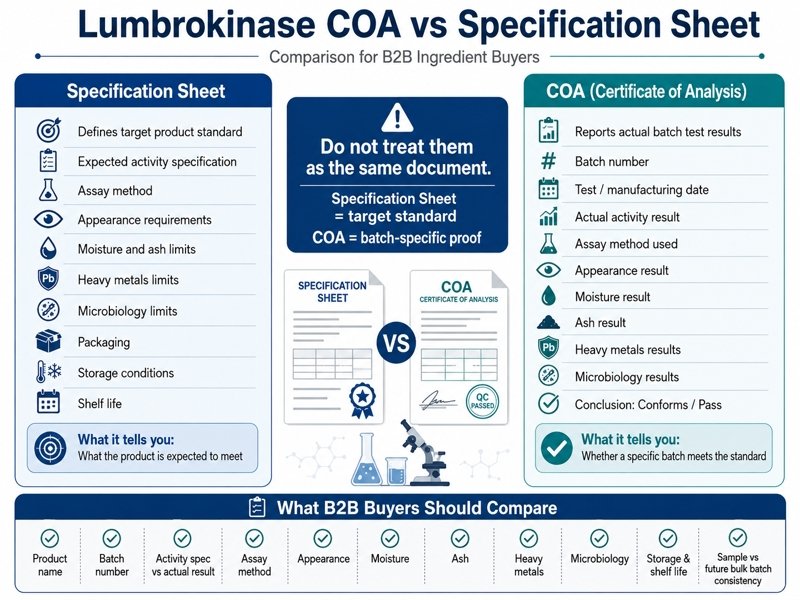
Quick Answer: Lumbrokinase COA vs Specification Sheet
A lumbrokinase specification sheet shows what the product is expected to meet, including activity range, appearance, moisture, ash, heavy metals, microbiology, packaging, storage, and shelf life.
A lumbrokinase COA shows whether one specific batch actually meets those requirements, including batch number, test date, tested results, and conclusion. Buyers should compare both documents before approving a sample or placing a lumbrokinase bulk order.
Why This Matters for B2B Buyers
A specification sheet may look complete, but it does not prove that the sample or bulk batch has already been tested. It is a product standard document.
A COA may show test results, but it only applies to the batch listed on that document. It should not automatically be treated as proof for all future batches unless the supplier can explain batch consistency, production control, and testing practices.
For B2B buyers, comparing both documents helps answer practical sourcing questions:
- Does the actual batch meet the target lumbrokinase specification?
- Is the activity result tested by the stated assay method?
- Does the sample batch match the quality level expected for a future bulk order?
- Are heavy metals and microbiology results available?
- Are storage, shelf life, and packaging conditions suitable for international shipping?
- Can the lumbrokinase supplier provide consistent documentation for future batches?
This is especially important before moving from sample evaluation to MOQ, pricing, lead time, and shipment confirmation.
Technical Explanation: What Is a Lumbrokinase Specification Sheet?
A lumbrokinase specification sheet defines the expected quality standard of the product. It is usually used before sample evaluation, quotation, formulation review, and supplier qualification.
A typical lumbrokinase specification sheet may include:
- Product name
- Material source
- Appearance
- Activity specification
- Assay method
- Moisture limit
- Ash limit
- Heavy metal limits
- Microbiology limits
- Packaging format
- Storage condition
- Shelf life
- General handling notes
For example, the specification sheet may state that the product is light yellow to brown powder, tested by fibrin plate assay, stored in a cool and dry place, and supplied with a defined activity range.
However, this document does not prove that every batch has the exact same result. It defines the target range that each batch should meet.
Buyers reviewing the Lumbrokinase product page should treat the specification sheet as a product standard reference, not as a batch test report.
Technical Explanation: What Is a Lumbrokinase COA?
A lumbrokinase COA, or Certificate of Analysis, reports the actual test results of a specific batch. It should normally include batch-related details, not only general product information.
A typical lumbrokinase COA may include:
- Product name
- Batch number
- Manufacturing date
- Expiry date
- Test date, if available
- Appearance result
- Activity result, if applicable
- Assay method
- Moisture result
- Ash result
- Heavy metals results
- Microbiology results
- Storage statement
- Batch conclusion
The key point is that the COA is batch-specific. If a buyer evaluates a sample from Batch A, the COA should also refer to Batch A. If the bulk order will be supplied from Batch B, the buyer should request the COA for Batch B before shipment or before final approval.
Lumbrokinase COA vs Specification Sheet: Key Differences
| Item | Lumbrokinase Specification Sheet | Lumbrokinase COA |
|---|---|---|
| Main purpose | Defines the target product standard | Reports actual test results for one batch |
| Batch number | Usually not batch-specific | Should include a batch number |
| Activity | Shows expected activity specification or range | Shows actual tested activity result |
| Assay method | States the intended testing method | Confirms the method used for that batch |
| Appearance | Defines expected color and form | Confirms actual appearance result |
| Moisture | Shows maximum acceptable limit | Shows tested moisture value |
| Ash | Shows maximum acceptable limit | Shows tested ash value |
| Heavy metals | Shows acceptable limits | Shows actual test results or conformity |
| Microbiology | Shows acceptable limits | Shows actual test results or conformity |
| Storage | Gives general storage requirement | May repeat storage condition for the tested batch |
| Shelf life | Defines general shelf life | Shows manufacturing and expiry date |
| Packaging | Shows standard packaging format | May confirm batch packaging if included |
| Use in purchasing | Used for supplier and product qualification | Used for batch approval and shipment review |
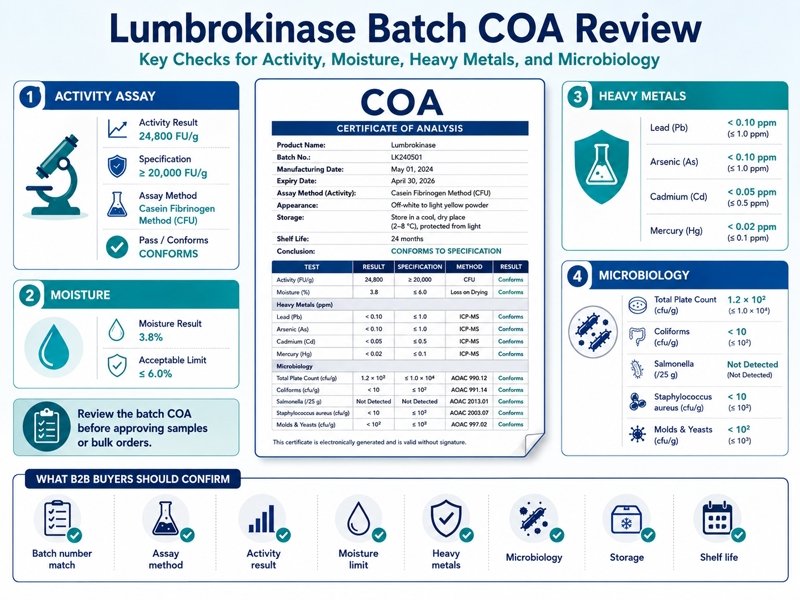
What Buyers Should Compare Before Sample Approval
Before approving a lumbrokinase sample, buyers should compare the sample label, COA, and specification sheet together.
1. Product Name and Source
Confirm that the product name is clear and consistent across documents. For lumbrokinase, the source should be earthworm-derived, not a general blended enzyme description.
A buyer should check whether the supplier clearly distinguishes lumbrokinase from other fibrinolytic enzyme ingredients. This is important for formulation, labeling, and internal quality review.
2. Batch Number
The COA should include a batch number. The sample bag, sample invoice, or supplier communication should match the same batch whenever possible.
If the buyer evaluates one batch but later receives another batch for bulk purchase, the COA should be updated accordingly.
3. Activity Specification and Actual Activity Result
The specification sheet may show the target activity level. The COA should show the actual activity result for the tested batch.
Activity units may appear as IU/mg, FU/g, LKU, U, or another enzyme activity format depending on the method and market practice. Buyers should not compare numbers without checking the assay basis. For more detail, see the related article Lumbrokinase Activity Units.
This article will not repeat the full unit explanation, but the practical point is simple: activity result and assay method should be reviewed together.
4. Assay Method
For lumbrokinase, the assay method is one of the most important items. A buyer should check whether the specification sheet and COA refer to the same testing method.
If one supplier uses a fibrin plate assay and another supplier uses a different system, the numerical activity values may not be directly comparable. Buyers should ask the supplier to explain the method before making quality judgments based only on activity numbers.
5. Appearance
The specification sheet may describe the expected appearance, such as light yellow to brown powder. The COA should confirm whether the tested batch conforms.
Appearance alone is not enough to judge quality, but obvious differences between sample and specification should be discussed with the supplier.
6. Moisture and Ash
Moisture and ash are practical quality indicators for powder ingredients.
Higher moisture may affect storage stability, flowability, and handling. Ash reflects inorganic residue and should be controlled within the stated range. Buyers should compare the specification limit with the actual COA result, especially before large-volume purchasing.
7. Heavy Metals
A lumbrokinase COA may include heavy metals such as lead, arsenic, cadmium, and mercury. The specification sheet should define acceptable limits, while the COA should show whether the tested batch meets those limits.
Buyers should also confirm whether the test items meet their market requirements, because finished product compliance depends on the buyer’s intended market and formulation.
8. Microbiology
Microbiology items may include aerobic plate count, coliforms, Salmonella, Staphylococcus aureus, molds, and yeasts.
For supplement and nutraceutical ingredient buyers, microbiology review is part of basic raw material qualification. If the specification sheet lists microbiological limits, the COA should report actual results or conformity for the tested batch.
9. Storage Conditions and Shelf Life
Lumbrokinase is an enzyme-sensitive ingredient. Buyers should review storage requirements carefully, especially for international shipping, warehouse handling, and production planning.
The specification sheet may state general storage conditions, while the COA may include manufacturing date and expiry date. Buyers should confirm remaining shelf life before placing a bulk order.
10. Packaging
Packaging information helps buyers evaluate handling, sampling, and order planning. For example, standard packaging may affect whether an order quantity matches supplier packing units.
Buyers should confirm whether the sample packaging and bulk packaging are the same or different, and whether inner bags, drums, labels, and sealing methods meet their handling needs.
Buyer Checklist: COA and Specification Review Before Bulk Order
| What to Check | Specification Sheet | COA | Buyer Question |
|---|---|---|---|
| Product name | Defines product identity | Confirms tested batch name | Is it clearly lumbrokinase? |
| Source | Shows earthworm-derived source | May confirm source | Is it a pure earthworm-derived enzyme ingredient? |
| Batch number | Usually not included | Should be included | Does the COA match the sample batch? |
| Activity | Target activity level | Actual tested result | Does the batch meet the target level? |
| Assay method | Expected method | Batch testing method | Are both documents using the same method? |
| Appearance | Expected color and form | Actual result | Does the sample match the description? |
| Moisture | Maximum limit | Tested value | Is the result within range? |
| Ash | Maximum limit | Tested value | Is the result acceptable? |
| Heavy metals | Limits | Results or conformity | Are the tested items enough for your market? |
| Microbiology | Limits | Results or conformity | Are safety-related items documented? |
| Storage | General condition | Batch storage statement | Can your warehouse meet the requirement? |
| Shelf life | General shelf life | Manufacturing and expiry date | Is remaining shelf life enough? |
| Packaging | Standard pack size | May confirm batch pack | Does packaging match your order plan? |
| Future supply | General product standard | Current batch only | Can the supplier keep quality consistent? |
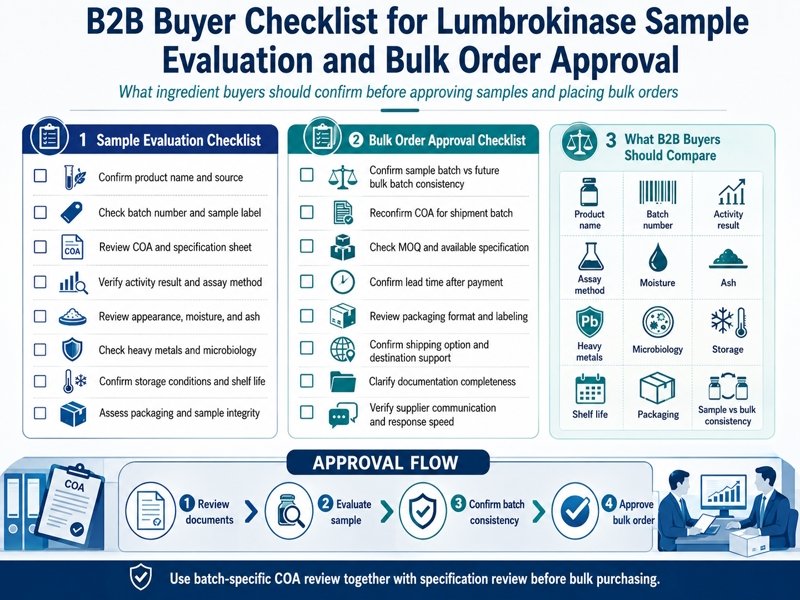
Common Mistakes or Misunderstandings
Mistake 1: Treating the Specification Sheet as a COA
A specification sheet is not a batch test report. It tells buyers what the product is expected to meet, but it does not show the actual result of the sample or bulk batch.
Mistake 2: Treating One COA as Proof for All Future Orders
A COA applies to a specific batch. If the buyer places repeat orders, each new batch should have its own batch-specific documentation.
Mistake 3: Comparing Activity Numbers Without the Assay Method
For lumbrokinase, activity values are method-dependent. Buyers should review the assay method together with the activity result.
Mistake 4: Ignoring Moisture, Ash, Heavy Metals, and Microbiology
Activity is important, but it is not the only quality indicator. Powder condition, storage stability, contaminants, and microbiology should also be reviewed.
Mistake 5: Approving a Sample Without Confirming Bulk Batch Expectations
A sample may be acceptable, but buyers should still confirm whether the same quality level can be supplied for MOQ or bulk orders. This is especially important when planning repeat purchasing or finished product production.
How This Comparison Supports Supplier Selection
A professional lumbrokinase supplier should be able to explain the difference between a specification sheet and a COA. The supplier should also be able to clarify batch number, assay method, activity result, storage, packaging, MOQ, lead time, and shipping options.
Before selecting a supplier, buyers can ask:
- Can you provide both a specification sheet and COA?
- Does the COA match the sample batch?
- What assay method is used for activity testing?
- Can future bulk batches meet the same specification level?
- What is the standard MOQ?
- What is the lead time after payment?
- Can you support international shipping?
- Is DDP door-to-door shipping available for my destination?
For a broader sourcing overview, buyers may also review What Is Lumbrokinase? Source, Activity and B2B Supply Guide, Lumbrokinase Sample Evaluation, and The Origin of Lumbrokinase.
Allworms Supply Notes
Allworms Bio-Tech Co., Ltd supplies earthworm-derived lumbrokinase as a B2B ingredient for dietary supplement, nutraceutical, enzyme formulation, and research-related applications.
COA and specification sheet can be provided for available batches. Buyers can request sample evaluation before placing a bulk order. A 100 g sample may be available for qualified B2B buyers, with international freight usually paid by the buyer.
The standard MOQ is usually around 1.5 kg, depending on product specification and current batch availability. Standard lead time is usually 7–15 days after payment. DDP door-to-door shipping may be available for selected destinations.
Buyers can also review the full FAQ page for sample policy, MOQ, lead time, payment, documentation, and shipping details.
This product is supplied as a B2B ingredient. Final formulation suitability, dosage, labeling, health claims, and regulatory compliance should be evaluated by the buyer according to the intended market and finished product use.
FAQ
1. Is a lumbrokinase COA the same as a specification sheet?
No. A lumbrokinase specification sheet defines the expected product standard, while a lumbrokinase COA reports the actual test results of a specific batch. Buyers should review both documents before sample approval or bulk purchasing.
2. Which document should I check first?
Start with the specification sheet to understand the target product standard. Then review the COA to confirm whether the specific batch meets that standard.
3. Should the sample batch and COA batch number match?
Yes, whenever possible. If the sample is from one batch and the COA is from another batch, buyers should ask the supplier to clarify the difference before making a quality decision.
4. Why is the assay method important in lumbrokinase documentation?
Lumbrokinase activity results depend on the assay method. Buyers should review the activity result together with the assay method, rather than comparing activity numbers alone.
5. What documents should I request before a lumbrokinase bulk order?
Buyers should request the lumbrokinase specification sheet, batch COA, sample details, packaging information, storage requirements, shelf life, MOQ, lead time, and shipping options. For quality evaluation, the COA should match the batch intended for shipment.
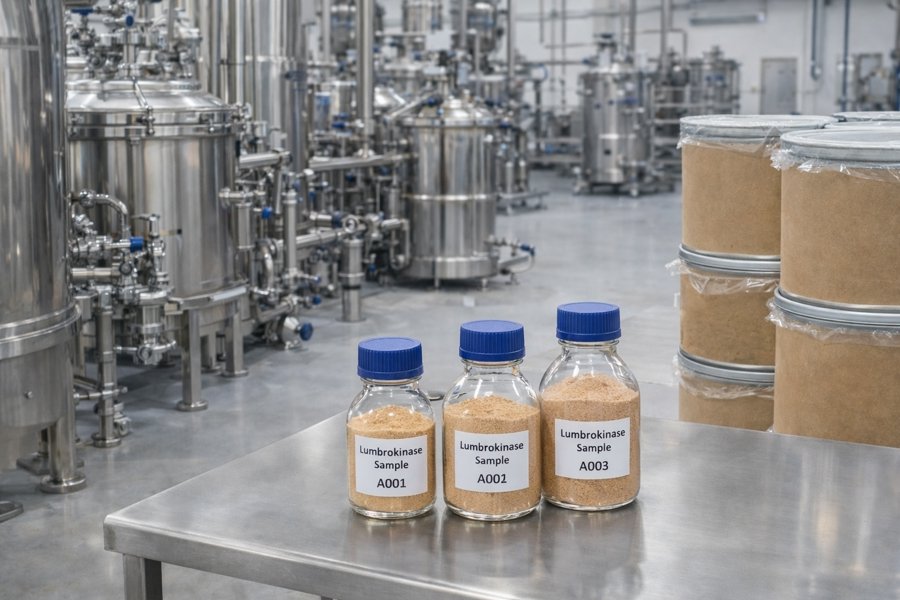
Need to compare a lumbrokinase COA vs specification sheet before sample approval?
Contact Allworms to request available batch documents, sample details, MOQ, lead time, pricing, and shipping options for your lumbrokinase sourcing project.