
Lumbrokinase origin is one of the first questions B2B buyers should understand before evaluating specifications, COA documents, and supplier capability. Lumbrokinase is an earthworm-derived fibrinolytic enzyme ingredient, commonly considered for dietary supplement, nutraceutical, enzyme formulation, and research-related applications. Its quality is not determined only by a number on a specification sheet. The earthworm source, raw material handling, extraction process, assay method, storage condition, and batch documentation all affect how buyers should compare suppliers.
For ingredient brands, OEM buyers, distributors, and formulation developers, understanding where lumbrokinase comes from helps reduce sourcing risk. It also supports better sample evaluation, clearer technical communication, and more reliable bulk purchasing decisions.
Quick Answer
Lumbrokinase originates from earthworms and is processed into an earthworm-derived fibrinolytic enzyme ingredient. Its quality depends on raw material control, extraction and drying process, activity assay method, COA documentation, and storage conditions. B2B buyers should review the lumbrokinase specification, assay method, batch COA, sample consistency, MOQ, lead time, and supplier manufacturing background before placing a bulk order.
Why This Matters for B2B Buyers
For lumbrokinase buyers, “origin” is not just a marketing detail. It affects product identity, quality control, batch consistency, and supplier reliability.
A buyer may see different suppliers describing lumbrokinase as an earthworm enzyme, fibrinolytic enzyme ingredient, or earthworm-derived extract. These descriptions may look similar, but the actual product quality can vary depending on raw materials, processing method, activity testing system, and whether the supplier is a manufacturer or only a trader.
Understanding lumbrokinase source helps buyers answer several practical questions:
Does the product come from earthworms?
Is the supplier able to control raw material quality?
Is the activity specification supported by a clear assay method?
Does the COA match the batch being supplied?
Can the supplier support samples, small trial orders, and bulk orders?
Is the product suitable for the buyer’s intended formulation and market?
For these reasons, lumbrokinase origin should be reviewed together with the lumbrokinase COA, specification sheet, assay method, sample evaluation, MOQ, lead time, and shipping plan.
Technical Explanation: What Is the Origin of Lumbrokinase?
Lumbrokinase is a group of fibrinolytic enzymes derived from earthworms. In B2B ingredient sourcing, it is usually positioned as an earthworm-derived enzyme ingredient for dietary supplement, nutraceutical, functional ingredient, enzyme formulation, and research-related applications.
The word “lumbrokinase” is closely connected to earthworm source. A properly documented product should clearly state the source material, such as fresh earthworms, and provide technical details including appearance, activity specification, assay method, moisture, ash, heavy metals, microbiology, storage, shelf life, and batch information.
Because lumbrokinase is enzyme-sensitive, the origin and processing route matter. Earthworm species, cultivation conditions, raw material freshness, washing, freezing, enzymatic extraction, filtration, drying, pulverization, and packaging can all influence batch quality and handling stability.
Buyers should avoid evaluating lumbrokinase only by price or activity number. A professional review should combine source identity, activity unit, assay method, COA, specification, and supplier capability.
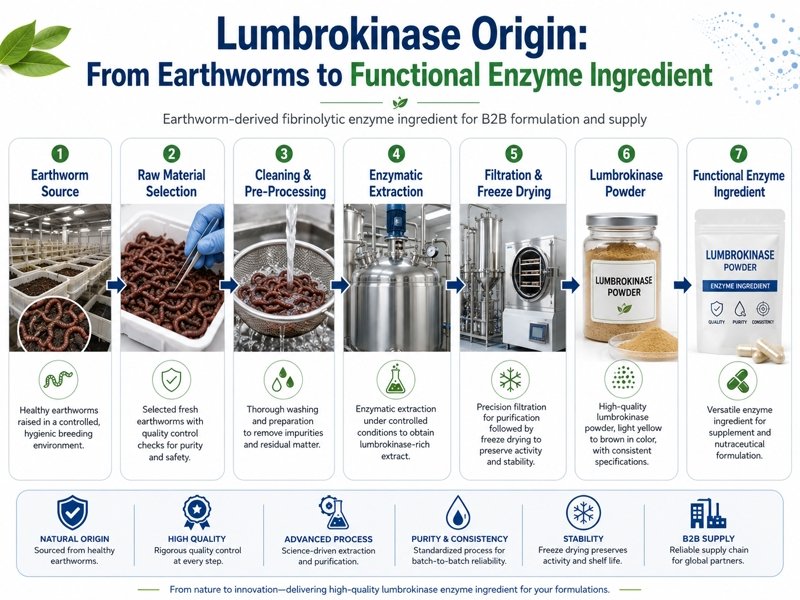
From Earthworms to Lumbrokinase Ingredient
The manufacturing process for lumbrokinase generally begins with selected earthworm raw materials. After sorting and cleaning, the raw material is processed through controlled steps designed to obtain an earthworm-derived enzyme powder.
A typical process may include:
Raw material sorting and washing
Freezing and controlled storage
Thawing and additional washing before production
Grinding or milling into slurry
Enzymatic processing or extraction
Filtration
Freeze drying or other controlled drying method
Pulverization and sieving
Packaging and warehousing
Each step can affect the final ingredient. For example, poor raw material handling may increase odor, impurities, microbial risk, or batch variation. Improper drying or storage may affect enzyme activity. Unclear filtration or purification control may lead to inconsistent appearance, solubility, or activity performance.
This is why buyers should ask not only “What is the activity?” but also “How is the activity tested?” and “How is the batch produced and controlled?”
Why Earthworm Source Matters
The lumbrokinase source matters because the raw material is the foundation of the enzyme ingredient. A supplier with better control over earthworm cultivation, maturity, collection, washing, and pre-processing is usually better positioned to support stable production.
For B2B buyers, raw material control affects:
Batch-to-batch consistency
Traceability
Microbiology control
Heavy metal risk management
Enzyme activity stability
Long-term supply reliability
Finished product suitability
If the supplier cannot explain the earthworm source, raw material handling, or production process, buyers may face higher risk when moving from sample testing to bulk orders.
For this reason, supplier selection should include both technical documentation and manufacturing background. Buyers should ask whether the supplier has its own raw material base, production facility, batch records, and quality control system.
Activity Specification and Assay Method
Lumbrokinase activity may be expressed in different units, including IU/mg, FU/g, LKU, or U, depending on assay system and market practice. These values are not always directly interchangeable because methods, substrates, incubation time, reference standards, and calculation conditions may differ.
For B2B purchasing, the activity number should always be reviewed together with the assay method. A COA that states “20,000 IU/mg” is more useful when it also identifies the test method, such as fibrin plate assay, and clearly links the result to a specific batch.
Buyers should check:
Activity unit used on the specification sheet
Assay method used for the COA
Whether the method is suitable for earthworm-derived lumbrokinase
Whether sample and bulk batch are tested under the same method
Whether the supplier can explain differences between IU/mg, FU/g, LKU, and U
Whether third-party testing uses the same or a different assay basis
Activity comparison across suppliers can be misleading when the assay basis is different. A higher number does not always mean better quality unless the testing method is comparable.
For more detail, buyers can review Lumbrokinase Activity Units and How to Read a Lumbrokinase Specification Sheet.
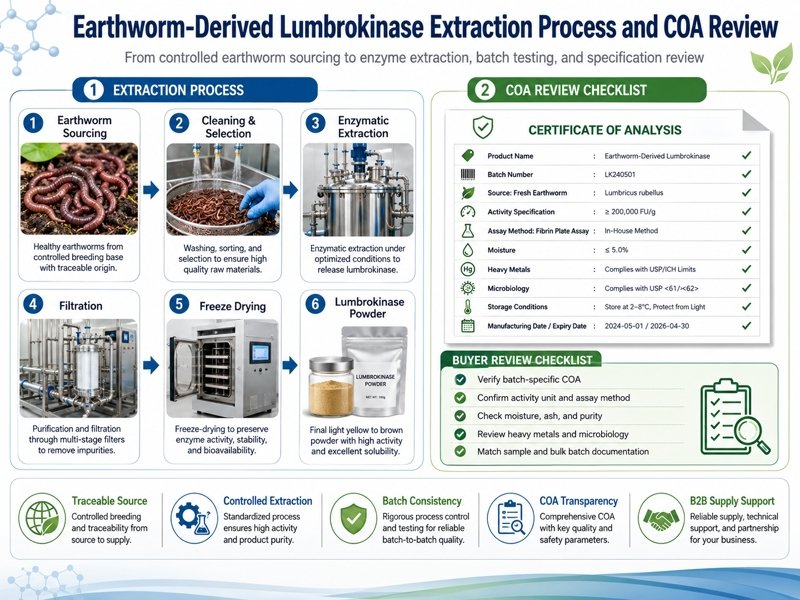
What Should Be Included in a Lumbrokinase COA?
A professional lumbrokinase COA should not only list activity. It should provide batch-based quality information that helps buyers evaluate identity, safety-related parameters, and consistency.
Important COA items may include:
Product name
Batch number
Source
Manufacturing date and expiry date
Appearance
Activity result
Assay method
Moisture
Ash or residue on ignition
Heavy metals such as lead, arsenic, cadmium, and mercury
Microbiology such as total plate count, coliforms, Salmonella, and Staphylococcus aureus
Storage condition
Conclusion or batch release statement
A COA should match the specific batch being offered. Buyers should avoid relying only on a general sample document that does not reflect the current batch.
For sample testing, the buyer should request both the COA and specification sheet. The specification sheet shows the supplier’s standard quality range, while the COA shows actual batch results.
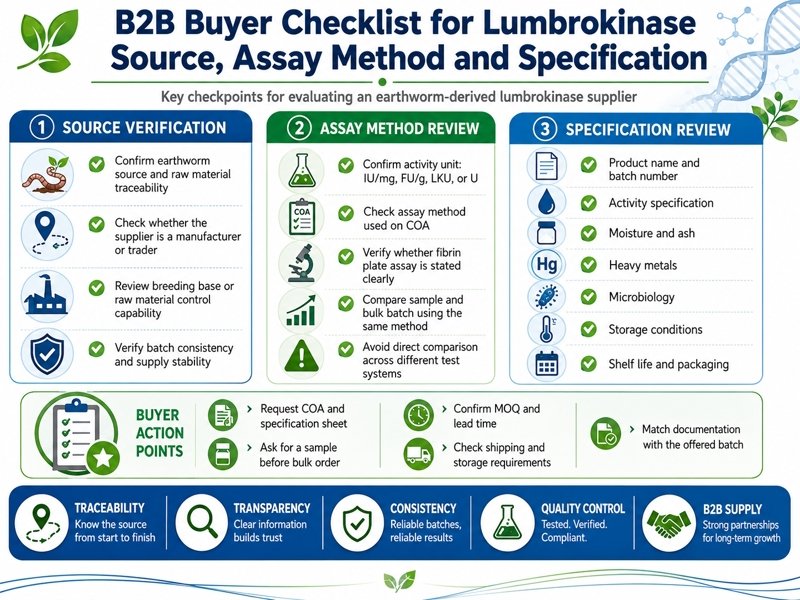
Buyer Checklist: Lumbrokinase Origin and Supplier Evaluation
| Checkpoint | What to Review | Why It Matters |
|---|---|---|
| Earthworm source | Fresh earthworm source, species information, raw material control | Confirms product identity and supports traceability |
| Manufacturer background | Whether the supplier has its own production facility | Helps reduce trader-related uncertainty |
| Raw material handling | Sorting, washing, freezing, storage, and pre-processing | Affects cleanliness, consistency, and batch quality |
| Extraction process | Enzymatic processing, filtration, drying, pulverization | Influences enzyme activity and finished powder quality |
| Activity specification | IU/mg, FU/g, LKU, U, or other unit | Prevents incorrect activity comparison |
| Assay method | Fibrin plate assay or other stated method | Activity units are method-dependent |
| COA | Batch number, activity, assay method, heavy metals, microbiology | Supports batch-level quality review |
| Specification sheet | Standard appearance, activity range, moisture, ash, storage, shelf life | Helps buyers compare supplier standards |
| Sample availability | 100 g sample or other sample quantity | Allows internal testing before bulk order |
| MOQ | Standard MOQ and packaging size | Helps plan trial order and formulation testing |
| Lead time | Production or shipping schedule after payment | Important for purchasing and launch planning |
| Storage | Cool, dry, sealed condition; moisture protection | Enzyme ingredients may be sensitive to heat and humidity |
| Shipping | DDP, DHL, air shipment, destination requirements | Affects delivery risk, cost, and customs handling |
Common Mistakes or Misunderstandings
Mistake 1: Treating all fibrinolytic enzymes as the same
Lumbrokinase is an earthworm-derived fibrinolytic enzyme ingredient. It should not be confused with other enzyme systems or blended fibrinolytic products. Buyers should confirm the source and product identity before comparing price or activity.
Mistake 2: Comparing activity numbers without checking the method
A lumbrokinase COA may use IU/mg, FU/g, LKU, or U. These units may reflect different testing systems. Direct conversion is not always reliable unless the same assay method and calculation basis are used.
Mistake 3: Focusing only on high activity
High activity may be important, but it is not the only purchasing factor. Buyers should also review moisture, ash, heavy metals, microbiology, storage, packaging, batch traceability, and manufacturing capability.
Mistake 4: Using a sample result to assume all future batches are identical
Sample testing is useful, but bulk orders should still be linked to batch COA review. Buyers should confirm whether the bulk batch is from the same batch as the tested sample or a later production batch.
Mistake 5: Treating lumbrokinase content as a finished-product claim
Lumbrokinase is supplied as a B2B ingredient. Final formulation suitability, dosage, labeling, health claims, and regulatory compliance should be evaluated by the buyer according to the intended market and finished product use.
Allworms Supply Notes
Allworms Bio-Tech Co., Ltd is a manufacturer of earthworm-derived ingredients with its own earthworm breeding base and production facility in Conghua, Guangzhou, Guangdong, China. This supports better control over earthworm raw material supply, production management, and batch traceability.
For lumbrokinase, Allworms focuses on earthworm-derived enzyme ingredient supply for B2B buyers. COA and specification sheet can be provided for available batches. Buyers may review activity specification, assay method, appearance, moisture, ash, heavy metals, microbiology, storage, and packaging details before sample evaluation or bulk order.
A 100 g sample may be available for qualified B2B buyers. Standard MOQ is usually around 1.5 kg, depending on specification and batch availability. Standard lead time is usually 7–15 days after payment. DDP door-to-door shipping may be available for selected destinations.
For product details, buyers can visit the Lumbrokinase product page. For transaction questions, sample policy, MOQ, lead time, and shipping details, buyers can also review the full FAQ page.
Related reading: What Is Lumbrokinase? Source, Activity and B2B Supply Guide, Lumbrokinase Activity Units, Lumbrokinase Sample Evaluation, and How to Read a Lumbrokinase Specification Sheet.
FAQ
1. What is the origin of lumbrokinase?
Lumbrokinase originates from earthworms. It is processed into an earthworm-derived fibrinolytic enzyme ingredient for dietary supplement, nutraceutical, enzyme formulation, and research-related applications.
2. Why does earthworm source matter for lumbrokinase?
Earthworm source matters because raw material quality affects batch consistency, traceability, activity performance, odor, microbiology, and heavy metal control. Buyers should review how the supplier manages earthworm cultivation, selection, cleaning, storage, and pre-processing.
3. How is lumbrokinase extracted from earthworms?
Lumbrokinase production generally includes raw material sorting, washing, freezing, thawing, grinding, enzymatic processing or extraction, filtration, drying, pulverization, sieving, and packaging. The exact process may vary by manufacturer and specification.
4. What should buyers check on a lumbrokinase COA?
Buyers should check product name, batch number, source, activity result, assay method, moisture, ash, heavy metals, microbiology, manufacturing date, expiry date, storage condition, and whether the COA matches the batch being supplied.
5. Can lumbrokinase activity units be directly converted?
Not always. Lumbrokinase activity may be reported as IU/mg, FU/g, LKU, or U, but values can differ depending on the assay method, substrate, standard, incubation condition, and calculation system. Buyers should compare activity only when the assay basis is clear.
Need a Lumbrokinase Origin, COA, Specification, or Sample Review for Your Formulation Project?
Contact Allworms to request current batch information, sample availability, MOQ, lead time, and shipping options.