
For B2B buyers sourcing lumbrokinase, activity value is one of the most important items on a specification sheet or COA. However, lumbrokinase activity units are not always simple to compare. A supplier may list IU/mg, another may use FU/g, and some documents may mention LKU or U. These numbers can look similar, but they may come from different assay methods, substrates, calculation models, and laboratory conditions.
This guide explains how B2B buyers can read lumbrokinase activity units from a practical sourcing perspective. It is written for supplement brands, nutraceutical companies, enzyme ingredient distributors, OEM buyers, and formulation developers who need to evaluate COA documents, compare suppliers, request samples, and confirm whether a lumbrokinase ingredient matches their quality requirements.
Quick Answer: Lumbrokinase Activity Units
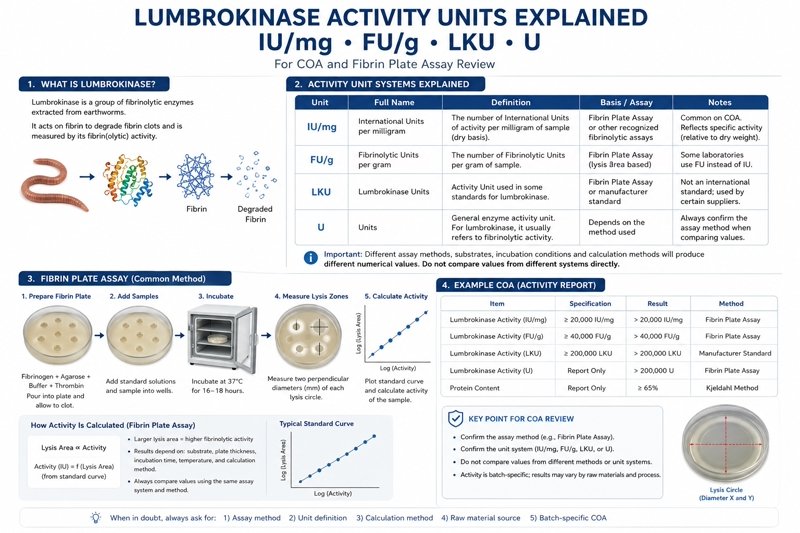
Lumbrokinase activity units describe the fibrin-related enzyme activity of an earthworm-derived lumbrokinase ingredient. Common expressions include IU/mg, FU/g, LKU, and U, but these values are not always directly convertible because assay methods and lab conditions may differ.
For B2B sourcing, buyers should not compare only the number. They should also confirm the assay method, sample basis, substrate, incubation conditions, reference standard, and whether the COA result matches the specification sheet.
Why This Matters for B2B Buyers
Activity value directly affects supplier comparison, formulation planning, label review, sample testing, and bulk order acceptance.
A buyer may receive two offers such as:
| Supplier | Stated Activity | Unit Format | Assay Information |
|---|---|---|---|
| Supplier A | 20,000 | IU/mg | Fibrin plate assay stated |
| Supplier B | 10,000 | FU/g | Method not clearly stated |
| Supplier C | 30,000 | U/mg | No substrate or standard listed |
At first glance, Supplier C may look stronger. In reality, the number alone is not enough. If the assay method is different, the test value may not represent the same activity basis.
This matters because B2B buyers often need to answer practical questions before placing an order:
Can the activity be verified by the buyer’s third-party laboratory?
Does the COA match the supplier’s specification sheet?
Is the unit suitable for the intended formula and product label?
Can the same activity specification be maintained in repeat orders?
Is the supplier providing an earthworm-derived lumbrokinase enzyme preparation or a multi-enzyme blend?
For lumbrokinase, technical clarity is more important than a high-looking number.
Technical Explanation: What Do Lumbrokinase Activity Units Mean?
Lumbrokinase is an earthworm-derived fibrinolytic enzyme ingredient used in dietary supplement, nutraceutical, enzyme formulation, and research-related applications. Its key quality indicator is enzymatic activity.
Because lumbrokinase acts on fibrin-related substrates, many activity assays are designed around fibrin degradation or fibrinolytic performance. However, different labs may use different protocols.
IU/mg
IU/mg means International Units per milligram, or an activity expression based on enzyme activity per unit weight.
In supplier documents, IU/mg is often used to show how much activity is present in one milligram of lumbrokinase powder. For example, a COA may state:
| COA Item | Example |
|---|---|
| Activity | ≥20,000 IU/mg |
| Assay Method | Fibrin Plate Assay |
| Result | >20,000 IU/mg |
For buyers, IU/mg is useful because it connects activity to ingredient weight. This can support formula calculation, sample comparison, and batch-to-batch quality review.
However, IU/mg should still be read together with the assay method. “20,000 IU/mg” from one fibrin plate method may not be directly equal to a value from another supplier using a different standard or calculation.
FU/g
FU/g usually refers to fibrinolytic units per gram. It is commonly seen in the broader fibrinolytic enzyme market, especially where nattokinase and other fibrinolytic enzyme ingredients are discussed.
FU/g can be useful for buyers who are familiar with fibrinolytic enzyme labeling. However, it may create confusion when comparing lumbrokinase with nattokinase or multi-enzyme blends.
A key point is this:
FU/g does not automatically equal IU/mg.
The result may depend on the substrate, enzyme type, fibrin plate conditions, reference standard, incubation time, and calculation model. A value tested under a nattokinase-oriented method may not represent the same basis as an earthworm-derived lumbrokinase assay.
For lumbrokinase buyers, FU/g should be accepted only when the supplier can clearly explain the assay basis.
LKU
LKU usually refers to lumbrokinase units. It may appear in some technical documents, supplier specifications, or market communication related specifically to lumbrokinase.
The advantage of LKU is that it sounds product-specific. The challenge is that the exact definition may vary depending on the standard being used.
When a supplier provides LKU, buyers should ask:
What is the full assay method?
Is it based on fibrin plate assay?
What reference standard is used?
Is the result calculated on powder weight, dried basis, or protein basis?
Can the supplier provide the original COA and test method?
Without these details, LKU may not be enough for accurate supplier comparison.
U
U means unit or enzyme activity unit. It is a broad term used in enzyme testing. In lumbrokinase documents, U may be expressed on different weight bases, such as U/mg or U/g, depending on the supplier’s reporting system and assay method.
U/g expresses the measured enzyme activity per gram of product under a defined assay system. However, the unit and weight basis alone do not establish equivalence between different products or laboratories.
The main issue with U is that it must be defined by the method. One laboratory’s U may not be identical to another laboratory’s U unless the same assay procedure, substrate, reference basis, test conditions and calculation method are used.
For procurement and QA teams, a U/g value should never be reviewed alone. It should be linked to a clearly identified assay method and supported by a batch COA and Specification Sheet.
Allworms currently specifies its earthworm-derived lumbrokinase enzyme preparation as:
Fibrinolytic Activity: ≥1,000,000 U/g
Assay Method: Fibrin Plate Assay
This specification is based on Allworms’ current routine testing and product-control system. It should not be directly converted into IU/mg, FU/g or LKU without a confirmed common assay basis.
Fibrin Plate Assay and Why Method Details Matter
The fibrin plate assay is one of the common methods used to evaluate fibrinolytic activity. In general, the test creates a fibrin-containing plate and measures the lysis area produced by the enzyme sample.
A typical fibrin plate assay may involve:
| Step | What It Means for Buyers |
|---|---|
| Buffer preparation | pH and ionic conditions can affect enzyme performance |
| Fibrinogen solution | Substrate type and concentration influence results |
| Thrombin solution | Used to form the fibrin network |
| Standard solution | Required for calibration and calculation |
| Test solution | Sample concentration should fall within the linear range |
| Incubation | Temperature and time affect the lysis circle |
| Lysis circle measurement | Activity is calculated from the lysis area or diameter |
| Duplicate testing | Helps reduce random testing variation |
This is why lumbrokinase activity units are method-dependent. Even when two suppliers both say “fibrin plate assay,” buyers should confirm whether the detailed conditions are the same.
For more specification-level review, buyers can also read: How to Read a Lumbrokinase Specification Sheet.
IU/mg vs FU/g vs LKU vs U: Practical Comparison
| Unit | Common Meaning | Useful For | Main Risk |
|---|---|---|---|
| IU/mg | Activity per milligram | Formula calculation and COA review | Not always comparable across methods |
| FU/g | Fibrinolytic units per gram | Fibrinolytic enzyme market comparison | May be based on different enzyme systems |
| LKU | Lumbrokinase unit | Lumbrokinase-specific documentation | Definition may vary by supplier |
| U | General activity unit | Technical enzyme documents | Must be defined by assay method |
The safest approach is to compare lumbrokinase activity only when the method basis is clear.
A buyer should ask:
Are the activity units tested by fibrin plate assay?
Is the result based on powder weight, dried basis, or protein content?
Is the reference standard identified?
Are test conditions available?
Can the supplier provide batch COA and specification sheet?
Can the buyer run sample testing before bulk purchase?
Buyer Checklist: Reviewing Lumbrokinase Activity Units
| Checklist Item | What to Check | Why It Matters |
|---|---|---|
| Activity value | IU/mg, FU/g, LKU, or U | Confirms the stated potency format |
| Assay method | Fibrin plate assay or other method | Determines whether values are comparable |
| Sample basis | As-is, dried basis, or protein basis | Affects calculated activity |
| Reference standard | Lumbrokinase standard or other standard | Supports test credibility |
| Substrate | Fibrinogen/fibrin system details | Different substrates may change results |
| Incubation conditions | Time, temperature, pH | Enzyme activity is condition-sensitive |
| COA consistency | Result matches specification | Confirms batch acceptance |
| Third-party testing | Buyer lab or external lab | Helps verify sample suitability |
| Product identity | Earthworm-derived lumbrokinase enzyme preparation or multi-enzyme blend | Prevents misleading activity comparison |
| Stability handling | Storage and shipping conditions | Enzymes may be affected by heat and moisture |
| Documentation | COA, specification sheet, assay method | Supports QA and regulatory review |
| Supply terms | Sample, MOQ, lead time, shipping | Helps move from evaluation to order |
Common Mistakes or Misunderstandings
Mistake 1: Comparing activity numbers without checking the method
A higher number does not always mean a stronger product. If two values are tested by different methods, they may not be directly comparable.
Mistake 2: Treating IU/mg and FU/g as automatically convertible
Some buyers ask for a simple conversion between IU/mg and FU/g. In practice, a reliable conversion may not be possible unless the same assay basis, standard, and calculation method are used.
Mistake 3: Comparing an earthworm-derived lumbrokinase preparation with a multi-enzyme blend
A product blended with other fibrinolytic enzymes may show a different activity profile from an earthworm-derived lumbrokinase enzyme preparation. Buyers should confirm the ingredient composition and product identity before comparing activity values.
Mistake 4: Ignoring storage and shipping conditions
Lumbrokinase is an enzyme ingredient. Prolonged exposure to heat, humidity, or repeated temperature fluctuation may affect activity. This is important for international shipping and customs clearance.
Mistake 5: Accepting a COA without assay method information
A lumbrokinase COA should not only state the activity result. It should also identify the assay method. For serious B2B sourcing, buyers should request the specification sheet and assay method information when needed.
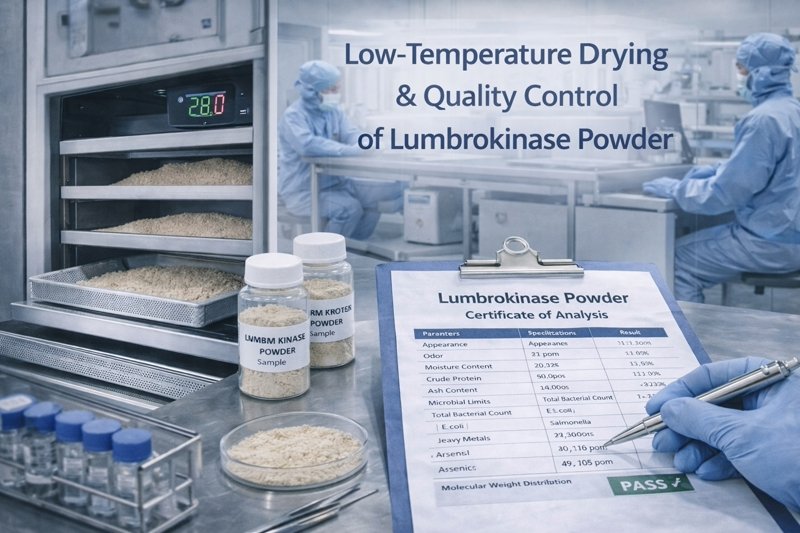
How to Read a Lumbrokinase COA
A practical lumbrokinase COA should include more than activity value. Buyers should review both enzyme activity and general quality items.
| COA Section | What Buyers Should Look For |
|---|---|
| Product name | Lumbrokinase powder |
| Source | Fresh earthworm or earthworm-derived material |
| Batch number | Needed for traceability |
| Manufacturing date | Helps evaluate freshness |
| Expiry date | Supports inventory planning |
| Activity | Example: ≥1000,000 U/g |
| Assay method | Example: fibrin plate assay |
| Moisture | Important for enzyme stability |
| Ash or residue on ignition | General composition indicator |
| Heavy metals | Lead, arsenic, cadmium, mercury |
| Microbiology | Total plate count, coliforms, Salmonella, Staphylococcus aureus |
| Storage | Cool, dry, sealed, protected from moisture and light |
A COA should be batch-specific. A general specification sheet is useful, but buyers should also request the COA for the actual batch being supplied.
For broader product and sourcing questions, buyers can also visit the Allworms FAQ page.
Formulation Considerations for Supplement Brands
Lumbrokinase is an enzyme-sensitive ingredient. Formulation developers should consider:
Capsule or tablet processing temperature
Compatibility with excipients
Moisture exposure during blending
Packaging barrier performance
Storage condition of finished products
Activity target per serving
Local labeling and claim requirements
Final formulation suitability, dosage, labeling, health claims, and regulatory compliance should be evaluated by the buyer according to the intended market and finished product use.
This product is supplied as a B2B ingredient. It is not intended to diagnose, treat, cure, or prevent disease.

Allworms Supply Notes
Allworms supplies an earthworm-derived lumbrokinase enzyme preparation for B2B ingredient applications. Batch COA, Specification Sheet, assay information and sample support are available for buyer evaluation.
Available supply support includes:
- 100 g sample evaluation
- Standard MOQ: 1.5 kg
- Standard packaging: 1.5 kg/bag
- In-stock orders dispatched within 3 days
- Production orders normally requiring 7–15 days
- Available-batch COA, Specification Sheet and assay information
- International express, air shipping and selected DDP options
Buyers who need a specific activity unit, such as IU/mg, FU/g, LKU, or U, are encouraged to share their target assay method or lab requirement before sample testing.
For product details, visit the Allworms Lumbrokinase product page.
FAQ
1. What are lumbrokinase activity units?
Lumbrokinase activity units describe the enzyme’s fibrin-related activity under a defined assay method. Common units include IU/mg, FU/g, LKU, and U. The unit should always be read together with the assay method.
2. Are IU/mg and FU/g directly convertible?
Not always. IU/mg and FU/g may be based on different methods, substrates, standards, and calculation systems. Direct conversion should only be made when the same assay basis is confirmed.
3. Why do different suppliers show different lumbrokinase activity values?
Different suppliers may use different assay methods, enzyme systems, reference standards, incubation conditions, and calculation models. This can produce different numerical values even for similar enzyme materials.
4. What should buyers check on a lumbrokinase COA?
Buyers should check activity value, assay method, batch number, moisture, heavy metals, microbiology, storage conditions, and whether the result matches the specification sheet. For activity comparison, the assay method is essential.
5. Can Allworms provide samples for activity testing?
Yes. Allworms may provide 100 g sample evaluation for qualified B2B buyers. Buyers usually pay international freight. Sample testing is recommended when the buyer has a specific assay method, activity unit, or formulation requirement.
Buyers may request available batch documents before sample evaluation, including COA, specification sheet, product information, and activity assay method notes. If your laboratory uses FU/g, LKU, U, or another fibrinolytic activity system, please share the method basis before testing so both sides can compare results more accurately.
Need Help Comparing Lumbrokinase Activity Units on Your COA?
Contact Allworms Bio-Tech Co., Ltd to request lumbrokinase activity specification, fibrin plate assay information, sample availability, MOQ, pricing, lead time, and international shipping options.