
For B2B buyers, lumbrokinase sample evaluation is not just about receiving a small bag of powder and checking one activity number. A sample is the first practical step to confirm whether the supplier’s lumbrokinase specification, COA data, assay method, packaging, communication, and future bulk supply can match your formulation or sourcing requirements.
Lumbrokinase is an earthworm-derived fibrinolytic enzyme ingredient used in dietary supplement, nutraceutical, enzyme formulation, and research-related applications. Because enzyme activity is method-dependent, buyers should evaluate the sample together with the COA, specification sheet, fibrin plate assay method, storage conditions, batch information, and supplier’s ability to provide the same specification for bulk orders.
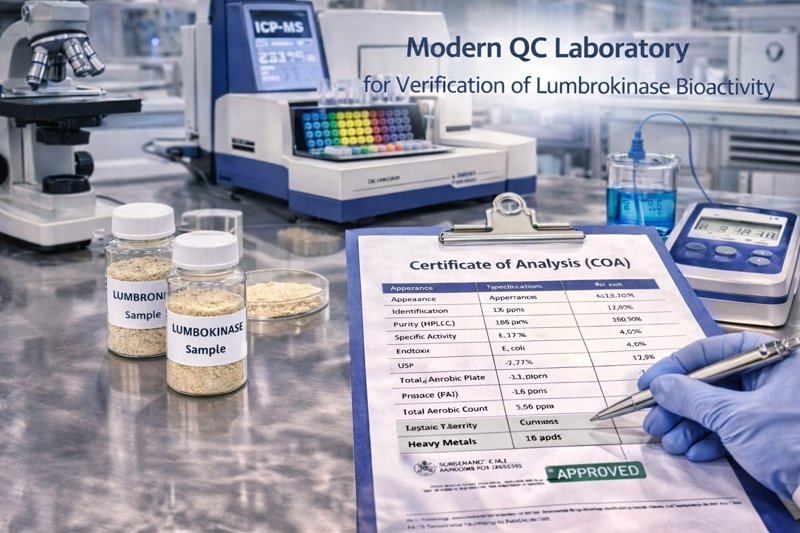
Quick Answer: Lumbrokinase Sample Evaluation
Lumbrokinase sample evaluation should check the COA, specification sheet, activity unit, assay method, sample appearance, packaging, batch number, storage condition, and consistency with future bulk orders. Buyers should not judge a lumbrokinase sample only by the activity number, because assay method, testing conditions, substrates, incubation time, and unit system can affect the result. A good evaluation process should also confirm supplier communication, MOQ, lead time, shipping options, and whether the same specification can be supplied in bulk.
Why This Matters for B2B Buyers
A lumbrokinase sample is often used before a bulk order to answer several important purchasing questions:
Can the product match the buyer’s intended specification?
Is the COA complete enough for internal review?
Does the activity unit match the buyer’s testing system?
Can the supplier explain the assay method clearly?
Will the bulk order come from the same or equivalent specification?
Is the supplier responsive when technical questions arise?
For supplement brands, ingredient distributors, OEM buyers, and formulation developers, the sample stage helps reduce risk before committing to a lumbrokinase bulk order. However, the sample test should be designed carefully. If the buyer only compares activity numbers without checking the assay basis, the result may create confusion instead of a clear purchasing decision.
Technical Explanation: How to Evaluate a Lumbrokinase Sample
1. Check the COA Before Testing the Sample
The lumbrokinase COA should be reviewed before the sample enters laboratory testing. A COA is not only a document for activity; it should also show whether the batch meets basic quality requirements.
Common items to check include:
Product name
Batch number
Manufacturing date and expiry date
Source material
Appearance
Activity specification and result
Assay method
Moisture
Ash or residue on ignition
Heavy metals
Microbiology
Storage condition
Authorized signature or approval
For lumbrokinase, the assay method is especially important. If the COA states only “activity” but does not clearly identify the assay method, the buyer should ask the supplier for clarification before comparing results.
2. Compare the COA with the Specification Sheet
The COA shows the actual result for a specific batch. The specification sheet shows the standard quality range that the supplier aims to provide.
For sample evaluation, buyers should compare:
COA activity result vs. specification activity range
COA appearance vs. specification appearance
COA moisture result vs. specification limit
COA microbiology result vs. specification limit
COA heavy metals result vs. specification limit
COA storage instruction vs. supplier handling guidance
If the sample COA and specification sheet do not match, ask the supplier to explain whether the sample is from an available batch, a previous batch, or a trial batch.
3. Confirm the Activity Unit
Lumbrokinase activity may be expressed in different units, such as IU/mg, FU/g, LKU, U, or other fibrinolytic activity systems. These units are not always directly interchangeable.
The same sample may show different numerical values under different assay systems because the test conditions may differ, including:
Substrate type
Buffer system
Temperature
Incubation time
Enzyme concentration
Standard reference
Calculation method
For this reason, buyers should avoid judging lumbrokinase quality only by the activity number. A higher-looking number is not always directly comparable unless the testing basis is the same.
4. Ask About the Fibrin Plate Assay Method
The fibrin plate assay is commonly used to evaluate fibrinolytic enzyme activity. In sample evaluation, buyers should confirm whether the supplier’s reported activity is based on fibrin plate assay or another method.
Key questions include:
What assay method is used?
What unit system is reported?
What standard reference is used?
Are the sample and standard tested on the same plate?
What incubation time and temperature are used?
Is the method used consistently for routine batch release?
If the buyer uses a different laboratory method, the supplier and buyer should compare the testing conditions before drawing conclusions. Different methods may produce different activity values even when testing the same enzyme ingredient.
5. Check Sample Appearance and Physical Condition
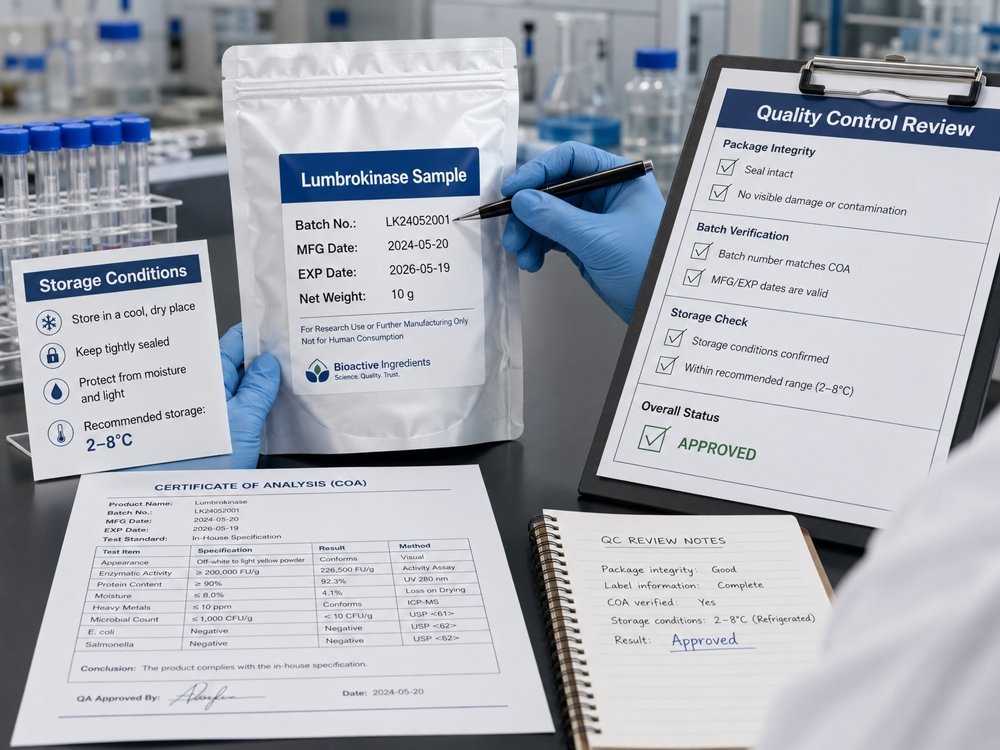
When receiving a lumbrokinase sample, buyers should record the physical condition before opening or testing it.
Common checks include:
Powder color
Odor
Caking or moisture exposure
Visible contamination
Package integrity
Label clarity
Batch number on label
Storage instruction on label
Lumbrokinase is an enzyme-sensitive material. If the package is damaged, exposed to moisture, or stored under unsuitable conditions, activity performance may be affected. Buyers should take photos of the received sample package and label for internal records.
6. Review Packaging and Label Information
Sample packaging should protect the powder from moisture, light, and contamination during international transit.
A practical sample label should include:
Product name
Batch number
Net weight
Activity specification
Storage condition
Supplier name
Production or expiry information when available
The batch number is especially important. It helps the buyer connect the sample, COA, and future bulk order. If the sample has no batch number, the buyer should request confirmation before proceeding with formal testing.
7. Confirm Storage and Handling Conditions
Lumbrokinase should be stored in a cool, dry place, tightly sealed, and protected from moisture and light. Buyers should also avoid repeated opening, long exposure to air, or prolonged storage in high temperature and humidity.
During sample evaluation, buyers should consider:
How long the sample stayed in transit
Whether customs clearance caused delays
Whether the destination climate is hot or humid
Whether the sample was sealed properly after opening
Whether the lab stored it according to instructions
If unexpected activity results occur, storage and handling history should be reviewed together with the assay method.
8. Test the Sample Against the Intended Specification
Before testing, buyers should define what they need for future procurement.
For example:
Required activity grade
Preferred unit system
Target dosage form
Finished product format
Required documentation
Market compliance requirements
Planned order quantity
Packaging preference
A sample result is only useful if it is compared with the buyer’s real bulk order requirement. If the buyer tests one activity grade but later asks for a different specification, a second sample or updated COA may be needed.
9. Confirm Bulk Order Consistency
One of the most important questions in lumbrokinase sample evaluation is whether the same specification can be supplied later for bulk orders.
Buyers should ask:
Is the sample from a regular production batch?
Can the same activity grade be supplied in bulk?
Can a COA be provided for the bulk batch before shipment?
Will the assay method remain the same?
What is the MOQ for this specification?
What is the normal lead time?
What shipping options are available?
Can the supplier support repeat orders?
This step helps avoid a common sourcing problem: the sample looks acceptable, but the supplier cannot provide the same specification consistently at bulk scale.
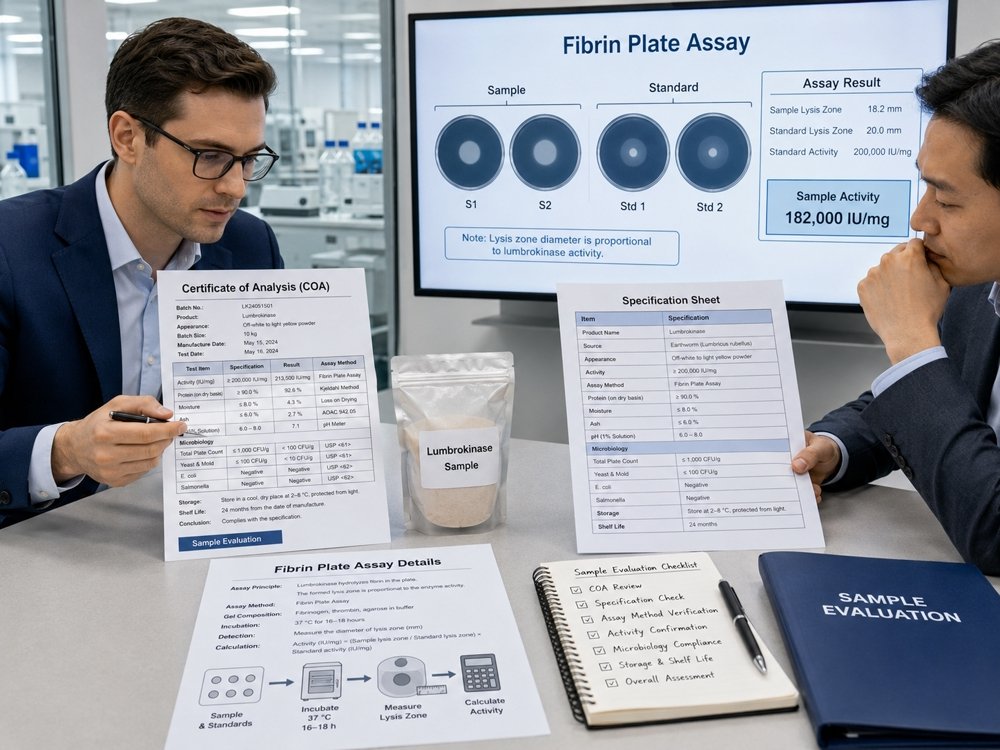
Buyer Checklist Table
| Evaluation Item | What to Check | Why It Matters |
|---|---|---|
| COA | Batch number, activity, assay method, moisture, ash, heavy metals, microbiology | Confirms actual batch quality data |
| Specification Sheet | Standard quality range, activity grade, appearance, storage, shelf life | Shows the supplier’s regular product standard |
| Activity Unit | IU/mg, FU/g, LKU, U, or other unit system | Prevents incorrect comparison between different methods |
| Assay Method | Fibrin plate assay or other method, test conditions, calculation basis | Activity values are method-dependent |
| Sample Appearance | Color, odor, powder condition, caking, moisture signs | Helps identify handling or storage issues |
| Packaging | Seal condition, moisture protection, label clarity | Protects enzyme activity during transit |
| Batch Number | Match sample label with COA and supplier record | Supports traceability and future bulk comparison |
| Storage Condition | Cool, dry, sealed, protected from light and moisture | Enzyme stability can be affected by poor storage |
| Supplier Response | Clear explanation of COA, method, units, MOQ, lead time | Shows technical and commercial reliability |
| Bulk Consistency | Same specification, same assay basis, COA for bulk batch | Reduces risk before larger procurement |
Common Mistakes or Misunderstandings
Mistake 1: Judging Only by the Activity Number
The activity number is important, but it is not enough. Buyers should always ask how the number was tested. A lumbrokinase sample reported as one unit system may not be directly comparable with another sample tested under a different system.
Mistake 2: Comparing IU/mg and FU/g Without Method Review
IU/mg and FU/g may be used by different suppliers or laboratories. However, buyers should not assume a simple universal conversion unless the method, standard, and calculation basis are confirmed.
Mistake 3: Testing the Sample Without Reviewing Storage History
If a sample is delayed in customs, exposed to heat, or opened repeatedly, enzyme activity may be affected. Storage and transit conditions should be reviewed if the test result is unexpected.
Mistake 4: Ignoring the Batch Number
A sample without clear batch traceability is difficult to connect with future bulk orders. Buyers should ensure the sample label, COA, and supplier records match.
Mistake 5: Assuming the Sample Specification Is Always Available in Bulk
Some suppliers may send a sample that is not from a regular production batch. Before placing a lumbrokinase bulk order, confirm whether the same activity grade and quality standard can be supplied at the required quantity.
Allworms Supply Notes
Allworms Bio-Tech Co., Ltd supplies lumbrokinase as an earthworm-derived fibrinolytic enzyme ingredient for dietary supplement, nutraceutical, enzyme formulation, and research-related applications.
For qualified B2B buyers, a 100 g free sample may be available for evaluation. The buyer usually pays international freight. COA and specification sheet can be provided for available batches.
Our standard MOQ is usually around 1.5 kg, depending on product specification and batch availability. Standard lead time is usually 7–15 days after payment. DDP door-to-door shipping may be available for selected destinations.
For more product details, buyers can review our Lumbrokinase product page. For order terms, sample policy, MOQ, lead time, and shipping questions, please visit our full FAQ page. Buyers who need more technical background may also read What Is Lumbrokinase? Source, Activity and B2B Supply Guide, Lumbrokinase Activity Units, and How to Read a Lumbrokinase Specification Sheet.
This product is supplied as a B2B ingredient. Final formulation suitability, dosage, labeling, health claims, and regulatory compliance should be evaluated by the buyer according to the intended market and finished product use.
FAQ
1. What should I check first when receiving a lumbrokinase sample?
Check the package condition, label, batch number, COA, specification sheet, storage instruction, and activity assay method. Before testing, confirm that the sample batch matches the COA and that the reported activity unit is clear.
2. Is lumbrokinase sample evaluation only about activity?
No. Lumbrokinase activity is important, but buyers should also check the assay method, unit system, testing conditions, COA data, moisture, ash, heavy metals, microbiology, packaging, storage, and supplier communication.
3. Why can different labs report different lumbrokinase activity values?
Different labs may use different substrates, standards, buffers, incubation times, temperatures, enzyme concentrations, and calculation methods. Because lumbrokinase activity is method-dependent, results should be compared only after the assay basis is confirmed.
4. Should I request a COA before testing the sample?
Yes. The COA helps the buyer understand the batch information, activity result, assay method, and basic quality data before internal testing. It also helps compare the sample with the future bulk order specification.
5. Can the same lumbrokinase sample specification be supplied in bulk?
This should be confirmed with the supplier before placing an order. Buyers should ask whether the same activity grade, assay method, COA standard, packaging, MOQ, and lead time can be supported for bulk orders.
Request A Lumbrokinase Sample COA And Specification Sheet?
Contact Allworms for sample details, MOQ, lead time, pricing, and shipping options.