
Buying 10–25 kg lumbrokinase powder is different from requesting a sample or making a general supplier inquiry. At this stage, the buyer is usually preparing for pilot production, a first commercial batch, distributor evaluation, contract manufacturing, or repeat small bulk supply.
Before requesting a final quotation or making payment, buyers need to confirm more than quantity and destination. The lumbrokinase COA, specification sheet, activity grade, activity unit, assay method, sample status, packaging format, lead time, shipping method, and delivery conditions should all be clear.
For supplement brands, nutraceutical companies, ingredient distributors, and formulation buyers, a structured pre-order review can prevent document mismatches, unclear activity comparisons, packaging changes, delivery delays, and unnecessary discussions after payment has already been made.
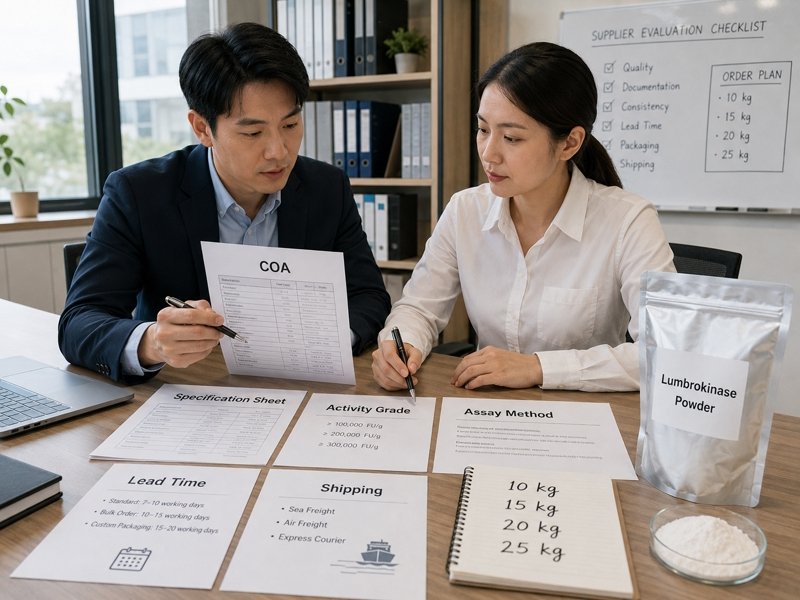
Quick Answer: What Should You Check Before Buying 10–25 kg Lumbrokinase Powder?
Before you buy 10–25 kg lumbrokinase powder, confirm the COA, specification sheet, activity grade, assay method, sample testing status, batch requirements, packaging, lead time, shipping method, destination information, and customs or delivery conditions.
A useful purchase process has three stages: provide complete information before requesting a quotation, verify commercial and technical details before payment, and approve batch, documentation, packaging, and shipment information before dispatch.
Why This Matters for B2B Buyers
A 10 kg, 15 kg, 20 kg, or 25 kg lumbrokinase order is often large enough to enter real production but still small enough to require careful purchasing control.
Typical purchasing situations include:
- pilot production after initial sample evaluation;
- a first commercial manufacturing batch;
- supplier qualification by an ingredient distributor;
- small-market production for a supplement brand;
- limited production by an OEM or contract manufacturer;
- repeat small bulk purchases before demand justifies larger orders.
The important point is that the purchase has moved beyond general research.
A buyer at this stage may already know what lumbrokinase is and may already have communicated with one or more suppliers. The remaining question is practical:
What exactly must be confirmed before the purchase moves forward?
The broader sourcing process—including sample, MOQ, COA, and shipping stages—is covered in Lumbrokinase Small Bulk Orders. For a specific 10–25 kg purchasing decision, however, buyers should work through the three transaction stages below.
Technical Explanation: Why Activity Grade Cannot Be Reviewed Alone
Lumbrokinase is an earthworm-derived fibrinolytic enzyme ingredient considered for dietary supplements, nutraceutical formulations, enzyme ingredient systems, and research-related applications.
When purchasing bulk powder, the activity grade is an important specification. However, the activity number should not be separated from its unit and assay context.
Depending on the supplier, laboratory, method, or market, activity may be expressed as IU/mg, FU/g, LKU, U, or another defined activity expression. These expressions should not automatically be treated as interchangeable.
For a 10–25 kg purchase, the practical questions are:
- What activity grade is being quoted?
- What activity unit is used?
- What assay method supports the reported result?
- Is the quoted grade a specification requirement or an actual batch result?
- Does the available batch COA meet the agreed purchasing requirement?
The goal is not to repeat a complete explanation of enzyme units. The purchasing point is simpler: the activity grade written in the quotation, the specification requirement, the COA result, and the agreed assay basis should tell a consistent story.
Buyers who need a more detailed method-level explanation can review Fibrin Plate Assay for Lumbrokinase Activity.
10–25 kg Lumbrokinase Purchase Checklist
| Checkpoint | What to Review | What to Confirm with Supplier |
|---|---|---|
| Order quantity | Exact required weight: 10 kg, 15 kg, 20 kg, 25 kg, or another quantity | Whether the requested quantity can be supplied under the quoted conditions |
| Product specification | Product source, appearance, activity requirement and other relevant quality parameters | Which specification applies to the quotation |
| Activity grade | Target activity level required for the project | The exact activity grade being quoted and supplied |
| Activity unit | IU/mg, FU/g, LKU, U, or another stated expression | The unit used in the COA and specification documents |
| Assay method | Method associated with the activity result | Whether the quoted activity and batch COA use the stated assay basis |
| COA | Batch number, activity result, moisture, ash or residue parameter where applicable, heavy metals, microbiology and other listed results | Whether a COA is available for the current or available batch |
| Specification sheet | Standard target requirements for the product | Whether the quoted product grade matches the document |
| Sample testing status | Whether testing is complete, pending, or not required | Whether the bulk specification should match the approved sample requirements |
| Sample-to-bulk consistency | Sample activity, appearance and relevant evaluation results | How the supplier manages the transition from sample approval to bulk order |
| Batch number | Available or planned production batch | When the final batch number and batch documentation can be confirmed |
| Packaging format | Bag size, number of bags, inner packaging and outer carton or drum | Exact packing arrangement for the ordered quantity |
| Storage requirement | Sealing, moisture protection and supplier storage instructions | Required receiving and warehouse conditions |
| Lead time | Production, preparation and release period | Number of days after payment before the order is ready for shipment |
| DHL shipping | Shipment size, destination and suitability for express delivery | Whether DHL is suitable for the specific order and destination |
| DDP availability | Destination country, postal code and local delivery conditions | Whether DDP service can be offered for the destination |
| Customs clearance preparation | Product documents and local importer requirements | Which documents accompany the shipment and which responsibilities remain with the buyer |
| Destination information | Country, city, postal code, full address and consignee contacts | Whether the quotation is based on complete delivery information |
| Repeat order plan | Expected purchasing frequency and future quantity | Whether the supplier can support the same specification for repeat small bulk purchasing |
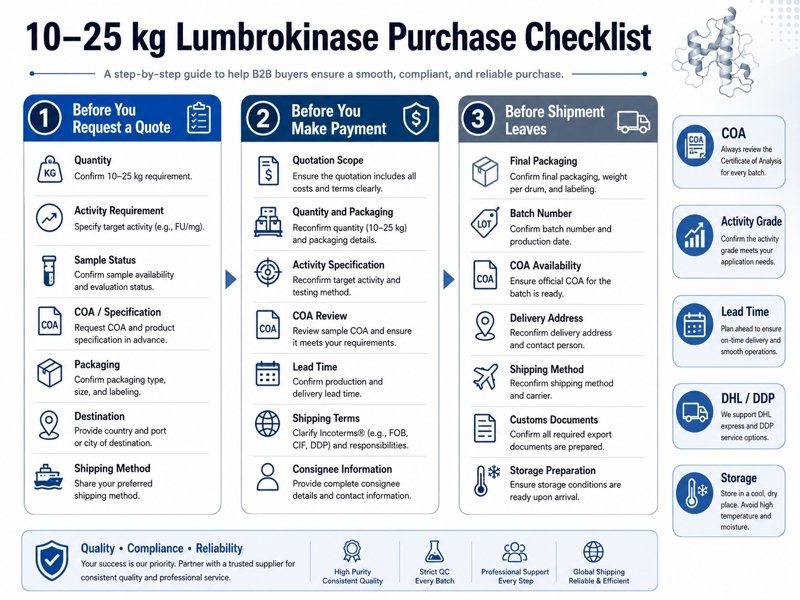
Stage 1: Before You Request a Quote
A quotation becomes more useful when the supplier understands exactly what the buyer is trying to purchase.
A message such as:
Please quote 20 kg lumbrokinase to the United States.
is usually not enough for accurate technical and shipping preparation.
The supplier still needs to know which activity grade is required, whether a particular activity unit is specified, whether sample testing has already been completed, what documentation is needed, how the buyer wants the material packed, and whether the quotation should include a specific delivery method.
Exact Target Quantity
State the actual expected quantity rather than only asking for a general price per kilogram.
For example:
- 10 kg for pilot manufacturing;
- 15 kg for a limited first production batch;
- 20 kg for commercial production;
- 25 kg for distributor inventory or repeat supply.
The final quantity can affect packaging arrangements, freight calculations, and preparation requirements.
Activity Requirement
Include the target lumbrokinase activity grade or the specification required by your technical team.
Do not assume that every quotation refers to the same grade.
A supplier may offer different activity levels, so the buyer should confirm which grade forms the basis of the price and documentation.
Activity Unit, If Relevant
When the purchasing specification requires a particular activity expression, state it clearly.
For example, a buyer may have an internal specification, contract manufacturer requirement, or laboratory testing plan based on a particular unit system.
The supplier needs this information before the buyer compares the activity value shown in the quotation or COA.
Sample Evaluation Status
Tell the supplier whether:
- no sample has been tested;
- a sample has been received but testing is pending;
- laboratory testing is complete;
- formulation evaluation is complete;
- the project is ready for bulk order approval.
This information helps avoid a situation where the buyer expects the bulk material to follow conditions that were never formally defined during the sample stage.
Required Documents
Before requesting a final quotation, state which documents must be reviewed.
For many buyers, this starts with the COA and specification sheet.
The distinction is practical:
- the specification sheet defines the target product requirements;
- the COA reports the actual results for a specific tested batch.
The two documents should be reviewed together before bulk approval. A more detailed document comparison is available in Lumbrokinase COA vs Specification Sheet.
Packaging Preference
Tell the supplier whether you have:
- a required net weight per bag;
- a maximum package size;
- warehouse handling limitations;
- sampling requirements for incoming QC;
- outer carton or drum preferences;
- special labeling or batch identification requirements.
Packaging should be confirmed before payment rather than changed during final order preparation.
Destination Country and Postal Code
The country name alone may not be sufficient for a final delivered quotation.
For a useful shipping evaluation, provide at least:
- destination country;
- city;
- postal code;
- commercial delivery location where relevant.
The postal code can affect courier availability, remote-area conditions, DDP feasibility, and final delivery calculations.
Shipping Preference
State whether you are considering:
- international express shipment;
- DHL where suitable;
- another available transport arrangement;
- DDP door-to-door service where available.
Do not request “shipping included” without clarifying what type of shipping arrangement is expected.
DDP Requirement
When DDP is required, mention it during the quotation stage.
DDP availability depends on destination and shipment conditions and should not be assumed for every country or postal code.
Requested Delivery Timing
Tell the supplier when the material is actually needed.
This is more useful than simply writing “urgent.”
The supplier can then separate:
- order preparation or production lead time;
- shipping transit arrangement;
- customs or import processing;
- final local delivery.
For deeper planning of order preparation time, see MOQ and Lead Time for Lumbrokinase Bulk Orders.
A Better 10–25 kg Quotation Request
A complete B2B request should contain:
| Information | Example of What to Provide |
|---|---|
| Target quantity | 20 kg |
| Activity requirement | Required activity grade |
| Activity unit | State required unit if applicable |
| Sample status | Tested / pending / not yet tested |
| Documents | COA and specification sheet required |
| Packaging | Preferred bag size or packing arrangement |
| Country | Destination country |
| Postal code | Full delivery postal code |
| Shipping preference | DHL, other available shipping, or DDP |
| DDP requirement | Yes / No / request availability check |
| Required timing | Target receiving date or production schedule |
Providing these details at the beginning makes the quotation easier to compare and reduces repeated clarification before purchase approval.
Stage 2: Before You Make Payment
Once the quotation is acceptable, the next checkpoint is not simply “send payment.”
Before payment, the buyer should confirm that both parties are approving the same technical product and the same commercial arrangement.
1. Confirm the Quotation Scope
Check whether the quotation clearly identifies:
- product;
- activity grade;
- quantity;
- packaging;
- unit price or total product amount;
- shipping arrangement where included;
- delivery term;
- quotation validity where applicable.
The buyer should know exactly what is and is not included.
2. Confirm Quantity and Packaging
A 10 kg order may not always be prepared in the same package configuration as a 25 kg order.
Confirm:
- number of bags;
- net weight per bag;
- total net weight;
- outer packing method.
This is especially important when the buyer’s warehouse, manufacturer, or testing laboratory has specific receiving procedures.
3. Confirm the Activity Specification
Verify that the product activity requirement in the quotation matches the technical requirement approved by the buyer.
The purchasing team should not approve one activity grade while the formulation or QC team expects another.
Where activity units differ between buyer and supplier documents, the issue should be resolved before payment rather than after the goods arrive.
4. Review the COA and Specification Sheet
For an available batch, buyers should review the COA provided for that batch or discuss what batch documentation will be available before shipment.
Depending on the applicable specification and document format, buyers may review items such as:
- batch identification;
- appearance;
- activity;
- activity unit;
- assay method;
- moisture;
- ash or residue-related parameter where applicable;
- heavy metals;
- microbiological results;
- storage instructions.
Allworms can provide COA and specification sheet information for available batches.
The objective is not simply to collect documents. The objective is to confirm that the product being purchased matches the agreed purchasing requirement.
5. Confirm Lead Time After Payment
Ask one direct question:
How many days after payment will the order be ready for shipment?
Allworms’ standard lead time is usually 7–15 days after payment, although the actual arrangement should be confirmed for the activity grade, quantity, packaging, and current production conditions.
Importantly, lead time is not the same as total door-to-door delivery time.
A 7–15 day preparation or production lead time should not be interpreted as a guaranteed total delivery period to the buyer’s warehouse.
6. Confirm Shipping Terms
Before payment, verify:
- which shipping method is included in the quotation;
- whether freight is included or separate;
- whether DHL is suitable for the shipment;
- whether DDP has been quoted;
- who is responsible for local import procedures when DDP does not apply.
For buyers who need a detailed logistics review, see International Shipping and Storage of Lumbrokinase.
7. Verify Consignee and Delivery Information
Check the following carefully:
- legal or company consignee name;
- delivery address;
- postal code;
- consignee contact person;
- telephone number;
- email address where required.
Address corrections made after dispatch can cause delay and additional handling complications.
8. Confirm Customs and DDP Conditions
The buyer should understand whether the order is:
- moving under a DDP arrangement available for that destination;
- moving by courier with import responsibilities handled according to the agreed shipping arrangement;
- subject to additional local requirements identified by the buyer or importer.
Supplier shipping support does not remove the buyer’s responsibility to evaluate ingredient importability, finished product use, labeling, or regulatory requirements in the intended market.
Stage 3: Before the Shipment Leaves
Payment does not end the purchasing checklist.
Before shipment approval, the buyer should make sure the final goods, documents, delivery information, and receiving plan are ready.
Final Packaging Confirmation
Confirm the final number of packages and the net weight arrangement.
This allows the receiving warehouse to prepare for:
- package counting;
- incoming inspection;
- internal sampling;
- stock registration;
- controlled storage.
Batch Information
Confirm the applicable batch number or batch identification information before or at shipment preparation.
The batch information should connect the goods received with the relevant batch documentation.
COA Availability
Check that the relevant COA is available according to the agreed documentation arrangement.
For a repeat order, the buyer should not assume that an earlier COA automatically represents the new batch.
Consignee Contact Information
Reconfirm the contact person and telephone number used for delivery.
For international express shipments, a reachable consignee can be important when the carrier requires delivery coordination or shipment information.
Delivery Address
Review the full address one final time before dispatch.
The final check should include:
- company name;
- street address;
- city;
- state or province where applicable;
- postal code;
- country.
Shipping Method
Confirm whether the final order is moving by the agreed method.
DHL may be suitable for certain international shipments, depending on order size, destination, and shipping arrangement.
For some destinations, DDP door-to-door shipping may also be available. This should be confirmed specifically for the order rather than assumed from a previous shipment or another destination.
Customs Documentation
Before dispatch, confirm which documents will accompany or support the shipment and whether the buyer has any importer-side requirements.
Customs preparation is most effective when handled before the shipment moves, not after it reaches the destination country.
Estimated Transit Arrangement
Ask for the expected shipping arrangement separately from the production lead time.
The buyer should understand that:
Order lead time + international transit + customs processing + local delivery = total practical receiving timeline.
These are different stages.
Receiving and Storage Preparation
Lumbrokinase is an enzyme-sensitive ingredient. Before delivery, the receiving team should already understand the supplier’s storage instructions and have a suitable storage area prepared.
The package should not arrive while the buyer is still deciding where and how to store it.
How to Check Sample Results Against the Intended Bulk Purchase
A tested sample can support a 10–25 kg buying decision, but the buyer should define what “sample approved” actually means.
Sample approval may include:
- document review;
- appearance check;
- internal laboratory testing;
- third-party activity testing;
- formulation compatibility evaluation;
- packaging or handling observations.
Before approving the bulk purchase, ask:
Which sample characteristics are required to carry forward into the bulk order specification?
For example, the buyer may have accepted a sample based on a particular activity requirement and assay context. The bulk purchase discussion should therefore reference that agreed requirement.
Do not assume that every future batch will be numerically identical in every test result. Instead, confirm the agreed specification, batch acceptance criteria, assay basis, and document requirements.
This keeps the purchasing decision practical and avoids turning one sample test result into an undefined promise for every future order.
Packaging Is a Purchasing Decision, Not a Last-Minute Detail
For 10–25 kg orders, packaging affects more than appearance.
It can influence:
- warehouse handling;
- number of packages received;
- incoming sampling procedures;
- frequency of package opening;
- moisture exposure after opening;
- production batch planning;
- freight calculation.
A buyer requesting 20 kg should therefore not approve the order based only on “USD per kg” and discuss package size later.
The quotation request should state any important packaging preference, and the final packing arrangement should be confirmed before payment or order preparation.
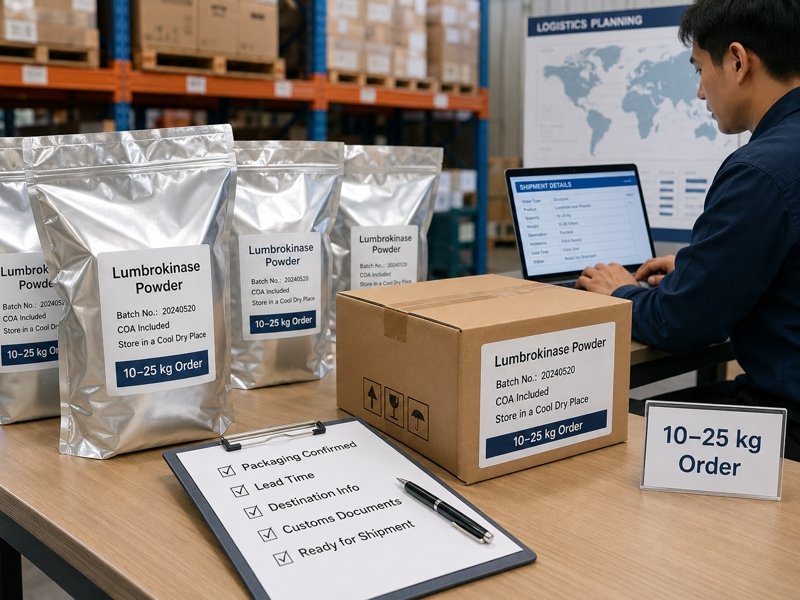
DHL, DDP and Customs: What to Confirm for a 10–25 kg Purchase
Shipping should be treated as a purchase approval checkpoint rather than a separate discussion after goods are ready.
When May DHL Be Suitable?
DHL may be considered for suitable international orders where express delivery is commercially and logistically appropriate.
Suitability depends on factors such as:
- shipment weight and package configuration;
- destination;
- courier service availability;
- customs environment;
- cost;
- delivery requirements.
The buyer should provide full destination details before requesting an accurate shipping arrangement.
When May DDP Be Available?
DDP door-to-door shipping may be available for selected destinations.
Buyers requesting DDP should provide:
- destination country;
- city;
- postal code;
- full delivery information;
- order quantity;
- product and packaging details.
The supplier can then evaluate the available arrangement.
DDP should not be assumed to be automatically available for every destination.
Customs Clearance Still Requires Planning
Even when a supplier supports international shipping, the buyer should consider:
- intended product use;
- destination-country import conditions;
- consignee requirements;
- local delivery arrangements;
- importer documentation needs.
These issues are easier to resolve before dispatch than while the goods are already in transit.
Common Mistakes When Buying 10–25 kg Lumbrokinase Powder
Mistake 1: Requesting Price with Only Quantity and No Specification
“Price for 20 kg?” is not a complete technical purchasing request.
Include the activity requirement, sample status, documents needed, packaging preference, destination, and shipping expectations.
Mistake 2: Comparing Activity Numbers Without Assay Context
A larger number is not automatically a better product when the test basis, method, or unit differs.
For purchasing purposes, confirm the activity grade, unit, and assay context together.
Mistake 3: Approving an Order Without Reviewing the COA
A quotation tells you the commercial offer. A COA provides actual batch test information where available.
They serve different purposes.
Mistake 4: Assuming Sample and Bulk Specifications Automatically Match
Sample approval should lead to a clearly defined bulk requirement.
Do not rely on verbal assumptions. Confirm the intended bulk specification and relevant batch documentation.
Mistake 5: Paying Before Confirming Packaging Requirements
Changing package size or configuration after order preparation begins can create unnecessary handling and delays.
Mistake 6: Treating 7–15 Days as Total Door-to-Door Delivery Time
Lead time after payment and international delivery time are different stages.
Customs processing and local delivery conditions can also affect the actual receiving date.
Mistake 7: Requesting DDP Without Complete Destination Information
A country name alone may not be sufficient to evaluate a DDP arrangement.
Provide the city and postal code at minimum, together with the order details.
Mistake 8: Failing to Prepare Storage Conditions Before Delivery
The warehouse should be ready before the goods arrive.
Storage preparation is part of the purchase process for an enzyme-sensitive ingredient.
Mistake 9: Focusing Only on Price Per Kilogram
The lowest price per kg does not explain the full purchasing conditions.
Compare:
- activity specification;
- assay basis;
- COA availability;
- packaging;
- lead time;
- shipping method;
- delivery terms;
- documentation;
- supplier communication;
- repeat-order support.
The final purchasing decision should reflect the complete order conditions.
Allworms Supply Notes for 10–25 kg Lumbrokinase Orders
Allworms Bio-Tech Co., Ltd. manufactures earthworm-derived ingredients and supports B2B lumbrokinase purchasing for supplement brands, nutraceutical companies, ingredient distributors, formulation developers, and research-related buyers.
For buyers preparing a 10–25 kg purchase:
- A 100 g sample may be available for qualified B2B buyers before bulk order approval.
- The buyer usually pays international freight for sample shipment.
- Standard MOQ is usually around 1.5 kg, depending on product specification, packaging, and destination.
- Orders around 10–25 kg may be discussed according to activity specification, quantity, packaging, documents, destination, and shipping method.
- COA and specification sheet information can be provided for available batches.
- Standard lead time is usually 7–15 days after payment.
- DHL may be used for suitable international shipments.
- DDP door-to-door shipping may be available for selected destinations.
- Final quotation and shipping arrangements should be confirmed according to activity grade, quantity, packaging, documents, destination, and shipping method.
Buyers who need product-level specifications and supply information can review the Lumbrokinase product page.
This product is supplied as a B2B ingredient. Final formulation suitability, dosage, labeling, health claims, and regulatory compliance should be evaluated by the buyer according to the intended market and finished product use.
FAQ
1. Can I order 10 kg of lumbrokinase powder?
Yes, a 10 kg lumbrokinase order may be discussed for B2B purchasing, depending on the required activity specification, packaging, destination, documentation, and shipping method. Before requesting a quotation, provide your target activity grade, sample testing status, delivery destination, postal code, and preferred shipping arrangement.
2. Can I order 25 kg for a first commercial batch?
A 25 kg order may be suitable for a first commercial production batch, distributor evaluation, inventory preparation, or repeat small bulk supply. Buyers should first confirm the approved specification, activity grade, COA requirements, packaging, lead time, and delivery arrangement.
3. What COA information should I check before buying 10–25 kg?
Check the product and batch identification, activity result, activity unit, assay method, moisture, relevant ash or residue parameter where applicable, heavy metals, microbiological results, and other items listed under the agreed product specification. Confirm that the COA belongs to the relevant available or supplied batch and that the batch meets the purchasing requirement.
4. Why should the assay method be confirmed with the activity grade?
Lumbrokinase activity values depend on the testing context. Activity expressions such as IU/mg, FU/g, LKU, or U should not be compared only by their numerical size when assay methods or reporting bases differ. For a bulk purchase, confirm that the activity grade, unit, assay context, specification requirement, and batch COA are understood before payment.
5. How long is the lead time, and can DHL or DDP shipping be arranged?
Allworms’ standard lead time is usually 7–15 days after payment. DHL may be used for suitable international shipments, while DDP door-to-door shipping may be available for selected destinations. Buyers should provide the target quantity, activity requirement, country, city, postal code, packaging preference, and requested delivery timing so that the appropriate shipping arrangement can be evaluated.
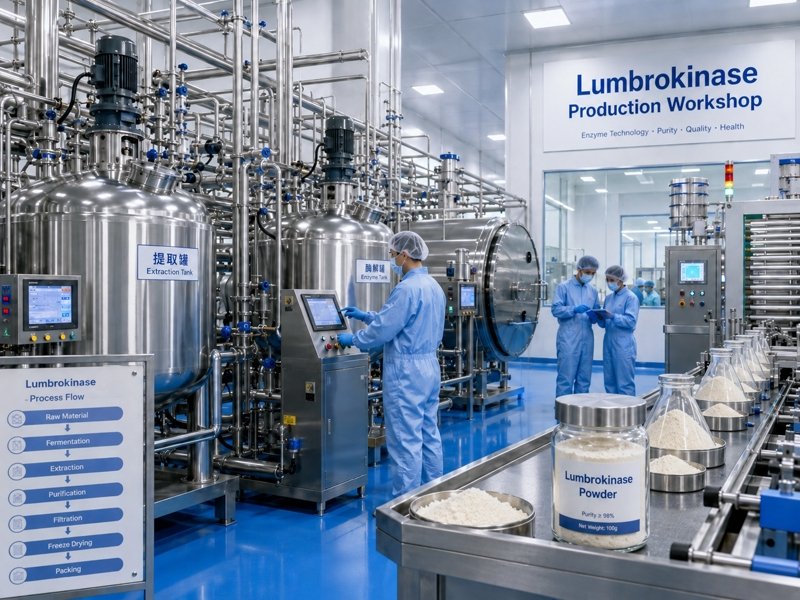
Preparing to buy 10–25 kg lumbrokinase powder?
Send your target quantity, activity requirement, packaging preference, destination, and shipping method to request available COA, specification information, lead time, and quotation.