
Choosing a lumbrokinase supplier for small supplement brands is different from buying a common powdered ingredient in large volume. Small supplement brands, nutraceutical companies, contract manufacturers, and ingredient distributors often begin with sample testing, pilot formulation, small trial orders, or first bulk order approval. At this stage, the goal is not only to find a low price, but to confirm whether the supplier can support documentation, activity specification, assay method review, MOQ discussion, lead time, packaging, shipping, and repeat order stability.
Lumbrokinase is an earthworm-derived fibrinolytic enzyme ingredient used in dietary supplement, nutraceutical, enzyme formulation, and research-related applications. Because it is an enzyme-sensitive ingredient, buyers should evaluate supplier reliability before committing to regular purchasing.
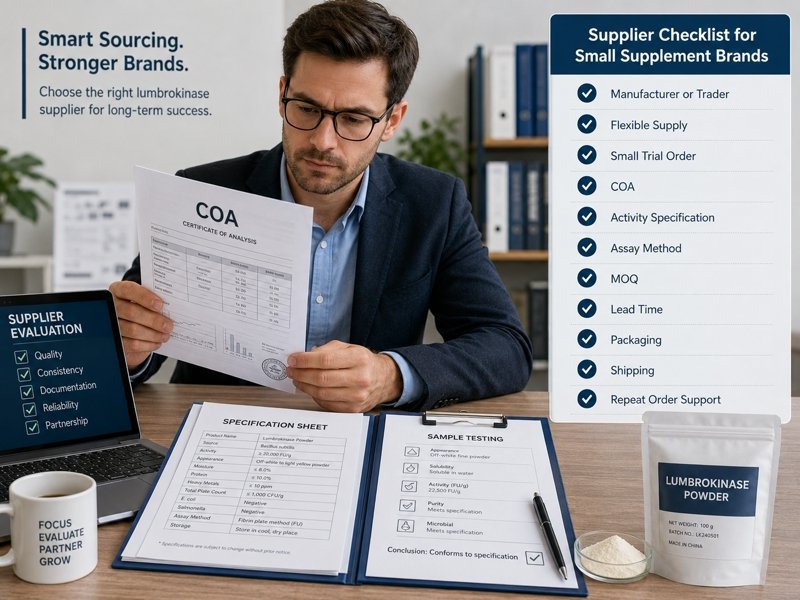
Quick Answer: Lumbrokinase Supplier for Small Supplement Brands
Small supplement brands should choose a lumbrokinase supplier for small supplement brands based on flexible supply, sample testing support, COA availability, specification clarity, activity grade, assay method, MOQ, lead time, shipping support, and repeat bulk order capability. A small trial order can help reduce sourcing risk before full bulk order approval. Buyers should not compare suppliers only by the lowest price because activity testing method, batch consistency, documentation quality, and communication support can directly affect purchasing decisions.
Why This Matters for B2B Buyers
Small brands usually have different purchasing conditions from large supplement companies. They may not need 100 kg or 500 kg at the beginning. Instead, they may need a 100 g sample, a 1.5 kg trial order, a 10 kg pilot batch, or a first commercial order after formulation testing.
This makes supplier selection more important, not less important. A small order still needs quality control. If the supplier cannot provide a clear COA, specification sheet, assay method, packaging information, or shipping plan, the buyer may face delays during formulation, labeling review, contract manufacturing, or distributor approval.
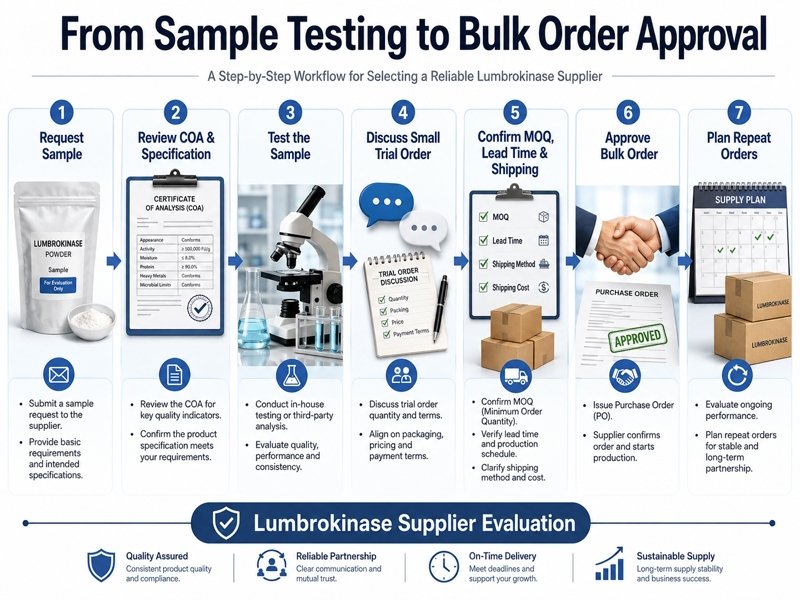
A reliable lumbrokinase supplier should help small B2B buyers move through these stages:
Sample request and document review
Sample testing and formula evaluation
Small trial order or pilot production
First bulk order approval
Repeat order planning and batch consistency review
For buyers who are already comparing order sizes, the related article Lumbrokinase Small Bulk Orders can support the purchasing stage after supplier screening.
Technical Explanation: How to Evaluate a Lumbrokinase Supplier
Lumbrokinase is not a generic powder where appearance and price are enough for purchasing decisions. It is an earthworm-derived enzyme ingredient, so buyers should check the source, production control, activity specification, assay method, and batch documents.
A specification sheet defines the target quality standard, such as appearance, activity grade, assay method, moisture, ash, heavy metals, microbiology, storage, shelf life, and packaging. A COA shows the actual test results for a specific production batch. For small brands, both documents are important because they help confirm whether a trial order or bulk order matches the intended formulation requirement.
Buyers should also ask how activity is expressed. Lumbrokinase activity may appear in IU/mg, FU/g, LKU, U, or other activity systems depending on the assay method. These numbers are not always directly interchangeable because substrates, lab conditions, incubation time, calculation methods, and reference standards may differ. A supplier should be able to explain the assay basis clearly instead of only quoting a high number.
For a deeper document comparison, buyers can review Lumbrokinase COA vs Specification Sheet before approving a supplier.
Why Flexible Supply Matters Before Scaling Up
Small supplement brands often need flexibility before committing to regular bulk orders. This may include sample support, smaller starting quantity, packaging discussion, DHL shipping, or DDP delivery options for selected destinations.
Flexible supply does not mean casual purchasing. It means the supplier understands that small brands may need to test the ingredient step by step before scaling up. A small trial order can help the buyer confirm:
Whether the sample matches the required activity grade
Whether the powder fits the intended dosage form
Whether the COA and specification are acceptable
Whether the contract manufacturer can handle the ingredient
Whether shipping and customs documents are practical
Whether the supplier responds clearly during the evaluation stage
This is especially useful for new supplement formulas, pilot batches, private label projects, distributor evaluation, and first-time lumbrokinase sourcing.
Sample Testing Before Bulk Order Approval
Sample testing should come before bulk order approval. For small supplement brands, this step helps reduce risk before spending money on larger quantity, packaging design, contract manufacturing, or market preparation.
Sample testing may include appearance review, odor, solubility observation, activity testing, moisture, microbiology, heavy metals, and compatibility with capsule, tablet, powder blend, or other intended formats. The exact testing plan depends on the buyer’s internal quality process and final product category.
A sample result should be compared with the supplier’s COA and specification sheet. If the buyer uses a different lab or assay method, the buyer should confirm whether the activity units and method are comparable before judging results.
For buyers building a testing plan, the article Lumbrokinase Sample Evaluation can be used as a separate reference without making this supplier-selection article a full sample testing guide.
Supplier Checklist for Small Supplement Brands
| Supplier Factor | Why It Matters | What Buyers Should Ask |
|---|---|---|
| Manufacturer or trading company | Direct manufacturing may support better batch traceability and technical communication. | Are you the manufacturer or a trading company? |
| Flexible supply support | Small brands may need sample, trial order, and later repeat supply. | Can you support sample testing and small trial orders before bulk purchasing? |
| Small trial order availability | Trial orders help reduce risk before first bulk order approval. | What trial order quantity can be discussed for our project? |
| Sample testing | Testing helps verify suitability before formulation or distributor approval. | Can you provide a sample with batch COA? |
| COA availability | COA shows actual batch results. | Can you provide COA for the available batch? |
| Specification sheet clarity | Specification defines target quality standards. | Can you provide the full specification sheet before ordering? |
| Activity specification | Activity grade affects formulation and comparison. | What activity grades are available? |
| Assay method | Different assay methods may produce different values. | What assay method is used for activity testing? |
| Batch consistency | Repeat orders require stable batch quality. | How do you manage batch-to-batch consistency? |
| MOQ | Small brands need to know whether the starting quantity is practical. | What is your MOQ for this specification and packaging? |
| Lead time | Production and delivery timing affect launch plans. | What is the standard lead time after payment? |
| Packaging | Packaging affects storage, handling, and production planning. | What standard packaging is available? |
| DHL or DDP shipping | Shipping method affects delivery time, customs handling, and cost. | Can you ship by DHL or provide DDP options for our destination? |
| Communication response | Clear communication reduces sourcing mistakes. | Who will support documents, sample, shipping, and order updates? |
| Repeat order support | Small brands may scale from sample to regular bulk orders. | Can you support future repeat orders if the trial batch is approved? |
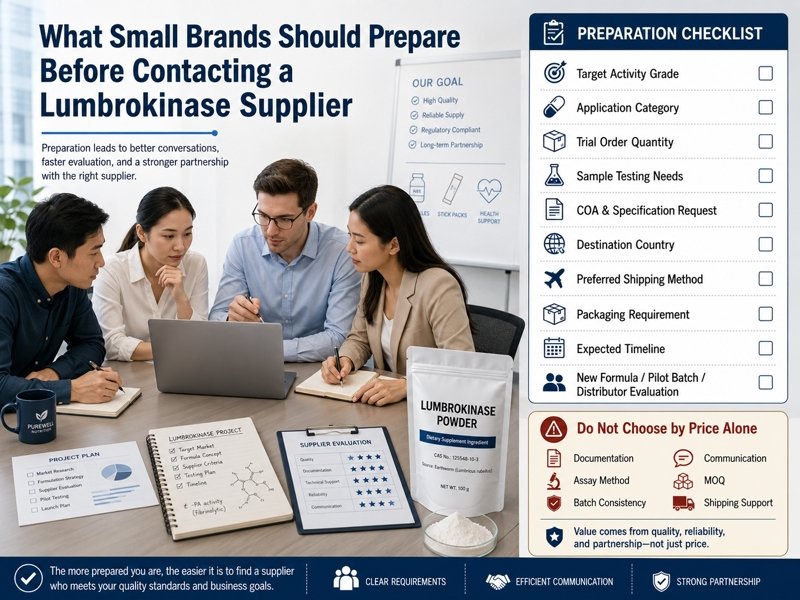
What Small Brands Should Prepare Before Contacting a Lumbrokinase Supplier
A supplier can respond more accurately when the buyer provides clear project information. Small supplement brands do not need to have every detail finalized, but they should prepare enough information for a practical quotation and document review.
Useful information includes:
Target activity grade or specification
Intended application category
Expected trial order quantity
Sample testing needs
Required documents, such as COA and specification sheet
Destination country
Preferred shipping method, such as DHL or DDP where available
Packaging requirement
Expected timeline
Whether the project is a new formula, pilot batch, contract manufacturing trial, or distributor evaluation
For example, a buyer who says “we need lumbrokinase for a capsule supplement project, want to test a sample first, and may need 1.5–10 kg after approval” will receive a more useful reply than a buyer who only asks for the lowest price.
Common Mistakes or Misunderstandings
Choosing Only by Lowest Price
The lowest price may not be the safest sourcing choice. For lumbrokinase, buyers should compare activity specification, assay method, COA, specification sheet, batch consistency, MOQ, lead time, shipping terms, and supplier communication before making a decision.
Asking for Bulk Price Before Checking Documents
Price is important, but document review should come early. A low quotation is not useful if the supplier cannot provide a COA, specification sheet, activity method, or clear batch information.
Skipping Sample Testing
Small supplement brands should avoid moving directly from quotation to bulk order without sample testing. A sample can help confirm whether the ingredient fits the buyer’s formulation and internal quality requirements.
Assuming MOQ Cannot Be Discussed
MOQ depends on specification, packaging, destination, and stock condition. Buyers should explain their trial order plan instead of assuming the supplier only accepts large-volume orders.
Ignoring Assay Method
Activity values should be reviewed together with the assay method. IU/mg, FU/g, LKU, and U may not be directly comparable across different testing systems.
Ignoring Batch Consistency
A successful first order does not automatically guarantee smooth repeat purchasing. Buyers should ask how the supplier manages batch consistency and future supply planning.
Not Confirming Future Repeat Order Support
Small brands may start small, but they still need to know whether the supplier can support future bulk orders. A supplier should be evaluated for long-term supply capability, not only one-time sample availability.
Not Confirming Shipping Terms Before Payment
DHL, DDP, customs documents, declared information, delivery timeline, and destination restrictions should be discussed before payment. Shipping uncertainty can delay sample testing or pilot production.
Treating a Small Trial Order as Casual Purchasing
A small trial order is still part of a quality-controlled sourcing process. Buyers should connect the trial order to COA review, sample testing, packaging confirmation, and bulk order approval.
How Ingredient Distributors Can Evaluate Supplier Reliability
Ingredient distributors often need to evaluate suppliers not only for their own purchasing needs, but also for downstream customers. This means documentation quality, response speed, and repeat order support become especially important.
A distributor should ask whether the lumbrokinase supplier can provide batch documents, explain activity specification, support sample evaluation, confirm MOQ and lead time, and maintain stable supply for future orders. If the distributor’s customer uses a different testing method, the distributor should clarify assay method differences before promising activity equivalence.
Distributors may also need to check whether the supplier can support different order stages: sample, small trial order, first bulk order, and repeat shipment. This makes communication quality a supplier-selection factor, not just a service detail.
When to Move from Trial Order to Bulk Order
A buyer may consider moving from small trial order to first bulk order when the following points are confirmed:
The sample has passed internal evaluation.
The COA and specification sheet are acceptable.
The activity grade and assay method are understood.
The contract manufacturer or formulation team has approved the ingredient.
MOQ, packaging, lead time, and shipping terms are confirmed.
The supplier can support repeat orders.
The buyer has reviewed storage and handling requirements.
If any of these points are unclear, the buyer should clarify them before bulk order approval.
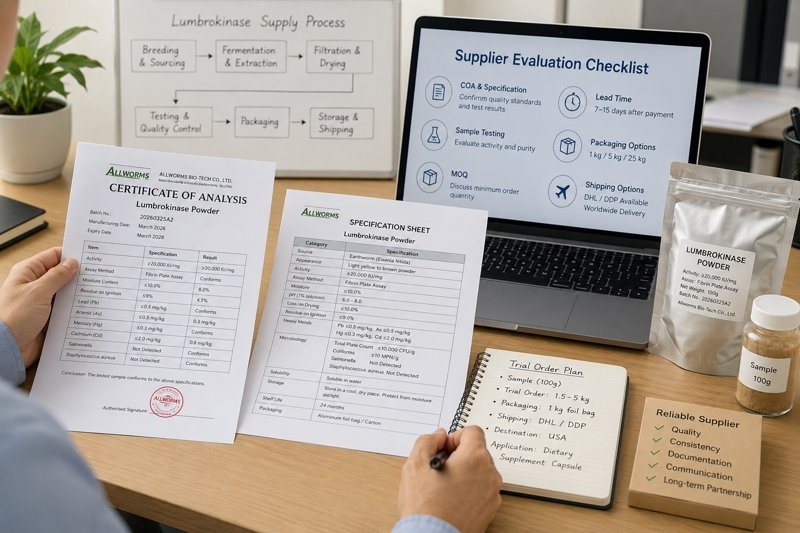
Allworms Supply Notes
Allworms Bio-Tech Co., Ltd is a manufacturer of earthworm-derived ingredients, including lumbrokinase. Buyers can review the Lumbrokinase product page for product-level information before requesting sample or order details.
COA and specification sheet can be provided for available batches. A 100 g sample may be available for qualified B2B buyers before bulk orders. Small trial orders may be discussed based on specification, quantity, packaging, and destination.
The standard MOQ is usually around 1.5 kg, depending on specification, packaging, and destination. Standard lead time is usually 7–15 days after payment. DHL shipping may be used for suitable international shipments. DDP shipping may be available for selected destinations.
This product is supplied as a B2B ingredient. Final formulation suitability, dosage, labeling, health claims, and regulatory compliance should be evaluated by the buyer according to the intended market and finished product use.
FAQ
1. How should a small supplement brand choose a lumbrokinase supplier?
A small supplement brand should choose a lumbrokinase supplier by checking COA availability, specification sheet clarity, activity grade, assay method, sample support, MOQ, lead time, packaging, shipping options, and repeat order capability. The lowest price should not be the only decision factor.
2. Can small brands order lumbrokinase without buying a very large quantity?
Yes, small brands may start with sample testing or a small trial order before approving a bulk order. The available quantity depends on specification, packaging, destination, and supplier arrangement.
3. Why is sample testing important before bulk order approval?
Sample testing helps the buyer confirm whether the lumbrokinase ingredient meets internal quality requirements and formulation needs. It can also help compare the buyer’s lab results with the supplier’s COA and specification.
4. What documents should buyers request from a lumbrokinase supplier?
Buyers should request a COA, specification sheet, activity information, assay method details, packaging information, storage conditions, and available shipping options. Additional documents may depend on the buyer’s country, application, and finished product category.
5. Should small supplement brands choose the lowest lumbrokinase price?
Not only by price. Buyers should compare price together with activity specification, assay method, COA, specification sheet, MOQ, lead time, shipping support, batch consistency, and supplier communication. A low price may create risk if the supplier cannot support documentation or repeat orders.
Looking for a lumbrokinase supplier for small supplement brands?
Contact Allworms to request sample support, COA, specification sheet, MOQ, lead time, and DHL or DDP shipping options based on your trial order or bulk order plan.