
What Contract Supplement Manufacturers Should Ask Before Approving Lumbrokinase Powder
For a contract supplement manufacturer, approving Lumbrokinase powder means deciding whether a defined supplier material can be used under its quality system for a customer’s formulation. A supplier specification may look suitable, yet leave unanswered questions about the customer’s requirements, the activity assay, manufacturing handling or future commercial batches.
The approval decision connects three parties: the customer defines product-specific needs; the contract manufacturer translates those needs into controlled raw-material and manufacturing requirements; and the supplier describes the material it can supply. Agreement between those parties should be established before the ingredient enters an approved raw-material system.

Begin with the customer’s intended material
Before reviewing a supplier, the contract manufacturer should establish what the customer has actually requested. Does the customer name a particular Lumbrokinase material or supplier? Has the customer approved a raw-material specification? Is the formulation still in development, or is the manufacturer being asked to use an ingredient already approved elsewhere?
The formulation and intended process also matter. A material selected for one customer project should not automatically be treated as approved for another project whose requirements differ. The manufacturer needs a clear account of any customer-specific technical or quality requirements and who has authority to approve a proposed material.
This starting point prevents a common approval error: accepting the supplier’s standard product description as though it were the customer’s raw-material requirement. Where requirements are incomplete, the contract manufacturer should resolve them with the customer before making a final supplier-material decision.
Confirm the exact powder being evaluated
“Lumbrokinase powder” is not, by itself, a complete material definition. The contract manufacturer should confirm the supplier’s product name or reference, the raw-material type, physical form, applicable specification version and intended commercial material. Packaging configuration may also be relevant when the ingredient will be received and handled at the manufacturing site.
These details should connect across the sample label, specification, batch certificate of analysis (COA) and eventual purchase documentation. If a sample is evaluated, the team should confirm whether it represents the material the supplier intends to provide for commercial production.
An approval record should identify the defined material and supplier relationship. That gives QA, formulation and purchasing teams a common reference when later documents or batches arrive.
Align customer, manufacturer and supplier specifications
The supplier’s specification is an essential input, but it does not automatically become the contract manufacturer’s approved raw-material specification. The manufacturer should compare it with both the customer’s requirements and its own quality-system requirements, then resolve gaps before approval.
For current Allworms Lumbrokinase, the commercial activity expression is fibrinolytic activity ≥1,000,000 U/g, measured by Fibrin Plate Assay. The contract manufacturer should decide whether that offered specification fits the intended customer formulation and its internal requirements. Other parameters should be reviewed against the applicable documents and project needs without assuming that every supplier uses the same limits.
If the customer has not defined a raw-material requirement, the formulation and QA teams may need to do so before comparing suppliers. The separate guide to defining a Lumbrokinase ingredient specification addresses that task in more detail.
Review activity together with its assay context
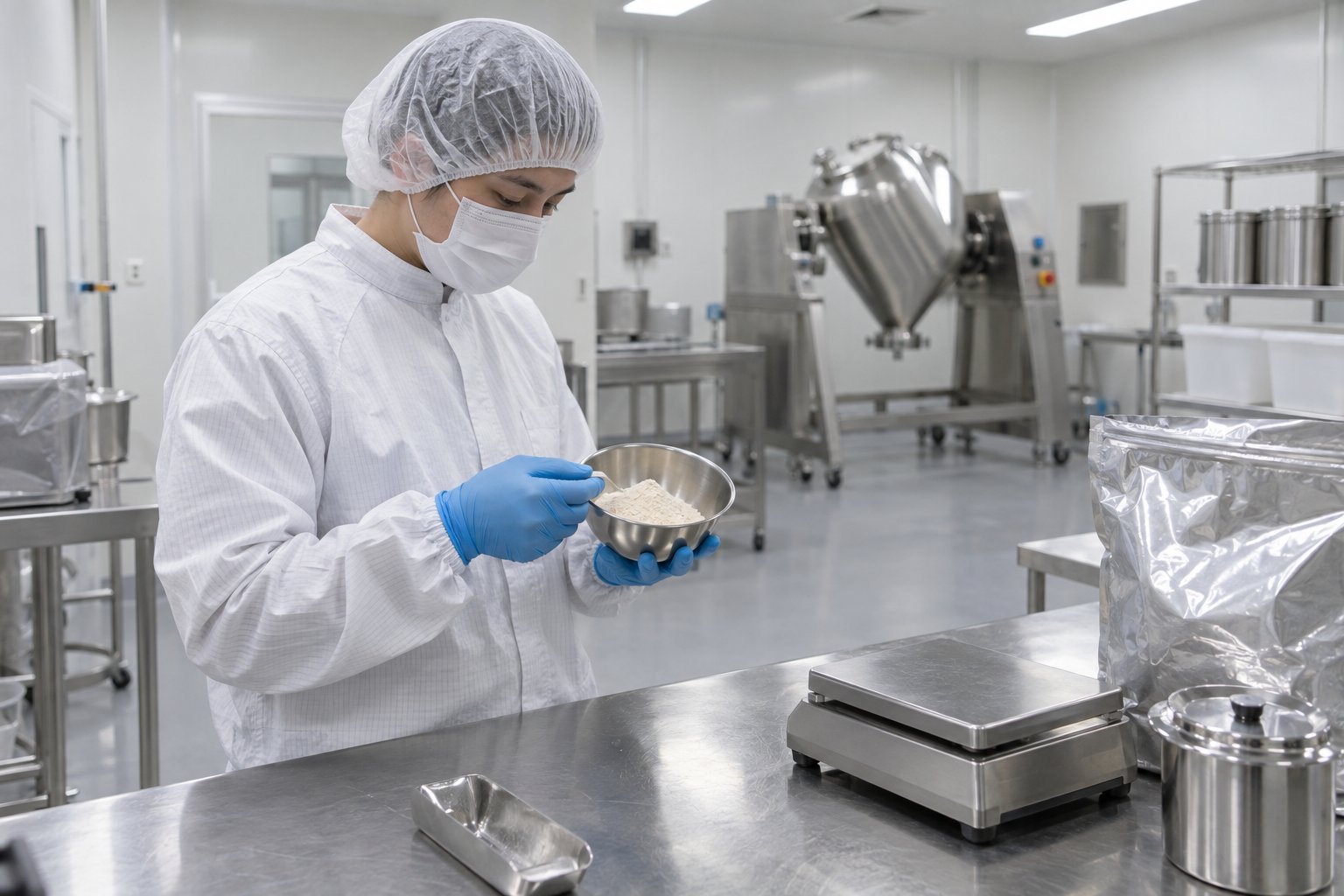
An activity figure cannot be evaluated in isolation. When a contract manufacturer reviews Allworms’ ≥1,000,000 U/g specification, it should also record that the stated method is the Fibrin Plate Assay. The method and reporting basis help the team understand what the supplier’s result represents and how it relates to the requirement being approved.
This becomes especially important if a customer brief, legacy formulation or internal document uses different activity terminology. The manufacturer should clarify the requirement and discuss assay comparability before deciding that a supplier material meets it. U/g, IU/mg, FU/g and LKU should not be assumed equivalent or converted without an appropriate, agreed basis.
The CMO approval question is focused: Does the supplier’s stated activity, with its assay method, match the material the customer and manufacturer intend to approve?
Define the documentation needed for approval
A contract manufacturer often needs documents that can be reviewed, approved and referenced again when commercial material is purchased. Depending on its procedures, the package may include a product specification, a representative or current-batch COA, assay information, relevant technical documents, packaging and storage information, and supplier or manufacturing quality information.
The team should identify required documents before treating the file as complete. It should also distinguish a specification from a COA: the specification states requirements for the material, while a COA reports results for a particular batch. One satisfactory COA does not, by itself, define the material that future batches must meet.
Document review should answer practical approval questions. Are the material identifiers consistent? Is the specification version clear? Does the COA identify its batch and report activity in a usable context? Can QA obtain the information required by its procedure? The manufacturer should request or verify any missing item rather than assume it exists.
For a broader discussion of evidence used in ingredient review, see How to Evaluate the Quality of Lumbrokinase.
Decide what testing contributes to approval
Document review may be sufficient for some preliminary decisions, but a contract manufacturer may also require a representative sample, independent testing or formulation evaluation. The decision should follow customer requirements, internal QA procedures, technical risk assessment and the status of supplier qualification.
If activity testing is planned, the laboratory brief should establish the sample identity, requested method, reporting units and calculation context before results are compared with supplier documents. Results obtained under different methods or reporting bases should be reviewed in context rather than treated as directly interchangeable.
Testing has a defined role here: it supplies evidence for the manufacturer’s material-approval decision. The team should document what question each evaluation is meant to answer and who will review the result. Detailed testing instructions and discrepancy investigations belong in separate procedures.
Check suitability for the intended manufacturing process
A technically acceptable specification does not establish that a powder can be used as planned in a customer’s production process. The formulation or manufacturing team should review the available information about appearance, powder condition, handling, packaging and storage. It should identify whether further evaluation is needed for the intended dosage form or processing steps.

For example, the team may need to inspect a sample’s physical condition or assess how it behaves during a pilot evaluation. It should request relevant handling information where the supplier documents do not answer a manufacturing question. No flowability, particle-size, stability or compatibility result should be presumed without supporting data.
This evaluation is project-specific. A finding that supports one formulation does not automatically settle another customer’s requirements. QA and formulation should agree which observations belong in the material-approval record and which require further work before production.
Plan for commercial batches, not only the sample
The manufacturer should ask how commercial material will remain aligned with the approved definition. Will future batches be supplied against the agreed specification? What batch documentation will accompany them? How will activity and other agreed quality parameters be reported?
Batch consistency means continued conformance to agreed requirements. It does not mean every batch must show identical numerical test results. The approval file should make clear which specification and documentation will govern future supply, so purchasing and QA are not forced to reinterpret the original sample decision for every production order.
Ingredient approval and batch acceptance remain distinct. Approval establishes whether a defined material and supplier may be used in the manufacturing system. The next QA task is to set the criteria for deciding whether an individual commercial batch is acceptable. That stage is covered in How to Set Lumbrokinase Batch Acceptance Criteria for Supplement Ingredient Purchasing.
Confirm supply and change-notification expectations

The purchasing team should confirm that the proposed material can support the customer’s planned manufacturing schedule. Relevant questions include expected commercial availability, packaging configuration, lead-time framework, batch-document availability and how schedule changes will be communicated. For Allworms, in-stock material is normally prepared in approximately three days; order production normally takes approximately 7–15 days. Actual timing should be confirmed for the order being planned.
The team should also agree with the supplier how relevant changes will be raised for review. Potential changes include the product specification, assay method, material or manufacturing information, packaging, storage instructions or another characteristic included in the approval. The manufacturer’s own quality system should determine which changes require notification, testing, customer communication or reapproval.
These expectations matter because an approved ingredient may support several customer formulations. A change acceptable for one project may need additional review for another. Defining the communication route during approval helps the CMO keep its material records and customer commitments aligned.
Bring the approval decision together
The contract manufacturer’s departments should work from one material definition. Formulation or R&D assesses suitability for the customer’s intended use. QA or supplier quality reviews the specification, documentation, testing and approval requirements. Purchasing checks availability and production planning. The customer confirms any product-specific requirement that falls under its control. The supplier provides information about the material it is offering.
| Approval area | What the contract manufacturer should confirm | Why it matters |
|---|---|---|
| Customer requirement | Intended formulation and any customer-approved material requirements | Establishes what the manufacturer is being asked to use |
| Ingredient identity | Supplier material reference, physical form and specification version | Connects samples, documents and future orders |
| Specification | Alignment among customer, internal and supplier requirements | Prevents automatic adoption of the supplier standard |
| Activity and assay | Stated activity alongside its method and reporting context | Supports a meaningful technical comparison |
| Documentation | Documents required by the manufacturer’s procedure | Creates a reviewable approval record |
| Sample and testing | Whether evaluation is required and what it must establish | Supplies evidence for the approval decision |
| Manufacturing suitability | Information or trials needed for the intended process | Addresses project-specific handling questions |
| Future batches | Agreed specification and batch-document expectations | Supports continued conformance |
| Supply and changes | Production timing and relevant change communication | Supports scheduling and controlled reassessment |
A practical workflow is to confirm the customer requirement, define internal raw-material needs, identify the offered supplier material, align the specification and assay, review documents, complete any required testing or manufacturing evaluation, and resolve supply and change-notification expectations. QA then completes ingredient and supplier approval under the manufacturer’s own procedure. Future commercial batches are assessed against the approved requirements when supplied and received.
Contract manufacturers seeking the current material description can review the Allworms Lumbrokinase product page and use the Allworms FAQ page for general supplier and product questions. These pages provide starting information; the manufacturer’s approved record should identify the documents and decisions that apply to its customer projects.
FAQs
What should a contract supplement manufacturer establish before approving Lumbrokinase powder?
It should identify the customer’s intended material, reconcile customer and internal requirements with the supplier’s specification, review activity and assay context, obtain required documents, complete any necessary testing or manufacturing evaluation, and define expectations for future supply and relevant changes.
Can the supplier specification become the manufacturer’s approved specification automatically?
No. It should be compared with customer requirements and the manufacturer’s own raw-material requirements. Any differences need review and resolution through the applicable approval process.
Why must activity and assay method be reviewed together?
The assay provides context for the reported activity. Allworms currently expresses fibrinolytic activity as ≥1,000,000 U/g by Fibrin Plate Assay. A differently expressed customer requirement should be clarified before the manufacturer decides whether it aligns.
Does every CMO need independent testing before ingredient approval?
The need depends on customer requirements, the manufacturer’s procedures, its risk assessment and the evidence already available. When testing is used, its method and reporting context should be defined before comparing results.
Is approval of a sample the same as approval of commercial batches?
No. A sample can support evaluation of the proposed material. The approval decision must also establish what specification and documentation will apply to future commercial batches.
What changes might require review after approval?
The manufacturer may need to review changes to the specification, assay method, relevant material or manufacturing information, packaging, storage instructions or other approved characteristics. Its quality system determines the response and whether customer involvement is required.

Review The Lumbrokinase Specification And Assay Method?
Discuss your approval requirements with Allworms.