How Dietary Supplement Companies Should Evaluate Earthworm-Derived Ingredient Suppliers
Choosing an earthworm-derived ingredient supplier requires more than comparing quotations or reviewing one certificate of analysis. Dietary supplement companies need to determine whether a supplier can support a defined specification, explain relevant test methods, connect samples and commercial material to identifiable batches, manage reasonable batch variation and maintain dependable communication as purchasing progresses.
This guide provides a qualification framework for supplement brands, contract manufacturers, QA/QC teams, sourcing teams and technical evaluators reviewing suppliers of Lumbrokinase, Earthworm Protein Powder or Earthworm Peptide Powder. It evaluates the supplier organization rather than comparing the ingredients.

Supplier Qualification Is a Sequence, Not a Document Check
A COA is important, but it cannot answer every qualification question. A useful process examines technical capability, documentation, traceability, sample support, consistency and commercial readiness together.
The sequence should move from supplier identification through specification, method, document, traceability, sample and commercial reviews to approval and ongoing management. This prevents purchasing from advancing before QA and R&D understand what will be supplied.
Buyers beginning this review can first confirm which ingredient category and format are available in the Allworms earthworm-derived ingredient portfolio. The next task is to define the exact material and requirements relevant to the intended application.
Start With the Product and Governing Specification
Ask the supplier to identify the product unambiguously and provide the specification that will govern supply. The specification should show the parameters used to define acceptable material, the units and, where critical, the associated test methods. The buyer should confirm that the document version being reviewed is the version expected to apply to samples, trial orders and commercial batches.
The three ingredient categories should not be forced into one specification model. For Lumbrokinase, fibrinolytic activity and its assay method are product-defining. Allworms currently expresses this as Fibrinolytic Activity: ≥1,000,000 U/g, measured by the Fibrin Plate Assay. Do not automatically convert U/g to IU/mg, FU/g or LKU or treat results from different assay systems as interchangeable.
For Earthworm Protein Powder, protein content, composition-related information, physical characteristics and formulation suitability may carry more weight. For Earthworm Peptide Powder, peptide or protein characteristics, molecular-weight information where available, dispersibility and sensory or physical properties may be relevant. These examples illustrate why buyers need product-specific criteria after establishing the general supplier framework.
For a wider explanation of how testing differs among the categories, review quality tests for earthworm-derived ingredients.
Review What Is Tested—and How It Is Tested
Supplier qualification should connect every critical result to its context. For each product-defining parameter, buyers should confirm the test item, method, reporting unit, specification basis and batch result. They should also understand whether the information comes from internal testing, third-party testing or another stated source where relevant.
Method alignment matters when a buyer verifies a sample independently. A difference may reflect the method, sample preparation, reporting basis or calculation procedure. Before comparison, QA should establish whether both laboratories are working on the same basis.
The objective is to determine whether the evidence supports the decision and the supplier can explain the specification, method and batch result.
Use Documentation to Support Decisions
Supplier documents should answer qualification questions rather than become a collection exercise. Depending on the ingredient and buyer requirements, the review may include:
- Product specification and batch COA
- Technical and test-method information
- Packaging, storage and shelf-life information
- Batch or raw-material traceability information
- A manufacturing or process description
- Applicable safety information
- Additional quality documents requested by the buyer and available from the supplier
QA should check document identity, product name, batch number, specification version, reporting units and consistency across records. A specification defines requirements; a batch COA reports results for identified material. One cannot replace the other.
Verify certification requirements directly for the intended market and application. Do not infer certificates, approvals or regulatory status from marketing language.
Make Traceability Part of Qualification
Traceability does not need to begin with an elaborate digital platform. It begins with practical links among the physical material and its records. Can a sample be linked to an identifiable batch and its COA? Can a commercial batch be matched to its documentation? Can the supplier identify relevant production or raw-material information and retain records needed for repeat supply?
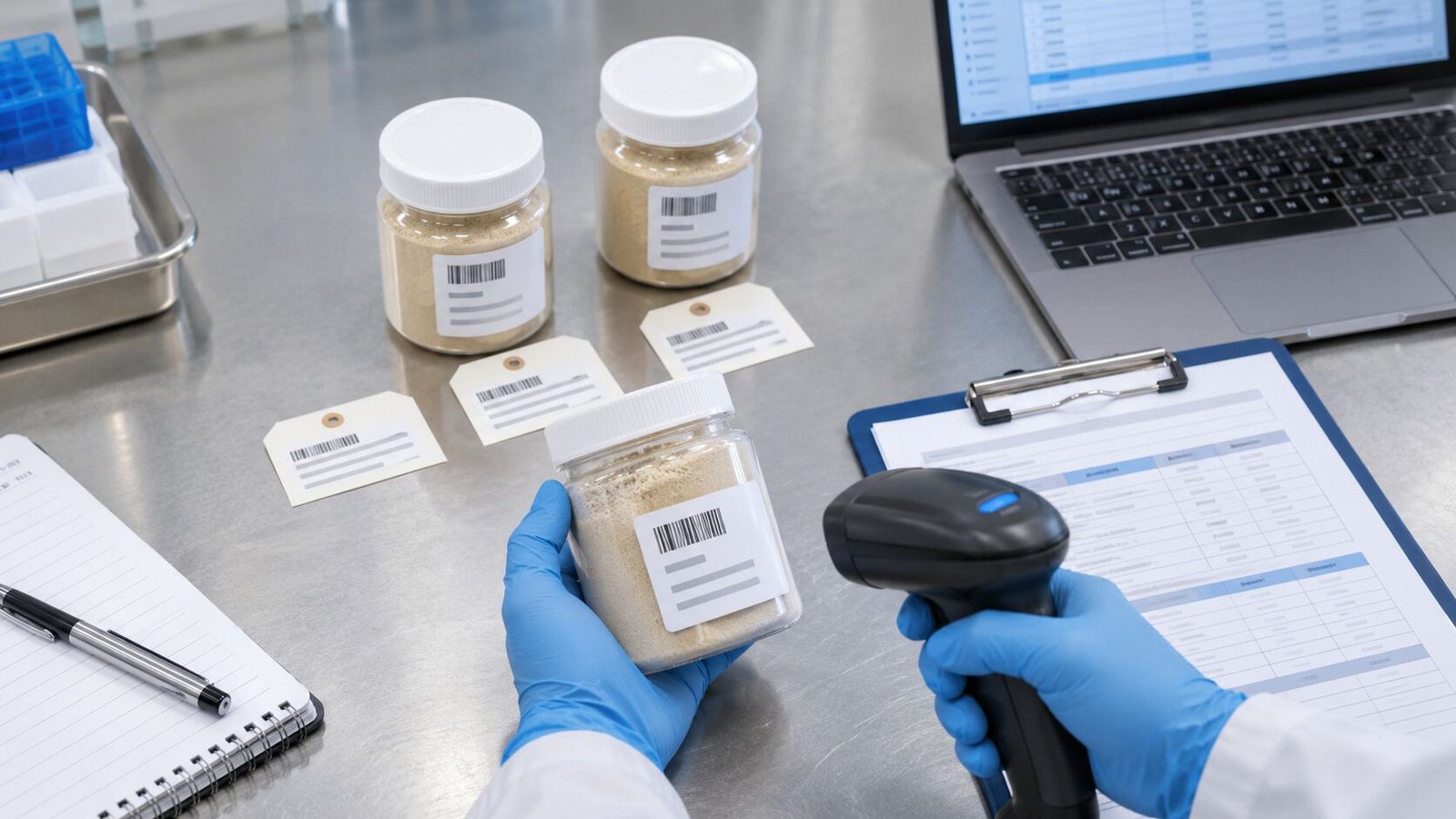
Buyers should ask how the supplier communicates meaningful changes between the evaluated sample and later material. The review depth should match product risk, company procedures and intended use. Seek sufficient evidence for qualification rather than assume complete farm-to-finished-product visibility.
Evaluate a Representative Sample With a Defined Purpose
A sample is useful only when the buyer knows what it is intended to prove. Depending on the ingredient, evaluation may cover identity or appearance, critical analytical parameters, physical characteristics, formulation suitability, documentation alignment, packaging and handling. Third-party testing may be added where the buyer’s qualification plan requires it.
Link the sample to its batch information and review documents. R&D and QA should distinguish acceptance-critical observations from supporting information. Product-specific protocols belong in their technical clusters; protein buyers can use the Earthworm Protein Powder sample evaluation guide for detailed checks.
Define the Sample-to-Commercial Transition
Sample approval does not mean every future commercial batch will be numerically identical. Before approval, establish how the process will move from sample to pilot or trial order, commercial batch and repeat supply.
Confirm that commercial material will be governed by the agreed specification, supported by a batch COA and supplied in the agreed packaging configuration. Identify which parameters can vary within specification, what differences should trigger communication and what must be reconfirmed before a purchase order is released.
Batch consistency means conformance to agreed requirements—not identical numbers. The supplier should support identifiable batches, relevant tests, reviewable documents and investigation of meaningful discrepancies. Do not invent statistical expectations without a justified history or protocol.
Assess Commercial Supply Capability
Technical approval is incomplete if the supplier cannot support purchasing. Sourcing should review production or inventory status, MOQ, packaging configuration, lead time, documentation preparation, shipping capability and repeat-order communication.

For Allworms, general commercial references include an MOQ of approximately 1.5 kg, packaging of approximately 1.5 kg per bag, preparation of in-stock material typically within about three days and order production typically within about 7–15 days. Actual timing and logistics should be confirmed for the specific product, quantity and destination.
Teams planning enzyme supply at a larger scale can continue to commercial-scale Lumbrokinase sourcing for product-specific scale-up considerations.
Supplier Qualification Table
| Qualification Area | What Buyers Should Confirm | Why It Matters |
|---|---|---|
| Product / Specification | Exact product, governing specification, version and intended application | Establishes what material is being approved |
| Testing & Methods | Critical test, method, unit, basis and result source | Makes analytical results interpretable |
| Batch COA | Product and batch identity, applicable results and alignment with specification | Connects documented results to supplied material |
| Documentation | Technical, storage, packaging, shelf-life, process and applicable safety information | Supports a defensible qualification decision |
| Traceability | Links among sample, batch, COA and relevant production records | Supports verification and repeat purchasing |
| Sample Evaluation | Representative sample, defined criteria and documented outcome | Tests suitability before commercial commitment |
| Batch Consistency | Conformance expectations and discrepancy process | Manages reasonable variation without demanding identical results |
| Packaging & Storage | Pack format, handling, storage and shelf-life information | Protects material through receipt and use |
| Commercial Supply | MOQ, availability, lead time, shipping and repeat-order support | Confirms operational readiness |
| Ongoing Communication | Change notification, document response and investigation support | Sustains qualification after initial approval |
Align QA, R&D and Sourcing Before Approval

Supplier qualification is not a purchasing-only decision. QA/QC typically owns specification, test, COA, traceability and acceptance review. R&D or formulation teams evaluate technical suitability, physical characteristics and performance in the intended formulation. Sourcing or procurement evaluates MOQ, lead time, packaging, commercial terms, logistics and continuity.
Agree on critical requirements before requesting a sample or issuing a purchase order. A sample may pass an R&D trial while documentation remains insufficient for QA, or qualified material may not fit commercial planning.
A Practical Supplier-Qualification Workflow
- Define the required ingredient, intended application and internal owners.
- Review the supplier’s current product specification.
- Confirm critical tests, methods, units and reporting basis.
- Review available qualification documents for relevance and consistency.
- Confirm how the sample and commercial batches are identified and documented.
- Request and evaluate a representative sample where appropriate.
- Define sample-to-commercial-batch expectations and acceptance-critical criteria.
- Review COA practices, batch consistency and discrepancy handling.
- Assess packaging, lead time, logistics and repeat-supply capability.
- Complete combined QA, R&D and sourcing approval, then define ongoing review requirements.
For operational details that vary by product or destination, buyers can consult the Allworms FAQ during the qualification process.
FAQs
What should supplement companies check first when qualifying a supplier?
Begin with the exact product, governing specification and intended application. This determines which tests, documents, sample checks and commercial questions are relevant.
Why review both a specification and a batch COA?
The specification defines the requirements for the material. The COA reports results for an identified batch. Buyers need both to assess conformance.
How important is the supplier’s test method?
It is critical for product-defining parameters. Results cannot be interpreted reliably without the method, unit and reporting basis, particularly when comparing supplier and third-party laboratory data.
Should a sample be tested before supplier approval?
When appropriate to the ingredient and buyer procedure, yes. The evaluation should follow predefined criteria and may include analytical, physical, formulation and documentation checks.
What traceability information should buyers request?
Buyers should seek practical links among the supplied sample or commercial material, its batch identity, COA and relevant production or raw-material records.
Does batch consistency mean identical results?
No. It means batches conform to the agreed specification and acceptance requirements, are tested on the relevant basis and are supported by traceable documentation.
What should be confirmed before moving to a commercial order?
Reconfirm the governing specification, batch documentation, acceptance-critical parameters, packaging, availability, lead time and how meaningful differences will be communicated.
How should QA and sourcing divide responsibilities?
QA should lead technical acceptance and documentation review, while sourcing leads commercial and supply assessment. R&D should confirm application suitability. Final approval should combine all three perspectives.

Evaluate Your Earthworm-Derived Ingredient Supplier With The Right Documents?
Contact Allworms to review specifications, batch documentation and sample options for your qualification process.