
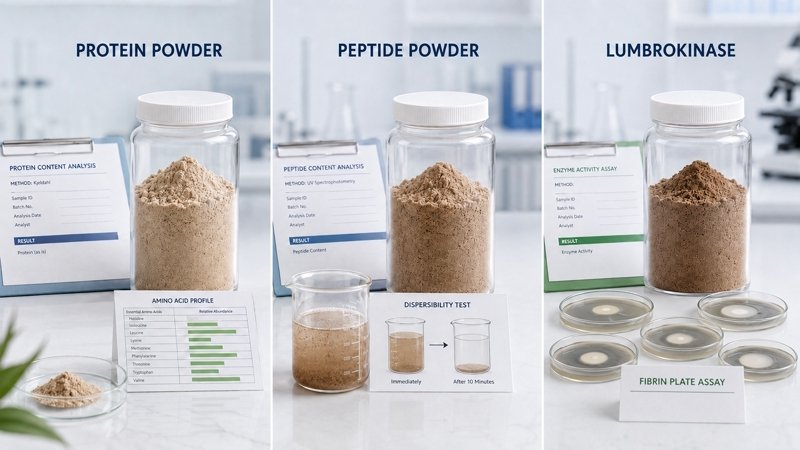
Earthworm ingredient quality tests must match the identity and intended use of each product. Although Earthworm Protein Powder, Earthworm Peptide Powder and Lumbrokinase originate from earthworm-derived raw materials, they are not interchangeable ingredients and should not be assessed through one standard testing framework.
Earthworm Protein Powder is evaluated primarily as a protein-rich ingredient. Earthworm Peptide Powder is evaluated as a stable peptide ingredient produced through enzymatic hydrolysis. Lumbrokinase, by contrast, is evaluated as an earthworm-derived fibrinolytic enzyme ingredient.
For purchasing teams, this distinction affects which COA items matter, which laboratory methods are relevant, how samples should be tested and how supplier specifications should be compared. Applying the wrong test logic may lead to misleading comparisons, unsuitable specifications or incorrect bulk-order decisions.
Quick Answer
Earthworm Protein Powder, Earthworm Peptide Powder and Lumbrokinase require different quality tests because they are different ingredient types.
Earthworm Protein Powder is evaluated mainly through protein-related and general quality parameters. Earthworm Peptide Powder requires peptide-focused evaluation and is not positioned as an active enzyme product. Activity units and assay methods are relevant to Lumbrokinase only because it is supplied as a fibrinolytic enzyme ingredient.
Why One Testing Framework Does Not Fit All Three Products
A quality test is useful only when it measures an attribute relevant to the product’s identity and the buyer’s application.
All three products may share certain general controls, such as moisture, heavy metals, microbiology, appearance and batch identification. However, these common checks do not eliminate the need for product-specific evaluation.
The primary differences are:
- Earthworm Protein Powder is selected mainly for its protein-rich composition.
- Earthworm Peptide Powder is produced through enzymatic hydrolysis and selected for its peptide characteristics and formulation suitability.
- Lumbrokinase is selected according to enzyme activity specifications and the test method used to determine that activity.
Using protein percentage alone to compare all three products would ignore peptide characteristics and enzyme activity. Similarly, requesting fibrinolytic activity data for protein powder or peptide powder would apply an enzyme test to products that are not positioned as active enzyme ingredients.
Buyers who are still determining which ingredient category fits their project can first review Earthworm-Derived Ingredients: How to Choose Between Protein Powder, Peptide Powder and Lumbrokinase.
Quality Tests for Earthworm Protein Powder
Earthworm Protein Powder should be evaluated as a protein-rich earthworm-derived ingredient for nutritional, functional ingredient, animal nutrition or related product-development applications.
Its core quality review may cover:
- Protein content
- Amino acid profile, if available and relevant
- Moisture
- Ash
- Heavy metals
- Microbiology
- Appearance and color
- Odor
- Batch number
- Packaging and storage information
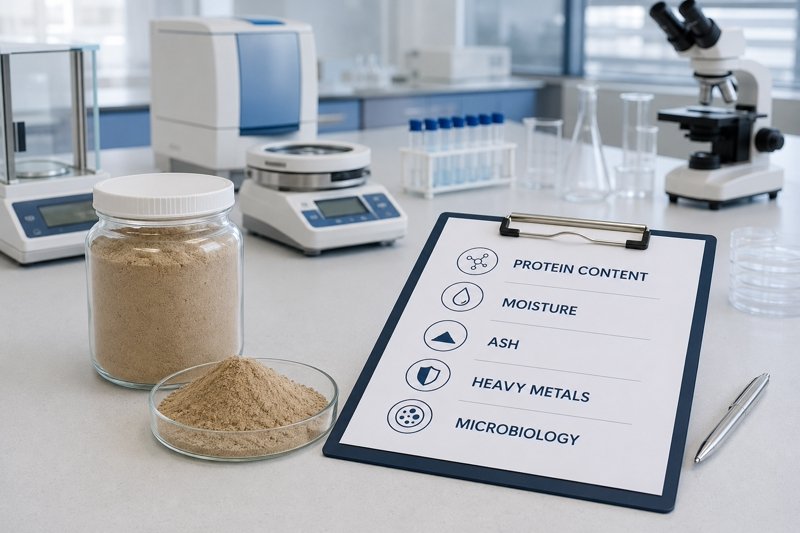
Protein content is an important identity and specification indicator, but a higher percentage does not automatically make one material more suitable. The buyer should also consider the formulation target, sensory characteristics, contaminants, processing requirements and applicable market rules.
An amino acid profile can provide additional compositional information when available. However, buyers should check whether the profile applies to the offered product and whether it represents a particular production batch or general product information.
Earthworm Protein Powder should not be evaluated through lumbrokinase activity units. IU/mg, FU/g, LKU, U/g, enzyme activity grades and fibrin plate assays are not appropriate quality criteria for this product.
Before sourcing the material, buyers can review the Earthworm Protein Powder product page to confirm its positioning, available specifications and document support.
Quality Tests for Earthworm Peptide Powder
Earthworm Peptide Powder is a peptide ingredient produced through enzymatic hydrolysis, filtration, concentration, spray drying and pulverization. The finished powder is positioned as a stable peptide ingredient, not as an active fibrinolytic enzyme product.
Relevant evaluation items may include:
- Peptide content
- Protein content as a supporting parameter
- Molecular weight information, if available
- Solubility or dispersibility where relevant
- Moisture
- Ash
- Heavy metals
- Microbiology
- Appearance and odor
- Batch information
- Storage conditions
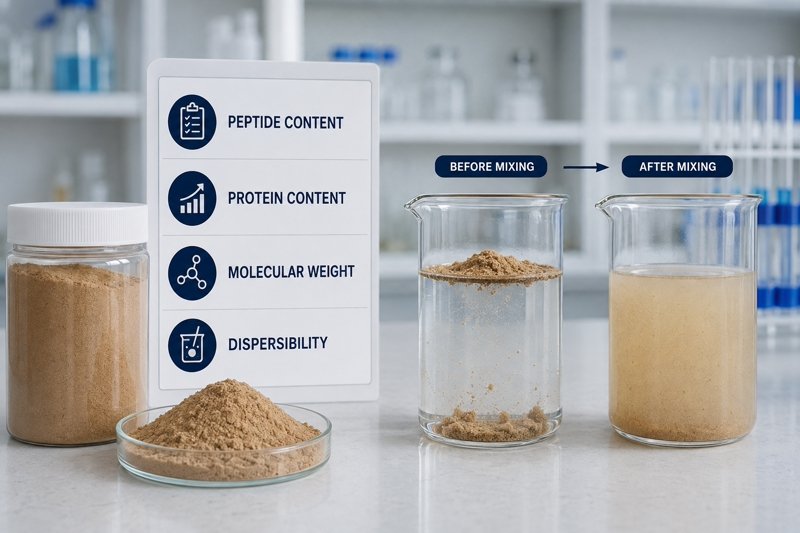
Peptide content is more directly relevant to this product than it is to Earthworm Protein Powder. Nevertheless, buyers should not make a purchasing decision from peptide percentage alone. The target formulation, quality documents, processing conditions, taste, dispersibility and intended finished-product format can also affect suitability.
Molecular weight distribution may be useful for certain formulation or research requirements, but buyers should request it only when it supports a defined technical decision. Suppliers should not be expected to provide an invented or unsupported molecular weight range.
Solubility and dispersibility also require practical interpretation. A material may disperse sufficiently for one formulation without being completely transparent or fully dissolved in another. Buyers should assess the powder in their actual liquid system, concentration, temperature, mixing process and pH conditions where relevant.
Lumbrokinase activity testing should not be applied to Earthworm Peptide Powder. Peptide content, protein content or dispersibility does not demonstrate fibrinolytic enzyme activity.
The Earthworm Peptide Powder product page provides further information for buyers evaluating this ingredient category.
Quality Tests for Lumbrokinase
Lumbrokinase should be evaluated as an earthworm-derived fibrinolytic enzyme ingredient for dietary supplement, nutraceutical, enzyme formulation and research-related applications.
Its quality review may include:
- Activity result
- Activity unit
- Assay method
- Fibrin plate assay information where relevant
- Activity grade
- Batch number
- Moisture
- Microbiology
- Heavy metals if listed
- COA and specification alignment
- Sample-testing results
- Sample-to-bulk specification consistency
An activity value should never be interpreted without its reporting basis. The buyer should identify the activity unit and ask how the result was determined. IU/mg, FU/g, LKU and U/g may reflect different methods or reporting systems and should not be treated as automatically interchangeable.

Where more detailed technical comparison is required, relevant variables may include sample preparation, substrate, reference standard, incubation conditions, calculation method and whether results are reported per gram, per milligram or on another basis.
This is particularly important when comparing results from two laboratories. Different numbers may reflect methodological differences rather than a simple difference in product quality. No fixed FU/g-to-IU/mg conversion should be assumed without validated method-comparison data.
The highest activity number is also not automatically the best commercial choice. Buyers should select an activity grade that matches the intended formulation, testing basis, cost structure and labeling strategy.
See the Lumbrokinase product page for the product’s B2B positioning and available evaluation support.
Product-Specific Quality Testing Comparison
| Product | Ingredient type | Main quality focus | Key COA or technical items | What buyers should not confuse |
|---|---|---|---|---|
| Earthworm Protein Powder | Protein-rich ingredient | Protein composition and general safety or stability indicators | Protein, moisture, ash, heavy metals, microbiology, appearance and batch number | Do not evaluate it through peptide claims or lumbrokinase activity units |
| Earthworm Peptide Powder | Stable peptide ingredient produced through enzymatic hydrolysis | Peptide characteristics and formulation suitability | Peptide content, supporting protein content, molecular weight information if available, dispersibility if listed, moisture, ash, heavy metals and microbiology | Do not treat it as Lumbrokinase or request active enzyme testing |
| Lumbrokinase | Earthworm-derived fibrinolytic enzyme ingredient | Activity specification and method interpretation | Activity result, unit, assay method, batch number, moisture, microbiology and heavy metals if listed | Do not evaluate it mainly as a protein nutrition or peptide ingredient |
COA vs Specification Sheet in Product-Specific Evaluation
A specification sheet defines the target requirements for a product. A Certificate of Analysis reports the test results associated with a specific batch.
Buyers should compare the batch COA against the correct product specification rather than treating any long list of tests as proof of suitability.
For Earthworm Protein Powder, the review may concentrate on protein, moisture, ash, heavy metals, microbiology and batch identification. For Earthworm Peptide Powder, peptide content becomes a primary parameter, while protein content may provide supporting information. Molecular weight or dispersibility data can be considered if they are included and relevant.
For Lumbrokinase, the activity result, activity unit and assay basis should receive particular attention. The COA should also be checked for batch identification and alignment with the agreed activity grade.
The website FAQ page can support buyers with broader questions about documents, samples, specifications, ordering and international supply.
Why the Testing Method Matters
Testing methods measure different quality attributes and cannot substitute for one another.
Protein content testing estimates protein-related composition but does not replace peptide content evaluation. Peptide content or dispersibility testing does not prove enzyme activity. A lumbrokinase activity assay is intended for Lumbrokinase and does not provide a relevant quality grade for Earthworm Protein Powder or Earthworm Peptide Powder.
Buyers should therefore ask three questions before comparing results:
- What product attribute is the test intended to measure?
- Which method and reporting basis were used?
- Does the result support a real formulation or purchasing requirement?
This prevents a common procurement problem: comparing two suppliers by similarly named results that were generated by different methods or that measure different product attributes.
Sample Evaluation Should Match the Product Type
Samples should be evaluated through a product-specific protocol rather than one universal test panel.
For Earthworm Protein Powder, sample work may include visual and odor checks, review of protein-related documents and a formulation trial. Sample-to-bulk specification consistency should then be confirmed before purchase.
For Earthworm Peptide Powder, buyers may examine appearance, taste where appropriate, dispersibility, processing behavior and peptide-related specifications. The test conditions should resemble the proposed finished-product process as closely as practical.
For Lumbrokinase, buyers should agree on the activity grade and assay basis before or during sample testing. If an independent laboratory is used, its method should be compared with the supplier’s method before conclusions are drawn from different activity results.
A sample does not guarantee that every future batch will be identical. If the original sample batch is unavailable after a long purchasing delay, the buyer should review the COA for the actual bulk batch and confirm that it meets the agreed specification. The final bulk batch does not need to carry the same batch number as the approved sample, but it should meet the agreed product-specific requirements.
Buyer Document Review Checklist
| Review step | Practical buyer question | Protein Powder | Peptide Powder | Lumbrokinase |
|---|---|---|---|---|
| Confirm identity | Is the commercial name supported by a clear ingredient description? | ✓ | ✓ | ✓ |
| Define the main attribute | What characteristic is the buyer actually purchasing? | Protein content | Peptide content and formulation properties | Enzyme activity |
| Check reporting basis | Are values expressed on a clear basis and linked to a method where necessary? | ✓ | ✓ | Essential |
| Match COA to specification | Does the offered batch meet the agreed targets? | ✓ | ✓ | ✓ |
| Review formulation relevance | Do sensory, dispersibility or processing properties meet the intended use? | As relevant | Important | As relevant |
| Review sample-to-bulk consistency | Does the actual bulk batch meet the approved specification? | ✓ | ✓ | Include activity grade and assay basis |
| Confirm commercial details | Are packaging, MOQ, lead time, storage and shipping arrangements clear? | ✓ | ✓ | ✓ |
Common Mistakes When Comparing Quality Tests
Several errors can distort supplier evaluation:
- Applying lumbrokinase activity units to Earthworm Protein Powder.
- Treating Earthworm Peptide Powder as Lumbrokinase.
- Comparing all three products only by protein percentage.
- Assuming higher protein, peptide or enzyme activity values always mean better formulation suitability.
- Reviewing a COA without confirming that its tests match the ingredient type.
- Requesting the same laboratory report for all three products.
- Comparing supplier results without checking methods and reporting bases.
- Asking for enzyme activity data for non-enzyme products.
- Ignoring sample-to-bulk specification consistency before bulk approval.
- Failing to define acceptance criteria before sending a sample to an external laboratory.
That final point is especially important. If acceptance criteria are created only after results are received, procurement teams may unintentionally judge a sample against a requirement that was never communicated to the supplier.
How Allworms Supports Product-Specific Quality Evaluation
Allworms supplies Earthworm Protein Powder, Earthworm Peptide Powder and Lumbrokinase to global B2B buyers. Available batch COAs, specification sheets and relevant product information can be provided for supplier and formulation evaluation.
Sample support, packaging, MOQ, lead time and shipping arrangements can be discussed according to the product type, specification, quantity, destination and purchasing stage. Before bulk-order approval, buyers should confirm the actual available batch, corresponding COA, specification alignment, packaging and transportation plan.
Suitable sealed packaging, moisture protection, cool and dry storage, warehouse handling and destination customs requirements should also be considered when protecting ingredient quality through the supply chain.
FAQ
Why do these three earthworm-derived ingredients require different quality tests?
They have different ingredient identities and purchasing purposes. Earthworm Protein Powder is assessed mainly as a protein-rich ingredient, Earthworm Peptide Powder as a peptide ingredient, and Lumbrokinase as a fibrinolytic enzyme ingredient.
What should buyers review for Earthworm Protein Powder?
Buyers may review protein content, amino acid information if available, moisture, ash, heavy metals, microbiology, appearance, odor, batch information, packaging and storage guidance. Enzyme activity units are not relevant to this product.
Is Earthworm Peptide Powder tested by lumbrokinase activity?
No. Earthworm Peptide Powder is produced through enzymatic hydrolysis but is not positioned as an active enzyme ingredient. It should be evaluated through peptide-related, compositional, general quality and formulation criteria.
What is most important when reviewing Lumbrokinase activity?
The activity result should be reviewed together with the activity unit, assay method and reporting basis. Buyers should not assume that results expressed in IU/mg, FU/g, LKU or U/g are directly interchangeable.
Can protein content be used to compare all three products?
No. Protein content is a key parameter for Earthworm Protein Powder and may be a supporting parameter for Earthworm Peptide Powder, but it does not replace peptide evaluation or Lumbrokinase activity testing.
What is the difference between a COA and a specification sheet?
The specification sheet defines the intended product requirements, while the COA records test results for a particular batch. Buyers should verify that the COA corresponds to the correct product and meets the agreed specification.
Should buyers request samples before placing a bulk order?
Sample evaluation is recommended when formulation compatibility, sensory characteristics, dispersibility or independent activity testing is important. The sample protocol should be designed for the specific ingredient type.
Can the same laboratory test be used for all three ingredients?
No single product-specific test can evaluate all three. Some general tests, including moisture, microbiology or heavy metals, may overlap, but protein, peptide and enzyme activity assessments serve different purposes.
Choose The Right Quality Tests For Your Earthworm Protein Powder, Peptide Powder Or Lumbrokinase Project?
Contact Allworms for specifications, batch documents and sample support