
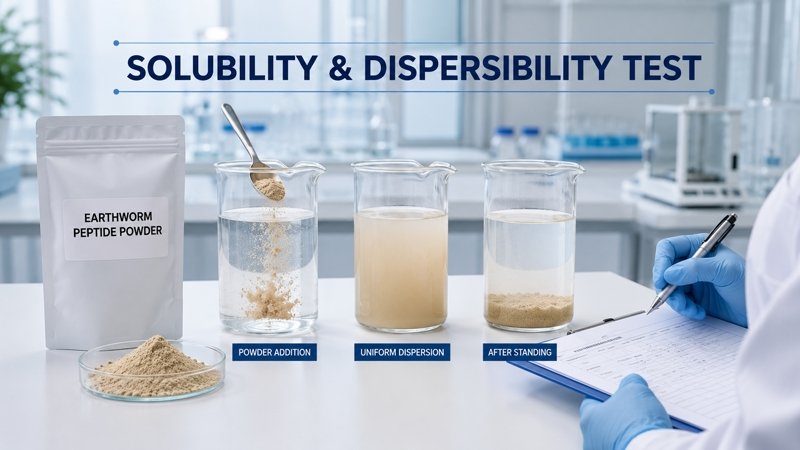
Earthworm peptide powder solubility should be evaluated under controlled conditions before a formulation team approves an ingredient sample or purchasing moves to a bulk order. A powder may appear acceptable in its original form but behave differently after contact with water, flavor systems, sweeteners, excipients, or other ingredients.
For B2B buyers, the purpose of this evaluation is not to predict absorption or health performance. It is to determine whether the ingredient can be processed consistently in the intended product format. Useful observations include dispersion time, clumping, floating material, sedimentation, hydrated appearance, odor, taste impact, and compatibility with the complete formulation.
These results should be assessed alongside the specification sheet, batch COA, peptide and protein content, molecular weight information when available, and the buyer’s application-specific requirements.
Quick Answer
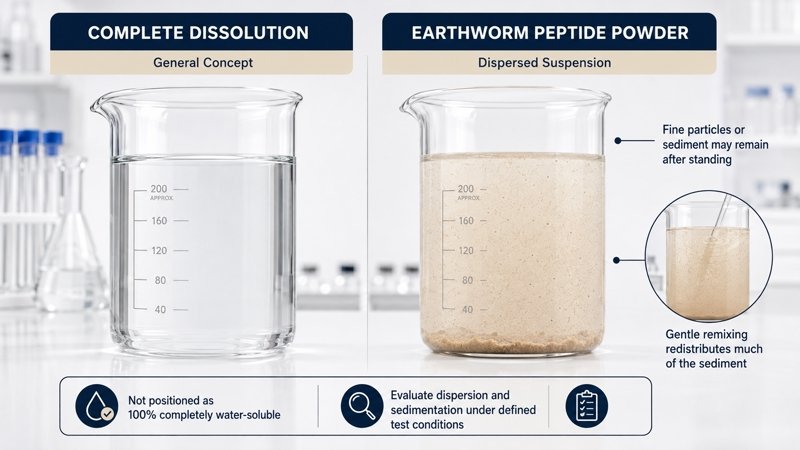
B2B buyers should test earthworm peptide powder solubility and dispersibility by recording how the sample mixes with water, whether it forms a uniform suspension, how long it takes to disperse, and whether clumps, floating particles, or sediment remain after standing. Allworms Earthworm Peptide Powder is not positioned as 100% completely water-soluble, so buyers should evaluate the degree of dispersion and sedimentation against the requirements of their intended formulation.
The results should be reviewed together with the specification sheet, COA, peptide content, protein content, molecular weight information if available, and application-specific requirements.
Why Solubility and Dispersibility Matter in Formulation Evaluation
Solubility and dispersibility affect how an ingredient moves through development, pilot production, and routine manufacturing. They may influence mixing procedures, processing time, visual consistency, powder handling, suspension stability, and sensory properties.
The importance of each property depends on the product format:
- A drink powder or sachet may require acceptable dispersion with limited clumping.
- A functional beverage concept may need controlled sedimentation and an acceptable hydrated appearance.
- A blended powder formula may require even distribution among ingredients with different particle characteristics.
- A capsule or tablet project may place greater emphasis on dry blending, flow, moisture, and compatibility with excipients.
- A premix supplier may need repeatable behavior when the peptide powder is combined with flavors, carriers, minerals, or other proteins.
- A contract manufacturer may need clearly defined mixing instructions before accepting the material for pilot production.
No single solubility result proves suitability for every application. Buyers should evaluate the sample under conditions that represent their own production system and finished-product concept.
For broader sample qualification criteria, buyers can consult Earthworm Peptide Powder Sample Evaluation before defining their approval procedure.
Solubility vs Dispersibility
Although these terms are sometimes used interchangeably, they describe different formulation properties.
Solubility refers to whether material dissolves into the liquid phase under defined conditions. A meaningful result therefore requires details such as sample concentration, liquid composition, temperature, pH, mixing method, and mixing time.
Dispersibility describes how easily the powder spreads through a liquid or dry blend without forming persistent clumps, floating layers, or uneven concentrations.
A material may disperse quickly but not dissolve completely. Fine particles may become evenly suspended while some insoluble material remains. Conversely, a powder that can eventually dissolve may initially form clumps that require longer mixing or stronger agitation.
These behaviors can be affected by composition, particle size, agglomeration, moisture exposure, liquid temperature, pH, and other ingredients in the formulation. Buyers should therefore avoid reducing the evaluation to a simple “soluble” or “insoluble” description.
Earthworm Peptide Powder is produced through enzymatic hydrolysis of earthworm-derived protein material. The finished powder is positioned as a peptide ingredient, not as an active enzyme ingredient or fibrinolytic product. Enzyme activity units and fibrin plate assays belong to lumbrokinase evaluation and are not appropriate measures of peptide powder solubility.
What Buyers Should Test in the Lab
A useful screening test does not require an elaborate protocol, but it does require consistent conditions and structured observations.
Water solubility
Add a defined quantity of sample to a recorded volume of water. Observe how much of the powder enters the liquid phase and whether the mixture forms a reasonably uniform suspension. Allworms Earthworm Peptide Powder may not dissolve completely and may leave fine suspended particles or sediment after standing. Buyers should record the observed behavior under defined conditions rather than assessing the sample only against complete transparency.
The conclusion should describe what occurred under the stated conditions rather than making a universal solubility claim.
Dispersion time and mixing behavior
Record how long the material takes to spread evenly through the liquid. Note whether it wets immediately, remains on the surface, sticks to the container wall, or requires additional agitation.
Buyers can also record whether adding powder to water produces a different result from adding water to powder.
Clumping and floating particles
Check for dry pockets, surface rafts, persistent lumps, or material collecting around the mixing tool. These observations can help the formulation team decide whether the ingredient requires pre-blending, staged addition, sieving, or a different mixing method.
Sedimentation after standing
Observe the mixture immediately after preparation and again at predetermined time points. A beverage buyer might review it after 10, 20, and 30 minutes, while another application may require a longer observation period.
Record the amount, appearance, and compactness of any sediment. If the mixture is shaken again, note whether the sediment redistributes easily.
The presence of some sediment does not by itself prove that the sample is defective. Buyers should determine whether the sediment level, appearance, and redispersibility are acceptable for the intended formulation and compare samples under identical test conditions.
Appearance, odor, and taste impact
Record color, turbidity, foam, surface film, and overall uniformity after mixing. Hydration can also make an ingredient’s characteristic odor more noticeable.
Taste evaluation may be relevant for beverage powders, sachets, or other orally consumed formulations. It should be conducted under the buyer’s internal procedures and interpreted in combination with the intended flavor system.
Dry powder flow and blending
For capsules, tablets, premixes, and blended powders, liquid solubility may be secondary. Buyers may instead assess powder flow, adhesion, dust generation, particle segregation, and distribution among other ingredients.
pH and temperature conditions
If the finished formulation is acidic, neutral, or prepared in warm water, the screening test should represent that environment. Room-temperature and warm-water comparisons may reveal meaningful differences, but buyers should not assume that hotter water is always preferable.
Compatibility with the complete formula
Testing in plain water is only an initial screen. Sweeteners, acids, minerals, gums, proteins, flavors, and carriers can change dispersion, precipitation, foam, odor, or sedimentation. Final approval should therefore include testing in the intended formulation system.
Test Conditions Buyers Should Record
Solubility results are meaningful only when another tester can understand how they were obtained. Each evaluation record should include:
- Sample identity and batch number
- Sample weight
- Water or liquid volume
- Water temperature
- Addition sequence
- Mixing equipment and speed
- Mixing duration
- Standing duration
- pH, if measured or adjusted
- Container type and approximate dimensions
- Visual observation time points
- Other ingredients present
- Tester notes and photographs, where useful
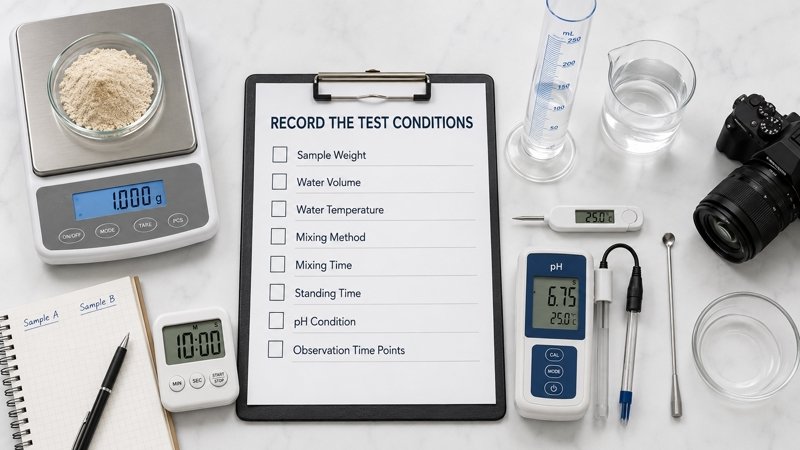
Recording the addition sequence is a particularly useful detail. The same powder can appear to behave differently when sprinkled slowly into moving water, added all at once, or pre-blended with another dry ingredient.
Container geometry can also affect observations. A narrow laboratory tube and a wide beaker may produce different vortexes and different visual impressions of sediment. Buyers comparing suppliers should use the same container, concentration, equipment, and observation schedule for every sample.
Without controlled conditions, a supplier-to-supplier comparison may reflect differences in the test procedure rather than differences between the ingredients.
Molecular Weight and Solubility Review
Molecular weight information, when available, may help buyers understand characteristics of the peptide profile and discuss whether the material fits a particular development concept. However, it should not be treated as a complete prediction of earthworm peptide powder water solubility.
Actual behavior can also depend on particle properties, the wider composition of the powder, processing conditions, pH, temperature, and interactions with other formulation components. A lower reported molecular weight does not automatically guarantee better solubility, and it should not be used to imply better absorption or stronger effects.
The relationship between peptide profile information and purchasing evaluation is discussed further in Molecular Weight in Earthworm Peptide Powder: What B2B Buyers Should Know. Even when suitable molecular weight data are available, buyers should still conduct application-specific sample testing.
Peptide Content, Protein Content, and Solubility
Peptide content and protein content provide composition-related information, but neither value replaces physical formulation testing.
Peptide content can help buyers compare the declared peptide-related specification, while protein content supports a broader review of the material’s composition. These figures should be evaluated together with the analytical method, reporting basis, specification limits, and batch documents.
Two samples with similar peptide or protein values may still differ in particle characteristics, odor, color, wetting behavior, or sedimentation. Buyers should avoid approving an ingredient based on one headline value when its practical behavior is important to the intended application.
COA and Specification Sheet Review
A specification sheet defines the supplier’s target requirements for the product. A COA reports test results for a particular production batch.
Solubility and dispersibility may not appear as routine COA items. Standard documents may focus instead on composition, appearance, moisture, ash, heavy metals, and microbiology. When solubility is important, buyers should ask whether the supplier can provide technical comments, relevant sample support, or available internal test guidance.
Safety and formulation behavior remain separate review areas. Buyers evaluating moisture, contaminants, and microbial requirements can refer to Safety Standards and Testing Requirements for Earthworm Peptide Powder.
Sample Testing Before Bulk Order
Sample testing is especially important when the intended application is sensitive to solubility, dispersibility, sedimentation, odor, taste, or ingredient interactions.
A practical sample approval record may include:
- Original powder appearance and odor
- Water mixing observations
- Dispersion and clumping behavior
- Sedimentation at defined time points
- Dry blending behavior
- COA review
- Specification conformity
- Formulation compatibility
- Any buyer-specific laboratory requirements
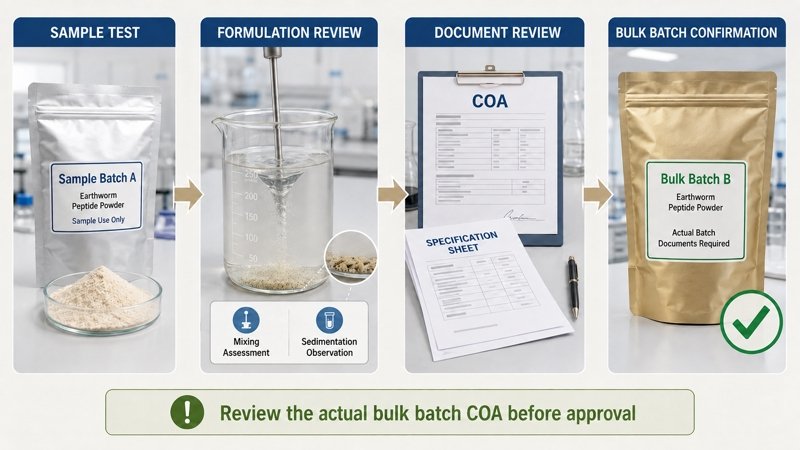
The sample and final bulk material may not carry the same batch number. If considerable time passes between sample approval and purchase-order placement, the original sample batch may no longer be available.
Before final bulk approval, the buyer should review the COA for the actual batch offered and confirm that it meets the agreed specification and purchasing requirements. Sample approval demonstrates that one evaluated sample was acceptable under defined conditions; it does not guarantee that every future batch will produce identical results.
Formulation-Specific Evaluation Examples
Beverage powder evaluation
A beverage powder developer may test dispersion time, surface clumping, sediment after 10–30 minutes, hydrated odor, taste impact, and compatibility with sweeteners, acids, or flavor systems. The team may also test whether gentle shaking can redistribute settled material.
Capsule or tablet evaluation
A capsule or tablet manufacturer may focus less on complete water dissolution and more on powder flow, moisture, particle behavior, dry-blend uniformity, and compatibility with carriers or excipients. Liquid testing may still be useful as supporting information, but it should not dominate the approval decision.
Distributor qualification
An ingredient distributor may provide samples to several end users with different applications. To make their feedback comparable, the distributor can issue a simple test sheet specifying sample concentration, water temperature, mixing method, standing time, and observation categories.
Earthworm Peptide Powder Solubility and Dispersibility Test Checklist
| Test Area | What Buyers Should Check | Why It Matters |
|---|---|---|
| Water solubility | Dissolved, suspended, or visibly insoluble material | Defines behavior under stated liquid conditions |
| Dispersibility | Wetting and even distribution | Identifies floating or uneven material |
| Mixing time | Time needed to reach a consistent appearance | Supports process planning |
| Clumping | Persistent lumps or dry pockets | May require a revised addition method |
| Sedimentation | Material settling at defined intervals | Supports suspension evaluation |
| Appearance after mixing | Color, turbidity, foam, film, uniformity | Helps assess finished-formula presentation |
| Odor after hydration | Change in odor after contact with liquid | Supports sensory review |
| Taste impact | Effect in the intended flavor system | Relevant to exposed oral formats |
| pH condition | Behavior at the intended formulation pH | Reduces misleading plain-water conclusions |
| Temperature condition | Room-temperature versus warm-water behavior | Helps define preparation conditions |
| Molecular weight information | Available profile data and method | Adds context without replacing testing |
| Peptide content | Specification, method, and result | Supports composition review |
| Protein content | Declared level and reporting basis | Provides broader composition context |
| COA | Results for the identified batch | Confirms batch-specific data |
| Specification sheet | Target requirements and limits | Defines the purchasing standard |
| Sample batch information | Batch number and production status | Supports traceability |
| Formulation compatibility | Behavior with actual ingredients | Provides application-relevant evidence |
| Bulk order confirmation | Actual batch COA and agreed requirements | Reduces sample-to-bulk approval risk |
Common Buyer Mistakes
Common errors during earthworm peptide powder formulation testing include:
- Assuming every peptide powder will dissolve completely
- Failing to record sample concentration or water temperature
- Comparing suppliers under different mixing conditions
- Evaluating only peptide content
- Assuming lower molecular weight always means better solubility
- Observing the mixture only immediately after mixing
- Ignoring sedimentation after standing
- Testing only in plain water rather than the intended formula
- Overlooking hydrated odor or taste impact
- Approving a bulk order without reviewing its actual batch documents
- Confusing Earthworm Peptide Powder with lumbrokinase
- Requesting enzyme activity data for a peptide ingredient
The Earthworm Peptide Powder product page provides product positioning and general supply information. Buyers should still define their own application-specific acceptance criteria.
Allworms Supply Notes
Allworms supports overseas B2B buyers with Earthworm Peptide Powder sample evaluation, specification review, batch COA support, and bulk supply discussions. Buyers can provide their intended application, test conditions, required quantity, destination, and documentation requirements when requesting support.
Sample availability, MOQ, packaging, lead time, and shipping arrangements can then be discussed according to the project. General answers covering documents, samples, storage, purchasing, and international supply are available on the FAQ page.
FAQ
1. Why should buyers test Earthworm Peptide Powder solubility?
Solubility testing shows how a specific sample behaves under defined liquid conditions. It can help buyers identify incomplete dissolution, clumping, floating material, sedimentation, or processing requirements before formulation approval.
2. Is solubility the same as dispersibility?
No. Solubility concerns whether material dissolves into the liquid phase. Dispersibility concerns how easily the powder spreads through a liquid or dry mixture without persistent clumps or uneven distribution.
3. Does lower molecular weight always mean better solubility?
No. Molecular weight information may contribute to peptide profile evaluation, but it is not the only factor affecting solubility. Actual sample behavior should be tested under application-relevant conditions.
4. Should buyers test solubility before bulk ordering?
Yes, when liquid behavior, suspension, sensory properties, or formulation compatibility affect the intended product. The test protocol and acceptance decision should be documented.
5. What test conditions should buyers record?
Record sample weight, liquid volume, temperature, pH where relevant, addition sequence, mixing method, mixing time, standing time, container type, observation points, and any other ingredients present.
6. Does a COA usually include solubility information?
Not necessarily. Solubility or dispersibility may not be standard COA items. Buyers should review available documents and conduct their own sample testing when these properties are commercially important.
7. Can Earthworm Peptide Powder be used in beverage formulas?
It may be evaluated for selected beverage concepts, particularly where a dispersed or shake-before-use system is acceptable. It should not be assumed suitable for a clear beverage or a formulation requiring complete dissolution without sediment. Buyers should test dispersion, sedimentation, appearance, odor, taste impact, pH compatibility, and interactions with the complete ingredient system.
8. Is Earthworm Peptide Powder the same as lumbrokinase?
No. Earthworm Peptide Powder is produced through enzymatic hydrolysis, but the finished powder is positioned as a peptide ingredient rather than an active enzyme ingredient. It is not lumbrokinase and should not be evaluated using lumbrokinase activity units or fibrin plate assays.
9. Can sample approval guarantee future bulk batches?
No. A sample approval applies to the tested material and recorded conditions. Buyers should review the COA and relevant information for the actual bulk batch before final acceptance.
Request A Sample And Technical Documents For Your Formulation Testing
Contact Allworms for MOQ, packaging, lead time, and shipping options
This product is supplied as a B2B ingredient. Final formulation suitability, dosage, labeling, claims, and regulatory compliance should be evaluated by the buyer according to the intended market and finished product use.