
An earthworm peptide powder sample evaluation should connect laboratory data, supplier documents, physical observations, and formulation performance to a defined purchasing specification. The objective is not simply to decide whether a powder “looks acceptable.” Buyers need to determine whether the ingredient is correctly identified, adequately documented, technically suitable for the intended formulation, and supported by a supplier capable of meeting the same agreed requirements during bulk supply.
Supplement brands, nutraceutical companies, ingredient distributors, and formulation developers should therefore establish acceptance criteria before testing the sample. These criteria may cover peptide content, protein content, molecular weight information, moisture, ash, contaminants, microbiology, appearance, solubility, packaging, and documentation.
A successful sample evaluation supports supplier qualification and bulk order approval, but it does not automatically approve every future production batch.
Quick Answer
During an earthworm peptide powder sample evaluation, B2B buyers should review the specification requirements, peptide content, protein content, molecular weight information if available, batch COA, appearance, solubility, formulation compatibility, and supplier documentation.
The sample results should be compared with the agreed specification and the intended application. Before bulk purchasing, buyers should also review the COA for the actual available or production batch because it may not be the same batch from which the original sample was supplied.
Why Sample Evaluation Matters Before Bulk Purchasing
Sample evaluation gives different departments an opportunity to assess the same ingredient from their respective perspectives.
Procurement may examine price, MOQ, lead time, packaging, and shipping. Quality personnel may review the COA, specification limits, test methods, contaminant controls, and batch identification. Formulation teams may focus on appearance, odor, dispersibility, solubility, flavor interaction, and compatibility with other ingredients.
This process supports several purchasing decisions:
- Whether the supplier’s product matches the buyer’s requested specification
- Whether the documentation is sufficient for internal supplier qualification
- Whether the ingredient behaves acceptably in the intended formulation
- Whether further laboratory or pilot testing is required
- Whether technical and commercial risks are acceptable before placing an order
Sample approval reduces uncertainty, but it should not be interpreted as an unlimited guarantee of future batch performance. Biological raw materials and processing conditions can create normal variations. The buyer and supplier should therefore agree on measurable acceptance limits rather than relying only on the physical appearance of one sample.
Buyers beginning their assessment can first review the Earthworm Peptide Powder product page for product positioning, sample availability, MOQ, documentation, and supply information.
What Buyers Should Check During Earthworm Peptide Powder Sample Evaluation
A practical evaluation should cover four connected areas: physical properties, analytical specifications, technical information, and documents.
Appearance and physical characteristics
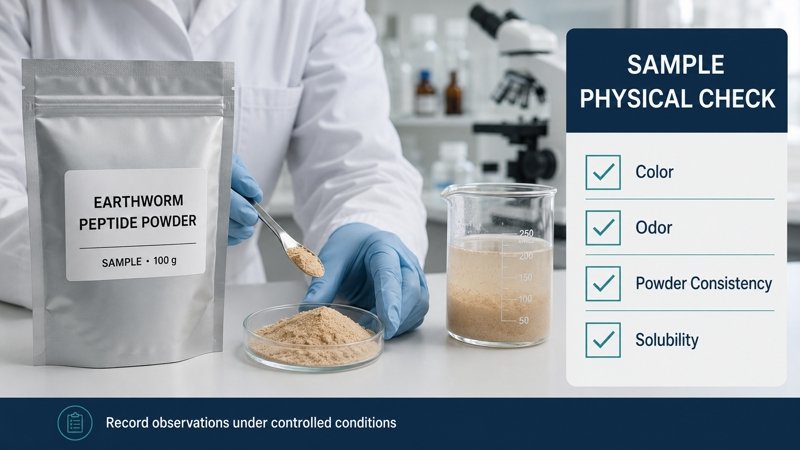
Record the sample’s color, odor, powder uniformity, visible agglomeration, foreign matter, and general handling characteristics. Earthworm-derived ingredients can have a characteristic color and odor, so buyers should define what is acceptable for their application instead of expecting the sensory profile of an unrelated peptide source.
Photography under consistent lighting can help create an internal reference. Buyers may also retain a sealed reference portion, subject to the sample’s storage requirements and shelf life.
These observations are useful for detecting obvious differences, but appearance alone cannot confirm peptide content, protein content, safety limits, or molecular weight characteristics.
Analytical specification review
The evaluation should address relevant specification items, including:
- Peptide content
- Protein content
- Moisture
- Ash
- Heavy metals
- Microbiological limits
- Appearance or sensory requirements
The buyer should identify which results are supplier-reported, which are shown on a batch COA, and which will be independently tested. Test methods and reporting bases should be clarified where they affect interpretation.
The Earthworm Peptide Powder Specification Guide provides further context for establishing product requirements before comparing individual batches.
Technical information
Technical review may include the manufacturing description, enzymatic hydrolysis information, molecular weight data if available, solubility or dispersibility guidance, recommended storage, and application-related limitations.
Earthworm Peptide Powder is produced through enzymatic hydrolysis of earthworm-derived protein material. However, the finished powder is positioned as a peptide ingredient, not as an active enzyme ingredient. It should not be evaluated using the enzyme activity units or fibrinolytic assay criteria used for lumbrokinase.
Documentation
At minimum, buyers should request a specification sheet, the relevant sample-batch COA where available, and basic product information. The documents should identify the product consistently and provide enough detail to connect the physical sample to its batch information.
The wider FAQ page explains common document, sample, MOQ, lead-time, and shipping questions for B2B buyers.
Molecular Weight Review During Sample Evaluation
Molecular weight information can help buyers understand the peptide profile created by the hydrolysis process. Depending on the supplier’s available testing, the information may be presented as molecular weight ranges, distribution percentages, or another laboratory-generated profile.
During sample evaluation, buyers should ask three practical questions:
- What type of molecular weight data is being provided?
- Does it refer to the sample batch, a representative product profile, or a general technical reference?
- Does the reported profile support the buyer’s intended formulation and internal specification?
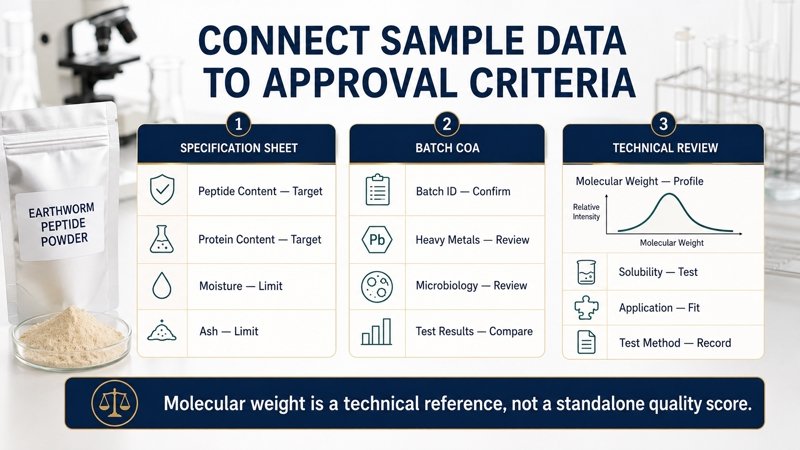
Molecular weight should be reviewed together with peptide content, protein content, processing information, solubility observations, and the intended application. It is a technical reference rather than a standalone quality score.
A lower molecular weight result does not automatically mean better quality. Aggressive hydrolysis may change sensory characteristics, composition, process yield, or formulation behavior. Likewise, two powders with similar molecular weight ranges may differ in peptide content, moisture, ash, contaminants, microbiological quality, or dispersibility.
For a more detailed explanation, see Molecular Weight in Earthworm Peptide Powder: What B2B Buyers Should Know.
Peptide Content and Protein Content Review
Peptide content provides information about the peptide-related portion of the ingredient under the stated test method. It is an important specification for a hydrolyzed peptide product, but its meaning depends on the analytical method and reporting basis used.
Protein content provides supporting composition information. It helps the buyer understand the broader nitrogen-containing protein and peptide profile but does not independently describe molecular weight distribution or formulation behavior.
Buyers should not assume that the highest peptide result is automatically the most suitable option. A meaningful comparison should consider:
- Whether the same test method is used
- Whether results are reported on an as-is or dry basis
- Whether the sample meets both peptide and protein requirements
- Whether moisture and ash influence the overall composition
- Whether the ingredient performs acceptably in the planned formula
Earthworm Peptide Powder should also not be treated as identical to Earthworm Protein Powder. The peptide product is evaluated with greater emphasis on hydrolysis, peptide-related specifications, molecular profile, and formulation behavior.
COA and Specification Sheet Review During Sample Evaluation
A specification sheet defines the target requirements or acceptance limits for the product. A Certificate of Analysis reports the actual test results for a particular batch.
During sample review, buyers should compare four sets of information:
- The identity and batch information on the sample label
- The acceptance limits in the specification sheet
- The actual results reported on the COA
- The buyer’s formulation and quality requirements
Check whether the product name, batch number, production or test date, and specification version are consistent across the available records. If the supplier provides a typical COA before dispatch, request the sample-batch COA once the sample is assigned.
The review should also distinguish quantitative results from pass/fail statements. A result such as “conforms” may be acceptable for some physical items, while procurement or quality teams may require numerical results for key composition or contaminant parameters.
For a parameter-by-parameter document discussion, refer to Earthworm Peptide Powder COA Review.
Sample Testing and Formulation Evaluation
A controlled workflow makes results easier to interpret and compare:
- Confirm that the sample package is intact and record the product name, batch number, sample size, receipt date, and storage instructions.
- Review the specification sheet, COA, and product information before laboratory or formulation testing begins.
- Convert internal expectations into written approval criteria rather than relying on a general impression.
- Conduct identity, composition, contaminant, or microbiological testing where required by the buyer’s quality system.
- Evaluate solubility, dispersibility, mixing behavior, sedimentation, color contribution, odor, and compatibility at the intended inclusion level.
- Record the formula, processing conditions, observation times, and test methods so another sample or bulk batch can be evaluated under comparable conditions.
- Document approved deviations, unresolved questions, and conditions that must be reconfirmed before purchasing.
A useful new control is to separate results into three categories: mandatory specification requirements, formulation preferences, and commercial considerations. A mandatory microbiological limit should not be treated in the same way as a preferred color shade or a negotiable packaging format.
Buyers should also use a representative formulation matrix. Testing only in water may not predict behavior in a capsule blend, tablet premix, powdered beverage, or multi-ingredient formula.
From Sample Approval to Bulk Order Approval
The normal purchasing path can be summarized as:
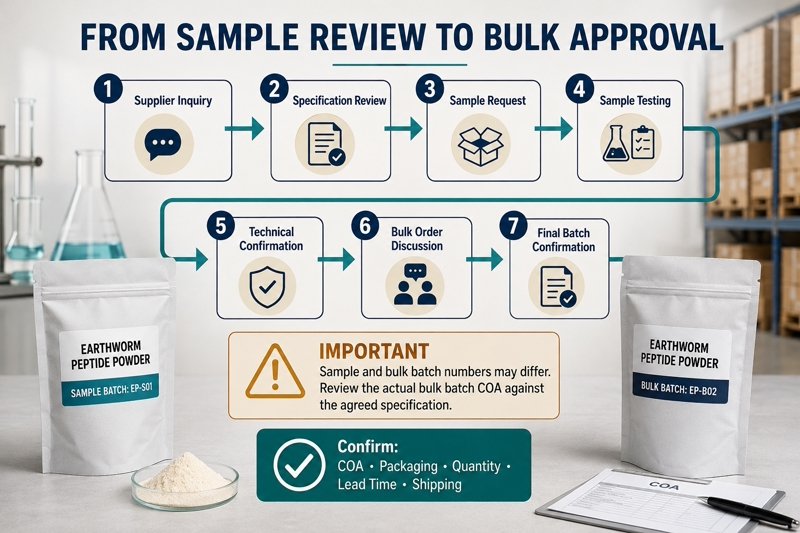
Supplier inquiry → Specification review → Sample request → Sample testing → Technical confirmation → Bulk order discussion → Final batch confirmation
Sample approval confirms that the tested material was acceptable under the buyer’s evaluation conditions. It does not mean the original sample batch will remain available indefinitely.
The sample and bulk order may have different batch numbers. If a long period passes between sample approval and purchase-order placement, the sampled batch may already have been allocated or sold. A newly produced bulk batch may also be required.
Before payment or shipment, the buyer should therefore confirm:
- The agreed product specification
- The available or planned bulk batch
- The bulk-batch COA
- Any required molecular weight or composition information
- Quantity and MOQ
- Packaging configuration
- Storage and shelf-life requirements
- Lead time and shipping arrangement
- Any retesting or pre-shipment approval requirement
If the actual bulk-batch COA meets the agreed specification but the batch number differs from the sample, this is not automatically a quality problem. The correct question is whether the new batch satisfies the documented acceptance criteria and whether any critical formulation-sensitive characteristics require reconfirmation.
Earthworm Peptide Powder Sample Evaluation Checklist
| Evaluation Item | What Buyers Should Check | Why It Matters |
|---|---|---|
| Product identity | Correct product name, source, type, and batch reference | Prevents confusion with protein powder or lumbrokinase |
| Specification sheet | Current limits, units, methods, and revision date | Defines the basis for acceptance |
| COA | Batch identity, actual results, dates, and approval status | Connects test data to the sample |
| Peptide content | Result, method, unit, and reporting basis | Supports peptide-related specification review |
| Protein content | Result, method, and dry/as-is basis | Provides broader composition information |
| Molecular weight information | Data format, batch relevance, and distribution ranges | Helps characterize the peptide profile |
| Moisture | Result against the agreed limit | Affects composition and storage behavior |
| Ash | Result and specification limit | Provides information about inorganic residue |
| Heavy metals | Required elements, limits, methods, and market needs | Supports contaminant assessment |
| Microbiology | Total count and specified organisms | Supports quality and market review |
| Solubility | Test medium, temperature, concentration, and time | Shows application-specific behavior |
| Sample appearance | Color, odor, uniformity, clumping, and foreign matter | Establishes a physical reference |
| Formulation compatibility | Behavior at the intended inclusion level | Helps identify processing or sensory issues |
| Packaging | Sample seal and proposed bulk packaging | Protects material during storage and shipping |
| Storage | Temperature, moisture protection, and shelf life | Preserves the evaluated characteristics |
| Supplier communication | Response quality and technical clarification | Indicates practical supplier support |
| Bulk order requirements | Batch, MOQ, quantity, COA, lead time, and shipping | Connects technical approval to purchasing |
Common Mistakes During Sample Evaluation
Common errors include:
- Comparing price before confirming equivalent specifications
- Focusing only on peptide content
- Assuming lower molecular weight always means higher quality
- Ignoring differences between the COA and specification sheet
- Confusing peptide powder with lumbrokinase
- Approving an order without written acceptance requirements
- Failing to confirm whether the sampled batch remains available
- Assuming one approved sample guarantees every future batch
- Testing solubility without recording concentration and conditions
- Ignoring compatibility with the actual formulation
- Treating preferred appearance as more important than mandatory safety limits
Earthworm Peptide Powder is produced through enzymatic hydrolysis, but it is supplied as a peptide ingredient rather than an active enzyme product. Lumbrokinase activity units and fibrinolytic assays are not appropriate acceptance criteria for this sample evaluation.
Allworms Supply Notes
Allworms supports overseas B2B buyers with Earthworm Peptide Powder sample evaluation, specification review, COA support, and bulk supply discussions.
Available product information, specification sheets, batch COAs, sample support, packaging, lead time, and shipping options can be discussed according to the buyer’s required quantity, destination, application, and document checklist. Molecular weight information may also be discussed based on availability and the buyer’s technical requirements.
A 100 g sample may be available for qualified B2B evaluation, with the buyer normally covering international freight. The standard MOQ is usually around 1.5 kg, while normal lead time is approximately 7–15 days after payment, depending on stock, specification, quantity, and shipping plan.
FAQ
Why should buyers test an Earthworm Peptide Powder sample before bulk ordering?
Testing helps buyers confirm documentation, physical properties, analytical requirements, and formulation compatibility before accepting the commercial risk of a larger purchase.
What should I check in an Earthworm Peptide Powder sample?
Check product identity, appearance, odor, peptide content, protein content, moisture, ash, heavy metals, microbiology, molecular weight information where available, solubility, documentation, and formulation performance.
Is molecular weight important when evaluating peptide powder?
Yes, it can help characterize the peptide profile and support application assessment. However, it should be considered with composition, specifications, test methods, and formulation results.
Does lower molecular weight mean better peptide powder quality?
No. Lower molecular weight is not automatically better. Suitability depends on the complete specification, intended application, processing requirements, and formulation behavior.
What documents should a supplier provide with a sample?
Buyers should request a specification sheet, sample-batch COA where available, product information, batch identification, storage guidance, and relevant technical information.
Should I review the COA before approving a sample?
Yes. The COA connects the reported test results to a specific batch and allows comparison with both the supplier’s specification and the buyer’s requirements.
Is Earthworm Peptide Powder the same as lumbrokinase?
No. Earthworm Peptide Powder is a hydrolyzed peptide ingredient and is not positioned as an active enzyme product. Lumbrokinase is evaluated as an enzyme ingredient using different technical criteria.
Can sample approval guarantee bulk-batch consistency?
No. It approves the tested sample under defined conditions. Buyers should still review the actual bulk-batch COA and confirm compliance with the agreed specification.
What should buyers confirm before placing a bulk order?
Confirm the specification, actual or planned batch, COA, quantity, MOQ, packaging, storage, lead time, shipping method, documentation requirements, and any pre-shipment testing conditions.

Request an Earthworm Peptide Powder Sample And Technical Documents
Discuss sample support and bulk order requirements with Allworms
This product is supplied as a B2B ingredient. Final formulation suitability, dosage, labeling, health claims, and regulatory compliance should be evaluated by the buyer according to the intended market and finished-product use.