
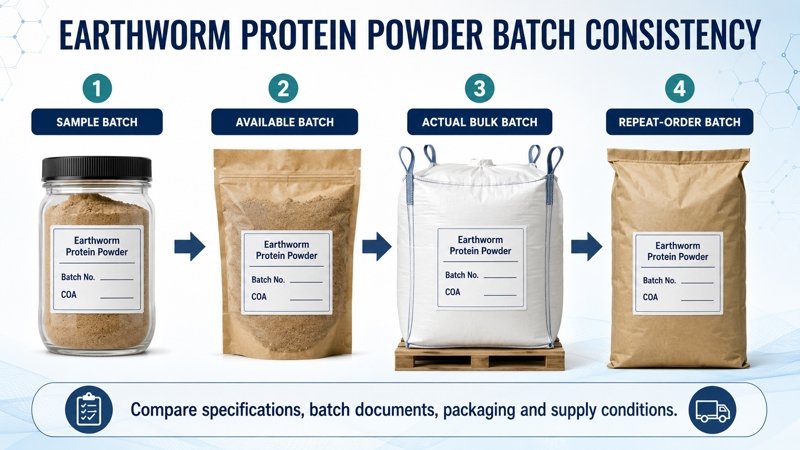
Earthworm protein powder batch consistency becomes especially important when a B2B buyer moves from sample evaluation to pilot production, bulk purchasing, or repeat ordering. The central question is not whether every batch produces identical numerical results. Buyers need to determine whether the actual batch being purchased meets the agreed specification, quality parameters, documentation requirements, and commercial conditions.
A structured comparison should follow the sourcing sequence: sample batch, currently available batch, actual bulk batch, and subsequent repeat-order batches. This allows quality teams and purchasing managers to identify meaningful differences before material enters formulation, production, or inventory.
The following process helps supplement brands, food ingredient buyers, nutraceutical companies, distributors, and formulation teams make practical batch approval decisions.
Quick Answer
Earthworm protein powder batch consistency should be reviewed by comparing the sample batch, actual bulk batch COA, specification sheet, protein content, moisture, ash, heavy metals, microbiology, appearance, manufacturing date, packaging, storage requirements, and supplier communication.
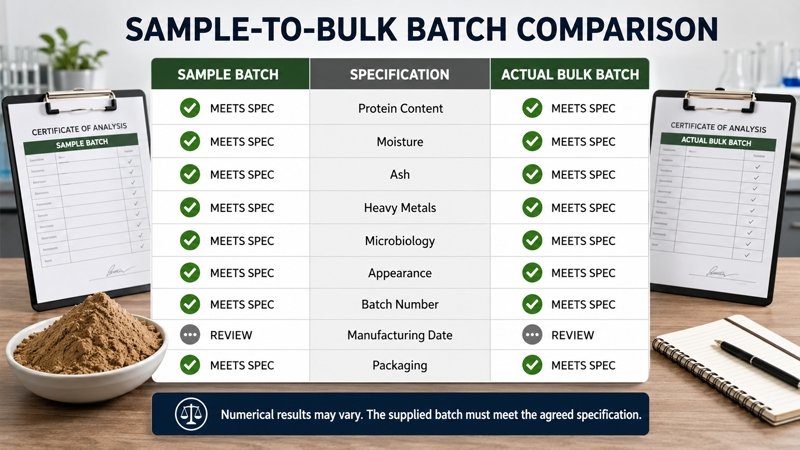
Buyers should focus on whether the actual bulk batch meets the agreed specification rather than expecting every numerical result to be identical. If the sampled batch is no longer available, the supplier should provide documents for the newer batch before shipment so the buyer can confirm sample-to-bulk specification consistency.
Why Batch Consistency Matters for Earthworm Protein Powder Buyers
A sample may be acceptable during laboratory testing, but commercial approval concerns the material that will actually be delivered. A difference between the sample reference and the supplied batch may affect internal documentation, formulation planning, production scheduling, or warehouse handling.
A clear batch comparison process supports:
- Approval of materials for pilot or commercial production
- Confirmation that purchasing requirements have been followed
- Review of quality documents by internal QA teams
- Consistent formulation and manufacturing planning
- More predictable inventory and warehouse management
- Supplier performance assessment
- Better preparation for repeat purchasing
Batch comparison is therefore both a quality activity and a procurement control. Buyers beginning with a supplier sample can refer to the Earthworm Protein Powder Sample Evaluation article for the initial assessment process. Once the sample is accepted, the focus should shift to the batch that will fulfill the purchase order.
What Batch Consistency Means in B2B Sourcing
For B2B sourcing, batch consistency means that the supplied material remains within the agreed product specification and meets the buyer’s documented requirements.
It does not mean:
- Every batch must have exactly the same protein percentage
- Every value on every COA must be identical
- A sample and bulk order must always carry the same batch number
- One approved sample automatically approves all future batches
Earthworm protein powder is a naturally derived ingredient, so some numerical or sensory variation may occur. The practical question is whether that variation remains acceptable under the agreed specification and the buyer’s intended use.
A sound evaluation combines specification alignment, COA comparison, physical observations, packaging and storage review, and clear supplier explanations. Buyers needing a more detailed interpretation of individual test fields can consult the Earthworm Protein Powder COA Review rather than treating batch comparison as a substitute for a complete COA assessment.
Sample Batch, Available Batch, Bulk Batch, and Repeat-Order Batch
These terms describe different points in the purchasing process:
- Sample batch: The batch from which the evaluation sample was taken.
- Available batch: Inventory currently available when the buyer requests a quotation or prepares a purchase order.
- Actual bulk batch: The batch allocated to fulfill the confirmed bulk order.
- Repeat-order batch: A later production or inventory batch offered for a subsequent purchase.
These batches may be the same, but they do not have to be.
If several weeks or months pass between sample testing and PO placement, the original sample batch may have been sold or may no longer have sufficient inventory. A newer batch may then be allocated to the order. In that case, the buyer should request the COA and relevant information for the actual bulk batch before shipment.
This process establishes sample-to-bulk specification consistency without creating an impractical requirement that every order use the original sample batch.
Sample-to-Bulk Comparison Workflow
A controlled comparison can be completed through five procurement stages.
1. Record the approved sample reference
Keep the sample batch number, sample COA, testing date, approved specification version, and any internal observations. This creates a traceable reference rather than relying on memory or an email stating that the sample was “acceptable.”
2. Confirm current inventory
Before issuing or finalizing the PO, ask whether the evaluated sample batch is still available. If it is not, request the batch number and production status of the available material.
3. Review the actual bulk batch
Compare its COA against the agreed specification and the approved sample reference. Pay particular attention to protein, moisture, ash, heavy metals, microbiology, appearance, production date, and remaining shelf life.
4. Resolve meaningful differences
A numerical difference within specification may not require rejection, but it may still require explanation if it affects formulation or internal acceptance criteria. Questions and responses should be documented before shipment.
5. Release the order
Use a simple internal status such as “approved,” “approved with clarification,” or “on hold.” This gives purchasing and QA teams a clear release decision and prevents unreviewed material from entering production.
What Buyers Should Compare Between Batches
Product identity and documentation
Confirm that the product name, grade, batch number, specification version, and packaging description correspond to the purchase order. A batch COA should be linked to a clearly identified lot rather than presented as a generic product document.
Buyers should also distinguish the specification sheet from the COA. The specification defines the acceptance requirements, while the COA reports the results or compliance status for a particular batch.
Protein content comparison
Protein content is a major comparison point because it may influence formulation calculations, procurement acceptance, or product positioning.
Compare:
- Protein content of the sample batch
- Protein content of the actual bulk batch
- Agreed minimum or target in the specification
- Test method, when stated
- Buyer-specific formulation requirements
A higher result is not automatically better. A buyer may require predictable performance within a defined range rather than the highest available percentage. Protein should also be considered alongside moisture, ash, microbiology, heavy metals, physical characteristics, and documentation.
If amino acid profile information forms part of the buyer’s approved technical package, confirm whether it is a standard batch-release item or a separate periodic test. Do not assume it will appear on every COA unless this was agreed in advance.
Moisture and powder handling
Moisture can be relevant to powder flow, storage, packing, and the buyer’s incoming-material review. Compare the sample and bulk results against the same specification limit.
The review should include:
- Moisture result on each available COA
- Specified maximum
- Packaging seal and inner-liner condition
- Storage instructions
- Condition observed after delivery
A moisture result within specification does not eliminate the need for proper handling. Buyers should maintain the stated storage conditions after receipt and report damaged or poorly sealed packaging promptly.
Ash, heavy metals, and microbiology
Ash, heavy metals, and microbiology provide additional comparison points, but the review must account for how results are reported.
Check whether:
- The same test items appear on both documents
- Results meet the applicable specification
- The COA provides actual numerical values or only compliance statements
- Methods or reporting units have changed
- The intended market requires additional testing or review
Microbiology panels can differ among suppliers, buyers, applications, and target markets. Buyers should define required organisms, limits, and reporting expectations instead of assuming that every supplier uses an identical panel. Regulatory acceptance should be evaluated for the intended destination and finished-product category without relying on generic limits.
Appearance and sensory consistency
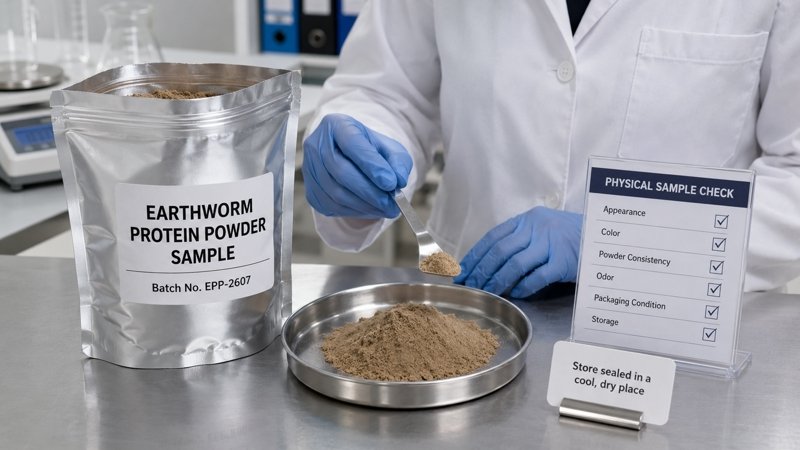
Useful incoming observations include powder color, physical form, odor description when documented, visible foreign matter, agglomeration, and packaging condition.
Minor natural differences in color or odor may occur between earthworm-derived ingredient batches. However, a significant departure from the approved reference—such as an unexpected color shift, abnormal odor, wet clumps, or damaged packaging—should be documented and clarified before use.
Photographs taken under consistent lighting can support internal comparison, although they should supplement rather than replace analytical records.
Manufacturing date and inventory timing
Manufacturing date helps explain whether the sample and bulk material came from different production periods. The buyer should also review the expiry or retest date when provided by the supplier.
Important questions include:
- How much time passed between sample testing and PO placement?
- Is the original sample batch still commercially available?
- How much shelf life remains when the material arrives?
- Does the batch fit the planned production and inventory schedule?
- Will a later repeat order probably require a new batch review?
Shelf-life decisions should follow the supplier’s documents and the buyer’s internal requirements. Buyers should not infer an expiry period that is not stated.
Packaging and storage consistency
Analytical compliance alone does not confirm that all purchasing requirements have been met. Compare the agreed pack size, inner packaging, outer packaging, label details, sealing condition, storage instructions, and relevant shipping arrangements.
Suitable packaging and storage help reduce quality risk during international transport and warehouse handling. If the bulk order uses a different pack size from the sample or trial order, the change should be confirmed before dispatch.
Product format and standard purchasing information can be checked through the Earthworm Protein Powder product page, while batch-specific conditions should be confirmed directly for each order.
Earthworm Protein Powder Batch Consistency Checklist
| Comparison Item | What Buyers Should Compare | Why It Matters |
|---|---|---|
| Product name | COA, specification, label, and PO description | Prevents product or grade mismatch |
| Batch number | Sample, available inventory, and allocated bulk lot | Establishes traceability |
| Sample batch COA | Approved results and test date | Creates the original reference |
| Actual bulk batch COA | Results for the lot allocated to the PO | Supports pre-shipment approval |
| Specification sheet | Limits, test items, methods, units, and version | Provides the acceptance basis |
| Protein content | Sample result, bulk result, and agreed target | Supports formulation and procurement review |
| Moisture | Results, limit, and packaging condition | Relates to handling and storage |
| Ash | Results and specification requirement | Adds context to overall composition |
| Heavy metals | Items tested, units, values, and compliance | Supports target-market quality review |
| Microbiology | Panel, reporting format, results, and limits | Supports incoming quality approval |
| Appearance | Color, form, odor description, and abnormalities | Identifies meaningful physical differences |
| Manufacturing date | Sample and bulk production timing | Clarifies inventory age and batch changes |
| Expiry or retest date | Remaining period and project schedule | Supports inventory planning |
| Packaging | Pack size, liner, seal, label, and outer container | Protects handling and traceability |
| Storage | Documented conditions and warehouse controls | Helps maintain material condition |
| Available batch confirmation | Quantity, batch identity, and allocation status | Prevents approval of the wrong inventory |
| Repeat-order comparison | New COA versus prior accepted orders | Tracks consistency over time |
Sample-to-Bulk Specification Consistency
Sample-to-bulk specification consistency means comparing four references before order approval:
- The sample that the buyer evaluated
- The specification accepted during that evaluation
- The supplier’s documents for the allocated bulk batch
- The commercial conditions stated in the purchase agreement
The buyer should confirm that the bulk batch meets the same agreed specification, even when it carries a different batch number. Packaging, quantity, storage, shipment conditions, and document requirements should also correspond to the PO.
This approach is more useful than simply asking whether the bulk material is “the same as the sample.” It converts a general assurance into verifiable acceptance points.
For broader supplier controls, including production capability and document responsiveness, see How to Choose a Reliable Earthworm Protein Powder Manufacturer.
Repeat-Order Batch Comparison
Repeat buyers should not assume that a successful previous order automatically approves a new batch. Before each reorder, compare the new COA with the previous order record and the current specification.
Review protein, moisture, ash, heavy metals, microbiology, appearance, packaging, manufacturing date, lead time, and any changes communicated by the supplier.
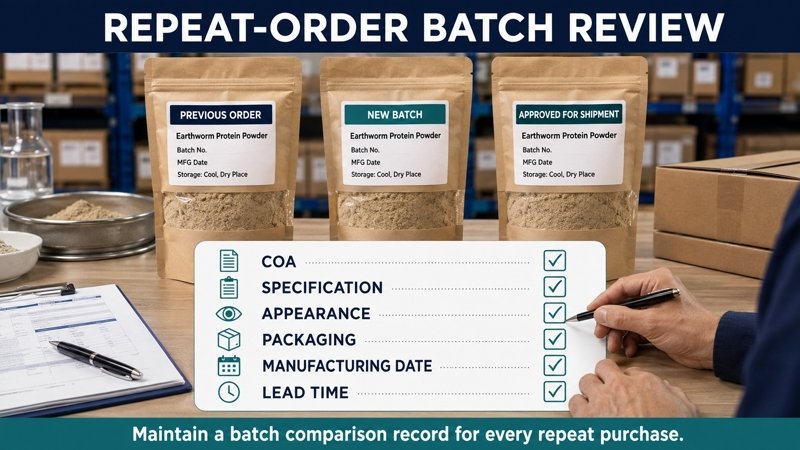
A simple internal batch history can make this process more efficient. Useful fields include:
- PO and batch number
- Specification version
- Key test results
- Date received
- Appearance observations
- Packaging condition
- Supplier explanations
- Internal approval status
Over several orders, this record helps buyers identify normal variation, recurring documentation gaps, or gradual changes that may not be obvious from one COA alone.
Common Buyer Mistakes
Common errors in earthworm protein powder batch comparison include:
- Requiring the sample and bulk batch to have the same lot number in every case
- Assuming one approved sample guarantees all future production
- Reviewing protein content while ignoring other quality parameters
- Failing to record the sample batch number
- Approving an order without reviewing the actual bulk batch COA
- Comparing COAs without confirming the applicable specification version
- Ignoring moisture, ash, heavy metals, or microbiology
- Overlooking manufacturing date and remaining shelf life
- Accepting changed packaging without confirmation
- Treating every numerical difference as a failure
- Failing to request explanations for meaningful differences
- Selecting a supplier on price without considering batch documentation
- Keeping no comparison record for repeat orders
The FAQ page can provide additional purchasing and supply answers, but batch-specific questions should be resolved against the documents for the material actually allocated to the order.
Allworms Supply Notes
Allworms is part of the manufacturer-side earthworm-derived ingredient supply system and supports overseas market development and international sales. For available Earthworm Protein Powder batches, a COA and specification sheet can be provided to support batch comparison.
Sample support may be available for qualified B2B buyers. MOQ, lead time, packaging, and shipping options depend on the required specification, quantity, packaging arrangement, destination, and current batch availability.
Before approving a bulk or repeat order, buyers can request confirmation of the available batch, applicable specification, batch documentation, packaging, storage conditions, and shipping plan. This helps connect the approved sample reference with the material that will actually be supplied.
FAQ
What does batch consistency mean for Earthworm Protein Powder?
It means the supplied batch meets the agreed specification, documentation requirements, and purchasing conditions. It does not require every analytical result to be numerically identical across batches.
Should the sample batch and bulk batch always be the same?
No. The original sample batch may no longer be available when the buyer places the order. If another batch will be supplied, the buyer should review its COA and confirm that it meets the specification approved during sample evaluation.
What should buyers compare between sample and bulk batches?
Buyers should compare the product and batch identity, COAs, specification version, protein content, moisture, ash, heavy metals, microbiology, appearance, production dates, packaging, storage requirements, and available-batch status.
Why is batch number important?
The batch number connects the physical material to its COA, manufacturing records, packaging labels, and purchasing documents. Without it, the buyer cannot reliably verify that the reviewed documents apply to the delivered material.
How should buyers handle repeat-order batch comparison?
Maintain a record of previous accepted batches and compare each new COA, production date, physical appearance, packaging format, and key quality parameter. Meaningful differences should be clarified before the reorder is released.
Confirm Batch Consistency Before Approving Your Bulk Order
Request the COA, specification, and available batch details today
This product is supplied as a B2B ingredient. Final formulation suitability, dosage, labeling, claims, and regulatory compliance should be evaluated by the buyer according to the intended market and finished-product use.