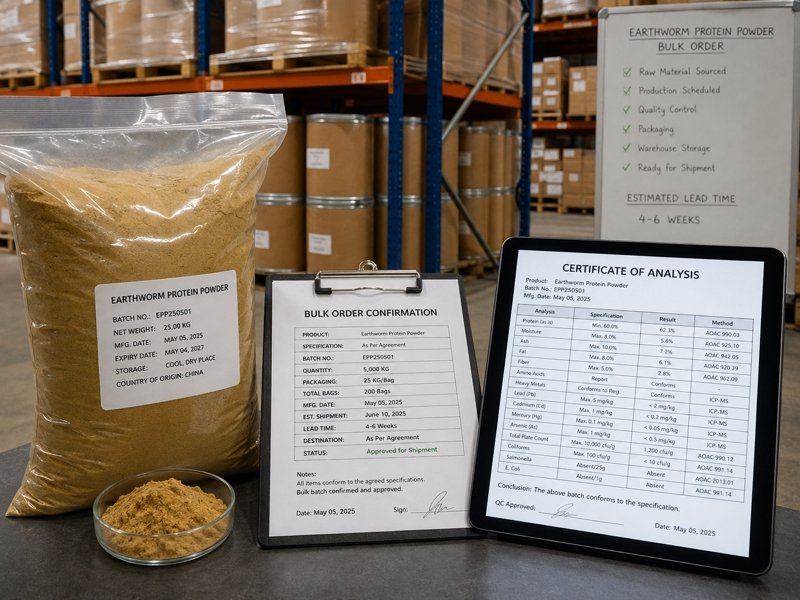
An earthworm protein powder COA review is an essential step before approving a sample, qualifying a supplier, purchasing a small bulk quantity, or placing a repeat order. The Certificate of Analysis should not be treated as a generic product brochure. It is a batch-specific document intended to show the actual test results associated with the material being offered or supplied.
For supplement brands, nutraceutical companies, ingredient distributors, formulation teams, and purchasing departments, the main question is not simply whether a supplier can provide a COA. Buyers should verify whether the document clearly identifies the product and batch, reports relevant quality indicators, matches the sample or available bulk material, and is consistent with the agreed specification sheet.
A structured review helps buyers identify missing information before testing, payment, production planning, or shipment.
Quick Answer: How Should Buyers Review an Earthworm Protein Powder COA?
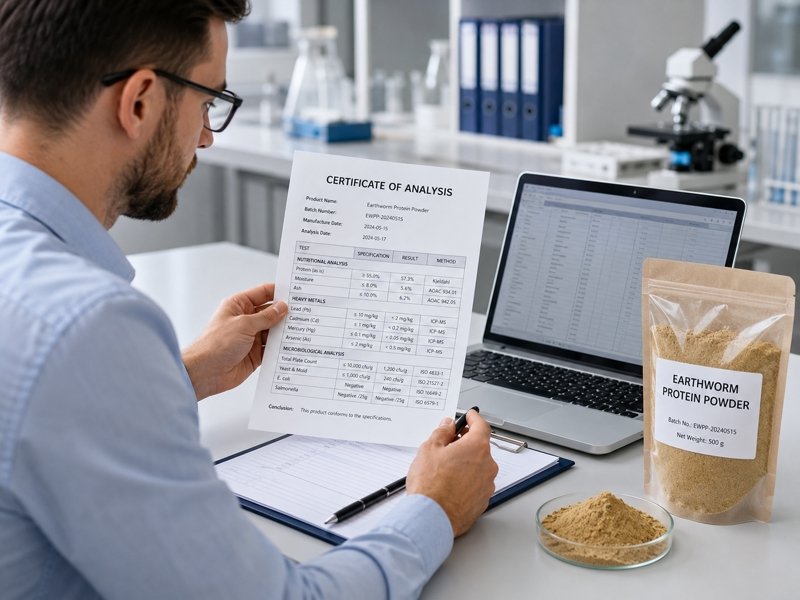
An Earthworm Protein Powder COA should be reviewed as a batch-specific quality document. Buyers should check the product name, supplier information, batch number, manufacturing date, protein content, moisture, ash, heavy metals, microbiology, appearance, storage conditions, and expiry or retest date if listed.
The COA should match the sample batch or the actual bulk batch being offered. Buyers should also compare the reported results with the specification sheet rather than reviewing the COA as a standalone document.
Why COA Review Matters for Earthworm Protein Powder Buyers
COA review is usually one of several document-control steps in a B2B purchasing process. It may take place before:
- approving a supplier sample;
- arranging internal or third-party testing;
- qualifying a new ingredient supplier;
- confirming a pilot-production quantity;
- approving a small bulk or commercial order;
- releasing a repeat shipment.
A supplier should not be approved only because a COA has been provided. A useful COA should be readable, traceable to a specific batch, relevant to the material being evaluated, and reasonably consistent with the supplier’s specification sheet.
For example, a COA without a batch number may contain acceptable-looking results but provide limited traceability. A COA prepared for an earlier batch may also be unsuitable for approving a different bulk batch unless the supplier clearly explains the relationship between the documents.
Buyers who need a broader overview of quality indicators can refer to Earthworm Protein Powder Safety Standards: What Buyers Need to Know. The present review focuses only on how those indicators should be checked when they appear on a batch COA.
COA vs Specification Sheet
The distinction between these two documents should remain clear throughout the review process:
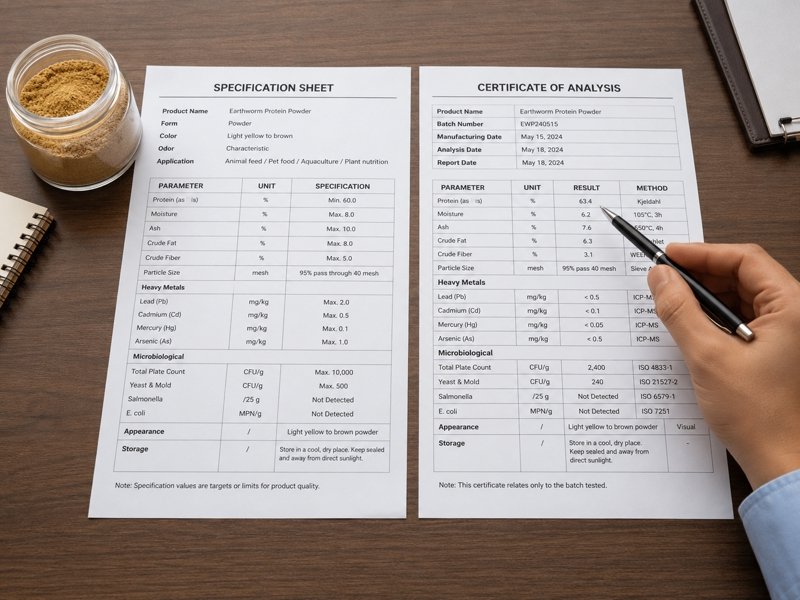
Specification Sheet: Defines the supplier’s target requirements, expected limits, or acceptable quality range for the product.
Certificate of Analysis: Reports the actual test results or conformity status for a specific production batch.
For example, the specification sheet may state a minimum protein requirement or a maximum moisture limit. The COA should then show the result obtained for the identified batch or state that the result conforms, depending on the document format.
A buyer should therefore compare the two documents line by line. For a broader explanation of the target parameters used when comparing supplier documents, buyers can refer to Key Specifications to Look for When Sourcing Earthworm Protein Powder.
1. Product Name and Supplier Information
Begin by confirming that the document clearly identifies the material being reviewed.
Check:
- the complete product name;
- the supplier or manufacturer-side company name;
- the product description, grade, or source if listed;
- whether the document refers specifically to Earthworm Protein Powder;
- whether the COA belongs to the sample or available bulk material.
This basic review helps prevent document mismatches. Earthworm Protein Powder should also not be confused with Earthworm Peptide Powder or lumbrokinase.
Earthworm Peptide Powder is produced through enzymatic hydrolysis and positioned as a stable peptide-rich ingredient. Lumbrokinase is an active fibrinolytic enzyme ingredient evaluated according to enzyme activity. Earthworm Protein Powder is reviewed primarily as a protein-rich ingredient, with protein content and routine physical, chemical, heavy-metal, and microbiological indicators.
2. Batch Number
The batch number connects the COA to a specific production lot or available inventory batch. It is one of the most important traceability fields on the document.
Before sample evaluation, confirm that:
- the sample label shows a batch number;
- the batch number on the sample matches the COA;
- the supplier can explain any coding differences;
- the document is not merely an undated example COA.
Before a bulk order, ask which batch will actually be supplied.
A sample batch and a future bulk batch do not always need to be identical. If a buyer completes testing several weeks or months after receiving the sample, the original batch may have been sold or allocated. In that situation, the supplier should provide the COA for the actual available bulk batch and confirm that it meets the agreed specification and purchasing requirements.
This prevents a common procurement error: approving one batch and assuming that an unrelated future batch is covered by the original document.
3. Manufacturing Date and Expiry or Retest Date
The manufacturing date helps buyers understand the age of the available material and whether it fits the expected project timeline.
Review:
- manufacturing date;
- expiry date, if listed;
- retest date, if the supplier uses one;
- remaining usable period;
- expected sample-testing and purchasing schedule;
- anticipated storage time after delivery.
A buyer may receive a sample, conduct formulation work, wait for internal approval, and place an order much later. During that period, the available inventory may change. The purchasing team should therefore reconfirm the actual batch date before issuing a purchase order.
Do not assume a standard shelf life unless it is supported by the supplier’s current documents. Storage planning, production scheduling, transit time, and expected inventory turnover should be considered together.
Buyers planning longer inventory cycles can also review Earthworm Protein Powder Shelf Life and Storage Considerations before confirming the available batch and delivery schedule.
4. Protein Content
Protein content is a central COA item for Earthworm Protein Powder because it affects ingredient positioning, formulation calculations, purchasing specifications, and batch acceptance.
Buyers should check:
- the actual reported protein result;
- the minimum requirement on the specification sheet;
- the testing method, when listed;
- the reporting basis, such as whether the value is reported on the received basis or dried basis;
- whether the result supports the intended formulation.
A higher number is not automatically better. The relevant question is whether the batch meets the agreed specification and performs consistently within the buyer’s formulation system.
A buyer should also avoid treating protein content as a complete measure of ingredient quality. It should be considered together with moisture, ash, physical characteristics, documentation, storage conditions, and batch consistency.
Where amino acid profile information is required for formulation or label review, it may need to be requested separately. It should not be assumed to form part of every routine batch COA.
5. Moisture
Moisture is relevant to powder condition, packaging integrity, warehouse handling, and storage control.
Review:
- the actual moisture value, if reported;
- the specification limit;
- the test method, if available;
- packaging condition;
- storage instructions;
- potential humidity exposure during shipping or warehousing.
A compliant moisture result at the time of production does not remove the need for proper handling. Poorly sealed packaging, repeated opening, high-humidity storage, or damaged outer cartons may affect the condition of the powder after shipment.
When the sample arrives, compare the document with the physical material. Caking, unusual clumping, damaged seals, or visible moisture exposure should be discussed with the supplier before approval.
6. Ash
Ash is a routine composition-related or quality-control indicator that may appear on an Earthworm Protein Powder COA.
Buyers should determine:
- whether ash is included in the agreed specification;
- the actual result or conformity statement;
- whether the result is within the stated limit;
- whether an unusual result requires clarification.
Ash should not be overinterpreted as a standalone medical-safety indicator. Its value is mainly in composition review, process consistency, and comparison with the agreed product requirements.
When reviewing repeat batches, significant changes in ash results may justify a supplier question, particularly when they occur together with changes in protein content, color, odor, or moisture.
7. Heavy Metals
Heavy-metal information may be required for supplier approval, finished-product planning, customer documentation, or target-market review.
The COA may list lead, arsenic, cadmium, mercury, or other elements depending on the supplier’s specification and the buyer’s requirements.
Check:
- which individual metals are included;
- whether the result is an actual numerical value or a compliance statement;
- the reporting unit;
- whether each result meets the supplier specification;
- whether the buyer’s market requires additional testing.
Do not assume that every supplier uses the same test panel or limits. A purchasing team should identify its target-market requirements before approving the document.
When more detailed numerical results are required for regulatory assessment or customer qualification, buyers can ask whether a separate laboratory report is available. Final compliance should be evaluated according to the intended market, ingredient category, dosage, and finished-product format.
8. Microbiology
Microbiological data may be part of routine quality review for Earthworm Protein Powder, but the exact panel can vary.
Depending on the specification, the COA may include:
- total plate count or aerobic count;
- yeast and mold;
- coliforms;
- Salmonella;
- Staphylococcus aureus;
- other agreed pathogen-related items.
Buyers should confirm that the panel is relevant to their intended application. They should also check whether results are reported as numerical values, “not detected,” or “conforms.”
A supplier’s standard microbiology panel may not automatically satisfy every target market or finished-product category. Additional testing may therefore be required by the buyer’s quality team, contract manufacturer, customer, or third-party laboratory.
9. Appearance and Physical Quality
Appearance descriptions commonly cover powder form and color. Odor may also be listed.
Compare the COA with the actual sample or delivered material:
- Is the material a uniform powder?
- Does the color fall within the stated description?
- Is the odor consistent with the document?
- Are there visible foreign particles or abnormal changes?
- Is the inner packaging sealed and undamaged?
Natural ingredients can show some batch-to-batch variation. However, unexplained differences between the COA description and the physical material should be documented and discussed before approval.
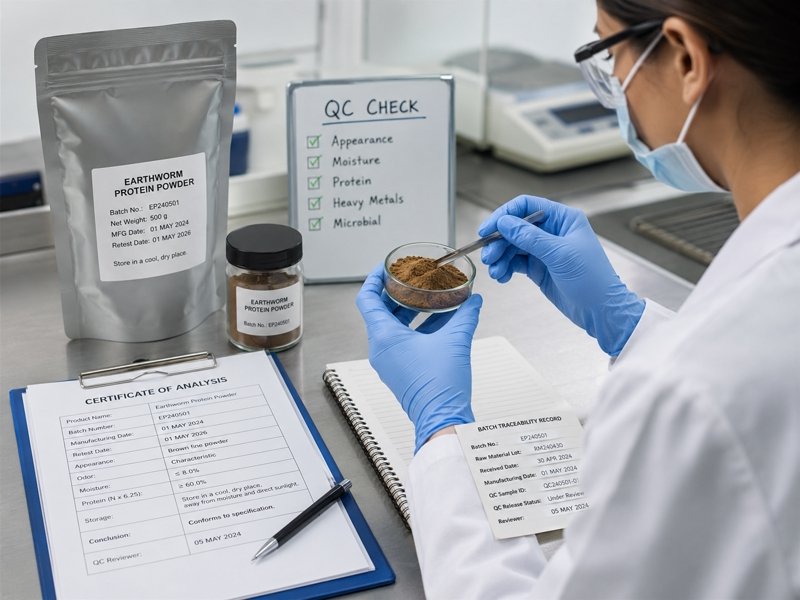
Detailed sample checks should be completed under the buyer’s own evaluation plan. After completing the document review, buyers should define the appearance, protein, moisture, packaging, formulation, and third-party testing checks required for their own sample approval process.
10. Storage Conditions
Storage instructions may appear on the COA, specification sheet, label, or separate product document.
Typical review points include:
- keeping the package tightly sealed;
- storing it in a cool, dry place;
- protecting it from moisture and high humidity;
- avoiding direct sunlight;
- controlling warehouse handling after delivery.
The purchasing and warehouse teams should make sure that the storage instructions can be followed throughout receipt, inspection, sampling, production, and remaining-stock management.
Storage information should also be considered when reviewing international shipping options. Transit route, climate, customs-clearance time, and final warehouse conditions may affect the buyer’s packaging and logistics decisions.
Earthworm Protein Powder COA Review Checklist
| COA Item | What Buyers Should Check | Why It Matters |
|---|---|---|
| Product name | Exact material and grade | Prevents document mismatch |
| Supplier information | Company name and document issuer | Supports supplier traceability |
| Batch number | Match with sample or offered batch | Connects results to actual material |
| Manufacturing date | Production timing and batch age | Supports inventory planning |
| Expiry or retest date | Remaining period, if listed | Helps assess project timing |
| Protein content | Actual value, method, and specification | Supports formulation and acceptance |
| Moisture | Result, limit, and handling conditions | Relevant to powder and storage control |
| Ash | Actual value and specification compliance | Supports composition consistency |
| Heavy metals | Panel, units, values, and limits | Supports market and safety review |
| Microbiology | Test panel and result format | Supports quality qualification |
| Appearance | Powder, color, and odor description | Enables physical comparison |
| Storage | Sealing, humidity, light, and temperature guidance | Supports post-delivery quality handling |
| COA conclusion | Authorized conclusion or approval status | Shows whether the batch passed |
| Actual bulk batch | COA for the material to be shipped | Prevents approval of the wrong batch |
Before Approving a Sample Based on the COA
Before testing or approving a sample, confirm that:
- the COA matches the sample batch;
- the sample label and product name are consistent;
- protein content and reporting basis are understood;
- moisture and ash have been reviewed;
- heavy-metal and microbiology panels are suitable;
- appearance and storage instructions are clear;
- internal or third-party test requirements have been defined.
COA review does not replace sample testing. It helps the buyer decide what should be verified during sample evaluation and whether the documentation is sufficient to proceed.
Before Approving a Bulk Order Based on the COA
Before issuing a bulk purchase approval, confirm:
- whether the original sample batch is still available;
- which actual batch will be shipped;
- whether a current COA is available for that batch;
- whether the batch meets the agreed specification;
- manufacturing and expiry or retest dates, if listed;
- packaging format and storage requirements;
- production or dispatch lead time;
- shipping conditions and destination requirements.
For bulk approval, document control should follow the actual shipment rather than relying only on the sample-stage paperwork.
Common Buyer Mistakes
Common mistakes include:
- assuming any COA is sufficient;
- failing to check the batch number;
- reviewing protein content without checking its specification basis;
- ignoring manufacturing or expiry information;
- overlooking moisture and storage conditions;
- assuming every supplier uses the same heavy-metal panel;
- assuming every microbiology panel is identical;
- approving a COA that does not match the sample;
- relying on a sample COA for a different bulk batch;
- selecting a supplier only by price;
- assuming one approved sample guarantees all future batches.
A more reliable approach is to define document requirements before ordering, approve the sample based on both documentation and testing, and reconfirm the actual batch before shipment.
Allworms Supply Notes
Allworms is part of the manufacturer-side earthworm-derived ingredient supply system and supports overseas market development and international sales. For available Earthworm Protein Powder batches, a COA and specification sheet can be provided for B2B evaluation.
Sample support may be available for qualified buyers. MOQ, lead time, packaging, and shipping options depend on the requested specification, quantity, packaging requirement, destination, and available batch conditions.
Buyers can review the Earthworm Protein Powder product page for current product and purchasing information and consult the FAQ page for general questions about COA, specifications, samples, MOQ, storage, and bulk supply.
FAQ
1. What should buyers check on an Earthworm Protein Powder COA?
Buyers should review the product name, supplier, batch number, manufacturing date, protein content, moisture, ash, heavy metals, microbiology, appearance, storage information, and expiry or retest date if listed. The COA should also match the sample or actual batch being offered.
2. Why is the batch number important?
The batch number connects the reported test results to a specific production lot. Without it, the buyer may be unable to confirm whether the COA belongs to the tested sample, available stock, or future shipment.
3. What is the difference between a COA and a specification sheet?
A specification sheet defines target requirements or acceptable limits. A COA reports the actual test results for a specific batch. Buyers should compare the COA against the specification rather than treating either document separately.
4. What happens if the original sample batch is no longer available?
The supplier should identify the actual bulk batch, provide its COA, and confirm that it meets the agreed specification. The buyer may also request a pre-shipment sample or additional testing when required by its approval procedure.
5. Is COA review enough before placing a bulk order?
No. COA review should be combined with supplier qualification, sample evaluation, specification agreement, packaging review, regulatory assessment, and confirmation of the actual bulk batch. Third-party testing may also be appropriate depending on the buyer’s quality plan.
Request Earthworm Protein Powder Batch Documents
Share your target protein specification, intended order quantity, sample evaluation needs, destination, and document requirements.
Request the available-batch COA, specification sheet, sample support, packaging details, lead time, and shipping options from Allworms.
This product is supplied as a B2B ingredient. Final formulation suitability, dosage, labeling, claims, and regulatory compliance should be evaluated by the buyer according to the intended market and finished-product use.
Share Your Protein Specification and Order Requirements
Request Batch COA, Sample Support, Lead Time and Shipping Details