
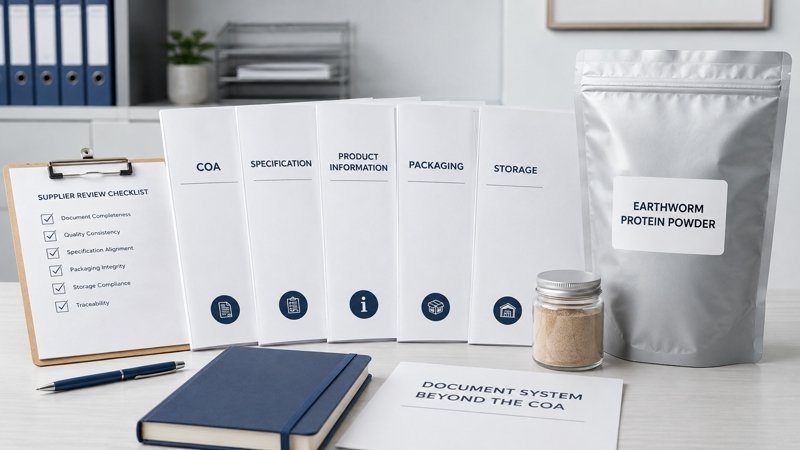
When reviewing earthworm protein powder supplier documents, B2B buyers should look beyond the Certificate of Analysis. A COA is essential because it reports test results for a specific batch, but it rarely covers the entire purchasing context.
Before approving a sample, qualifying a supplier, or placing a bulk order, buyers may also need a specification sheet, product information sheet, available batch details, sample records, packaging information, storage guidance, shelf-life information, and relevant shipping documents. Written confirmations concerning the agreed specification, order quantity, lead time, and delivery terms should also form part of the purchasing record.
Together, these documents help QA, formulation, and purchasing teams determine what the product is, which requirements it should meet, which batch will be supplied, and how it should be received, stored, evaluated, and approved.
Quick Answer
B2B buyers should not rely only on the COA when evaluating an Earthworm Protein Powder supplier. They should also review the specification sheet, product information, available batch information, sample-related documents, packaging details, storage guidance, shelf life or retest information if listed, and shipping or import documents where applicable.
The complete document set should support three decisions: whether to test the sample, whether to approve the supplier, and whether to release the actual bulk batch for purchasing.
Why the COA Is Important but Not Enough
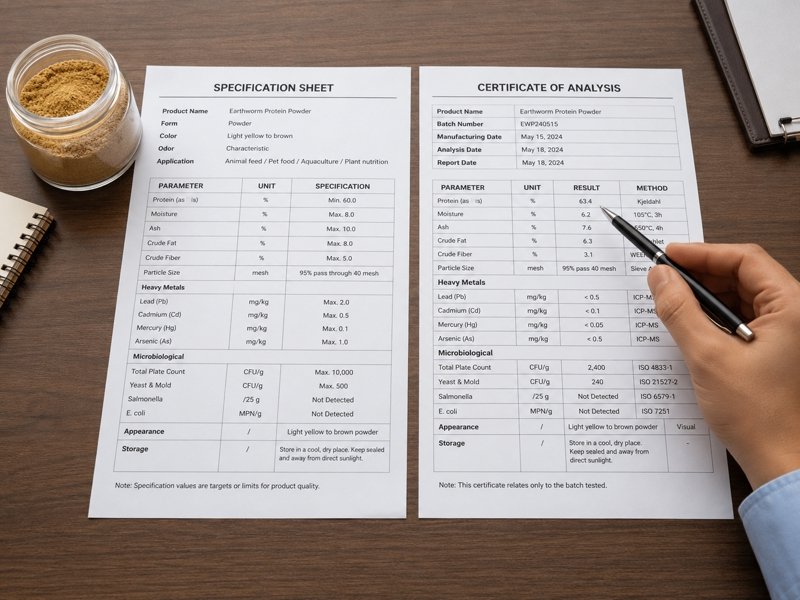
A COA is a batch-specific quality document. Depending on the supplier’s testing program, it may identify:
- Product and batch number
- Protein content
- Moisture and ash
- Heavy metals
- Microbiological results
- Manufacturing date
- Expiry or retest date, if listed
These results help buyers determine whether the tested batch meets stated limits. Buyers who need more guidance on individual entries can refer to the Earthworm Protein Powder COA Review.
However, a COA does not usually explain the complete commercial and handling framework. It may not state the standard packaging configuration, sample status, currently available quantity, warehouse handling instructions, shipping arrangements, or which conditions were agreed during supplier discussions.
The COA should therefore be treated as one controlled record within a broader supplier documentation system—not as a substitute for every other product and purchasing document.
1. Specification Sheet: The Target Requirements
The specification sheet defines the supplier’s target requirements for the product. Buyers should check whether it identifies:
- Product name and description
- Protein content target
- Appearance
- Moisture and ash limits
- Heavy-metal limits
- Microbiological indicators
- Packaging information
- Storage conditions
- Shelf life or retest information, if listed
The central distinction is simple:
Specification Sheet = target requirements.
COA = actual results for a specific batch.
This distinction prevents a common purchasing error: treating one favorable batch result as the permanent product standard.
The specification should also reflect the characteristics relevant to the intended application. For example, protein content may be central to a nutritional formulation, while amino acid profile information may be requested separately when it is relevant and available. Buyers can compare basic commercial information on the Earthworm Protein Powder product page before requesting documents for a particular grade or batch.
2. Product Information Sheet: Understanding the Ingredient
A product information sheet, product profile, or technical information sheet provides context that a specification or COA may not contain.
Depending on availability, it may include:
- Product description and source
- Appearance and general characteristics
- General processing description
- Intended B2B ingredient applications
- Storage and packaging information
- References to available quality documents
This sheet helps purchasing and formulation teams verify that the offered material matches the requested ingredient category. It should describe Earthworm Protein Powder as an earthworm-derived protein ingredient rather than implying that it is interchangeable with Earthworm Peptide Powder or an active enzyme ingredient such as lumbrokinase.
A product information sheet should support technical understanding without making unsupported medical or consumer health claims.
3. Available Batch Information: Identifying What Can Be Supplied
Buyers should ask which batch is available now or expected to be supplied against the purchase order. Useful information may include:
- Batch number
- Manufacturing date
- Available quantity
- COA status
- Expiry or retest date, if listed
- Packaging status
- Suitability for sample or bulk supply
This becomes important when several weeks or months pass between sample testing and commercial approval. The sample batch may have been sold or may no longer contain enough material for the planned order.
The sample and bulk material do not always need the same batch number. The more practical requirement is sample-to-bulk specification consistency: the actual bulk batch should meet the agreed specification and be reviewed through its own batch documentation.
If a newer batch will be supplied, the buyer should request its COA and confirm its specification status before shipment. The Earthworm Protein Powder Batch Consistency guide provides a deeper explanation of comparisons between sample and bulk batches.
An approved sample supports a purchasing decision at a particular point in time; it does not guarantee the characteristics of every future batch.
4. Sample-Related Documents
A sample should arrive with enough identifying information to connect the physical material to the supplier’s documents.
Buyers may request or confirm:
- Sample label
- Product name
- Sample batch number
- Sample COA, if available
- Current specification sheet
- Storage guidance
- Sample dispatch date
- Courier tracking information
- Documents required by an internal or third-party laboratory
Before testing begins, the buyer should verify that the label, batch number, and COA refer to the same material. Otherwise, the laboratory may produce valid results for a sample that cannot be connected reliably to the supplier’s batch records.
The intended purpose of the sample should also be recorded. Screening appearance and odor, confirming protein content, performing contaminant testing, and conducting formulation trials are different evaluation activities. More detailed planning considerations are covered in Earthworm Protein Powder Sample Evaluation.
5. Packaging Information
Packaging information helps buyers plan warehouse receiving, storage, pilot production, and small bulk use. Before purchasing, they should confirm:
- Standard pack size
- Inner and outer packaging
- Sealing condition
- Label contents
- Packaging available for trial quantities
- Whether repeated opening should be minimized
- How the package limits moisture exposure
- Number of units or packages in the shipment
Pack size is not only a freight consideration. If a formulation team uses small quantities over an extended period, one large package may be opened repeatedly. Smaller sealed units may be easier to manage, but availability and cost must be confirmed with the supplier.
Buyers should avoid assuming that website photos represent the exact packaging for every quantity. The packaging configuration should be confirmed in writing for the actual quotation or purchase order.
6. Storage Guidance
Storage guidance explains how the powder should be handled after delivery. Depending on the applicable product documents, buyers may need to check instructions concerning:
- Cool and dry storage
- Sealed packaging
- Protection from moisture
- Avoidance of high humidity
- Protection from direct sunlight
- Warehouse handling after receipt
- Keeping unopened units sealed before use
These instructions should be distributed to warehouse and production personnel rather than remaining only in the purchasing team’s email archive.
Storage statements should be based on supplier documentation. Buyers should not assume that a general powder-storage procedure confirms product stability under every temperature, humidity, or open-package condition.
7. Shelf Life, Expiry, or Retest Information
Where provided, buyers should review the manufacturing date together with the stated shelf life, expiry date, or retest date. These terms should not automatically be treated as interchangeable.
The review should consider:
- Manufacturing date
- Expiry date, if listed
- Retest date, if used
- Remaining documented shelf life
- Sample-testing timeline
- Formulation and pilot-production schedule
- Expected commercial use date
A batch may comply with the specification but still offer insufficient remaining time for a long internal approval process. This is particularly relevant when samples must pass third-party testing before a bulk order can be released.
Buyers should ask the supplier to clarify any unclear date format or shelf-life basis rather than calculating an expiry date independently.
8. Shipping and Import-Related Documents
Shipping documents depend on the destination, courier, order size, and buyer requirements. Relevant records may include:
- Commercial invoice
- Packing list
- Shipping label
- Customs declaration information
- Courier or airway bill information
- Consignee details
- Product description used for shipment
- Destination and delivery terms
Buyers should confirm the legal company name, delivery address, contact person, telephone number, and any receiving restrictions before dispatch. They may also discuss DHL or other courier options and request DDP service where applicable and available.
Import requirements vary by destination, product classification, intended use, and buyer responsibility. Buyers should confirm applicable requirements with their import, customs, or regulatory advisers. Supplier shipping information should not be treated as legal advice or automatic confirmation that a product can be imported into every market.
9. Supplier Communication Records
Email confirmations, quotations, proforma invoices, and approved specification discussions can form an important part of the purchasing record.
Buyers should retain written confirmation of:
- Agreed specification
- Available or planned batch
- Sample identity
- Order quantity
- Packaging configuration
- Document requirements
- Lead time
- Shipping method
- Payment and delivery terms
These records help resolve situations in which a COA is technically acceptable but the shipment does not match the agreed pack size, timeline, or available batch.
For small bulk and repeat orders, a simple supplier approval record can reduce misunderstanding and shorten future purchasing reviews. A useful record includes the last approved specification version, last accepted batch, required documents, packaging format, and any buyer-specific testing requirements.
Document Review Before Sample Approval
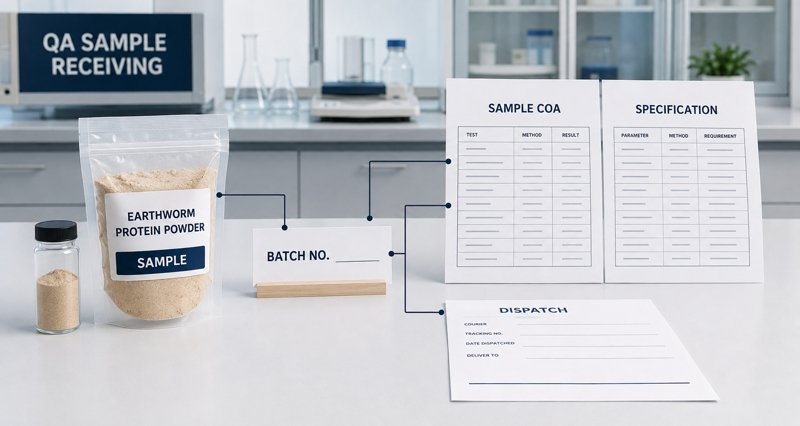
Before approving a sample for laboratory or formulation work, verify:
- The sample label identifies the product and batch.
- The COA, when provided, corresponds to that batch.
- The specification sheet states the target requirements.
- Product information matches the requested ingredient.
- Storage guidance is available to the receiving team.
- The testing purpose and required documents have been defined.
- Any discrepancy has been clarified in writing.
The objective is traceability: the physical sample, supplier documents, and internal test request should describe the same material.
Document Review Before Bulk Order Approval
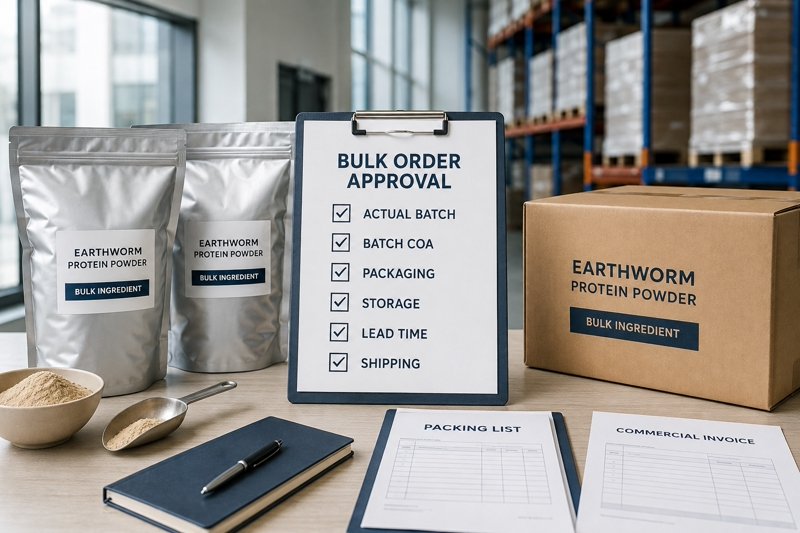
Before releasing a bulk purchase, buyers should reconfirm:
- The actual batch available for supply
- The COA for the actual bulk batch
- The applicable specification sheet and version
- Manufacturing date and expiry or retest date, if listed
- Packaging and labeling details
- Storage guidance
- Order quantity and MOQ
- Lead time
- Shipping method and destination requirements
- Compliance with the agreed specification
This second review remains necessary even when the sample was approved. It connects the earlier evaluation to the material that will actually be purchased and shipped.
Earthworm Protein Powder Supplier Document Checklist
| Document | What Buyers Should Check | Why It Matters |
|---|---|---|
| COA | Product, batch number, dates, protein, moisture, ash, heavy metals, and microbiology | Reports results for a specific tested batch |
| Specification sheet | Target values, test items, packaging, storage, and date information | Defines the requirements against which batches are assessed |
| Product information sheet | Source, description, processing overview, and intended ingredient applications | Confirms product identity and commercial positioning |
| Available batch information | Batch number, quantity, date, COA status, and packaging status | Shows which material can actually support the order |
| Sample label or details | Product name, batch, dispatch date, and document match | Connects the physical sample to test records |
| Packaging information | Pack size, inner and outer packaging, sealing, and labels | Supports receiving, storage, and production planning |
| Storage guidance | Temperature description, dryness, sealing, light, and moisture precautions | Supports appropriate warehouse handling |
| Shelf life or retest information | Manufacturing date, expiry or retest date, and remaining time | Helps align testing and production schedules |
| Shipping documents | Invoice, packing list, consignee data, labels, and transport details | Supports dispatch, customs review, and receiving |
| Supplier communication records | Specification, batch, quantity, packaging, lead time, and agreed terms | Preserves the basis of sample and order approval |
Common Buyer Mistakes
Common document-review mistakes include:
- Relying only on the COA
- Failing to request a specification sheet
- Assuming the COA belongs to the sample or bulk batch without checking
- Ignoring currently available batch information
- Reviewing packaging only after placing the order
- Failing to distribute storage guidance internally
- Overlooking manufacturing date and remaining shelf life
- Keeping important supplier agreements only in verbal discussions
- Assuming document titles and contents are identical across suppliers
- Treating an approved sample as a guarantee for all future batches
- Skipping document review before a repeat order
- Choosing a supplier solely by price
The FAQ page provides additional answers concerning specifications, samples, MOQ, documentation, and international supply.
Allworms Supply Notes
Allworms is part of the manufacturer-side earthworm-derived ingredient supply system and supports overseas market development and international sales. COA and specification sheets can be provided for available Earthworm Protein Powder batches.
Sample support may be available for qualified B2B buyers. MOQ, lead time, packaging, and shipping options depend on the required specification, quantity, packaging expectations, destination, and available batch conditions.
Buyers should confirm the actual batch, related documents, packaging, storage guidance, and shipping plan before approving a bulk order.
This product is supplied as a B2B ingredient. Final formulation suitability, dosage, labeling, claims, and regulatory compliance should be evaluated by the buyer according to the intended market and finished-product use.
FAQ
1. What documents should buyers request beyond the COA?
Buyers should request the specification sheet, product information sheet, available batch information, sample details, packaging information, storage guidance, and shelf life or retest information if listed. Shipping documents and written commercial confirmations may also be required.
2. What is the difference between a COA and a specification sheet?
A specification sheet defines the target requirements for the product. A COA reports actual test results for one identified batch. Buyers should compare the batch results against the applicable specification rather than reviewing either document alone.
3. Should buyers request available batch information?
Yes. Available batch information helps confirm which material can support the sample or bulk order, whether its COA is ready, how much is available, and whether the remaining shelf life fits the buyer’s schedule.
4. Should buyers review the COA again before approving a bulk order?
Yes. If the bulk order will use a different batch from the evaluated sample, the buyer should review the COA for the actual bulk batch. Even when the batch is unchanged, its identity and availability should be reconfirmed before shipment.
5. Is a COA enough for Earthworm Protein Powder supplier approval?
Usually not. Supplier approval may also depend on the specification, product identity, packaging, storage guidance, sample traceability, available batch, shipping preparation, and the supplier’s written confirmation of purchasing requirements.
Share Your Specifications And Document Requirements
Request batch details before bulk order approval