
A functional ingredient with a bit more character
Functional food developers are under pressure from both sides now. Consumers want more from every serving, while brands want cleaner labels, sharper stories, and ingredients that don’t look like every other protein in the market. That’s where earthworm peptide powder starts to feel interesting.
Not trendy-interesting. Useful-interesting.
Earthworm-derived protein and peptide ingredients sit in that rare zone where nutrition, bioactivity, and formulation story all overlap. Research in the files you shared points to earthworm protein as a high-protein raw material, often in the 56–70%+ range depending on source and processing, with good essential amino acid composition and potential as a food resource for functional products. After gastrointestinal digestion or hydrolysis, it can yield smaller bioactive peptides linked with antioxidant and ACE-inhibitory activity.
And that’s the key point, really: for functional food formulation, the value is not only “it contains protein.” The real value is that peptide-rich fractions may carry targeted physiological relevance.
That changes the conversation.
Instead of asking, “Can I add another protein?” formulators start asking, “Can I build a better concept around a bioactive peptide ingredient that also supports a premium positioning?” That’s a very different brief.
Protein is good. Peptides are where it gets interesting
Here’s the thing: in functional foods, not all protein ingredients behave the same way. A standard protein powder might help with nutrition claims, protein fortification, or satiety concepts. A peptide powder, though, often brings a more specialized angle.
The supporting reseach explain this pretty well. Earthworm protein can be converted into smaller peptide fractions through digestion or hydrolysis, and those smaller molecules are valued because peptide ingredients are often positioned as easier to absorb and more suitable for functional applications than intact protein.
That matters for finished products.
In practice, a formulator may choose earthworm peptide powder over crude earthworm protein when the goal is not just protein enrichment, but a more refined “active nutrition” concept—something closer to cardiovascular support, oxidative stress support, recovery positioning, or healthy aging concepts. The science is still developing, yes, but the formulation logic is already clear.
It’s a bit like the difference between using whole coffee beans and using a standardized extract. Both come from the same source, but one gives you a broader nutrition story while the other gives you a tighter functional angle.
Why functional food brands are paying attention
There are a few reasons earthworm peptide powder fits the functional food space so well.
First, the raw material story is strong. One study describes earthworm as a protein-rich resource with good amino acid quality and notes that earthworm protein is considered a potential food source and functional food ingredient.
Second, the science is getting more specific. Not vague “traditional use only” specific. Actual peptide-identification specific.
In the antioxidant study, researchers identified 6030 peptide sequences after fractionation and highlighted three peptides—AFWYGLPCKL, WPWQMSLY, and GCFRYACGAFY—as showing especially strong antioxidant activity. The paper explicitly says these findings support the application of earthworm proteins as antioxidants in health foods and functional foods.
In the ACE-inhibitory study, researchers isolated seven novel ACE-inhibitory peptides, with SSPLWER and RFFGP showing the strongest activity among the synthesized peptides, and concluded that earthworm proteins can be used as a new potential protein resource for functional foods.
Third, the market-facing application ideas are already starting to take shape. One of our product texts points to uses in functional beverages, health products, protein bars, biscuits, cereal products, dairy-style applications, and other health-oriented foods. That document is more commercial than academic, of course, but it’s still useful because it reflects how suppliers are already thinking about product translation.
So yes, the ingredient is unusual. But unusual does not mean impractical. Sometimes it means underused.
The bioactivity angle: what formulators can actually work with
Let me explain the three most relevant formulation narratives.
1. Antioxidant positioning
The Food Chemistry paper found that earthworm protein digestion products showed antioxidant activity, and several peptides stood out after screening and validation. The study goes further than simple activity screening and looks at structure-activity relationships, which gives the ingredient more scientific texture than a generic “contains antioxidants” claim.
For formulation teams, that opens up categories like:
- daily wellness powders
- recovery nutrition blends
- active aging products
- beauty-from-within concepts
- antioxidant support beverages
That said, a responsible brand should keep the wording grounded. “Supports antioxidant formulation concepts” is a very different sentence from making disease-linked promises. The former is smart. The latter is trouble.
2. Cardiovascular-support positioning
The ACE-inhibitory peptide work is especially relevant for functional food developers focused on heart-health categories.
The study identified seven novel ACE inhibitory peptides from in vitro gastrointestinal digestion product, with SSPLWER showing particularly strong activity. It also notes that food-derived ACE-inhibitory peptides may be more acceptable to consumers than synthetic inhibitors, at least from a positioning perspective.
That gives brands a serious starting point for cardiovascular support concepts in:
- sachet powders
- capsules paired with functional food lines
- heart-health nutrition bars
- senior wellness beverages
- daily nutrition blends aimed at healthy circulation positioning
Again, caution matters. Ingredient science can guide formulation and positioning, but finished-product claims depend on local regulations, substantiation level, dosage, and product format. No shortcuts here.
3. General wellness and active nutrition
Some of the broader review material describes earthworm extract as containing multiple bioactive agents and summarizes antithrombotic, antioxidant, anti-inflammatory, wound-healing, and other pharmacological activities. That review is useful for background framing, though not every effect belongs in a food claim strategy.
For food formulation, the smarter move is to translate that wide bioactive profile into gentler commercial language:
- daily vitality
- wellness support
- active lifestyle nutrition
- healthy aging support
- recovery-friendly nutrition concepts
That keeps the formulation story credible and commercially usable.
Where does it fit in actual food products?
This is where things get real. A promising peptide is one thing. A finished product that people will actually drink, chew, or reorder is another.
Earthworm peptide powder can reasonably be explored in several formats: functional drinks, nutrition powders, health foods, protein bars, biscuits, cereal products, and fortified foods.
Here are the most realistic fits.
Powders and sachets
This is probably the easiest entry point.
Why? Because powders let brands control dose, pair the peptide with other functional ingredients, and work around taste challenges with flavor systems. They also give suppliers room to sell into private label, practitioner brands, sports recovery concepts, and healthy aging SKUs.
Honestly, if a brand is trying earthworm peptide powder for the first time, this is the least painful route.
Functional beverages
The concept is attractive, but formulation will need discipline.
The food application text suggests juice and tea-style functional drinks as possible carriers. That makes sense from a concept standpoint, especially for antioxidant or daily wellness positioning. But beverage systems are unforgiving. Solubility, sedimentation, taste, heat treatment, and shelf stability all show up fast.
So yes, it can work. But it’s not the place to be casual.
Bars, cookies, and baked nutrition products
This is another practical lane. The commercial document explicitly mentions protein bars and biscuits. These formats help with taste masking and allow the ingredient to sit inside a broader protein-plus-function story.
The tradeoff is heat. If the brand cares about preserving specific peptide functionality, process temperature and residence time need a close look.
Cereal, grain, and convenience health foods
There’s also a strong case for cereal or grain-based formats, especially where the product concept is more about daily maintenance than clinical-style targeting. Again, your file specifically mentions cereals and grains as possible applications.
This is a good fit for brands selling routine wellness, not hard-stop intervention.
Now for the messy part: formulation challenges
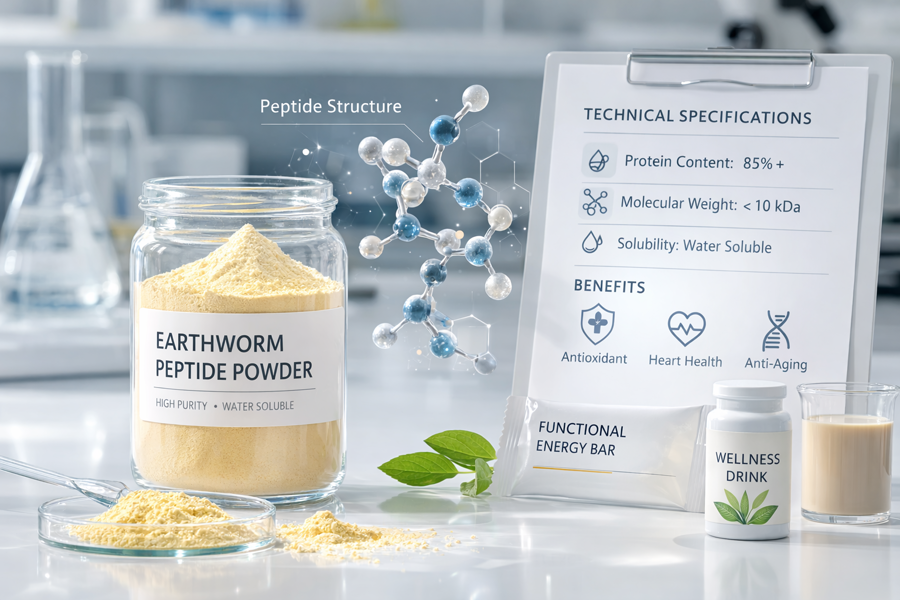
This ingredient has promise, but let’s not pretend it formulates like vanilla whey.
One of the food application documents directly points out the big issues: effective extraction, stability, and preserving original taste or product palatability. That sounds obvious, but it’s actually the heart of the whole matter.
Taste and aroma
This is usually the first commercial barrier.
Animal-derived peptide ingredients can bring bitterness, savory notes, or a lingering aftertaste. Earthworm peptide powder may require masking systems, sweetener balancing, acid control, and possibly pairing with stronger flavor directions rather than delicate profiles.
Citrus? Maybe.
Dark berry? Better.
Light floral water? Probably not your friend.
Solubility and dispersion
In powders and beverages, clean dispersion matters. Nobody wants floaters, haze, or a muddy drink ring around the bottle. Supplier grade, particle size, hydrolysis level, and carrier system all affect this.
Heat and processing tolerance
Peptide ingredients are not automatically fragile, but bioactivity can shift depending on process conditions. If the marketing story leans heavily on peptide functionality, developers should test the finished matrix rather than assuming the raw-material data transfers perfectly.
Dose economics
A beautiful ingredient story can fall apart if the effective inclusion level wrecks margins or sensory quality. That’s why suppliers who can provide concentrated, standardized, and well-documented peptide fractions will have an edge over sellers offering a generic “earthworm powder” with fuzzy specs.
Regulatory positioning
And yes, this one matters a lot.
An ingredient can be scientifically exciting and still awkward in certain markets. Product type, regulatory category, local acceptance of animal-derived novel ingredients, labeling language, and claim wording all affect commercial success. So the formulation discussion should always run alongside a regulatory review—not after the packaging is already designed.
How to position it without sounding unbelievable
This is where some brands get too excited and trip over their own marketing.
Earthworm peptide powder should usually be positioned as a premium functional ingredient with peptide-based value, not as a miracle cure. The uploaded science supports antioxidant and ACE-inhibitory potential in hydrolysates and isolated peptides, and the broader review supports the idea that earthworm extracts contain multiple bioactive substances.
But strong science does not give permission for reckless claims.
The better commercial language sounds like this:
- peptide-based functional nutrition ingredient
- suitable for cardiovascular wellness concepts
- fits antioxidant-support formulations
- designed for premium active nutrition products
- useful for differentiated functional food development
That tone works better with serious buyers too. Dietary supplement brands, nutraceutical manufacturers, and functional food developers usually respond better to precise, credible wording than to dramatic promises.
A quiet claim often sells better than a loud one.
Why suppliers like this category so much
For B2B suppliers, earthworm peptide powder has another advantage: differentiation.
There are countless marine collagen products, generic plant proteins, and mainstream whey concepts. Buyers have seen them all. Earthworm peptide powder stands out because it gives a brand three stories at once:
- a protein-origin story
- a peptide-function story
- a niche innovation story
That combination is valuable.
It also gives manufacturers room to segment. One grade might be developed for powdered nutrition. Another for compressed tablets or capsules. Another for beverage premixes. Another for food fortification where cost control matters more than bioactive storytelling.
That kind of portfolio logic is exactly what ingredient distributors, OEM factories, and private label partners look for.
So, is it ready for mainstream functional foods?
Yes and no.
Yes, because the scientific foundation is getting better. The research you shared does support the idea that earthworm protein can generate bioactive peptides relevant to functional food concepts, especially around antioxidant and ACE-inhibitory activity.
No, because mainstream success in food is never just about science. It also depends on sensory acceptance, regulatory fit, documentation quality, processing compatibility, and whether the supplier can deliver a clean, stable, consistent ingredient lot after lot.
That’s the contradiction—and it’s not really a contradiction once you see the whole picture.
The ingredient can be genuinely promising and still need careful product design.
Both things can be true.
The smart way forward for brands and manufacturers
For most B2B buyers, the practical roadmap looks like this:
Start with a clearly defined product format. Powdered drink mix, nutrition sachet, bar, biscuit, or tablet-adjacent functional food. Don’t try to force one ingredient into every format at once.
Then ask the supplier harder questions than usual:
What is the peptide content?
How was it hydrolyzed?
What is the sensory profile?
What is the recommended inclusion range?
What stability data exists?
What claims are supportable in the target market?
That’s where serious business happens.
Because in functional food formulation, the ingredient is only half the job. The other half is whether it can behave in the real world—on the line, on the label, and on the shelf.
And earthworm peptide powder? It has a compelling case. Not effortless, but compelling.
FAQs
1. What is earthworm peptide powder used for in functional food formulation?
Earthworm peptide powder is mainly explored for functional food concepts tied to antioxidant support, cardiovascular wellness positioning, active nutrition, and premium health-food development. It may be used in powders, beverages, bars, biscuits, and cereal-based products depending on stability and taste targets.
2. Is earthworm peptide powder better than regular earthworm protein for functional foods?
For many functional food formulations, yes. Earthworm peptide powder is generally more suitable when a brand wants a bioactive peptide story rather than simple protein fortification. Peptide-rich ingredients are usually chosen for more targeted positioning and easier incorporation into high-value wellness products.
3. Can earthworm peptide powder be added to functional beverages?
It can, but beverage formulation needs careful work. Solubility, taste, sedimentation, and processing stability all need testing. Functional beverage use is mentioned in your uploaded food application material, but real success depends on the specific formulation system.
4. What bioactive benefits are most associated with earthworm peptide powder?
The strongest food-relevant directions in the shared research are antioxidant activity and ACE-inhibitory activity from identified earthworm-derived peptides. Those findings make earthworm peptide powder especially relevant for functional food categories linked with wellness and cardiovascular-support concepts.
5. What should buyers check before sourcing earthworm peptide powder for food products?
Buyers should check peptide content, sensory profile, raw material origin, processing method, stability data, recommended dosage range, specification consistency, and regulatory suitability for the target market. For a functional food ingredient like earthworm peptide powder, documentation quality matters almost as much as the ingredient itself.