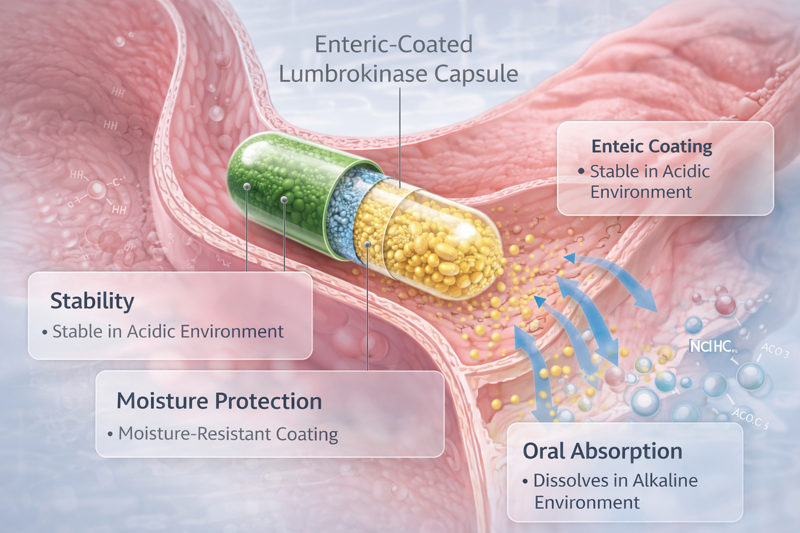


The short answer? Yes—but not in the same way everywhere
Lumbrokinase can be suitable for different regional markets, but suitability is not universal, and it definitely is not plug-and-play. That’s the part some suppliers gloss over.
On paper, the ingredient has obvious appeal. It comes from earthworm-derived fibrinolytic enzymes and is widely discussed for antithrombotic and thrombolytic potential in the scientific literature. A 2024 review describes lumbrokinase as one of the key bioactive agents in earthworm extract and notes its strong anticoagulant and thrombolytic properties, while also highlighting ongoing interest in clinical translation.
But markets don’t buy ingredients “on paper.” They buy a regulatory story, a claims story, a safety story, and a consumer acceptance story. Sometimes those line up nicely. Sometimes they absolutely do not.
So, is lumbrokinase suitable for different regional markets? Yes—but only when the format, claims, positioning, and documentation match the local rules and buyer expectations.
What decides whether a region is a good fit?
Here’s the thing: with lumbrokinase, the science matters, but the market category matters even more.
A region is usually attractive when five things line up:
1. The market already understands enzyme-based wellness ingredients
If buyers and consumers are used to enzyme ingredients, specialty cardiovascular support products, or traditional medicine-based actives, lumbrokinase has a better chance.
2. The claims environment is workable
In the United States, for example, dietary supplements can use structure/function claims, but not disease claims, and firms making those claims generally must notify FDA within 30 days after first marketing. (U.S. Food and Drug Administration)
That sounds manageable, and in some cases it is. But it also means a brand cannot casually market a supplement as a treatment for thrombosis, stroke, or coronary disease without moving into drug territory. That’s a very different commercial reality from how some ingredient sellers talk about the material.
3. The ingredient has a believable cultural or historical context
Earthworm-derived ingredients have a much stronger historical and traditional footing in East Asia than in many Western markets. The 2024 review in your source materials notes that earthworms have been used as antithrombotic agents in East Asia for centuries and are classified in the Chinese Pharmacopeia.
That kind of familiarity doesn’t guarantee easy registration, of course. Still, it lowers the “What exactly is this?” barrier.
4. The buyer can support quality documentation
For B2B buyers, this is not optional. With lumbrokinase, regional suitability often comes down to whether the supplier can provide identity methods, activity specifications, contaminant controls, microbial data, batch consistency, and a clean manufacturing narrative.
Honestly, this is where deals are won or lost.
5. Consumer perception is not working against you
An ingredient can be scientifically interesting and commercially awkward at the same time. Earthworm-derived ingredients may attract strong attention in some markets, but that attention can be either good or bad. If the local market leans toward TCM-style heritage positioning, it may help. If the market is more squeamish, the same feature may need careful reframing around enzyme standardization, purification, and application science.
East Asia: usually the most natural fit
If you’re looking for the region where lumbrokinase makes the most intuitive sense, East Asia is usually first on the list.
Why? Because the ingredient story already has context there. Historical use matters. Traditional medicine familiarity matters. Practitioner channels matter. And buyers in those markets are often more open to animal-derived actives with a strong function-led narrative.
Some of the review is useful here. It states that earthworms have been used as antithrombotic drugs in East Asia for centuries and that oral lumbrokinase formulations have been approved in several countries, with ongoing work on molecular mechanisms and bleeding-related concerns.
That does not mean every East Asian market is easy. It means the commercial conversation starts from a more favorable place.
For manufacturers, this often makes East Asia attractive for:
- practitioner-led cardiovascular support products
- traditional medicine-adjacent formulations
- enzyme-focused tablets and capsules
- premium health products aimed at middle-aged and older consumers
In plain English: the education burden is lower, and the concept feels less foreign.
North America: possible, but positioning is everything
North America can be viable, but it is rarely a “say less and ship more” market.
In the U.S., FDA distinguishes among health claims, nutrient content claims, and structure/function claims for dietary supplements. Structure/function claims may describe how a nutrient or ingredient supports the normal structure or function of the body, but they are not the same as disease treatment claims. (U.S. Food and Drug Administration)
That makes lumbrokinase tricky but not impossible.
A few implications for the U.S. market:
What may work
- circulation support positioning
- cardiovascular wellness support language
- enzyme-based systemic wellness concepts
- practitioner or niche e-commerce channels
What gets risky fast
- “dissolves blood clots” on consumer labels
- stroke prevention claims
- deep vein thrombosis treatment language
- direct comparisons to prescription anticoagulants
That’s the contradiction with lumbrokinase. Its strongest scientific and commercial appeal is tied to clot-related language, yet those same words can create the biggest compliance problems in supplement markets.
Canada can also be interesting, especially because Health Canada maintains a Licensed Natural Health Products Database and requires licensed products to carry an NPN or DIN-HM. For suppliers, that means Canada can be attractive when a customer is willing to do the regulatory homework and build a proper dossier rather than chase a quick listing.
So yes, North America can work. But it tends to favor sophisticated brands, not casual spec-sheet sellers.
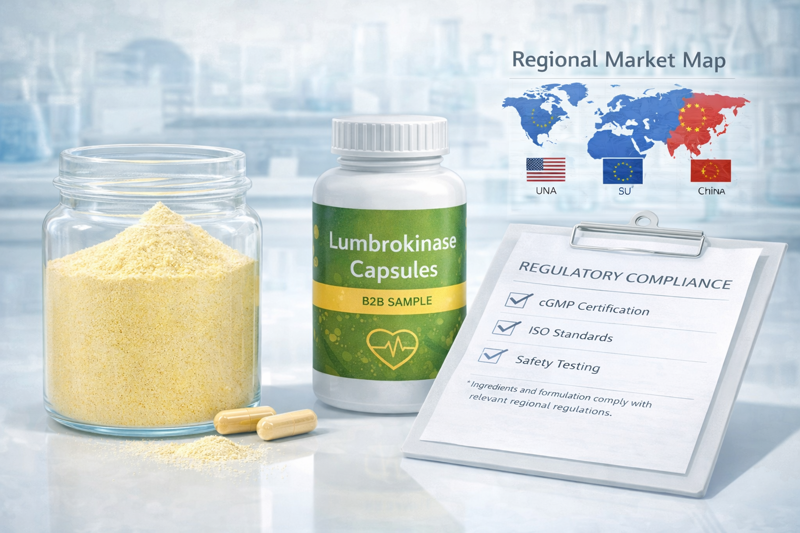
Europe: the hardest road for most suppliers
Europe is where many promising ingredients slow down.
The European Commission’s novel food framework is the central issue. The Commission’s Novel Food pages explain that foods not consumed to a significant degree in the EU before 15 May 1997 may fall under the Novel Food Regulation, and the Union list compiles authorized novel foods along with conditions of use and specifications. (Food Safety)
For a specialized ingredient like lumbrokinase, that matters a lot.
Why Europe is tough:
- novel food questions can arise quickly
- animal-derived specialty ingredients face extra scrutiny
- claims are heavily constrained
- buyer due diligence is usually deeper
- mainstream consumer acceptance may be weaker than in Asia
Could a company build a path into Europe? Sure. But for most ingredient suppliers, Europe is not the first market to test. It is the market to approach after you already have strong safety data, a stable manufacturing file, and enough patience to handle a slower commercial cycle.
You know what? That’s not a bad thing. Europe can still be strategically valuable. It’s just not the easiest first yes.
Southeast Asia and Australia: interesting middle-ground markets
These markets are worth a closer look because they often sit between East Asia’s familiarity and Europe’s rigidity.
Singapore’s HSA maintains a system for notified health supplements and traditional medicines. (HSA) That doesn’t mean every lumbrokinase product will fit neatly, but it does show a structured framework where category choice matters.
Australia is also notable. TGA explains that complementary medicines are non-prescription medicines, and that listed and registered complementary medicines follow different entry pathways and evidence expectations. (Therapeutic Goods Administration (TGA))
For suppliers, these are promising “middle-ground” regions because:
- buyers are used to regulated wellness products
- enzyme and specialty ingredients can be understood by the market
- the compliance pathway is demanding, but not necessarily impossible
- premium positioning is often accepted when documentation is solid
In these markets, the smart move is usually not to lead with the boldest thrombolytic story. It is to lead with standardization, quality controls, and carefully framed support claims.
So which regional markets are the best fit?
If we rank regional suitability from a practical B2B standpoint, it usually looks something like this:
Best fit now
East Asia
Strong cultural context, clearer ingredient story, better product-market resonance.
Good opportunities with disciplined positioning
North America, selected Southeast Asian markets, Australia
Commercially interesting, but claim language and category strategy must be tight.
Longer-term or specialist play
Europe
Possible, but often slower, costlier, and more document-heavy.
That doesn’t mean Europe has no future. It means you probably don’t start there unless you already know exactly why you’re entering.
A smarter way to bring lumbrokinase to market
For brands, manufacturers, and distributors, the better question may not be “Can we sell it everywhere?”
It may be this: “Which market matches our current evidence package, brand tone, and claims tolerance?”
That’s a much more profitable question.
If your strengths are:
- traditional medicine storytelling
- practitioner channels
- cardiovascular support categories
- strong batch documentation
then East Asia and selected adjacent markets may be your best route.
If your strengths are:
- compliance discipline
- niche premium supplements
- careful structure/function language
- strong customer education
then North America and Australia may be workable.
If your strength is simply “we have the ingredient,” that’s not enough. Not for lumbrokinase. Not anymore.
Final thought
Lumbrokinase is not a one-market ingredient, but it is not a universal ingredient either. It travels well only when the market understands either the tradition behind it or the technical case for it.
That’s why the most successful regional strategy is usually phased:
start where the ingredient story feels familiar, build documentation and commercial proof, then expand into stricter markets with a stronger file.
A little less hype, a little more market fit—that’s usually what wins.
FAQs
1. Is lumbrokinase easier to market in Asia than in Europe?
Generally, yes. East Asian markets often have stronger historical familiarity with earthworm-derived actives, while Europe tends to place heavier emphasis on novel food status, authorization pathways, and tightly controlled claims. (Food Safety)
2. Can lumbrokinase be sold as a dietary supplement in the United States?
It may be positioned in the dietary supplement space, but U.S. marketing must stay within FDA rules for supplement claims. Structure/function claims are allowed in certain circumstances, while disease treatment claims create much higher regulatory risk. (U.S. Food and Drug Administration)
3. What makes lumbrokinase suitable for premium regional markets?
The ingredient tends to fit premium markets when suppliers can offer standardized enzyme activity, clean manufacturing records, contaminant controls, and a carefully framed cardiovascular wellness story rather than overly aggressive therapeutic claims. The clinical and pharmacological interest around lumbrokinase supports that premium positioning.
4. Which buyers are most likely to adopt lumbrokinase first?
Dietary supplement brands, practitioner-channel brands, nutraceutical formulators, and specialty health product manufacturers are usually the most realistic first adopters—especially those already working with enzyme ingredients or cardiovascular support concepts.
5. Is lumbrokinase a good ingredient for global expansion?
It can be, but global expansion usually works best in stages. A smart lumbrokinase global market strategy often starts in regions with stronger ingredient familiarity, then moves into stricter regions once safety files, regulatory support, and label language are fully prepared.