
How to Evaluate the Quality of Lumbrokinase
For QA, R&D, and sourcing teams, evaluating Lumbrokinase quality requires more than comparing activity numbers. Activity is important, but it becomes meaningful only when it is reviewed alongside the assay method, ingredient specification, batch results, broader quality parameters, consistency, and supporting documentation.
A practical quality-evaluation system therefore connects six elements:
Activity + Assay Context + Specification + Batch Results + Consistency + Documentation
No single element provides enough evidence on its own. A high activity claim without a defined method is difficult to interpret. A specification without a batch COA does not confirm the material actually supplied. One acceptable batch does not establish repeat commercial consistency.
The purpose of quality evaluation is to determine whether a clearly identified Lumbrokinase raw material is supported by measurable requirements, appropriate testing, representative batch evidence, and sufficient information for ingredient or supplier approval.
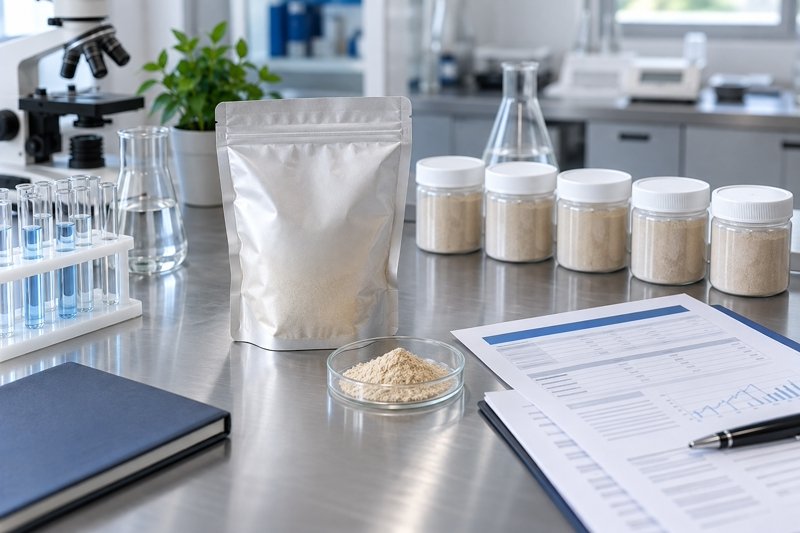
Start by Defining What Lumbrokinase Quality Means
Lumbrokinase quality is multidimensional. It should not be judged solely from:
- A high activity number
- A supplier’s “premium” or “high-purity” description
- Powder color or appearance
- One analytical result
- A specification sheet without batch data
The first step is confirming what material is being evaluated. Lumbrokinase is an earthworm-derived enzyme ingredient, but broad terms such as “earthworm extract,” “earthworm protein,” or “earthworm peptide” do not automatically identify a standardized Lumbrokinase material.
The product name, ingredient type, source description, and intended commercial specification should be consistent across the supplier’s technical documents. Buyers requiring current product-level information can review the Lumbrokinase Powder Supplier page before moving into detailed qualification.
Once ingredient identity is clear, the evaluation should progress from activity and assay context to specifications, batch evidence, consistency, and documentation.
Evaluate Fibrinolytic Activity With the Assay Method
Fibrinolytic activity is a central quality parameter for Lumbrokinase. However, an activity number cannot be interpreted independently from its test method and reporting basis.
The current Allworms commercial expression is:
- Fibrinolytic Activity: ≥1,000,000 U/g
- Assay Method: Fibrin Plate Assay

These two lines belong together. The first defines the activity requirement, while the second identifies the method used to evaluate it.
Buyers may encounter other suppliers reporting activity in U/g, IU/mg, FU/g, LKU, or another format. A larger numerical value under one reporting system does not automatically indicate a higher-quality ingredient than a smaller value reported under another system. Differences in methods and calculation bases can prevent direct comparison.
For this stage, buyers should ask:
- Is the activity specification clearly stated?
- Is the assay method identified?
- Do the specification and COA use the same expression?
- Is the buyer comparing results generated under sufficiently comparable methods?
- Can the supplier provide additional method context when needed?
Detailed unit interpretation belongs in Lumbrokinase Activity Units: IU/mg, FU/g, LKU and U Explained. The quality decision principle is simpler: never separate the activity result from the method that produced it.
Use the Ingredient Specification as the Quality Framework
A Lumbrokinase specification defines what the commercial raw material is expected to meet. It establishes the agreed parameters and acceptance criteria against which samples and subsequent batches can be evaluated.
Depending on the material, intended application, and buyer requirements, the specification may address:
- Ingredient identity and source
- Fibrinolytic activity
- Activity assay method
- Appearance
- Moisture
- Ash
- Relevant safety parameters
- Heavy metals
- Microbiological parameters
- Packaging and storage information
Not every buyer will use an identical specification. Requirements can differ according to formulation, finished-product category, target market, and internal quality systems. The important point is that the specification should be sufficiently clear to support repeat purchasing and batch acceptance.
A vague document that lists only a product name and activity claim provides a weak quality framework. Conversely, a specification filled with test items is not automatically adequate if the activity method is missing, acceptance criteria are unclear, or the document does not match the material being offered.
For a parameter-by-parameter explanation, see How to Read a Lumbrokinase Specification Sheet.
Compare the Specification With the Batch COA
The specification and Certificate of Analysis serve different purposes:
- Specification: what the material is expected to meet.
- Batch COA: results reported for a particular tested batch.

Quality evaluation requires both documents to be reviewed together. Collecting a COA is not enough; buyers should determine whether its identity, batch information, activity result, assay reference, and other reported parameters align with the agreed specification.
This comparison can reveal practical gaps. For example, an activity requirement may appear on the specification while the COA uses a different unit expression. A parameter may have an acceptance limit but no corresponding batch result. The sample identification may not match the batch number shown on the COA.
The buyer should resolve material discrepancies before approval rather than assuming that document availability alone demonstrates conformity. The dedicated Lumbrokinase COA vs Specification Sheet: What B2B Buyers Should Check article explains this document comparison in greater depth.
Evaluate More Than Activity Alone
Activity describes an essential functional characteristic, but it is not the complete Lumbrokinase quality profile. A professional raw-material review may also consider physical, compositional, safety, and microbiological parameters relevant to the intended application.
Appearance can provide an initial indication of whether a sample or batch is consistent with its description, but it cannot verify enzyme activity or overall quality. Moisture and ash contribute additional information about the powder and should be evaluated against the agreed specification.
Heavy metals and microbiological parameters are also relevant to ingredient qualification. The exact requirements should be determined according to the buyer’s target market, formulation, finished-product category, and internal quality standards.
This broader review prevents a common mistake: approving a material because its activity result is acceptable while overlooking whether the rest of its quality profile supports the intended commercial use.
Consider Purity and Grade Language Carefully
Terms such as “pure,” “high purity,” “premium grade,” and “pharmaceutical grade” should not be treated as independent proof of Lumbrokinase quality.
Unless a term has a clearly defined technical basis, it may reflect marketing language rather than a measurable acceptance criterion. Buyers should ask what composition, test method, specification, quality system, or application standard supports the description.
For dietary supplement and nutraceutical ingredient evaluation, measurable specifications, assay context, batch results, and supporting documents are more useful than an undefined grade label. A supplier should not be assumed to provide a pharmaceutical API merely because “pharmaceutical grade” appears in a product description.
Evaluate Batch-to-Batch Consistency
A successful sample or one conforming batch is valuable evidence, but it does not complete the commercial quality assessment. Ingredient qualification should also consider whether future production batches can continue to conform to the agreed requirements.
Relevant consistency considerations may include:
- Fibrinolytic activity results
- Physical characteristics
- Moisture, ash, safety, and microbiological parameters
- COA format and reported test items
- Documentation consistency
- Conformity between approved samples and commercial batches
Buyers do not need unsupported promises of perfect uniformity. They need a realistic specification, repeatable quality controls, batch-level results, and a process for addressing deviations or technical questions.
When reviewing a supplier, ask how the agreed specification will be applied to future batches and whether batch-specific COAs will remain available during commercial supply.
Review Supporting Quality Documentation
Ingredient quality is evaluated through both the material and the information supporting it. The required document package will vary between buyers, but it may include:
- Product specification sheet
- Batch-specific COA
- Assay-method information
- Relevant technical product information
- Packaging and storage instructions
- Supplier or manufacturing quality information where appropriate
Documents should agree with one another. Product identity, activity expression, assay method, and key parameters should not change without explanation between the specification, COA, sample information, and supplier correspondence.
The document review should also remain proportional to the buyer’s application and qualification system. The objective is not to collect the largest possible file package. It is to obtain sufficient, relevant, and internally consistent information to support a defensible decision.
Common questions about Allworms products, documentation, samples, and commercial evaluation are addressed on the Allworms FAQs page.

Connect Sample Evaluation With Supplier Qualification
A representative sample allows QA and R&D teams to move from document review to material evaluation before making a larger commercial commitment.
A practical sequence is:
Supplier information → Specification review → Representative sample → Buyer evaluation or testing → Technical assessment
The sample should be clearly identified, and its corresponding batch COA should be available where applicable. Buyers can then evaluate whether the powder, documentation, activity information, and other relevant characteristics align with their requirements.
Sample approval should not silently replace commercial-batch control. If the later commercial shipment comes from a different batch, the buyer should obtain the appropriate COA and confirm conformity with the agreed specification.
Distinguish Pre-Purchase Evaluation From Incoming QC
Pre-purchase quality evaluation and incoming quality control are connected but separate stages.
This article focuses on evaluating the ingredient and supplier before commercial approval. The objective is to define requirements, examine supporting evidence, evaluate a representative material, and decide whether the proposed supply is acceptable.
Incoming QC begins after a commercial batch arrives. Its purpose is to confirm that the delivered material, packaging, batch identity, documentation, and required test results conform to the approved purchasing and quality requirements.
Establishing a clear pre-purchase specification makes post-delivery verification more effective.
Lumbrokinase Quality-Evaluation Framework
| Quality Area | What Buyers Should Review | Why It Matters |
|---|---|---|
| Ingredient identity | Product name, ingredient type, earthworm-derived source, document consistency | Confirms that the material being evaluated is actually the intended Lumbrokinase ingredient |
| Fibrinolytic activity | Defined activity requirement and batch result | Establishes a central measurable characteristic of the ingredient |
| Assay method | Method associated with the activity specification and result | Provides the context needed to interpret or compare activity data |
| Specification | Parameters and acceptance criteria for commercial supply | Creates the quality framework for sample and batch evaluation |
| Batch COA | Batch identity and actual analytical results | Shows whether a particular batch conforms to the specification |
| Broader quality parameters | Physical, compositional, safety, and microbiological categories | Prevents quality from being reduced to activity alone |
| Batch consistency | Conformity of subsequent batches and consistency of documentation | Supports repeat commercial purchasing |
| Supporting documentation | Specification, COA, assay information, and relevant technical records | Provides evidence for ingredient and supplier qualification |
A Practical Approval Workflow
QA, R&D, and sourcing teams can use the following sequence:
- Define the raw-material and application requirements.
- Confirm ingredient identity and source.
- Review fibrinolytic activity together with its assay context.
- Review the ingredient specification and acceptance criteria.
- Examine the supporting technical documentation.
- Compare a representative batch COA with the specification.
- Evaluate or test a representative sample where appropriate.
- Assess expectations for subsequent commercial-batch consistency.
- Resolve missing information, document conflicts, or method questions.
- Approve, conditionally approve, or reject the ingredient and supplier.
This process keeps activity at the center of Lumbrokinase evaluation without allowing one number to substitute for the complete quality assessment.
FAQ
1. How should buyers evaluate Lumbrokinase quality?
Buyers should evaluate ingredient identity, fibrinolytic activity, assay method, specification, batch COA, broader quality parameters, consistency, and supporting documentation as one connected system.
2. Is higher fibrinolytic activity always evidence of better quality?
No. A higher number does not automatically demonstrate better overall quality, especially when suppliers use different assay methods, reporting units, or calculation bases. Activity must be interpreted within its method and specification context.
3. Why does the assay method matter?
The assay method provides the basis for the reported activity result. Without method context, buyers may incorrectly compare values that were generated under different testing systems.
4. What role does a Lumbrokinase specification play?
The specification defines the expected commercial quality requirements and acceptance criteria. It provides the framework used to evaluate samples and future batches.
5. How is a batch COA different from a specification?
A specification states what the material is expected to meet. A batch COA reports results for a particular tested batch. Buyers should compare the batch results with the agreed specification.
6. Should quality evaluation include parameters besides activity?
Yes. Depending on the application, buyers may also need to review physical characteristics, moisture, ash, heavy metals, microbiological parameters, and other relevant requirements.
7. How important is batch-to-batch consistency?
It is essential for commercial supply. One acceptable sample does not establish that later batches will meet the same requirements. Buyers should evaluate how the specification and batch testing will be applied during repeat production.
8. Should buyers evaluate a sample before supplier approval?
A representative sample can provide useful evidence before commercial approval. It should be evaluated alongside its identification, applicable batch COA, specification, assay information, and the buyer’s technical requirements.
Review The Lumbrokinase Specification And Current Batch Documentation?
Request a representative sample for your technical evaluation.
3 comments on “How to Evaluate the Quality of Lumbrokinase”
Comments are closed.