
Not a standalone wonder—more like a smart portfolio fit

For many brands, lumbrokinase doesn’t enter the catalog as a flashy one-off. It slips in more strategically than that.
A cardiovascular line is already selling circulation capsules. A wellness brand already has enzyme blends. A practitioner-focused company already carries formulas for healthy aging, mobility, or metabolic support. Then someone on the product team asks a fair question: can lumbrokinase strengthen what we already sell instead of forcing us to build a brand-new category from scratch?
That’s usually the right question.
Lumbrokinase has drawn attention because it is a fibrinolytic enzyme from earthworm sources and has been studied for antithrombotic and thrombolytic activity. Reviews also note its oral formulation history and its fibrin specificity, which is part of why it stands apart in the first place.
Still, science alone doesn’t build a product line. Brands need format fit, regulatory judgment, supplier consistency, and messaging that won’t make the legal team sweat. That’s where integration really happens.
First things first: where does lumbrokinase actually fit?
Here’s the thing—brands rarely build around the ingredient first. They build around the customer problem first.
So lumbrokinase is usually worked into existing lines in one of five ways:
1. The cardiovascular support line extension
This is the most obvious route, and honestly, still the cleanest one.
Brands with heart health, circulation, or vascular wellness products often use lumbrokinase as a premium extension rather than a replacement. Instead of reformulating the entire line, they add:
- a higher-end capsule SKU
- a practitioner-only version
- a “targeted circulation” formula
- a companion product to omega-3, CoQ10, nattokinase, or general vascular support blends
Why does this work? Because the consumer already understands the category. You’re not teaching from zero. You’re refining the offer.
And from a commercial angle, that matters a lot.
2. The enzyme portfolio upgrade
Some nutraceutical brands already sell digestive enzymes, systemic enzyme blends, or specialty enzyme products. For them, lumbrokinase can serve as a technical upgrade—something that lifts the perceived sophistication of the line.
It says, in effect: this isn’t another me-too enzyme product.
That can be useful when a catalog is getting crowded and every SKU starts sounding like its neighbor.
3. The healthy aging repositioning play
Not every brand wants to talk directly about circulatory support all day long. Some prefer broader language around active aging, daily wellness, or staying sharp and mobile.
In those cases, lumbrokinase may be introduced inside a healthy aging family rather than a strict heart-health silo. It’s a softer entry point, and sometimes a smarter one for cross-border markets where claims need extra caution.
4. The practitioner channel formula
Professional brands often handle novel or technical ingredients better than mass retail brands do. Why? Because the practitioner does part of the education.
That makes lumbrokinase easier to integrate into:
- clinic-only SKUs
- pharmacy-adjacent lines
- targeted wellness protocols
- higher-price technical formulations
This is one of those cases where channel strategy shapes product design more than R&D does.
5. The pharmaceutical or quasi-pharma bridge product
Some suppliers and manufacturers approach lumbrokinase from a more medical angle because of its long-standing association with fibrinolytic activity and circulation-related applications. Reviews of earthworm extract literature also note oral lumbrokinase formulations and ongoing interest in clinical translation.
That opens space for companies working in pharmaceutical ingredients, adjunct products, or tightly specified finished-dose manufacturing. Not every market allows the same route, of course. But from a portfolio perspective, lumbrokinase can sit closer to the pharma end than a typical “beauty from within” ingredient ever could.
So how do brands actually add it without making a mess?

This is where reality kicks in.
A product team might love the ingredient, but integration tends to succeed only when it matches what the brand already does well. Not what it wishes it did. There’s a difference.
Option A: Add a premium hero SKU
This is probably the least risky move.
Instead of rebuilding the full line, the brand launches one hero product—often capsules—with tighter positioning and cleaner storytelling. The existing line keeps serving broad demand, while the new SKU attracts more informed buyers.
That approach helps with pricing, too. Lumbrokinase usually fits better in a premium slot than in a low-cost commodity product.
Option B: Build a stacked formula
Some brands prefer combination formulas, especially if they already sell multi-ingredient solutions.
This can work well, but only if the blend has a real formulation logic. Otherwise it feels like a kitchen sink product in a fancy bottle.
The strongest stacked formulas usually follow one of these themes:
- circulation and vascular support
- healthy aging
- enzyme-based systemic support
- recovery and active lifestyle support
The trick is not to overcrowd the label. A technical ingredient like lumbrokinase often needs breathing room.
Option C: Create a line-within-a-line
This is common for mature brands.
Maybe the company already sells basic wellness SKUs through retail and wants a more advanced tier for cross-border e-commerce, clinics, or distributors. Lumbrokinase then becomes part of a sub-range—same brand umbrella, sharper positioning.
It’s a bit like moving from standard suspension parts to performance suspension in the auto world. Same machine. Different buyer. Different expectation.
Dosage form matters more than people admit
Capsules dominate for a reason.
Lumbrokinase is an enzyme ingredient, and brands generally want a dosage form that feels precise, stable, and easy to position as technical. Capsules do that job well. They also suit premium packaging and smaller serving sizes.
Other formats sound exciting on paper, but each comes with baggage:
Tablets
Possible, yes. But compression stress, excipient compatibility, and dissolution concerns can complicate the build. If the brand already has a strong tablet line and knows how to manage enzyme-sensitive systems, fine. If not, capsules are usually the safer bet.
Sachets and stick packs
These can look modern, but the fit depends on whether the formula concept supports them. For lumbrokinase alone, that’s often a harder sell. It tends to feel more credible in capsule form than in a drinkable daily stick.
Functional foods and beverages
Now we’re entering trickier territory. Earthworm-derived protein and peptides have been discussed for functional foods, and research around earthworm proteins points to broader food-resource potential.
But lumbrokinase specifically is usually better suited to capsules or technical supplement formats than mainstream foods. Heat, moisture, flavor expectations, and consumer psychology all get in the way. Some ideas sound innovative right up until the pilot batch.
The sourcing question nobody can dodge
You can’t integrate lumbrokinase well if your source is shaky. Simple as that.
Buyers in dietary supplements, nutraceutical ingredients, and pharma-adjacent manufacturing tend to look hard at:
- raw material origin
- species/source consistency
- enzyme activity specification
- processing controls
- contaminant testing
- microbiology and heavy metals
- batch-to-batch reproducibility
- documentation for downstream registration
And they should.
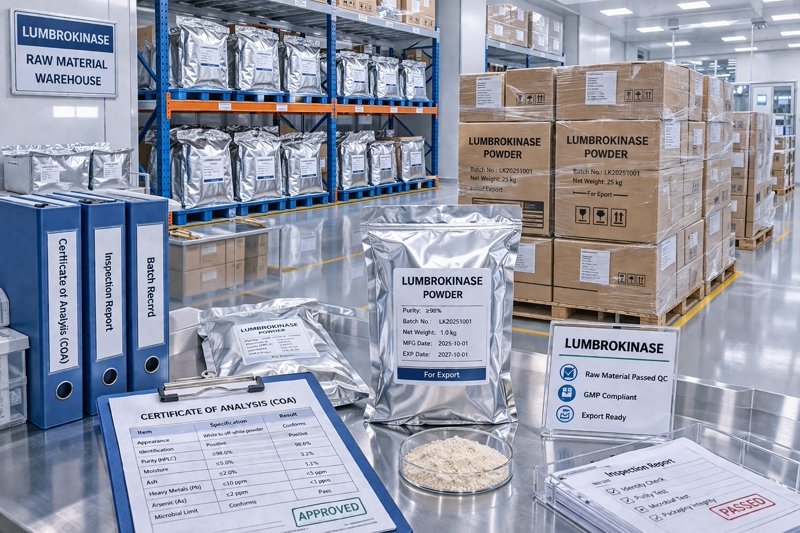
Earthworm-derived ingredients are not ordinary commodity proteins. Even basic production descriptions in the uploaded materials show the importance of raw material selection, separation, washing, filtration, low-temperature drying, sterilization, and packaging.
That means the supplier conversation can’t stop at “What’s your price per kilo?”
It has to go further:
How is activity standardized?
What testing methods are used?
How stable is the ingredient in the finished matrix?
What are the residual odor and color characteristics?
What documentation supports export or finished-product filing?
That’s the boring part, maybe. It’s also the part that keeps a promising launch from becoming an expensive headache.
Formulation teams know this already: compatibility beats hype
Honestly, brands sometimes get carried away with the ingredient story and forget the formula has to survive manufacturing, shipping, and shelf life.
When integrating lumbrokinase, teams usually need to check:
Stability in the chosen system
Enzyme ingredients can be sensitive to heat, humidity, and aggressive processing conditions. That affects excipient selection, fill conditions, and packaging decisions.
Sensory impact
Even when the ingredient is technically strong, odor and color can limit broader format expansion. Another reason capsules often win.
Label simplicity
A premium enzyme ingredient doesn’t always need ten supporting actives. Sometimes fewer ingredients make the formula easier to explain and easier to trust.
Regional compliance
The same formula may not travel neatly from one market to another. What works in one jurisdiction as a supplement may face a very different path elsewhere. So smart brands often start with a region-specific launch rather than chasing global uniformity from day one.
Positioning: don’t oversell it, and don’t undersell it either
This balance is where good brands separate themselves from noisy ones.
Lumbrokinase can easily be overhyped. That’s a mistake.
It sits in a category tied to circulation, fibrin, and technical enzyme function. That means the messaging has to stay disciplined. Scientific enough to feel credible, but not reckless. Professional enough to reassure distributors and manufacturers, but not so dense that buyers tune out.
The best positioning usually sounds like this:
- targeted
- science-aware
- premium
- quality-controlled
- intended for serious product concepts, not novelty launches
In other words, it should feel like an engineered ingredient choice, not a gimmick.
And there’s a reason for that. Reviews of the literature describe lumbrokinase as a potent fibrinolytic enzyme with antithrombotic relevance, note that it can act with fibrin specificity, and mention oral formulation development. That supports serious positioning—but not magical claims.
Where it fits best by buyer type
Let me make this practical.
For dietary supplement brands
Lumbrokinase works best as a premium capsule extension in cardiovascular, circulation, or healthy aging lines. It is especially useful when the brand wants a higher-value SKU rather than another basic multivitamin-style release.
For nutraceutical ingredient suppliers
The pitch is less about flashy consumer branding and more about technical support: specification sheets, activity data, manufacturing reliability, and application guidance for brand customers.
For health supplement manufacturers
It can strengthen private-label offerings, especially for clients seeking differentiated vascular-support or advanced enzyme products. Here, formulation assistance becomes a selling point in itself.
For pharmaceutical ingredient or adjunct suppliers
The opportunity is more technical and compliance-heavy. Product-market fit depends on local regulation, dose form strategy, and the quality of the evidence package.
For wholesalers and dealers
Education becomes the real lever. A distributor can’t move a specialized ingredient well if the sales team treats it like generic protein powder. It needs category training, audience segmentation, and a clear explanation of where the ingredient belongs.
For cosmetics suppliers
This is the least direct fit for lumbrokinase itself, though broader earthworm-derived bioactives have been discussed in wound-healing, anti-aging, and skin-related contexts in the literature.
If the portfolio is cosmetic-first, earthworm peptides or related bioactives may offer a more natural bridge than lumbrokinase as a hero ingredient.
A smart integration roadmap, without the drama

Brands that do this well usually follow a simple sequence.
Start with the line gap
Ask what the current portfolio lacks:
a premium cardiovascular SKU,
a more technical enzyme option,
a clinic-only product,
or a differentiated cross-border offer.
Not every brand needs lumbrokinase. That’s worth saying plainly.
Match the right channel
Mass retail? Maybe difficult.
Professional channel? Much easier.
Distributor-led B2B? Often promising.
Cross-border digital? Possible, with careful positioning.
Lock the supplier first
Don’t build the marketing deck before confirming specification quality, documentation, and supply continuity. That’s backwards, and it happens more than people admit.
Keep the first launch narrow
One focused SKU usually beats three confused ones.
Expand only after the market teaches you something
Once the first product proves demand, then a brand can consider:
higher-strength variants,
combination formulas,
regional adaptations,
or practitioner-exclusive packs.
That’s how real product lines grow—step by step, not in one dramatic leap.
The quiet truth? Integration is mostly a brand discipline question
Lumbrokinase is interesting. The science is interesting. The ingredient story is interesting.
But plenty of interesting ingredients never become durable products.
The brands that succeed are the ones that treat lumbrokinase as part of a system: sourcing, specification, dosage form, positioning, compliance, and channel strategy all working together. When that happens, the ingredient can elevate an existing line rather than distract from it.
And that’s the sweet spot, really.
Not novelty. Not noise. Just a sharper, more credible product architecture.
FAQs
1. What types of brands are most likely to add lumbrokinase to existing product lines?
Brands in cardiovascular health, circulation support, healthy aging, and specialty enzyme categories are usually the best fit. A lumbrokinase product line extension works especially well for companies that already sell premium capsule supplements.
2. Is lumbrokinase better as a standalone product or part of a blend?
It depends on the portfolio strategy. A standalone lumbrokinase capsule gives cleaner positioning and easier education, while a blend can work when the formula has a clear role in a broader vascular or healthy aging supplement line.
3. Why do many manufacturers prefer capsules for lumbrokinase products?
Capsules are usually easier for enzyme stability, cleaner for technical positioning, and more practical for premium supplement manufacturing. For many brands, capsule formats suit lumbrokinase better than beverages, gummies, or conventional functional foods.
4. What should buyers check when sourcing lumbrokinase raw material?
They should review enzyme activity specification, raw material origin, batch consistency, microbiological safety, heavy metal testing, manufacturing controls, and export-ready documentation. For a lumbrokinase ingredient supplier, those details are not optional—they’re the foundation of trust.
5. Can lumbrokinase help differentiate a private-label supplement range?
Yes, especially in crowded cardiovascular and enzyme categories. A private-label lumbrokinase supplement can give manufacturers and brand owners a more technical, premium-looking offer, provided the formulation, quality documents, and market positioning are handled carefully.
Sources referenced: earthworm protein antioxidant peptide research , ACE-inhibitory earthworm peptide research , and the 2024 comprehensive review on bioactive agents in earthworm extract and lumbrokinase applicationsHow Brands Integrate Lumbrokinase into Existing Product Lines.
One comment on “How Brands Integrate Lumbrokinase into Existing Product Lines”
Comments are closed.