
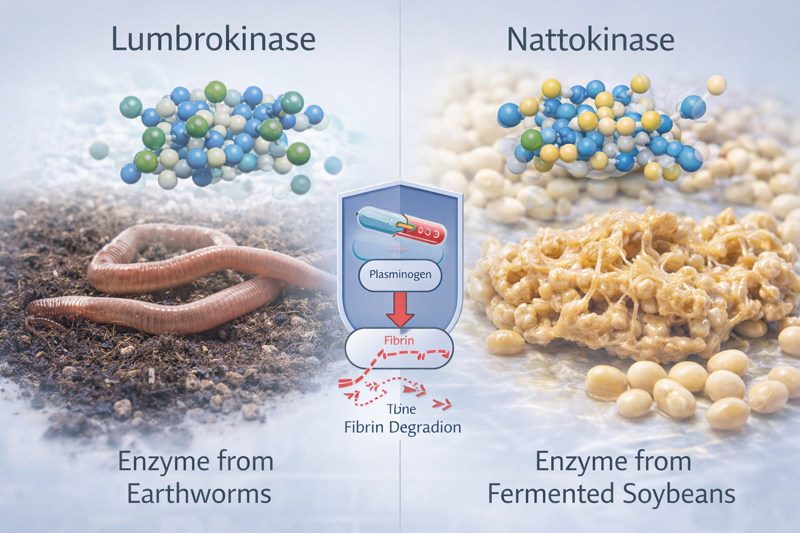
For supplement brands, nutraceutical companies, ingredient distributors, and formulation developers, lumbrokinase vs nattokinase should not be evaluated as a simple “which one is stronger” question. Both may be discussed as fibrinolytic enzyme ingredients, but they differ in source, production background, activity unit expression, assay method context, COA documentation, supplier availability, and formulation positioning.
A practical B2B comparison should focus on ingredient identity, specification control, assay method, sample testing, batch consistency, packaging, storage, lead time, and regulatory suitability for the intended market. This article explains the key differences between lumbrokinase and nattokinase from a sourcing and quality evaluation perspective, without making unsupported treatment-effect comparisons.
Quick Answer: Lumbrokinase vs Nattokinase
Lumbrokinase vs nattokinase mainly differs in source, production background, activity reporting, assay method context, and supplier documentation. Lumbrokinase is an earthworm-derived fibrinolytic enzyme ingredient, while nattokinase is commonly produced from natto or fermented soybean-based fermentation systems.
For B2B buyers, the better choice depends on formulation purpose, specification requirements, COA support, sample testing results, and bulk supply consistency. Buyers should not compare activity numbers such as IU/mg, FU/g, LKU, or U without checking the assay method and testing conditions.
Why This Matters for B2B Buyers
In real ingredient sourcing, lumbrokinase and nattokinase are often compared because both are enzyme ingredients related to fibrin-focused formulation discussions. However, they are not the same ingredient.
A buyer reviewing these two materials may need to answer several practical questions:
Can the supplier clearly identify the source?
Does the COA match the specification sheet?
Which activity unit is used?
Which assay method supports the activity value?
Can the sample test result be matched with future bulk batches?
Is the ingredient suitable for the buyer’s formulation, label positioning, and target market?
These questions matter more than broad claims about effect. Final product claims depend on the finished product brand, formulation design, dosage, label language, and local regulations.
For buyers evaluating earthworm-derived enzyme ingredients, the [Lumbrokinase product page] can provide product-level details, while [What Is Lumbrokinase? Source, Activity and B2B Supply Guide] offers a broader introduction to source, activity, and supply considerations.
Technical Explanation: Source, Enzyme Type and Positioning
Lumbrokinase Source
Lumbrokinase is derived from earthworms. In B2B ingredient sourcing, this source difference is important because raw material control, species selection, extraction process, enzyme activity, odor, appearance, and batch consistency may all influence the final ingredient profile.
Allworms supplies lumbrokinase as an earthworm-derived fibrinolytic enzyme ingredient for dietary supplement, nutraceutical, enzyme formulation, and research-related applications. Buyers typically review source information, activity specification, assay method, heavy metals, microbiology, moisture, ash, storage, and batch COA before sample approval.
Nattokinase Source
Nattokinase is commonly associated with natto, a fermented soybean food, and nattokinase ingredients are often produced through fermentation-based systems. From a sourcing perspective, buyers may evaluate fermentation strain, soybean or fermentation substrate background, activity unit expression, allergen considerations, specification format, and supplier documentation.
The key point is not that one ingredient is automatically “better” than the other. The key point is that the two ingredients come from different source systems and require different documentation review.
Ingredient Positioning
Lumbrokinase is positioned as an earthworm-derived fibrinolytic enzyme ingredient. Nattokinase is usually positioned as a fermented soybean-derived or fermentation-derived enzyme ingredient.
For supplement brands and formulators, this difference can affect:
Ingredient story
Label positioning
Consumer acceptance
Target market review
Regulatory classification
Activity specification
Supplier qualification
Formulation compatibility
A buyer choosing between the two should confirm whether the finished product strategy needs an earthworm-derived enzyme ingredient, a fermentation-derived enzyme ingredient, or a broader fibrinolytic enzyme ingredient concept.
Lumbrokinase vs Nattokinase Comparison Table
| Comparison Point | Lumbrokinase | Nattokinase | B2B Buyer Review Focus |
|---|---|---|---|
| Source | Earthworm-derived | Commonly natto or fermented soybean-derived | Confirm raw material source and label suitability |
| Ingredient Type | Fibrinolytic enzyme ingredient | Fibrinolytic enzyme ingredient | Do not treat them as identical materials |
| Production Background | Earthworm raw material extraction and enzyme processing | Fermentation-based production background | Review process description and supplier capability |
| Common Activity Unit Expressions | IU/mg, U, LKU, or other method-based units may appear | FU/g is commonly seen, but other formats may appear | Do not compare numbers without method context |
| Assay Method Considerations | May use fibrin plate assay or supplier-specific method | May use fibrinolytic activity assay systems | Compare assay method, substrate, standard, incubation and calculation basis |
| COA Review Points | Activity, assay method, appearance, moisture, ash, heavy metals, microbiology | Activity, assay method, appearance, moisture, microbiology, allergen-related details if relevant | Confirm batch-specific test results |
| Specification Sheet Review Points | Source, activity range, assay method, storage, shelf life, packaging | Activity range, assay method, production background, storage, shelf life | Compare long-term purchasing standard |
| Sample Testing Needs | Important before bulk approval | Important before bulk approval | Test sample using buyer’s intended method where possible |
| Batch Consistency | Depends on raw material control, extraction process and QC | Depends on fermentation process and QC | Confirm whether bulk batch matches sample batch |
| Formulation Positioning | Earthworm-derived enzyme ingredient for supplement and nutraceutical use | Fermentation-derived enzyme ingredient for supplement and nutraceutical use | Choose based on formulation concept and target market |
| Supplier Evaluation Focus | Source traceability, activity method, COA, batch consistency, MOQ, lead time, shipping | Fermentation control, activity method, COA, batch consistency, documentation | Compare reliability, not only price |
Activity Units: Why the Numbers May Not Be Directly Comparable
One common mistake in lumbrokinase vs nattokinase sourcing is comparing only the activity number.
For example, a buyer may see:
IU/mg
FU/g
LKU
U
These activity unit expressions do not always share the same testing basis. A high number in one system does not automatically mean it is stronger than a lower number in another system. The result depends on the assay method, substrate, standard material, incubation conditions, sample preparation, calculation method, and laboratory procedure.
For lumbrokinase sourcing, buyers should review [Lumbrokinase Activity Units] for a more detailed explanation of IU/mg, FU/g, LKU, and U. When comparing suppliers using different unit systems, [How to Compare Lumbrokinase Suppliers When Activity Units Differ] is also useful.
The practical rule is simple: activity units must be reviewed together with assay method and COA documentation.
Assay Method: Do Not Compare Without Testing Context
Assay method is one of the most important points in an enzyme ingredient comparison.
For lumbrokinase, fibrin plate assay may be used to evaluate fibrinolytic activity. However, assay results can vary when different laboratories use different substrates, standards, incubation time, temperature, sample concentration, plate conditions, or calculation models.
Buyers should ask:
What assay method is used?
Is the assay method shown on the COA?
Is the method the same as the method used in the specification sheet?
Can the supplier explain the unit expression?
Can the buyer repeat or verify the test with its own laboratory?
Can the sample result be used as a reference for future bulk order approval?
For more assay-related detail, buyers can review [Fibrin Plate Assay for Lumbrokinase Activity]. The purpose is not to repeat the full assay method here, but to show why method context is necessary before comparing lumbrokinase and nattokinase activity numbers.
COA and Specification Sheet Review
A COA and a specification sheet are not the same document.
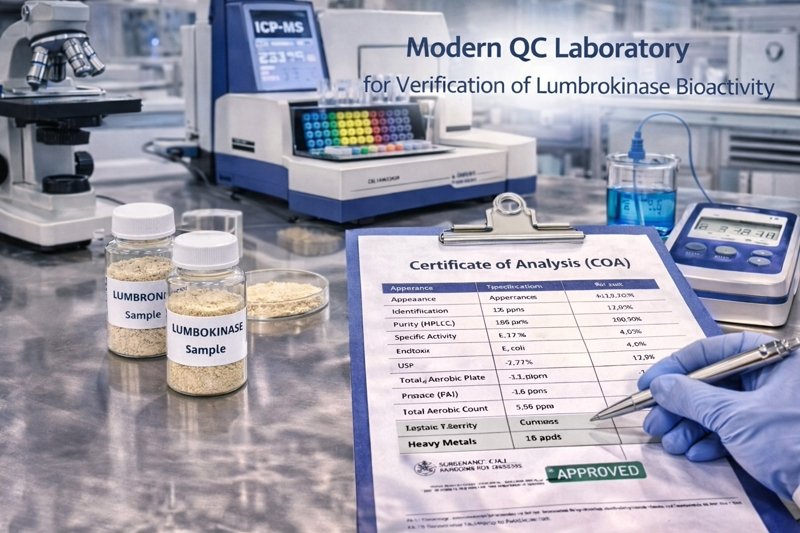
The specification sheet describes the expected product standard. The COA shows actual test results for a specific batch. In lumbrokinase vs nattokinase sourcing, both documents should be reviewed before sample approval and bulk purchasing.
A practical COA review should include:
Product name
Source
Batch number
Manufacturing date
Expiry date or retest date
Appearance
Activity result
Assay method
Moisture
Ash or residue on ignition
Heavy metals
Microbiology
Storage conditions
Supplier signature or authorization
A practical specification review should include:
Ingredient identity
Source description
Activity range
Unit expression
Assay method
Physical properties
Packaging format
Storage condition
Shelf life
Quality control standard
For more detail, buyers can review [Lumbrokinase COA vs Specification Sheet].
Sample Testing Before Bulk Order
Before approving a lumbrokinase or nattokinase bulk order, buyers should test a sample under conditions close to the intended quality review process.
Sample testing may include:
Appearance and odor review
Solubility or dispersion check
Activity verification
Moisture and ash testing
Heavy metals review
Microbiology review
Compatibility with capsules, tablets, powders, or blends
Stability review under expected handling conditions
Internal lab or third-party lab confirmation
For enzyme ingredients, sample approval should not be treated as the final step. Buyers should also confirm how the supplier controls future bulk batches. The sample result only has commercial value if future production can match the approved standard.
For a deeper sample approval process, buyers can review [Lumbrokinase Sample Evaluation] and [Lumbrokinase Batch Consistency].
Buyer Checklist: Comparing Lumbrokinase and Nattokinase Suppliers
| Checklist Item | What to Ask | Why It Matters |
|---|---|---|
| Ingredient Source | Is it earthworm-derived, natto-derived, soybean-derived, or fermentation-derived? | Confirms identity, label positioning, and market suitability |
| Product Name | Is the ingredient clearly named as lumbrokinase or nattokinase? | Avoids confusion between different enzyme ingredients |
| Activity Unit | Is activity shown as IU/mg, FU/g, LKU, U, or another format? | Prevents misleading number-only comparison |
| Assay Method | What method supports the activity result? | Activity values depend on testing method |
| COA | Can the supplier provide a batch-specific COA? | Confirms actual batch quality |
| Specification Sheet | Can the supplier provide the expected product standard? | Supports long-term purchasing control |
| Sample | Is sample evaluation available before bulk order? | Helps verify suitability before purchase |
| Batch Consistency | Can the supplier match sample and bulk batch quality? | Reduces risk after sample approval |
| Heavy Metals | Are lead, arsenic, cadmium, and mercury controlled? | Important for supplement ingredient review |
| Microbiology | Are total plate count, yeast and mold, coliforms, Salmonella, and Staphylococcus aureus reviewed? | Supports quality and safety documentation |
| Storage | What storage conditions are recommended? | Enzyme activity may be sensitive to heat and moisture |
| Packaging | What standard packaging is available? | Affects handling, stability, and warehouse planning |
| MOQ | What is the minimum order quantity? | Helps buyers plan sample-to-bulk transition |
| Lead Time | How long after payment or order confirmation? | Affects production schedule |
| Shipping | Can the supplier support international shipping or DDP where available? | Reduces import and delivery uncertainty |

Common Buyer Mistakes
Choosing Based Only on the Highest Activity Number
A higher activity number does not always mean a better ingredient. Without assay method context, the number may not be comparable across suppliers or across ingredient types.
Assuming FU/g, IU/mg, LKU, or U Can Be Directly Compared
Different unit systems may reflect different methods and calculation standards. Buyers should avoid direct conversion unless the testing basis is clearly defined.
Ignoring Assay Method and Testing Conditions
Activity values are method-dependent. Substrate, standard, incubation time, temperature, sample preparation, and lab procedure may all influence results.
Comparing Lumbrokinase and Nattokinase as the Same Ingredient
Both may be discussed as fibrinolytic enzyme ingredients, but they differ in source, production background, documentation, and formulation positioning.
Focusing on Health-Effect Claims Instead of Documentation
B2B buyers should prioritize specification, COA, assay method, sample testing, batch consistency, and regulatory review. Final product claims should be evaluated according to the intended market and finished product use.
Approving a Sample Without Confirming Bulk Batch Consistency
Sample testing is only useful if the supplier can support consistent future batches. Buyers should ask whether the bulk batch will match the approved sample specification.
Choosing Only by Price
Low price can be attractive, but enzyme ingredients require quality documentation, activity verification, storage control, reliable communication, and stable supply.
Allworms Supply Notes
Allworms Bio-Tech Co., Ltd is a manufacturer of earthworm-derived ingredients, including lumbrokinase, Earthworm Protein Powder, and Earthworm Peptide Powder. For lumbrokinase, Allworms focuses on earthworm-derived enzyme ingredient supply for B2B buyers in dietary supplement, nutraceutical, enzyme formulation, and research-related applications.
COA and specification sheet can be provided for available batches. Buyers can request sample evaluation before bulk orders. A 100 g sample may be available for qualified B2B buyers, and the buyer usually pays international freight.
The standard MOQ is usually around 1.5 kg, depending on product specification. Standard lead time is usually 7–15 days after payment. DDP door-to-door shipping may be available for selected destinations. Bulk order details should be confirmed based on specification, quantity, packaging, and destination.
Lumbrokinase is an enzyme-sensitive material. Buyers should store it in a cool, dry place, keep packaging sealed after opening, and avoid prolonged exposure to heat and moisture.
This product is supplied as a B2B ingredient. Final formulation suitability, dosage, labeling, health claims, and regulatory compliance should be evaluated by the buyer according to the intended market and finished product use.
How B2B Buyers Should Choose Between Lumbrokinase and Nattokinase
The right ingredient depends on the buyer’s product strategy.
Choose based on:
Formulation purpose
Ingredient source preference
Activity specification requirement
Assay method expectation
Target market review
Label positioning
COA and specification requirements
Internal testing results
Batch consistency needs
Supplier reliability
MOQ, lead time, and shipping support
For buyers specifically looking for an earthworm-derived enzyme ingredient, lumbrokinase may be the more relevant option. For buyers seeking a fermentation-derived enzyme ingredient, nattokinase may fit a different formulation direction.
The decision should be based on documentation, sample testing, and supplier qualification rather than unsupported claims about treatment effect.
FAQ
1. What is the main difference between lumbrokinase and nattokinase?
The main difference is source and production background. Lumbrokinase is derived from earthworms, while nattokinase is commonly associated with natto or fermented soybean-based production. For B2B buyers, activity unit, assay method, COA, specification, and supplier reliability should also be reviewed.
2. Can lumbrokinase and nattokinase activity numbers be directly compared?
Not always. Activity units such as IU/mg, FU/g, LKU, and U may follow different assay methods and calculation systems. Buyers should compare activity values only when the assay method, standard, substrate, testing conditions, and reporting basis are understood.
3. Should buyers choose lumbrokinase or nattokinase based on health-effect claims?
No. B2B buyers should evaluate ingredient identity, source, specification, COA, assay method, sample testing, batch consistency, formulation suitability, and target market compliance. Final claims depend on the finished product and local regulations.
4. What documents should buyers request before purchasing lumbrokinase?
Buyers should request a specification sheet, batch COA, assay method information, activity unit explanation, heavy metals and microbiology results, storage recommendations, packaging details, MOQ, lead time, and shipping options.
5. Does Allworms provide lumbrokinase samples for evaluation?
Yes. A 100 g sample may be available for qualified B2B buyers, with international freight usually paid by the buyer. Buyers can use the sample for COA review, activity testing, formulation checks, and internal approval before placing a bulk order.

Comparing Lumbrokinase vs Nattokinase for Your Next Enzyme Ingredient Project?
Contact us to request lumbrokinase COA, specification sheet, sample details, MOQ, pricing, lead time, and shipping support.