
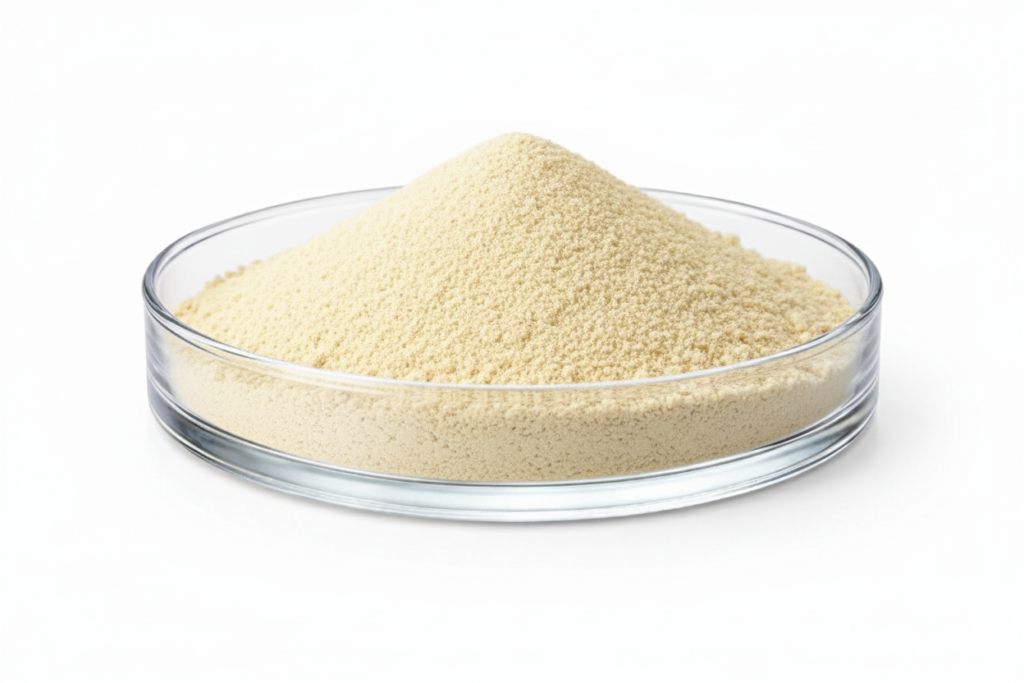

Lumbrokinase sounds impressive on paper. And yes, it is. It’s a fibrinolytic enzyme system associated with earthworm-derived bioactive fractions and has been widely studied for thrombolytic and related bioactivity. But here’s the thing—industrial success does not depend on bioactivity alone. It depends on whether that activity survives real manufacturing. Heat. Moisture. pH shifts. Shear. Storage. Transport. Capsule filling. Even a “simple” drying step can quietly turn a strong enzyme material into a weak one.
For B2B buyers, that changes the conversation. The question is not only “Does this ingredient work?” It’s also “Will it still work after processing, packaging, shipping, and shelf time?”
That’s why stability sits right at the center of industrial value. Not off to the side. Right in the center.
Why stability is the real gatekeeper
Lumbrokinase is an enzyme, and enzymes are sensitive by nature. Enzyme activity is generally sensitive to temperature and acidity/alkalinity, and lumbrokinase loses activity above 60°C. Spray drying can deactivate lumbrokinase through brief exposure to high heat.
That single point carries a lot of weight in industrial settings.
Why? Because plenty of common operations can cross that threshold or create equivalent stress:
- thermal drying
- sterilization
- wet granulation
- aggressive blending
- hot-fill systems
- long exposure to humid air during staging
- poor warehouse temperature control
So when a supplier says an ingredient is “high activity,” that’s only half the story. You need to know whether the process protected that activity from raw material intake to final batch release.
And honestly, this is where many ingredient discussions get fuzzy. People love headline potency. Fewer people want to discuss what happens after the third processing step, when potency starts slipping.
Let me explain: stability is not one thing
In industrial practice, “stability” is really a bundle of risks.
1. Thermal stability
This is the obvious one. Lumbrokinase is highly vulnerable to heat stress, and once enzymatic structure changes, activity can drop sharply or disappear. Your materials specifically note that activity can be lost above 60°C.
That means manufacturers should pay close attention to:
- inlet and outlet drying temperatures
- residence time during drying
- sterilization method
- compression heat during tableting
- storage near heat sources
- transport in hot climates
A product may look fine after processing—same color, same powder flow, same odor—and still have weaker activity. That’s the tricky part. Enzymes fail quietly.
2. pH stability
The same source also flags sensitivity to acid-base conditions. For industrial buyers, that matters during extraction, purification, blending with acidic excipients, and any liquid formulation work.
If pH is poorly controlled, the active protein system may denature or shift away from its preferred conformation. In plain language: the enzyme may still be there, but not in a form that performs well.
This is especially relevant in:
- liquid nutraceutical concepts
- enzyme blends
- acidic sachet products
- functional shots
- certain pharmaceutical intermediate steps
So yes, pH is a lab parameter. But in production, it becomes a money parameter.
3. Moisture stability
Moisture is the slow saboteur. Too much residual moisture in a powder can accelerate activity loss, aggregation, microbial risk, and lot-to-lot drift. Even when a process is “low temperature,” poor drying uniformity can still create stability headaches later.
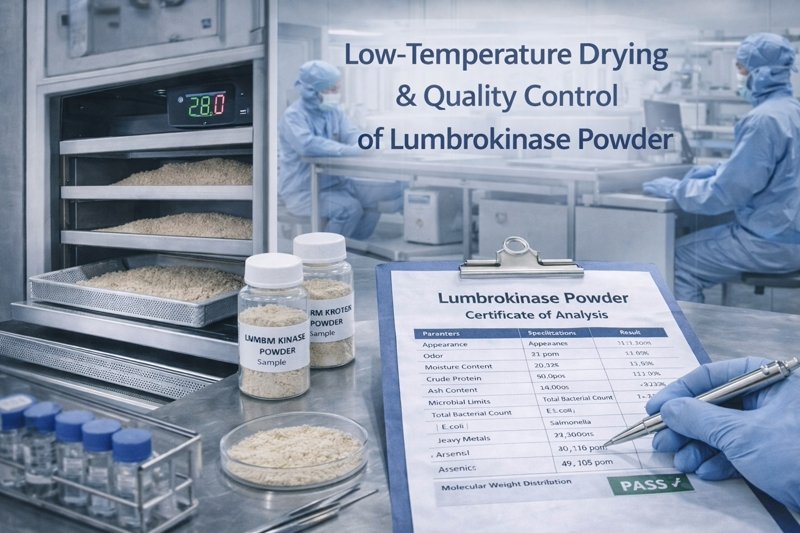
Our production flow describes a process that includes separation, low-temperature drying, milling, sterilization, and packaging. That low-temperature drying point matters because it suggests a stability-aware approach to handling sensitive earthworm-derived proteins.
Low temperature alone is not enough, of course. But it’s a signal that the processor understands the problem.
4. Mechanical and processing stress
This part gets less attention than it should. Repeated transfers, high-shear mixing, pressure during compression, and prolonged exposure to air can all chip away at performance. Not always dramatically, but enough to matter in a tight specification system.
Think of lumbrokinase like a high-performance component in a machine. You don’t judge it only by the design drawing. You judge it after assembly.
Where stability gets won—or lost—in manufacturing
Now let’s move from theory to factory floor reality.
Raw material handling comes first
Earthworm-derived proteins and enzyme systems are part of a broader bioactive composition that includes fibrinolytic enzymes among other functional compounds. That means upstream raw material handling matters a lot.
If raw materials are poorly cleaned, inconsistently processed, or left too long before extraction, stability risk starts early. Not later. Early.
A stable final ingredient usually starts with:
- controlled species sourcing
- fast post-harvest handling
- standardized cleaning
- consistent separation steps
- minimized unnecessary thermal exposure
There’s no glamour in that. But it’s where reliable ingredients are made.
Extraction and purification need a light touch
The broader literature shows earthworm proteins can be processed into purified fractions and bioactive peptides through controlled extraction, separation, chromatography, and digestion models.
That tells us something useful for industrial applications: process control is already central to preserving meaningful biological function.
For lumbrokinase-focused materials, purification has to balance two competing goals:
- remove impurities and improve consistency
- avoid process conditions that damage activity
Push purification too hard, and you may end up polishing away the very thing buyers want.
Drying is the big turning point
If there’s one step that deserves a red circle on the batch record, it’s drying.
Low-temperature drying as part of the earthworm protein manufacturing flow. Spray drying can deactivate lumbrokinase because brief high heat exposure is enough to knock out activity.
That creates a clear industrial takeaway: not every “efficient” drying method is suitable for an active lumbrokinase ingredient.
From a process standpoint, the preferred direction is usually:
- lower thermal load
- shorter exposure
- tighter moisture endpoint control
- validated post-drying activity retention
This is where some suppliers separate themselves from the pack. They do not merely dry the material. They dry it without wrecking it.
Sterilization needs careful design
And then comes the awkward question: how do you control microbial risk without destroying a heat-sensitive enzyme?
That’s the balancing act.
Your production flow includes a sterilization step after drying and milling. For a lumbrokinase-active product, the sterilization strategy must be chosen very carefully. Traditional heat-heavy methods may not be ideal if activity preservation is a priority.
So buyers should ask the unglamorous but crucial questions:
- What sterilization method was used?
- Was enzyme activity checked before and after?
- Is the sterilization method validated against both microbial limits and activity retention?
If a supplier can’t answer those cleanly, that’s a signal.
Formulation format changes everything
Not all finished formats stress lumbrokinase equally.
Capsules
Capsules are often the friendliest option because they can avoid severe thermal and moisture loads. For many buyers, this is the simplest route when preserving enzyme performance matters most.
Tablets
Tablets can be tougher. Compression force, friction, added binders, and possible granulation steps may create more risk. It’s not impossible, not at all—but it needs more care.
Powders and sachets
These can work well if moisture is tightly controlled and the excipient system is compatible. The catch is warehouse life. Powders can absorb ambient moisture if packaging is weak.
Liquid products
Liquids are usually the hardest route for a sensitive enzyme system. pH, water activity, preservative compatibility, and long-term stability all become more complicated. This is where good ideas often run into ugly reality.
So no, one dosage format is not “better” in every case. But some are definitely less forgiving.
What a serious buyer should ask a lumbrokinase supplier
Honestly, this is where purchasing teams can save themselves a lot of pain.
Do not stop at a COA. Ask for the stability story behind the COA.
A solid supplier should be able to discuss:
- activity assay method and units
- activity before processing and after processing
- drying method
- thermal controls across the process
- residual moisture target
- packaging barrier system
- recommended storage condition
- real-time or accelerated stability data
- batch-to-batch variation
- microbial control strategy
If they only talk about headline potency and never about retention, that’s a bit like selling frozen seafood by showing you the ocean.
The commercial side people sometimes forget
Stability is not only a technical issue. It’s a business issue.
Poor stability can lead to:
- claims drift during shelf life
- failed release testing
- customer complaints
- reformulation costs
- export headaches
- damaged distributor trust
For pharmaceutical ingredient suppliers and nutraceutical manufacturers, that means stability affects margin, reputation, and regulatory confidence all at once.
And there’s another layer here. Earthworm protein has been described in your source material as recognized as a new food resource in China since 2009, and research has highlighted its value as a functional protein source with bioactive peptide potential. That growing application space makes consistency even more important. As markets expand, buyers become less tolerant of vague specifications.
Which is fair, really.
So what does “good stability management” look like?

It usually looks boring. That’s the funny part.
Not flashy. Not dramatic. Just disciplined.
A well-managed lumbrokinase program tends to include:
- controlled sourcing
- gentle extraction
- low-temperature or otherwise enzyme-protective drying
- minimal harmful thermal exposure
- compatible excipient selection
- moisture-resistant packaging
- clear storage instructions
- routine retained-sample checks over shelf life
Boring wins here. Boring, careful, repeatable process control.
And in enzyme manufacturing, that’s a compliment.
Final thought: performance begins with protection
Lumbrokinase has strong commercial appeal because of its recognized fibrinolytic and thrombolytic relevance. But industrial usefulness depends on more than biological promise. It depends on how well that promise survives reality—heat, pH, moisture, processing, shipping, and time.
So when evaluating lumbrokinase for industrial applications, don’t just ask whether it is active.
Ask whether it stays active.
That’s the question that separates a nice brochure from a dependable ingredient.
FAQs
1. Why is lumbrokinase stability important in industrial applications?
Lumbrokinase stability matters because enzyme activity can decline during drying, blending, sterilization, packaging, and storage. For industrial buyers, stable lumbrokinase means more reliable potency, better shelf-life performance, and fewer batch failures.
2. Does heat affect lumbrokinase during manufacturing?
Yes. Heat is one of the biggest risks. Your source material notes that lumbrokinase can lose activity above 60°C, which means thermal drying and other hot process steps must be tightly controlled.
3. What processing method is better for preserving lumbrokinase activity?
In general, lower-temperature, enzyme-protective processing is more favorable than heat-intensive methods. A production flow in your materials specifically includes low-temperature drying, which supports the idea that gentler processing is important for sensitive earthworm-derived proteins.
4. How should manufacturers store lumbrokinase raw materials?
Manufacturers should store lumbrokinase raw materials in dry, temperature-controlled conditions with strong moisture-barrier packaging. The goal is to reduce exposure to heat, humidity, and repeated handling that can weaken enzyme activity over time.
5. What should buyers ask a lumbrokinase supplier about stability?
Buyers should ask for activity assay data, post-process retention data, drying method details, residual moisture targets, packaging type, and shelf-life study results. A trustworthy lumbrokinase supplier should be able to explain how activity is protected from production through final delivery.
Start Your Lumbrokinase Sourcing With Confidence
Talk to our team about bulk lumbrokinase pricing