
For B2B ingredient buyers, lumbrokinase quality standards should be evaluated as a complete quality information system rather than a single activity number or one line on a COA.
Before approving lumbrokinase for sample testing, supplier qualification, small bulk purchasing, or repeat orders, buyers may need to review the raw material source, product identity, appearance, activity specification, activity test method, moisture, heavy metals, microbiology, packaging, storage conditions, batch documentation, and supplier technical support.
The purpose of this quality review is not to make consumer safety or therapeutic effectiveness claims. It is to determine whether an earthworm-derived fibrinolytic enzyme ingredient is clearly identified, appropriately documented, technically understandable, and suitable for the buyer’s intended formulation and procurement process.
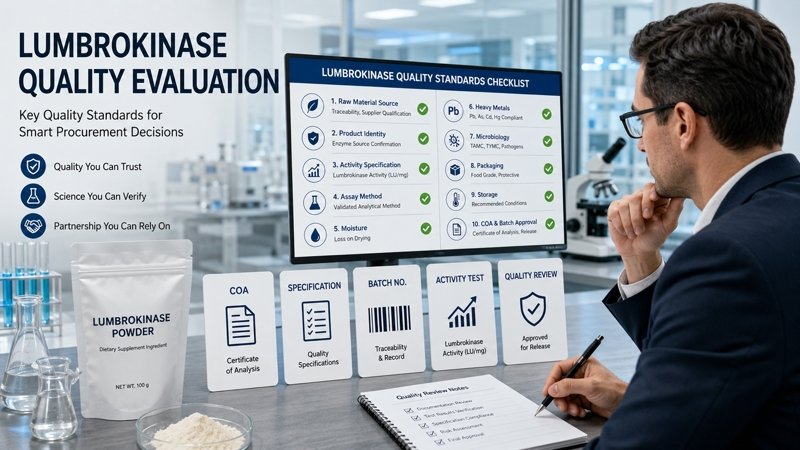
Quick Answer: What Do Lumbrokinase Quality Standards Include?
Lumbrokinase quality standards for B2B purchasing should include raw material source verification, product identity, appearance, enzyme activity specification, assay method context, moisture control, heavy metal review, microbiological testing, packaging, storage, batch identification, and supplier documentation.
A high activity number alone is not enough for supplier approval. Buyers should connect the specification sheet, actual batch COA, assay method, sample evaluation, packaging condition, and actual bulk batch information before making a purchasing decision.
Why This Matters for B2B Buyers
Lumbrokinase is an earthworm-derived fibrinolytic enzyme ingredient considered for dietary supplement, nutraceutical, enzyme formulation, and research-related applications.
For a purchasing or quality team, the central question is not simply:
“What is the highest activity available?”
A more practical question is:
“Can the supplier clearly explain and document the source, identity, activity specification, assay method, relevant quality parameters, storage requirements, and actual batch being supplied?”
This distinction matters because ingredient approval usually involves several departments or decision stages.
A purchasing team may review commercial terms and supply reliability.
A formulation team may review the target specification and material suitability.
A quality team may review COA data, test methods, batch identification, moisture, heavy metals, and microbiology.
A laboratory may conduct internal or third-party testing.
A warehouse team may need clear packaging and storage information.
A strong quality review therefore connects technical data, batch information, physical handling, and supplier communication.
Buyers who are still reviewing the basic product specification can first examine the Lumbrokinase product page for product-level information before moving into batch-specific evaluation.
A Practical Quality Evaluation Sequence
A useful way to evaluate lumbrokinase is to follow the material through a logical quality chain:
Source verification → identity review → activity test → assay method context → moisture → heavy metals → microbiology → packaging → storage → supplier documents → actual batch approval
This approach helps buyers avoid approving a supplier based on one isolated result.
1. Verify the Raw Material Source
What should buyers ask?
Before evaluating detailed test data, buyers may want to understand:
- What is the earthworm raw material source?
- Can the supplier explain where the raw material comes from?
- Is raw material management connected with downstream production?
- Can the supplier provide consistent source information?
- Is there a clear relationship between raw material sourcing and the manufacturing system?
Raw material source does not automatically prove that one product is superior to another. However, source information is part of traceability and supplier qualification.
For an earthworm-derived enzyme ingredient, buyers may reasonably want to understand how the raw material moves from cultivation or sourcing into processing.
A supplier that can clearly explain this path may be easier to evaluate than one that can provide only a product name and price quotation.
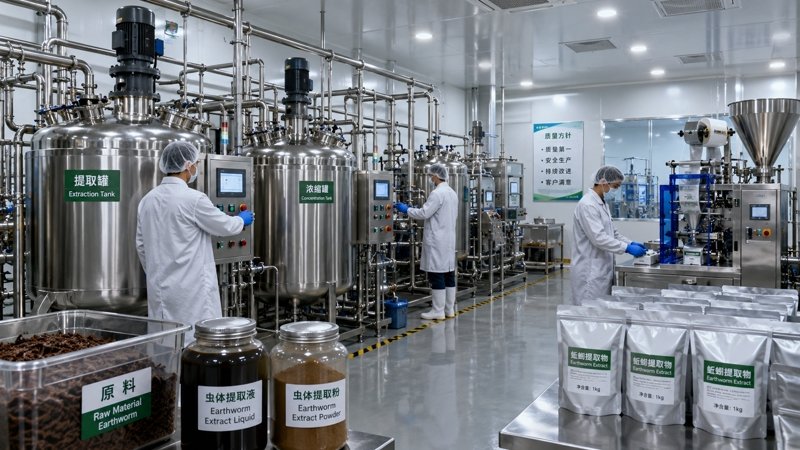
In Allworms’ supply system, the breeding base and downstream production system are connected as parts of the earthworm-derived ingredient supply chain. The company’s cultivation documentation describes partitioned farming management, mature earthworm preparation, raw material handling, and the connection between breeding and downstream processing.
The purpose of reviewing this information is traceability and supply understanding—not making health superiority claims based on animal source.
2. Confirm Product Identity and Batch Identification
Identity review should begin with basic documentation.
Buyers should confirm:
- product name;
- product category;
- earthworm-derived source description;
- expected appearance;
- labeling;
- batch number;
- specification reference;
- supporting product documentation.
For lumbrokinase, the buyer should be able to determine whether the supplied material is documented as lumbrokinase or earthworm-derived enzyme material according to the supplier’s own specification and batch records.
Appearance is also part of practical receiving inspection.
For example, supplier documentation may describe the material by a defined powder color range. Allworms’ product information describes its lumbrokinase as a light yellow to brown powder, while the detailed assay document describes a pale yellow to yellowish-brown powder with a characteristic odor and hygroscopic properties.
Appearance alone is not sufficient to prove identity. However, unexpected changes in color, odor, packaging condition, label information, or batch identification can justify additional investigation before the material enters production.
Practical receiving question
A useful receiving check is:
Does the product received match the product name, batch number, appearance range, packaging label, and COA provided for that shipment?
That question is more useful than relying on appearance alone.
3. Review the Activity Specification
Lumbrokinase quality evaluation normally includes enzyme activity, but buyers should avoid treating the activity number as an independent quality conclusion.
Review these points together:
- target activity grade;
- reported activity result;
- activity unit;
- assay method;
- batch-specific result;
- consistency between the specification and the COA.
Activity may be expressed through systems such as IU/mg, FU/g, LKU, or U, depending on the test system and market practice.
The key quality question is not simply which numerical value is larger.
The key question is:
What activity was specified, how was it measured, and does the actual batch result satisfy the agreed specification?
For buyers who need a deeper explanation of document roles, the distinction is discussed in Lumbrokinase COA vs Specification Sheet.
At this stage, the practical distinction is simple:
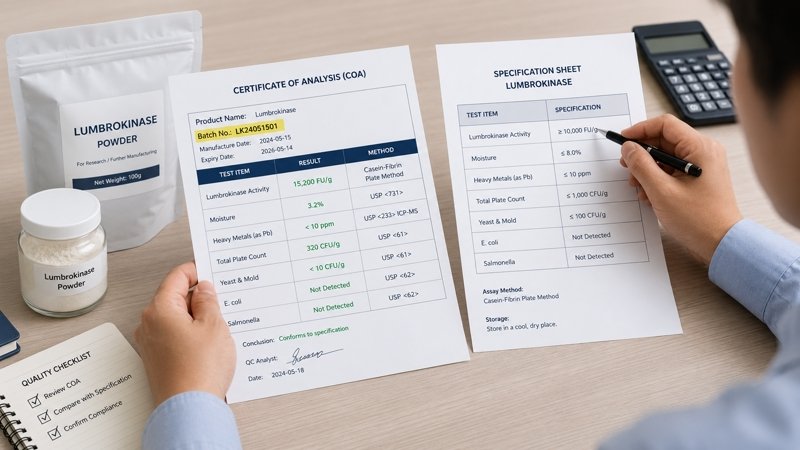
The specification sheet defines target requirements. The batch COA reports test results for a specific batch.
Both have a role in quality approval.
4. Review the Activity Test Together With the Assay Method
An enzyme activity result should be evaluated together with its testing context.
Buyers may need to confirm:
- reported activity unit;
- test method;
- sample preparation;
- reference standard, where applicable;
- test conditions, where available;
- whether the supplier can explain the method;
- whether the buyer’s laboratory uses the same method.
This does not mean every purchasing team needs to reproduce the full analytical procedure.
It means that a result should not be interpreted without knowing how it was generated.
Allworms’ documented lumbrokinase method uses a fibrin plate system involving fibrinogen, thrombin, agarose, standard solutions, controlled incubation, and measurement of lysis zones. The procedure also specifies sample preparation and calculation against a reference curve.
Because laboratory procedures, sample preparation, substrates, reference materials, incubation conditions, and calculations may differ, numerical values from different systems should not automatically be treated as directly interchangeable.
Buyers needing a more detailed technical explanation can review Fibrin Plate Assay for Lumbrokinase Activity.
For this quality evaluation process, one principle is enough:
Review the activity result and assay method as one package.
5. Check Moisture as a Quality-Control Factor
Moisture is easy to overlook because buyers naturally focus on enzyme activity.
However, lumbrokinase is supplied as a powdered enzyme ingredient, and moisture review is relevant to:
- powder condition;
- packaging integrity;
- warehouse handling;
- exposure to humidity;
- storage management;
- batch COA review.
A buyer should check whether moisture or loss-on-drying information appears in the specification or batch COA and whether the actual batch result meets the applicable purchasing requirement.
The current Allworms 20,000 IU/mg batch COA, for example, contains a moisture specification and an actual batch result rather than only a general statement.
Moisture evaluation should also be connected to receiving inspection.
A damaged seal, poorly closed package, or prolonged exposure to a humid warehouse environment may increase quality risk even when the original batch documentation was acceptable.
The practical question is therefore not only:
“What is the moisture result on the COA?”
It is also:
“Was the material protected from moisture from packing through receiving and storage?”
6. Review Heavy Metal Information
Heavy metal review can form part of lumbrokinase supplier qualification and ingredient quality evaluation.
Buyers should check:
- which heavy metal items are listed;
- whether limits or requirements are stated;
- whether actual batch results are available;
- whether the test panel meets the buyer’s internal requirements;
- whether additional testing is needed for the intended market or finished product category.
One supplier may report several individual elements, while another may use a different test panel.
Buyers should not assume that every lumbrokinase supplier tests the same items.
The current Allworms batch COA includes entries for lead, arsenic, mercury, and cadmium.
However, the buyer remains responsible for evaluating whether the supplied documentation is sufficient for the intended market, finished product, and internal quality system.
Specific legal or finished-product requirements can vary according to jurisdiction and application, so procurement teams should confirm applicable requirements rather than using one universal assumption.
7. Review the Microbiological Test Panel
Microbiological quality review may include items such as:
- total plate count or aerobic count, if listed;
- coliforms, where applicable;
- yeast and mold, if included;
- Salmonella;
- Staphylococcus aureus;
- other pathogen-related items included in the specification.
The exact panel may differ between suppliers and specifications.
Therefore, the correct buyer question is not:
“Does every supplier have exactly the same microbiology table?”
It is:
“Which microbiological items are included in this supplier’s specification, what does the actual batch COA report, and is that panel suitable for our intended use?”
For example, the current available Allworms documentation includes coliforms, Salmonella, and Staphylococcus aureus in the batch COA, while broader product specification materials may contain additional microbiological parameters.
Buyers should evaluate the documents actually supplied for the purchasing project rather than relying on assumptions.
8. Check Packaging Before Approving the Material
Packaging is part of quality control because it connects the tested powder with the material that arrives at the buyer’s warehouse.
Before approval, confirm:
- inner packaging format;
- seal integrity;
- label information;
- product name;
- batch number;
- outer shipping protection;
- suitability for the intended order quantity;
- suitability for the buyer’s storage arrangement.
For example, a buyer purchasing a trial quantity may have different storage and handling needs from a buyer purchasing repeated commercial batches.
The packaging format should support practical handling after receipt.
A buyer should also check whether the batch number shown on the product label matches the COA for that shipment.
This is a simple check, but it is important because quality documents are useful only when they can be connected to the actual material received.
9. Review Storage Conditions as Part of Quality Risk Control
Lumbrokinase is an enzyme-sensitive material.
Suitable storage control should generally consider:
- sealed packaging;
- cool and dry storage;
- protection from moisture;
- avoidance of high humidity;
- avoidance of direct sunlight;
- reduction of prolonged uncontrolled heat exposure;
- receiving inspection after international shipment;
- appropriate warehouse handling.
Balanced handling language is important.
A short-term temperature variation does not automatically mean that the product has been destroyed.
A more accurate quality-control position is:
Prolonged or uncontrolled exposure to heat and humidity may increase quality risk and should be minimized through suitable packaging, transport planning, and storage conditions.
The product documents reviewed for this article instruct storage in cool, dry conditions and protection against moisture and light.
10. Evaluate Supplier Documents as a Connected System
Supplier documentation should not be treated as unrelated PDF files collected for administrative purposes.
Together, the documents should help answer:
- What product is being supplied?
- What specification is being offered?
- Which batch is available?
- What actual results were reported?
- What activity method was used?
- How should the ingredient be stored?
- How is the product packaged?
- Can the supplier explain technical questions?
Common documents may include:
- specification sheet;
- batch COA;
- product information sheet;
- storage guidance;
- packaging information;
- assay method explanation where available;
- batch identification information.
Specification Sheet vs Batch COA
A specification sheet describes the target requirements for a product grade.
A COA reports the test results associated with a specific batch.
For quality approval, the buyer should compare the two.
The objective is to confirm that:
- the target product specification is clearly defined;
- the actual batch can be identified;
- the corresponding COA is available;
- the actual results meet the agreed purchasing requirements.
The current Allworms 20,000 IU/mg COA demonstrates this batch-specific structure by identifying the product, batch number, manufacturing information, specifications, results, activity method, and conclusion.
Lumbrokinase Quality Evaluation Checklist
| Quality Area | What Buyers Should Review | Why It Matters |
|---|---|---|
| Source | Earthworm source and traceability information | Helps buyers understand the upstream supply path |
| Identity | Product name, labeling, source description and documentation | Confirms that the supplied material matches the purchasing specification |
| Appearance | Powder color, physical condition and visible changes | Supports receiving inspection and deviation detection |
| Activity Specification | Target activity grade and required result | Defines the agreed enzyme performance requirement |
| Activity Unit | Unit reported on specification and COA | Prevents inappropriate comparison of different reporting systems |
| Assay Method | Test method and relevant testing context | Gives meaning to the reported activity result |
| Moisture | Specification and actual batch result | Supports powder condition and handling evaluation |
| Heavy Metals | Listed elements and batch results | Supports ingredient quality and market-specific review |
| Microbiology | Test panel and reported batch results | Helps evaluate microbiological quality documentation |
| Packaging | Format, seal, label and shipping protection | Protects the relationship between tested batch and received material |
| Storage | Temperature, humidity, sealing and light protection guidance | Helps reduce avoidable handling risk |
| Batch Number | COA, label and shipment batch identification | Connects documents to the actual material |
| Specification Sheet | Target requirements | Defines what the supplier is offering |
| COA | Actual batch test results | Supports batch-level approval |
| Supplier Communication | Ability to explain data, method and batch status | Supports technical clarification and purchasing decisions |
What Should Buyers Check on a Lumbrokinase COA?
A lumbrokinase COA should be read as a batch document.
Depending on the supplier’s documentation format, buyers may review:
Product Name
The product name should correspond to the material being evaluated.
Batch Number
The batch number connects the document to the physical material.
This should be checked against sample labels and, later, against the bulk material being supplied.
Test or Manufacturing Information
Where available, review manufacturing date, test date, expiry information, or other batch timing information.
Not every COA uses exactly the same format.
Activity Result
Check the actual result, not only the specification target.
For example, a document may show a minimum specification in one column and the actual result in another.
Activity Unit
Confirm the reporting unit.
Avoid comparing different unit expressions without understanding the analytical context.
Assay Method
Check whether the activity method is stated.
Where additional clarification is needed, ask the supplier how the result was generated.
Moisture
Review the specification and actual batch result where included.
Heavy Metals
Check which elements are actually listed.
Do not assume that an unlisted item has been tested.
Microbiology
Review the microbiological panel included in the specific COA.
Again, do not assume that every supplier uses the same panel.
Conclusion or Compliance Statement
Where present, review the batch conclusion or conformity statement.
The purpose is to understand how the supplier connects the actual results with the stated specification.
Buyers who are still at the early qualification stage may use Lumbrokinase Sample Evaluation as a supporting reference, but the COA itself should remain part of the broader supplier and batch approval process.
What Should Buyers Confirm Before Sample or Bulk Approval?
Before approving a sample or placing a bulk order, buyers should confirm the following areas.
Source Information
Can the supplier clearly explain the earthworm-derived raw material source and its connection with production?
Product Identity
Does the product name, appearance, label information, and supporting documentation match the material being evaluated?
Target Specification
Has the buyer clearly defined what grade is being evaluated?
Activity Grade
Is the requested activity level clearly stated?
Assay Method
Does the buyer understand which method supports the supplier’s reported activity?
COA Availability
Is a batch-specific COA available for the material under evaluation?
Sample Batch Number
Can the tested sample be connected with a specific batch number?
Actual Bulk Batch Number
When the PO is placed, which batch will actually be supplied?
This point is particularly important when there is a long interval between sample testing and commercial purchasing.
Packaging
Is the packaging format suitable for the intended quantity and warehouse handling?
Storage
Can the buyer maintain suitable receiving and storage conditions?
Lead Time
Is the production or dispatch lead time clearly confirmed?
Shipping Condition
Is the planned transport arrangement suitable for the destination and order quantity?
Sample-to-Bulk Specification Consistency
A common misunderstanding is that an approved sample and the final bulk order must always have exactly the same batch number.
That is not always realistic.
For example, a buyer may:
- receive a sample;
- conduct internal testing;
- send the material to a third-party laboratory;
- complete formulation work;
- conduct internal supplier approval;
- place a PO several months later.
By that time, the original sample batch may already have been sold or may no longer be available in the required quantity.
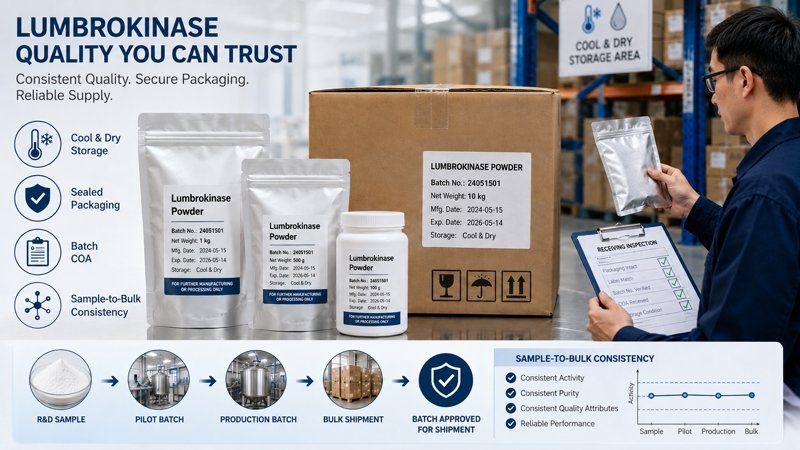
The correct quality approach is sample-to-bulk specification consistency, not automatic batch-number identity.
When the original sample batch is no longer available, the buyer should:
- confirm the actual bulk batch available;
- request the corresponding batch COA;
- compare the actual batch against the agreed specification;
- reconfirm activity grade and assay method;
- review relevant quality results;
- complete approval according to the buyer’s internal process.
This approach recognizes normal inventory movement while still protecting the buyer’s quality requirements.
An approved sample does not automatically guarantee that every future batch can be accepted without review.
Common Buyer Mistakes When Evaluating Lumbrokinase Quality
Mistake 1: Choosing a Supplier Only by the Highest Activity Number
A number without unit and method context is incomplete information.
Mistake 2: Ignoring the Assay Method
Different analytical systems may produce different results.
A meaningful review connects activity grade, unit, method, and batch result.
Mistake 3: Reviewing the Specification but Not the Actual Batch COA
The specification defines targets.
The actual batch still needs batch-level documentation.
Mistake 4: Assuming Every Supplier Uses the Same Heavy Metal Panel
Test panels may differ.
Review the items actually listed.
Mistake 5: Assuming Every Supplier Uses the Same Microbiology Panel
The same principle applies to microbiological testing.
Check the supplier’s actual specification and batch documentation.
Mistake 6: Ignoring Moisture and Storage
Activity is important, but powder handling and moisture exposure also belong in quality review.
Mistake 7: Overlooking Packaging Integrity
A good COA does not remove the need to inspect packaging condition at receiving.
Mistake 8: Failing to Confirm the Actual Bulk Batch
The sample batch may no longer be available when the buyer places the PO.
Always identify the batch that will actually be supplied.
Mistake 9: Assuming One Approved Sample Guarantees Every Future Batch
Supplier qualification and batch approval are related, but they are not identical.
Repeat-order quality systems should include appropriate batch review.
Mistake 10: Choosing Only by Price
Price is part of purchasing.
Quality documentation, assay clarity, batch traceability, packaging, lead time, and supplier technical response also affect the real purchasing decision.
Mistake 11: Treating Supplier Communication as Unimportant
A technically sensitive ingredient may require questions about assay method, batch data, storage, or specification interpretation.
A supplier’s ability to answer these questions clearly is part of practical supplier evaluation.
Allworms Supply Notes
Allworms is part of the manufacturer-side earthworm-derived ingredient supply system and supports overseas market development and international sales. The manufacturing system is connected with earthworm raw material supply and production.
For available lumbrokinase batches, a COA and specification sheet can be provided.
A 100 g sample may be available for qualified B2B buyers before bulk order approval, while the buyer usually pays international sample freight.
The standard MOQ is usually around 1.5 kg, depending on specification, packaging, and destination.
Small bulk quantities such as 10–25 kg may be discussed according to activity specification, quantity, packaging, and destination.
Standard lead time is usually 7–15 days after payment.
DHL shipping may be used for suitable international shipments, while DDP delivery may be available for selected destinations.
Additional procurement and product questions can also be reviewed through the FAQ page.
FAQ
1. What quality items should buyers check before sourcing lumbrokinase?
Buyers should review raw material source, product identity, appearance, activity grade, activity unit, assay method, moisture, heavy metals, microbiology, packaging, storage, batch identification, specification sheet, COA, and supplier technical communication.
Supplier approval should not depend only on one activity value or one test result.
2. Why does raw material source matter when evaluating lumbrokinase?
Raw material source information supports traceability and helps the buyer understand how the upstream earthworm supply is connected with manufacturing.
Source information should be used for supplier and supply-chain evaluation, not to make unsupported claims of therapeutic or health superiority.
3. Why should activity results be reviewed with the assay method?
Enzyme activity results depend on how testing is performed.
The activity unit, sample preparation, substrate system, reference material, incubation conditions, and calculation method may influence the reported value.
Therefore, buyers should evaluate the result together with its assay-method context.
4. Should buyers review heavy metals and microbiology data?
Yes. These items can form part of ingredient quality review and supplier qualification.
Buyers should check which parameters are included in the specification and actual batch COA rather than assuming that every supplier uses the same test panel.
The buyer should also evaluate whether additional requirements apply to the intended market and finished product category.
5. Why does moisture matter for lumbrokinase powder?
Moisture is relevant to powder condition, packaging integrity, humidity exposure, storage, and quality control.
Buyers should review available moisture data and maintain suitable sealed, cool, and dry handling conditions.
6. What supplier documents should lumbrokinase buyers request?
Depending on the project, buyers may request a specification sheet, batch COA, product information, storage guidance, packaging information, batch identification, and assay method explanation where available.
The key is to connect the documents with the actual material being evaluated.
7. Does an approved sample guarantee all future lumbrokinase batches?
No.
An approved sample supports supplier and product evaluation, but future batches should still be reviewed according to the buyer’s internal quality process.
This is particularly relevant for activity, batch COA, packaging, and other agreed specification requirements.
8. What happens if the original sample batch is no longer available?
The buyer should confirm which bulk batch will actually be supplied, request its COA, compare it with the agreed specification, confirm activity grade and assay method, and review relevant quality results.
The goal is sample-to-bulk specification consistency, not necessarily an identical sample and bulk batch number.
9. How should lumbrokinase be stored?
Lumbrokinase should generally be kept sealed in cool, dry conditions and protected from moisture, direct sunlight, high humidity, and prolonged uncontrolled heat exposure.
The buyer should follow the supplier’s applicable storage documentation for the purchased material.
10. Should buyers review the actual bulk batch COA before shipment?
Where batch-level approval is part of the buyer’s quality process, reviewing the actual bulk batch COA is advisable.
This is especially relevant when the final bulk batch differs from the original sample batch because of the time between sample testing and PO placement.
This product is supplied as a B2B ingredient. Final formulation suitability, dosage, labeling, health claims, and regulatory compliance should be evaluated by the buyer according to the intended market and finished product use.
Evaluating lumbrokinase quality standards for a new sourcing project?
Share your target activity specification, intended order quantity, sample testing plan, destination, and document requirements.
Contact Allworms to request available batch information, COA, specification sheet, sample support, lead time, and shipping options before supplier or bulk batch approval.
2 comments on “Lumbrokinase Quality Standards: What B2B Buyers Should Evaluate”
Comments are closed.