Before you compare prices, MOQs, or packaging styles, pause for a second. When you source earthworm protein powder, the real question is not “Who has the lowest quote?” It is “What exactly am I buying?”
That sounds obvious, sure. But in practice, plenty of buyers end up comparing samples that look similar on paper and behave very differently in formulation, digestion studies, stability work, and end-product positioning. One batch may be closer to a crude dried earthworm meal. Another may be a refined protein extract. Another may be a peptide-rich hydrolysate sold under a protein-style name. Those are not the same thing. Not even close.
And that is where good sourcing starts: with specifications that actually mean something.
Research on earthworm-derived protein materials shows why this matters. Raw dried earthworm material in one study contained about 60.34% protein, 17.73% fat, 8.76% ash, and 10.46% moisture, while a more refined earthworm protein extract reached 96.03% protein and only 0.98% fat after extraction and purification. That gap is huge, and it changes everything from label claims to flavor, oxidation risk, and formulation behavior.
So, if you are a supplement brand, nutraceutical ingredient distributor, pharmaceutical raw material buyer, or cosmetics supplier, here are the key specifications worth checking before you sign anything.
A quick outline
- Why “earthworm protein powder” is a broad label
- Core compositional specs to verify
- Processing specs that quietly shape quality
- Bioactivity-related specs for premium positioning
- Safety, contamination, and batch consistency checks
- What a serious supplier should be able to show
- FAQs
First things first: what does “earthworm protein powder” even mean?
Here’s the thing: the phrase sounds tidy, but the category is messy.
Some products are closer to whole-material powders. Some are extracted proteins. Some are enzymatically hydrolyzed or autolyzed ingredients with high soluble peptide content. A buyer who skips this distinction can end up asking for the wrong spec sheet, the wrong test method, and honestly, the wrong product.
Published work on earthworm proteins describes them as high-protein materials, often in the 56% to 66% dry-weight range, with good essential amino acid content and particularly notable lysine, leucine, and arginine levels. Other studies report dry earthworm protein content ranging from about 60% to over 70%, depending on species, rearing medium, freshness, and treatment.
That sounds promising, and it is. But it also means your first sourcing spec should be product identity:
1. Product type and definition
Ask the supplier to define the ingredient in plain technical terms:
- Whole dried earthworm powder
- Earthworm protein extract
- Earthworm protein hydrolysate
- Earthworm peptide powder
- Enzyme-active material containing lumbrokinase or related fibrinolytic fractions
Why does this matter so much? Because the expected protein level, fat level, sensory profile, solubility, and functional claims can all shift depending on which one you are buying.
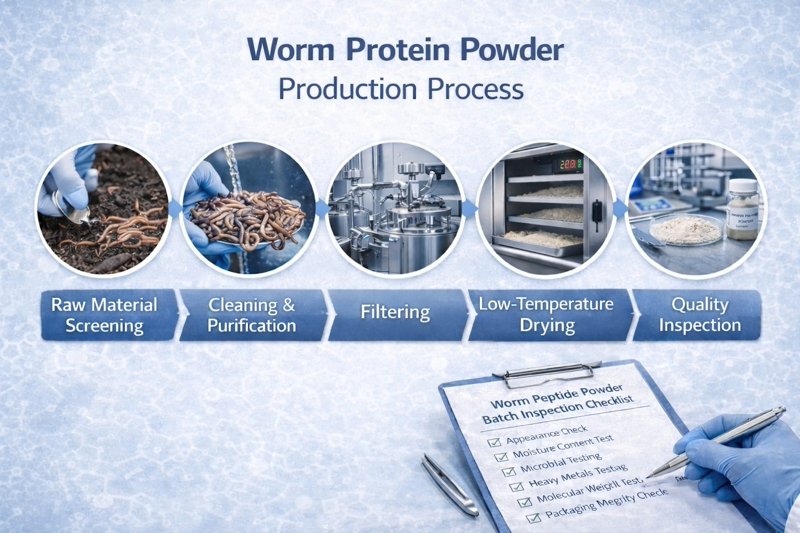
For example, one documented production description for “earthworm protein powder” includes selection, cleaning, hydrolysis, centrifugal filtration, low-temperature drying, milling, sterilization, and packaging. That is a very different process path from simply drying and powdering raw material.
If a supplier cannot clearly define the ingredient class, that is not a small red flag. That is the flag.
2. Protein content: the headline spec that buyers still misread
Yes, protein percentage matters. But no, the highest number is not always the smartest choice.
A refined extract with very high protein purity may suit capsule, tablet, or premium nutraceutical applications. A lower-protein powder may still work in functional food systems if cost, mouthfeel, or broader nutrient retention is part of the plan.
Still, you need a target.
Published data show:
- dried earthworm raw material at about 60.34% protein in one antioxidant-peptide study
- earthworm protein extract at 96.03% protein after alkali-soluble acid precipitation in the same work
- earthworm protein generally reported in the 60% to 70%+ range in other studies, with some dry materials reported even higher depending on source and method
What to ask for:
- Protein assay method used
- Result on as-is basis and dry basis
- Nitrogen-to-protein conversion factor
- Typical value and specification limit
- Batch-to-batch variation data
Honestly, this is where buyers sometimes get dazzled by a single nice number. Don’t. A believable range with a sound method is better than a flashy figure with no method attached.
3. Moisture content: boring on paper, crucial in real life
Moisture is one of those specs people glance at and move on. They shouldn’t.
Too much moisture can affect flowability, microbial risk, caking, shelf life, and the stability of sensitive bioactive fractions. In one published raw material example, moisture was 10.46%.
For sourcing, ask:
- Moisture limit
- Water activity, if available
- Storage recommendation
- Packaging barrier properties
- Stability data under normal warehouse conditions
If the powder is meant for export, moisture control is even more important. Long transit plus poor barrier packaging is where “good product at dispatch” turns into “problem cargo at arrival.”
4. Fat content: a quiet predictor of flavor and oxidation
This one gets overlooked more than it should.
Raw earthworm material in the cited study had 17.73% fat, but the purified protein extract dropped to just 0.98% fat. That difference tells you a lot. Higher fat may mean stronger odor, higher oxidation sensitivity, and more challenging shelf stability. Lower fat usually supports cleaner flavor and better handling in many supplement formats.
Ask your supplier:
- Total fat
- Oxidation indicators if relevant
- Defatting or extraction step used
- Sensory impact of lipid fraction
- Whether flavor masking is usually needed in finished products
If you plan to use the powder in beverages, sachets, or chewables, fat content is not a minor detail. It can make your formulation team love you or curse your name.
5. Ash content: the mineral clue that tells you how clean the material is
Ash gives you a rough read on mineral residue and overall purification level.
In the same study, raw material showed 8.76% ash, while a refined extract went through more controlled processing and purification.
High ash is not automatically bad. But unexplained ash is bad. It may point to residual inorganic matter, process carryover, or less refined input material.
Check:
- Total ash
- Whether desalting is used
- Residual salts from processing
- Mineral profile where relevant
- Whether ash level is stable across lots
For premium nutraceutical positioning, a cleaner ash profile usually supports a cleaner story.
6. Amino acid profile: where nutritional value becomes real
A protein percentage alone does not tell you protein quality.
Earthworm proteins have been described as containing eight essential amino acids, with lysine, leucine, and arginine among the more abundant amino acids. The amino acid composition has also been described as favorable compared with some common reference proteins.
That makes amino acid data especially useful for buyers who want to position earthworm protein as:
- a differentiated animal-derived protein source
- a functional food ingredient
- a peptide precursor for hydrolysis-based applications
- a premium active in health-focused blends
Ask for:
- Full amino acid profile
- Essential amino acid breakdown
- Free amino acids versus bound amino acids
- Lot-to-lot variation
- Whether the profile reflects raw powder, extract, or hydrolysate
A good amino acid profile can help your sales team tell a better story. A documented one can help your regulatory and technical teams sleep better.
7. Molecular weight distribution: especially important for peptide-oriented buying
Now we’re getting into the part many casual buyers skip and serious buyers don’t.
If your application depends on absorption, peptide functionality, or bioactive positioning, molecular weight distribution matters a lot. Research on earthworm gastrointestinal digestion products found that after digestion, the proportion of components under 1 kDa increased from 44.80% to 80.19%, while fractions above 5 kDa dropped from 29.17% to 1.52%.
That tells you something practical: processing can dramatically shift the ingredient from a protein-heavy material toward a small-peptide-rich material.
So ask:
- Is this material mainly intact protein or hydrolyzed peptides?
- What is the MW distribution?
- What percentage is under 1 kDa, 3 kDa, or 5 kDa?
- Is the test done by HPLC/HP-SEC or another method?
- How does the MW profile correlate with the intended application?
For sports nutrition, healthy aging, cardiovascular positioning, or premium functional foods, this spec can be more valuable than a simple crude protein number.
8. Degree of hydrolysis and soluble peptide content
If the supplier sells a hydrolysate or peptide powder, ask for these two specs right away.
In one antioxidant-focused study, simulated gastrointestinal digestion of refined earthworm protein produced a hydrolysate with a degree of hydrolysis of 22.91% and soluble peptide content of 79.19%. In an immunomodulatory autolysate study, the degree of hydrolysis was 22.38% and soluble peptide content 77.92%.
Those are not throwaway numbers. They help explain solubility, digestibility trends, and the likelihood of peptide-rich fractions being present.
If your supplier markets “earthworm peptide powder,” but cannot provide:
- degree of hydrolysis
- soluble peptide percentage
- molecular weight distribution
- hydrolysis method
then, well, that marketing claim is doing a lot of heavy lifting.
9. Processing method: because quality is built long before testing
A decent spec sheet tells you what the powder is. A better one tells you how it got there.
From the files provided, earthworm protein preparation and downstream work may involve drying, crushing, sieving, alkaline extraction, acid precipitation, dialysis, enzymatic digestion, chromatography, filtration, low-temperature drying, sterilization, and packaging, depending on the product type.
Why buyers should care:
- High heat can affect sensitive fractions
- Low-temperature drying may better protect quality
- Inadequate cleaning raises contamination risk
- Poor filtration can hurt consistency
- Overprocessing can flatten functional value
Ask the supplier to walk you through:
- raw material cleaning and separation
- extraction or hydrolysis conditions
- drying method
- sterilization method
- contamination control points
- final sieving or particle size control
You do not need every trade secret. You do need enough process transparency to know the supplier is not winging it.
10. Microbiological specifications: non-negotiable
This is one of the hardest practical lines in sourcing. If the micro spec is weak, the rest barely matters.
For any earthworm-derived powder intended for supplements, nutraceuticals, foods, or cosmetics, ask for a full microbiological panel, typically including:
- Total plate count
- Yeast and mold
- Coliforms
- E. coli
- Salmonella
- Staphylococcus aureus, where relevant
- Other market-specific pathogen requirements
Because earthworms are a biological raw material sourced from farming systems, this is not an area for assumptions. A supplier should have batch release testing, not vague reassurance.
11. Heavy metals and environmental contaminants
Earthworms live in soil-linked environments. That means sourcing and farming conditions matter a lot.
Even though one internal background file notes relatively low heavy metal concerns in some earthworm materials, you should never treat that as universal proof for a commercial lot. Each supplier, farm system, and region can vary.
Ask for current lot data on:
- Lead
- Arsenic
- Cadmium
- Mercury
- Possibly chromium and other region-specific contaminants
- Pesticide residues if relevant
- Veterinary or environmental residue screening if relevant
This is especially important if you sell into stricter export markets or want a premium clean-label angle.
12. Species, origin, and traceability
Not all earthworms are the same, and not all origins are equal in buyer perception.
The files reference different species and raw material descriptions, including Pheretima aspergillum in research settings and a production file describing Eisenia fetida-type raw material.
That means you should ask for:
- Species identification
- Farming origin
- Harvest and preprocessing details
- Batch traceability
- Raw material acceptance criteria
This is not just about science. It is also about documentation. If there is ever a complaint, recall, or regulatory question, traceability suddenly becomes very exciting.
13. Bioactivity testing: useful, but only if it matches the product story
This part gets a bit tricky.
A lot of buyers want “bioactivity,” but they don’t always define what they mean. Antioxidant? ACE inhibitory? Immunomodulatory? Fibrinolytic? General peptide functionality? These are different claims and different assays.
The research files show several relevant activity pathways:
- antioxidant activity after gastrointestinal digestion, with identified peptides such as AFWYGLPCKL, WPWQMSLY, and GCFRYACGAFY showing strong activity
- ACE inhibitory activity, with seven novel ACE-inhibitory peptides identified and two leading peptides, SSPLWER and RFFGP, showing IC50 values of 14.30 ± 0.81 μM and 117.63 ± 0.36 μM, respectively
- immunomodulatory potential in autolysates, with WNWLLPLMLG highlighted as especially active in macrophage validation work
The practical lesson? If a supplier claims functionality, the assay should fit the claim.
Ask:
- What activity is being claimed?
- What test method supports it?
- Is the test performed on the finished commercial ingredient, not only on a lab fraction?
- Is the method internal or third-party?
- Are results reported per gram, per mg protein, or another basis?
A fancy peptide sequence in a paper is interesting. A consistent commercial assay on saleable batches is useful.
14. Solubility, dispersibility, and sensory behavior
This sounds less glamorous than peptide mapping, but it matters every day in product development.
Whether you are filling capsules, compressing tablets, making stick packs, blending protein systems, or exploring cosmetic actives, the powder has to behave.
Check:
- Water solubility
- Dispersibility
- Sedimentation
- Bulk density
- Flowability
- Particle size
- Odor and color profile
A technically impressive ingredient that smells rough, clumps badly, or settles like wet cement can be a commercial headache. No one enjoys learning that after placing a bulk order.
15. Packaging, shelf life, and batch consistency
Last but definitely not least: the supplier should prove they can make the same product twice.
Ask for:
- COA from multiple lots
- Shelf-life data
- Retest period
- Recommended storage
- Packaging type and barrier details
- Batch size consistency
- Change-control policy for raw material or process updates
Batch consistency is what separates a one-time sample supplier from a real long-term partner.
So, what should a solid sourcing checklist look like?
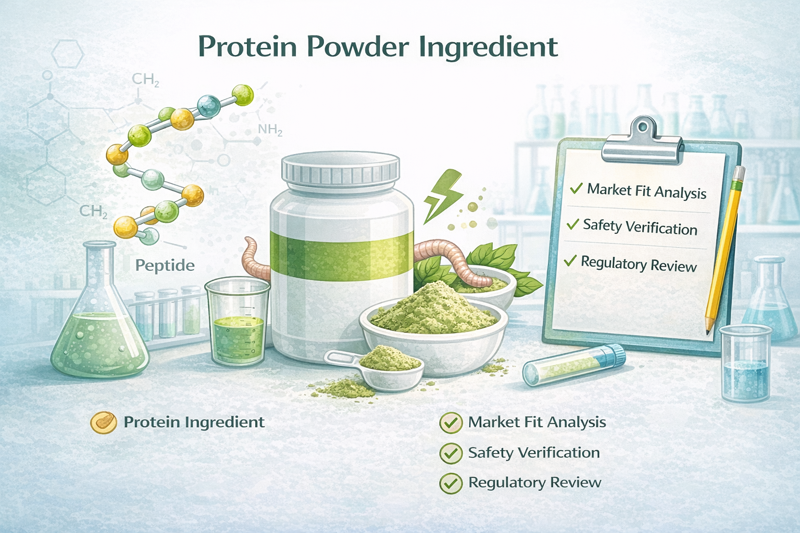
In simple terms, a strong earthworm protein powder specification package should cover:
- clear product identity
- protein, moisture, fat, and ash
- amino acid profile
- molecular weight distribution if peptide-rich
- degree of hydrolysis and soluble peptide content for hydrolysates
- microbiological limits
- heavy metals and contaminants
- species and origin traceability
- processing summary
- relevant bioactivity data if claimed
- shelf life, packaging, and lot consistency
That may feel like a lot. It is a lot. But this is ingredient sourcing, not a lucky dip.
The bottom line
A good earthworm protein powder is not defined by one bold number on a sales sheet. It is defined by a cluster of specifications that make sense together.
Protein percentage matters. So do moisture, fat, ash, amino acid quality, and purity. If the product is peptide-focused, molecular weight distribution, hydrolysis degree, and soluble peptide content become even more important. And across all versions of the ingredient, safety specs, traceability, and consistent manufacturing are the real backbone.
You know what? That is often the difference between a supplier who merely has product and a supplier who is ready for serious business.
If you source with that mindset, you will not just buy earthworm protein powder. You will buy the right version of it.
FAQs
1. What is the most important specification when sourcing earthworm protein powder?
The most important starting point is product identity. You need to know whether the ingredient is whole earthworm powder, extracted earthworm protein, or hydrolyzed earthworm peptide powder. After that, protein content, moisture, fat, ash, microbiological safety, and traceability become the key commercial specs.
2. What protein content should buyers expect in earthworm protein powder?
It depends on the product type. Raw dried material may be around 60% protein, while refined extracts can reach much higher purity. Published research reported raw material at 60.34% protein and a refined extract at 96.03% protein, so buyers should always ask whether the result is for raw powder or purified earthworm protein extract.
3. Why does molecular weight distribution matter in earthworm peptide powder sourcing?
Molecular weight distribution helps show whether the material is rich in small peptides or mostly intact protein. For buyers targeting functional foods, nutraceuticals, or premium health supplements, a higher proportion of low-molecular-weight peptides can support better positioning and more relevant technical storytelling.
4. Should buyers ask for ACE inhibitory or antioxidant test data for earthworm protein ingredients?
Yes, but only when the supplier is making a matching functional claim. If the product is sold as a bioactive earthworm peptide powder for cardiovascular or antioxidant product development, then ACE inhibitory or antioxidant assay data should come from the commercial ingredient, not just from academic fractions or unrelated internal samples.
5. What documents should a serious earthworm protein powder supplier provide?
A serious supplier should provide a specification sheet, COA, microbiological report, heavy metals report, production flow summary, shelf-life data, packaging details, and traceability information. For peptide-oriented materials, they should also be ready to share molecular weight distribution, degree of hydrolysis, and soluble peptide content data.
2 comments on “Key Specifications to Look for When Sourcing Earthworm Protein Powder”
Comments are closed.