
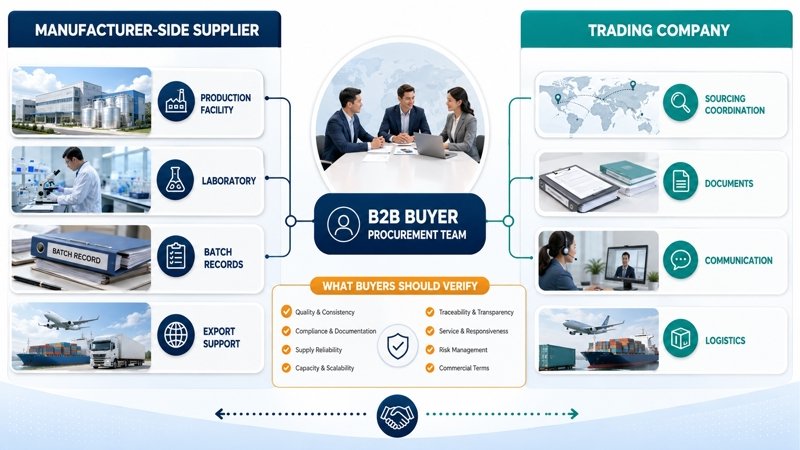
Choosing between a lumbrokinase manufacturer-side supplier and a trading company requires more than comparing quotations. Because lumbrokinase is an enzyme-sensitive ingredient, B2B buyers need to know who can access production information, confirm the available batch, explain activity specifications, supply batch-specific documents, and respond when technical or quality questions arise.
A manufacturer-side supplier may be closer to production, quality documentation, stock status, and batch planning. A trading company may offer useful sourcing, export, communication, and logistics services. The more important question is whether the supplier—regardless of its business type—can provide transparent, verifiable, and timely support throughout sample evaluation, bulk approval, shipment, and repeat purchasing.
Quick Answer
When comparing a lumbrokinase manufacturer with a trading company, B2B buyers should assess production-side access, batch document support, actual batch confirmation, activity and assay communication, sample-to-bulk specification consistency, packaging, storage, lead time, and repeat supply capability.
A manufacturer-side supplier may offer stronger production and batch communication. A trading company can still be a suitable partner if it can identify the production source, provide reliable documents, answer technical questions, and coordinate orders transparently.
Why Supplier Type Matters in Lumbrokinase Sourcing
Lumbrokinase is an earthworm-derived fibrinolytic enzyme ingredient considered for dietary supplements, nutraceutical products, enzyme formulations, and research-related applications. Its purchasing requirements differ from those of a conventional dry commodity.
The quoted product name and activity number do not provide enough information for supplier approval. Purchasing and QA teams should determine who controls or has direct access to:
- Production and raw material information
- Quality documents and batch records
- Available inventory and production schedules
- Sample preparation and shipment
- Packaging and storage information
- Activity testing and assay explanations
- International shipment coordination
- Technical responses when results differ between laboratories
Supplier type affects how quickly and accurately these questions can be answered. Buyers can review the Lumbrokinase product page for ingredient-level product and supply information before requesting batch-specific details.
What a Lumbrokinase Manufacturer-Side Supplier Can Usually Support
A manufacturer-side supplier is connected to the production and quality systems behind the product. This does not automatically make every manufacturer suitable, but it may shorten the information path between the buyer and the people responsible for production, testing, and batch release.
Production process familiarity
A manufacturer-side team should be able to explain the general production process without disclosing confidential manufacturing information. It may also provide clearer answers about earthworm raw material management, processing stages, drying, powder preparation, testing, and packaging.
This becomes useful when a formulation or QA team needs to understand whether the offered material is consistent with its intended application.
Batch control and document access
Manufacturer-side suppliers can often obtain an available-batch COA, specification sheet, batch number, packaging information, and storage guidance more directly. Buyers should still confirm whether the documents refer to current inventory, a typical specification, or a previous production batch.
For a broader explanation of document types, see Lumbrokinase Supplier Documents Beyond the COA.
Activity and assay communication
A manufacturer-side supplier may be better positioned to consult production or laboratory personnel about the activity unit, assay basis, sample preparation, and reporting format. It should not simply forward an activity figure without being able to explain its context.
Order and repeat-supply planning
Direct production-side access may make it easier to discuss stock availability, production scheduling, packaging preparation, trial quantities, and repeat orders. However, buyers should confirm realistic lead times rather than assuming that a factory connection means every specification is immediately available.
What a Trading Company May Provide
A trading company can add value when it has established production partners and maintains reliable information channels. Its support may include:
- Comparing production sources
- Coordinating export documentation
- Managing language and time-zone differences
- Arranging international logistics
- Consolidating different ingredients
- Helping buyers access manufacturers that do not export directly
- Handling routine commercial communication
The concern is not the label “trading company.” The concern is whether additional supply-chain layers reduce transparency or delay technical answers.
Before approval, buyers should verify whether the trading company can identify the actual production source, provide batch-specific documents, explain whether a COA belongs to the sample or intended shipment, and obtain answers about assay methods, packaging, storage, and repeat availability.
A capable trading company should also be transparent about its role. Unclear or changing descriptions—such as presenting itself as the factory in one communication and as an independent sourcing company in another—deserve further verification.
Compare Document Access
Document access is one of the clearest practical differences to examine. Depending on the order and destination, buyers may request:
- COA for the available batch
- Product specification sheet
- Product information
- Packaging information
- Storage guidance
- Batch information
- Country-of-origin information when required
- Assay method or reporting-basis explanation when relevant
The issue is not merely whether a document can be forwarded. Buyers should determine whether the supplier can explain what the document means, who issued it, which batch it covers, and whether it applies to the sample, current inventory, or proposed bulk shipment.
A useful test is to ask a follow-up question about one COA item. For example, ask whether the reported activity is an acceptance limit or an actual result. The accuracy and speed of the response can reveal how closely the supplier is connected to its quality team.
Compare Batch Confirmation Ability
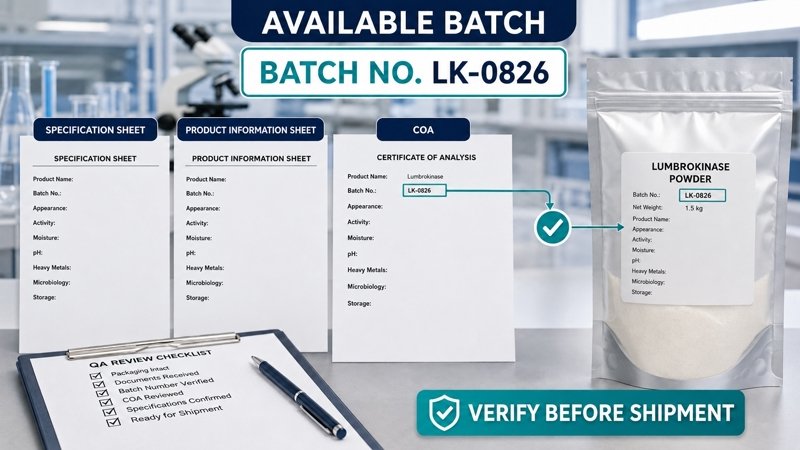
Batch confirmation should be a central part of the comparison. A manufacturer-side supplier may be closer to actual inventory, batch status, production scheduling, and updated quality documents. A trading company may also provide this support, but buyers should verify the information route.
Ask whether the supplier can:
- Confirm the actual available batch
- Provide the COA for the intended shipment batch
- Confirm the batch number before shipment
- Issue updated documents if the proposed batch changes
- Explain how sample-to-bulk specification consistency is managed
- Reserve an evaluated batch, if commercially possible
- State how long a quotation or batch confirmation remains valid
The last two points are often overlooked. A supplier may provide a suitable COA today, but that batch might be sold before the buyer completes internal approval. Buyers should distinguish between “batch currently available,” “batch provisionally allocated,” and “representative previous batch.”
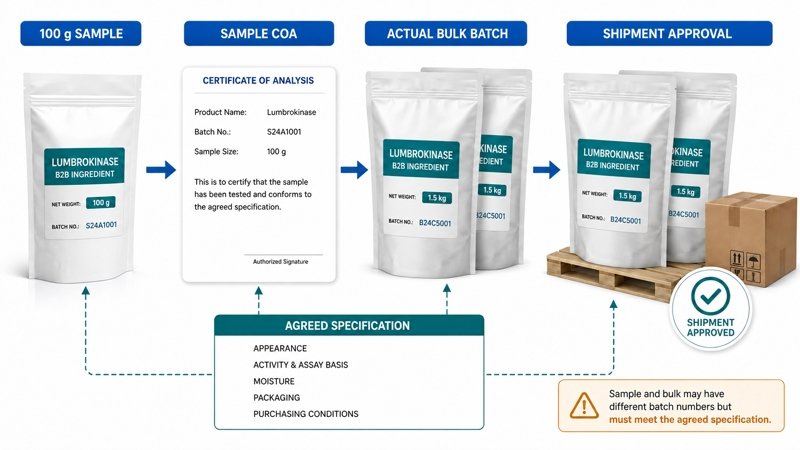
The sample batch and final bulk order batch may not always be the same, especially when there is a long interval between sample testing and PO placement. If the original sample batch is no longer available, the buyer should review the COA for the actual bulk batch and confirm that it meets the agreed specification, activity grade, assay basis, packaging requirement, and purchasing conditions.
Matching batch numbers are not always necessary, and approval of one sample does not guarantee every future batch. The practical objective is controlled sample-to-bulk specification consistency supported by updated verification.
For more detail on production controls, read How Lumbrokinase Manufacturers Ensure Consistent Activity.
Compare Activity and Assay Communication
Activity specifications require method context. Whether a supplier reports IU/mg, FU/g, LKU, or U, the number should be reviewed together with the assay method and reporting basis.
Buyers should ask:
- What activity specification is offered?
- Which activity unit is used?
- What assay method is applied?
- Does the COA identify the method or reporting basis?
- Is the result reported per gram, per milligram, or on another basis?
- Can the supplier discuss differences if a third-party laboratory obtains another result?
Where relevant, method review may include the substrate, standard, sample preparation, dilution, incubation time, incubation temperature, calculation method, reporting basis, and laboratory protocol.
There is no universal fixed conversion among FU/g, IU/mg, LKU, and U. One unit is not automatically superior to another, and the highest numerical activity is not necessarily the most suitable purchasing choice. Buyers should compare the requested specification using a defined assay context.
Compare Production Capacity, Samples, and Lead Time
Production capacity should be evaluated in relation to the buyer’s actual order pattern rather than through a general annual-capacity claim.
A prospective supplier should be able to discuss:
- A sample for evaluation
- An approximately 1.5 kg trial order
- Small bulk quantities such as 10–25 kg
- Current stock availability
- Production scheduling if stock is unavailable
- Packaging preparation
- Repeat-order planning
- A realistic dispatch date
Standard MOQ is usually around 1.5 kg, depending on specification, packaging, and destination. Small bulk orders of 10–25 kg may be discussed according to activity requirements, quantity, packaging, and delivery destination.
Buyers should also distinguish production lead time from transit time. “Available from stock,” “ready for dispatch,” and “delivery within a stated period” are not interchangeable. Customs clearance can add further time and should not be presented as a production delay.
Compare Packaging, Storage, and Shipping Support
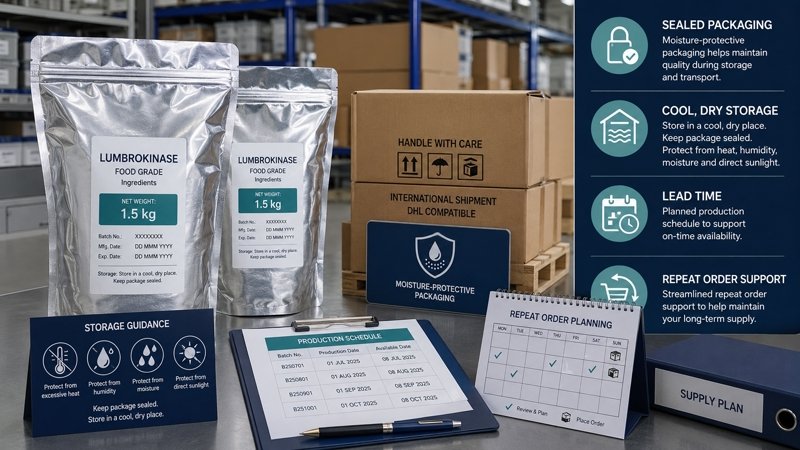
Order readiness includes the supplier’s ability to confirm how the material will be protected after batch approval.
Buyers should verify:
- Packaging format and net weight
- Inner and outer packaging
- Seal integrity and moisture protection
- Storage conditions
- Label and batch-number placement
- Shipping method and expected transit conditions
- DHL suitability for the destination
- DDP availability for selected destinations
- Responsibility for customs documents and clearance
Lumbrokinase is enzyme-sensitive and should be protected from prolonged or uncontrolled exposure to heat, humidity, moisture, direct sunlight, and unsuitable storage conditions. This does not mean every short temperature fluctuation automatically destroys the product. It means packaging, route planning, transit duration, and post-arrival storage should be considered together.
A supplier should state what shipping arrangement is being offered instead of using “door-to-door” without clarifying whether duties, customs clearance, or local charges are included.
Compare Long-Term Cooperation Stability
The first shipment is only one part of supplier evaluation. A suitable long-term supplier should be able to support repeat specification confirmation, updated COAs, realistic scheduling, and communication when a batch or packaging detail changes.
Buyers should examine whether the supplier:
- Maintains consistent product naming and specifications
- Provides updated batch information for repeat orders
- Reconfirms activity and assay basis when necessary
- Discusses future demand and production scheduling
- Maintains packaging consistency or announces changes
- Responds clearly to quality questions
- Keeps commercial and technical statements consistent
- Avoids promising permanent stock or identical results without evidence
The quality of escalation is another useful comparison point. Buyers should ask who handles an out-of-specification concern, laboratory discrepancy, damaged package, or document correction—and how the supplier obtains a production-side response.
For a wider supplier-approval perspective, consult How Lumbrokinase Buyers Evaluate Supplier Reliability Before Placing an Order.
Lumbrokinase Manufacturer vs Trading Company Comparison Checklist
| Comparison Area | Manufacturer-Side Supplier | Trading Company | What Buyers Should Verify |
|---|---|---|---|
| Production access | May communicate directly with production personnel | May communicate through a manufacturing partner | Who provides production answers and how quickly? |
| Batch document support | Can often access current batch records directly | May request documents from the production source | Do documents belong to the available or proposed batch? |
| COA explanation | May consult the laboratory or QA team | Depends on technical access to the producer | Can the supplier explain limits, results, and batch identity? |
| Specification sheet support | Usually connected to the controlled product specification | May provide a manufacturer-issued or reformatted sheet | Who controls and approves specification changes? |
| Activity and assay communication | May have direct access to testing personnel | May depend on information supplied by its partner | Are unit, method, and reporting basis clearly explained? |
| Sample support | May arrange a production or stock sample | May coordinate sampling from one or more sources | Is the sample source and batch identified? |
| Actual batch confirmation | Often closer to inventory and production status | Must obtain confirmation from its production source | Is the shipment batch confirmed before dispatch? |
| Packaging and storage information | May confirm packaging preparation directly | May coordinate buyer requirements with the factory | Are format, seal, label, and storage conditions documented? |
| Lead time discussion | May access stock and scheduling information directly | May combine production and export timelines | Does the stated lead time separate production and transit? |
| Repeat order support | May plan production against repeat demand | May maintain supply through partner coordination | Can the same agreed specification continue to be supported? |
| Accountability during quality questions | Can often escalate internally to QA or production | May act as an intermediary during investigation | Who owns the response, evidence collection, and resolution? |
Questions Buyers Should Ask Before Ordering
- What is your role in the lumbrokinase supply chain?
- Do you have direct production-side and quality-side support?
- Can you provide the COA and specification sheet for the available batch?
- Can you confirm the actual shipment batch before the order is dispatched?
- How do you support sample-to-bulk specification consistency?
- Can you explain the activity unit, assay method, and reporting basis?
- What packaging and storage guidance do you provide?
- Can you support repeat orders of 10–25 kg?
- Who responds if our laboratory result differs from the supplier’s COA?
- If the proposed batch changes, will updated documents be sent for review?
Common Buyer Mistakes
Common purchasing errors include:
- Assuming every manufacturer is automatically better
- Assuming every trading company is unreliable
- Selecting a supplier only by price
- Accepting documents without checking the batch number
- Failing to confirm whether an indicated batch is actually available
- Not identifying who answers technical and quality questions
- Comparing activity numbers without assay-method context
- Ignoring packaging, moisture protection, and storage details
- Failing to assess repeat-supply capability
- Assuming one approved sample represents every future batch
The most reliable decision comes from evidence, not the supplier’s company label alone.
Allworms Manufacturer-Side Supply Support
Allworms is part of the manufacturer-side earthworm-derived ingredient supply system and supports overseas market development and international sales. The system connects earthworm raw material supply, production, quality documentation, and B2B export support.
COAs and specification sheets can be provided for available batches. A 100 g sample may be available for qualified B2B buyers, with international freight normally paid by the buyer. Standard MOQ is usually around 1.5 kg, while 10–25 kg orders can be discussed according to specification, packaging, quantity, and destination.
Standard lead time is generally 7–15 days after payment when production is required. DHL may be used for suitable shipments, and DDP service may be available for selected destinations. Final arrangements should be confirmed according to activity specification, quantity, packaging, documents, payment terms, and destination.
Additional answers on sourcing and supply are available through the FAQ page.
FAQ
1. Is a lumbrokinase manufacturer always better than a trading company?
No. Manufacturer-side access may improve production, batch, and technical communication, but buyers should evaluate actual responsiveness, document accuracy, assay understanding, logistics support, and accountability. A well-connected trading company may provide reliable service when its production source and information channels are transparent.
2. How can buyers verify manufacturer-side production access?
Ask who manufactures the material, who issues the COA, how current batch availability is confirmed, and who answers technical questions. Consistent answers across sales, quality documents, packaging information, and shipment records are more useful than a general “factory direct” statement.
3. Must the sample and bulk order have the same batch number?
No. The original batch may no longer be available when the purchase order is placed. Buyers should review the actual bulk-batch COA and reconfirm the agreed specification, activity grade, assay basis, packaging, and purchasing conditions.
4. What is the most important document to request?
No single document answers every procurement question. The COA provides batch test information, while the specification sheet defines acceptance requirements. Buyers may also need packaging, storage, origin, assay, and shipment information depending on their QA process and destination.
5. How should buyers compare lumbrokinase activity specifications from different suppliers?
Compare the activity unit together with the assay method, substrate, standard, sample preparation, incubation conditions, calculation method, and reporting basis. Do not rely on a fixed conversion between IU/mg, FU/g, LKU, and U or assume that the highest number is automatically the best choice.
B2B CTA
Compare your lumbrokinase manufacturer options using batch-specific evidence, not supplier labels alone. Contact Allworms to request available-batch documents, sample support, MOQ, lead time, packaging, and shipping information.
This product is supplied as a B2B ingredient. Final formulation suitability, dosage, labeling, health claims, and regulatory compliance should be evaluated by the buyer according to the intended market and finished product use.