Earthworm Protein Powder Quality Grades: What Buyers Should Evaluate
Buyers searching for “pharmaceutical-grade Earthworm Protein Powder” may be trying to identify material with dependable quality, controlled contaminants and useful technical documentation. The phrase, however, does not tell a purchasing team which requirements apply or whether a particular batch meets them.
For supplement brands, contract manufacturers and technical evaluators, earthworm protein powder quality should be assessed through a defined specification, relevant testing, batch documentation and suitability for the intended application.
The useful purchasing question is: what does the claimed grade mean, and what evidence supports it?
Quick Answer: What Defines Earthworm Protein Powder Quality?
Earthworm Protein Powder quality is defined by how well an identified material meets documented requirements relevant to its intended use.
Those requirements may cover protein content, moisture, ash, heavy metals, microbiology, appearance, odor and application-relevant powder characteristics. Buyers also need enough analytical context to interpret results and enough batch information to connect the documents to the material being evaluated.
The Earthworm Protein Powder product page provides a starting point for reviewing the commercial ingredient and available product information. A grade description should then be checked against the applicable specification rather than accepted as a complete technical answer.
What Does “Pharmaceutical Grade” Mean for an Ingredient Buyer?
A buyer encountering “pharmaceutical-grade Earthworm Protein Powder” should ask which specific standard, specification or regulatory framework the supplier means.
Does the term refer to a named requirement for the exact ingredient? Is it a supplier’s internal category? Is it being used informally to describe tighter controls? These interpretations are different and require different evidence.
Without a defined reference, the label alone cannot establish pharmaceutical suitability, API status, purity or compliance with a pharmacopeial requirement.
Allworms supplies Earthworm Protein Powder as a protein-rich B2B ingredient for nutritional and formulation-development applications, subject to the buyer’s intended use and market requirements. It is not presented here as a pharmaceutical/API-grade material.
Research on isolated earthworm proteins, peptides or enzymes does not establish the grade of a commercial protein powder. The identity and supporting evidence must relate to the actual product under consideration.
How to Interpret Common Grade and Quality Terms
Commercial terminology can help introduce a product, but it needs to be translated into requirements that a technical team can review.
| Term encountered | What remains unclear | Evidence buyers should request |
|---|---|---|
| Pharmaceutical grade | Which exact standard or framework applies | Named requirements and product-specific evidence supporting the claim |
| Food grade | Intended use and applicable market requirements | Product identity, relevant specification and documentation for the proposed application |
| Supplement grade | Whether the term has a documented supplier definition | Agreed ingredient requirements and relevant testing information |
| Premium or high quality | Which measurable characteristics distinguish the material | Identified parameters, acceptance criteria and supporting results |
| High purity | What substance or fraction is being measured | Defined analyte, analytical method and reporting basis |
| Professional grade | What technical difference the label represents | Written definition linked to verifiable requirements |
A supplier may legitimately offer different specifications. The distinction becomes useful when buyers can identify what changes between them and why those changes matter to their project.
Start With a Defined Specification
The specification describes the target requirements and acceptance criteria for the ingredient. It gives QA, formulation and purchasing teams a shared reference.
If a quotation says “premium grade,” ask what measurable difference that category represents. It might refer to a particular protein requirement, physical characteristic or documentation package. Until the distinction is written down, different teams may interpret the same description differently.
Buyers should also distinguish acceptance limits from typical values or individual test results. A number presented without context should not automatically become a contractual limit.

The Earthworm Protein Powder specification guide supports the separate task of deciding which parameters to review. On this page, the central point is that a quality label becomes meaningful only when connected to defined requirements.
A Grade Label Does Not Replace Batch Documentation
A specification states what is required. A Certificate of Analysis reports information associated with a particular batch within the documented testing framework.
The two documents serve different purposes. A product description cannot demonstrate that the batch being offered meets the specification, while a COA cannot independently establish every claim made about a product’s grade.
For an initial review, a representative COA may help buyers understand the available reporting format. Before accepting commercial material, the relevant documentation should correspond to the supplied batch.
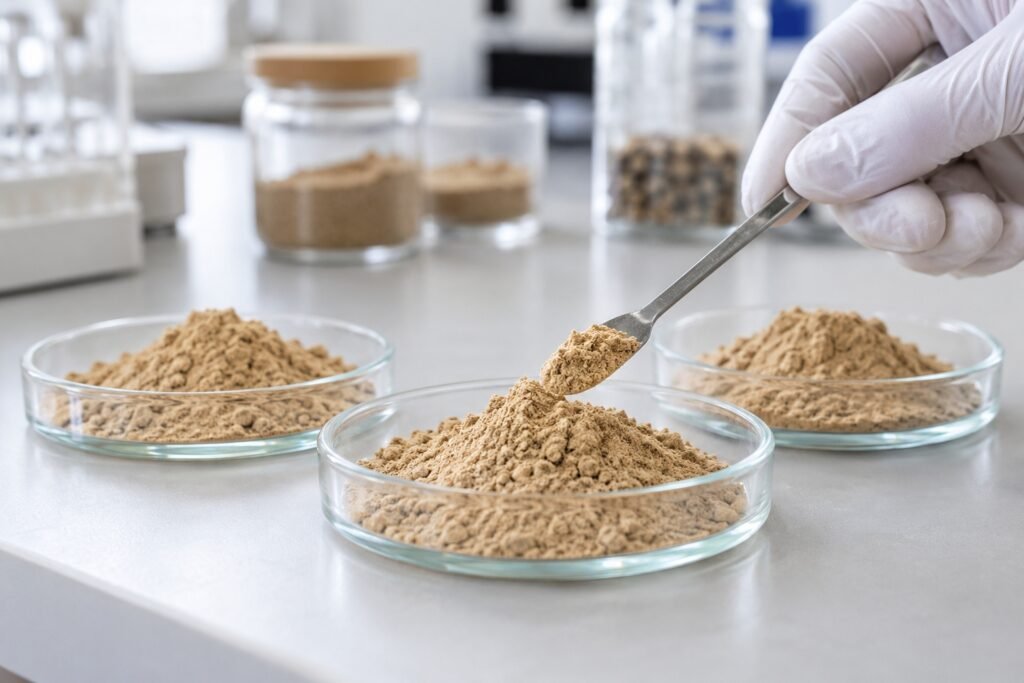
Buyers should clarify which results reflect testing of that batch and which statements rely on other documented controls. Unclear reporting should prompt clarification rather than an assumption that every listed item was measured on every lot.
The Earthworm Protein Powder supplier documents guide explains how supporting information beyond the COA can contribute to technical evaluation.
Which Measurable Characteristics Matter?
The relevant characteristics depend on the specification and intended application. Their value comes from the questions they answer, rather than from their association with a grade label.
Protein content helps characterize the ingredient’s composition. It does not by itself establish purity, contaminant control, a particular peptide profile or formulation performance.
Moisture and ash may form part of the agreed quality profile. Moisture provides information about the powder’s water content, while ash provides information about inorganic residue. Neither result alone proves storage stability or identifies the source of every inorganic component.
Heavy-metal results should be evaluated against applicable requirements using clearly reported units and methods. A “pharmaceutical-grade” description should not be assumed to guarantee lower concentrations.
Microbiological information needs defined criteria and relevant testing context. Broad descriptions such as “clean” or “controlled” cannot replace results for the specified organisms or counts.
Appearance, odor and physical condition also matter. A powder may meet analytical requirements while presenting sensory or handling characteristics that need further evaluation.
These areas together provide a more useful quality picture than any single headline number.

Why Methods and Reporting Basis Matter
A numerical result needs analytical context before it can support a meaningful comparison.
For protein content, buyers should understand the reported method, calculation basis and whether the percentage refers to the material as supplied or a dry basis. Results expressed differently should not be compared as though they describe identical conditions.
The same principle applies to contaminant and microbiological information. A result reported as “not detected” must be understood within the method’s detection capability; it should not be interpreted as proof of absolute absence.
When two suppliers report different numbers, the first step is to check whether the material, methods, units and reporting bases are sufficiently aligned. A larger or smaller number does not automatically demonstrate a better grade.
Manufacturing Information Supports Evaluation
Raw-material and manufacturing controls can help buyers understand how a supplier manages the ingredient. Relevant information may include source identification, starting-material preparation, processing controls and batch traceability.
However, a process name does not establish a finished-product grade. Descriptions such as “advanced extraction” or “low-temperature processing” need a connection to characteristics that buyers can verify.
For example, if a supplier claims its processing supports physical uniformity, the useful follow-up is to review the relevant specification, sample condition or measured characteristic.
The process-to-quality evaluation article develops that relationship in more detail. Here, manufacturing information should support the quality assessment without becoming a substitute for finished-batch evidence.
Intended Application Determines What Is Relevant
A quality assessment should begin with the proposed application. A capsule manufacturer, a tablet developer and a powder-blend formulator may place different emphasis on physical and sensory characteristics.
For a capsule project, powder handling and filling behavior may affect development decisions. For a tablet project, compatibility with the proposed compression system may require evaluation. For a flavored powder blend, odor, color and behavior within the finished mixture may be significant.
These are application requirements, not proof of a universal grade hierarchy. A material suitable for one project may require additional evaluation for another.
The buyer should separately establish the requirements for the intended destination market and finished-product use. Technical specifications, sample performance and market suitability answer related but distinct questions; none should be inferred solely from a grade label.

A Practical Evidence-Based Evaluation Framework
A concise review can move through six steps:
- Define the intended application. Identify the product format and ingredient function.
- Clarify the grade claim. Ask for the written meaning of any grade terminology.
- Agree on measurable requirements. Establish which characteristics determine acceptance.
- Review analytical context and batch documents. Connect results to methods, reporting bases and the relevant material.
- Evaluate the sample in the proposed application. Check the characteristics that documents cannot fully establish.
- Record the technical decision. State what has been accepted and what remains unresolved.
This framework prevents an attractive label from bypassing technical review. It also makes discussions between supplier, QA and formulation teams more precise.
General information about product distinctions and document availability is available in the Allworms FAQ.
Questions to Ask Instead of “Is It Pharmaceutical Grade?”
A more productive technical discussion asks:
- What does your grade description specifically mean?
- Which specification applies to the material offered?
- Are the listed numbers limits, typical values or batch results?
- Which methods and reporting bases support the results?
- What batch-specific documentation is available?
- Which characteristics still require evaluation in our application?
If answers remain unclear, keep the issue open during technical review. More confident marketing language does not resolve missing evidence.
FAQs
1. What does pharmaceutical-grade Earthworm Protein Powder mean?
The term needs a defined reference. Buyers should ask which exact standard, specification or framework it describes. Without supporting context, it is insufficient to establish quality, pharmaceutical suitability or API status.
2. Does Allworms supply pharmaceutical-grade Earthworm Protein Powder?
Allworms’ current positioning is a protein-rich B2B ingredient for nutritional and formulation-development applications. This article does not identify the material as pharmaceutical/API grade. Suitability requires review for the specific application and market.
3. How should buyers evaluate Earthworm Protein Powder quality?
Connect the product identity and intended use to a defined specification, relevant test information, batch documentation and sample evaluation. Clarify any grade claim before using it as a purchasing criterion.
4. Is protein content the same as purity?
No. A protein-content result characterizes one aspect of composition under the stated analytical framework. It does not independently establish the purity of a specific protein, peptide or enzyme.
5. Does a COA prove pharmaceutical grade?
No. A COA provides batch-related analytical information. Establishing a pharmaceutical-grade claim would require evidence addressing the specific standard or framework claimed, beyond the presence of a COA.
6. Is a higher protein percentage always better?
No. Its value depends on the formulation objective and agreed specification. Buyers should consider the complete quality profile and application behavior rather than rank materials using protein percentage alone.
7. Does meeting analytical specifications guarantee formulation suitability?
No. Analytical compliance supports ingredient acceptance, but the powder may still require evaluation for handling, blending, filling, compression or sensory compatibility within the proposed formulation.
8. Can suppliers use internal quality grades?
Yes, provided the categories are clearly defined. Buyers should understand the measurable differences, applicable specifications and supporting evidence. Internal categories should not be presented as recognized pharmaceutical classifications without substantiation.
Making a Quality Decision
A useful Earthworm Protein Powder quality assessment connects each claim to a requirement, each requirement to evidence and that evidence to the intended application. Grade terminology can introduce the discussion; documented characteristics should determine the decision.

Review The Current Specification And Batch Documentation?
Discuss your technical and sample evaluation requirements with Allworms.
One comment on “What Makes Pharmaceutical-Grade Earthworm Protein Powder Different?”
Comments are closed.