
International lumbrokinase shipping and storage requires more planning than moving an ordinary dry commodity powder. Lumbrokinase is an earthworm-derived fibrinolytic enzyme ingredient used in dietary supplement, nutraceutical, enzyme formulation and research-related applications. Because it is an enzyme-sensitive material, buyers should pay attention to packaging integrity, moisture protection, transit conditions, customs preparation, receiving inspection and post-delivery storage.
The objective is not to assume that every brief temperature change will automatically damage the material. Rather, international buyers should minimize prolonged or uncontrolled exposure to heat, humidity, moisture and direct sunlight. For a small bulk order, shipping arrangements should therefore be discussed before dispatch, including the destination, packaging format, shipping route, customs documents and warehouse conditions at the receiving end.
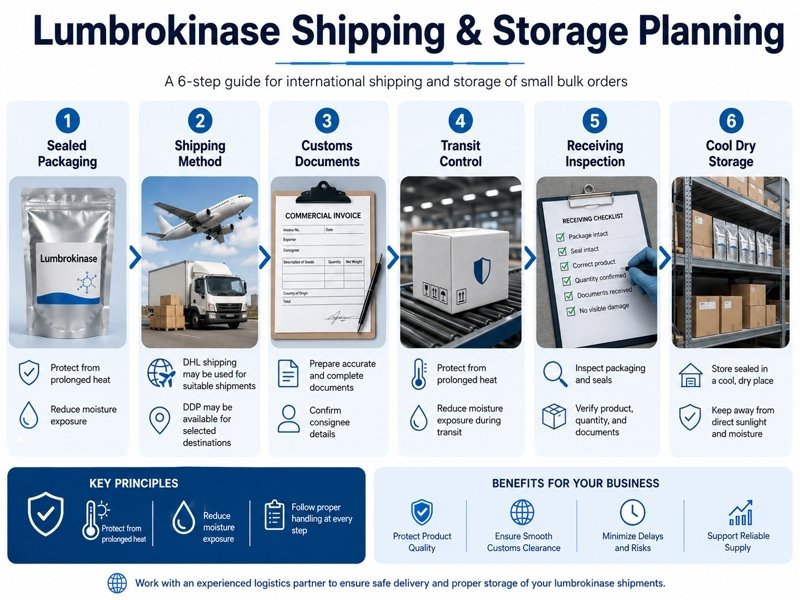
Quick Answer: How Should Lumbrokinase Be Shipped and Stored?
For proper lumbrokinase shipping and storage, the product should remain in sealed packaging and be stored in a cool, dry place, protected from prolonged heat, moisture, humidity and direct sunlight.
For international small bulk orders, buyers should confirm the packaging format, shipping method, customs documentation, destination requirements, consignee details and storage arrangements before the shipment leaves the supplier. Shipment planning should also distinguish order preparation lead time from international transit, customs clearance and local delivery.
Why This Matters for B2B Buyers
A supplement brand or ingredient distributor may focus first on activity specification, price and quantity. However, once an enzyme ingredient begins an international journey, the risk profile changes.
A small bulk lumbrokinase shipment may pass through several environments:
- supplier warehouse and dispatch handling;
- courier or freight terminals;
- aircraft or transport vehicles;
- customs inspection facilities;
- local delivery networks;
- the buyer’s receiving area;
- long-term warehouse storage.
At each stage, the package can face different combinations of temperature, humidity, waiting time and handling conditions.
This does not mean a shipment requires alarm whenever conditions fluctuate temporarily. The more practical concern is cumulative risk from prolonged exposure, uncontrolled storage conditions, damaged packaging or unexpected customs delays.
For this reason, shipping and storage should be planned before dispatch, not after the shipment is already moving.
Buyers preparing a small international order can also review Lumbrokinase Small Bulk Orders for the broader purchasing context, while this guide remains focused specifically on logistics and storage risk management.
Technical Explanation: Why Lumbrokinase Needs More Careful Handling Than Ordinary Powders
Lumbrokinase Is an Enzyme-Sensitive Material
Lumbrokinase is not simply a nutritional filler or an ordinary dry commodity. It is an earthworm-derived enzyme ingredient whose quality evaluation includes enzymatic activity.
That difference matters in logistics.
Dry appearance alone does not make all powders equally tolerant of unsuitable transport and storage conditions. For an enzyme-sensitive material, buyers should pay particular attention to:
- moisture ingress;
- prolonged heat exposure;
- high-humidity environments;
- direct sunlight;
- repeated unnecessary opening;
- damaged package seals;
- extended transit or customs delays;
- unsuitable warehouse placement.
The goal is controlled handling, not exaggerated claims about instability.
A short temperature fluctuation does not necessarily mean that a batch has automatically lost its intended quality. However, prolonged or poorly controlled exposure to heat and humidity may increase quality risk. Suitable packaging, transport planning and post-delivery storage are therefore reasonable preventive measures.
Sealed Packaging Is the First Protective Barrier
For international transportation, the immediate package is the first line of protection against environmental moisture and handling exposure.
A suitable packaging arrangement should be selected according to:
- order quantity;
- bag size;
- outer carton or drum configuration;
- transport method;
- expected route;
- local climate;
- storage practices after delivery.
Buyers should not treat packaging as a purely cosmetic choice. The package must remain properly sealed through transport, customs handling and warehouse transfer.
Where sealed inner bags are used, they should remain closed until the buyer has a suitable receiving and storage procedure ready. Opening a bag unnecessarily in a humid receiving area can create avoidable exposure.
Allworms product information recommends cool, dry storage and notes the importance of avoiding prolonged high-temperature and high-humidity exposure for this enzyme-sensitive material.
Moisture Protection Requires Attention Before and After Shipping
Moisture exposure can occur in more than one place.
Potential sources include:
- damaged or poorly closed inner packaging;
- condensation around unsuitable storage areas;
- opening containers in high-humidity rooms;
- storing packages directly against damp floors or walls;
- leaving cartons in non-controlled receiving zones;
- resealing partially used packages incorrectly.
A sealed package helps reduce exposure during transport and storage, but warehouse practice is equally important. Buyers should have a defined storage location ready before the shipment arrives.
The available Allworms batch COA states that the product should be stored in a cool, dry place, kept tightly sealed and protected from moisture and light.
Lumbrokinase Shipping and Storage Risk Checklist
| Risk Factor | Why It Matters | What Buyers Should Confirm |
|---|---|---|
| Packaging seal | A damaged or incomplete seal may increase moisture exposure risk | Confirm inner package integrity and closure method |
| Moisture exposure | Enzyme-sensitive powder should be protected from unnecessary moisture contact | Confirm moisture-resistant sealed packaging and dry receiving conditions |
| Prolonged heat exposure | Extended uncontrolled heat may increase stability risk | Review destination climate, route and expected handling conditions |
| Humidity | High-humidity environments can increase moisture management concerns | Confirm sealed storage and dry warehouse placement |
| Direct sunlight | Direct exposure should be avoided during storage and receiving | Store cartons and inner packages away from direct sunlight |
| Transit duration | Longer routes increase the time the shipment remains outside the buyer’s warehouse | Confirm the intended transport method and expected routing arrangement |
| Seasonal weather | Summer heat, rainy seasons or other climate factors may affect logistics planning | Discuss destination and season before dispatch |
| Customs delay | Inspection or documentation review can extend shipment time | Prepare required documents and destination information before dispatch |
| Document completeness | Incomplete or inconsistent documents can slow clearance | Confirm the document set required for the destination and shipment type |
| Consignee information | Incorrect contact details can delay clearance or final delivery | Verify consignee name, phone number and full delivery address |
| DHL shipping | Express courier can be suitable for certain international shipments | Confirm whether DHL is suitable for the destination, quantity and package |
| DDP availability | DDP is route- and destination-dependent | Confirm availability before quotation and dispatch |
| Warehouse storage | Good transport cannot compensate for unsuitable storage after delivery | Prepare a cool, dry, clean storage location in advance |
| Package inspection after delivery | Damage, moisture signs or leakage should be identified early | Inspect carton and inner seal condition immediately after receipt |
Before Shipment: What Buyers Should Confirm
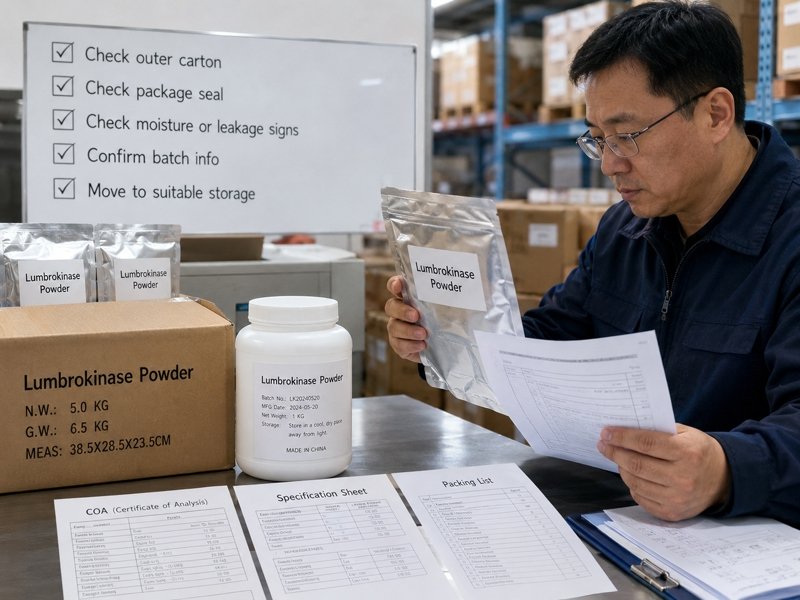
A reliable international shipment begins with complete information.
Before dispatch, the buyer and supplier should confirm the following points.
1. Order Quantity
Quantity affects the packaging arrangement, courier suitability, outer carton configuration and shipping route.
A 1.5 kg shipment, a 10 kg shipment and a larger repeat order may require different logistics arrangements. This article does not replace a full MOQ purchasing guide; the point here is that shipping planning starts with the actual quantity.
2. Packaging Format
Confirm:
- inner package size;
- number of bags;
- outer packing format;
- whether special packaging requirements are needed;
- whether the warehouse can handle the selected packaging format.
For enzyme-sensitive material, suitable sealed packaging should be used to reduce moisture exposure risk during transport and storage.
3. Destination Country
A supplier cannot properly evaluate an international shipping arrangement based only on product weight.
The destination affects:
- courier availability;
- transit routing;
- DDP service possibility;
- documentation requirements;
- import procedures;
- seasonal transport considerations;
- local delivery conditions.
Therefore, a buyer requesting a shipping quotation should provide the destination country and, where needed, the city or postal code.
4. Complete Consignee Information
Before dispatch, verify:
- consignee company or recipient name;
- complete street address;
- city and postal code;
- country;
- telephone number;
- email address where relevant.
Incorrect consignee information can cause avoidable delays, especially when a courier or customs agent needs to reach the importer quickly.
5. Customs Documentation Requirements
Customs procedures vary by destination, importer type and shipment arrangement.
Before the product leaves the supplier, buyers should confirm whether the destination or their customs representative requires particular import documentation, product descriptions or supporting files.
A COA and specification sheet can support product identification and buyer documentation review, but they should not be treated as automatic substitutes for destination-specific import documents.
Buyers needing a broader explanation of batch documentation can review the Allworms FAQ page, while shipping-specific document requirements should be confirmed for the actual destination.
6. Preferred Shipping Method
For suitable international shipments, DHL may be considered depending on destination, quantity, packaging and local service conditions.
The buyer should discuss the proposed transport method before dispatch rather than requesting an unspecified “fastest shipping” option without considering customs handling and receiving conditions.
7. Whether DDP Service Is Available
DDP shipping may be available for selected destinations, but availability should never be assumed for every market.
Before confirming a DDP arrangement, check:
- destination;
- quantity;
- package dimensions;
- local service conditions;
- current route suitability.
Where available, DDP can simplify certain parts of the delivery process. However, the exact arrangement should be confirmed for the specific shipment.
8. Expected Storage Arrangement After Delivery
The buyer should know where the shipment will go after delivery.
Questions to resolve include:
- Will the goods move directly to a warehouse?
- Is the receiving area dry?
- Will packages remain temporarily in a loading dock?
- Is the storage area protected from direct sunlight?
- Who is responsible for inspecting the shipment?
- Will the inner packaging remain sealed until material use?
Storage planning should not begin only after the courier arrives.
9. Destination-Specific Handling or Import Requirements
Some shipments may require additional preparation depending on the destination and intended use.
The buyer should check local requirements through the appropriate importer, customs broker, logistics provider or compliance adviser. The supplier should be given relevant requirements early enough to prepare applicable shipment documents before dispatch.
Planning International Shipping for Small Bulk Lumbrokinase Orders
DHL Shipping for Suitable International Shipments
DHL shipping may be used for suitable international lumbrokinase shipments.
For small bulk quantities, express courier service can be practical because it provides organized tracking and an established international delivery network. However, suitability still depends on:
- destination country;
- shipment quantity;
- packaging dimensions;
- customs requirements;
- local delivery conditions.
A courier service does not remove the need for customs preparation. Buyers should still ensure that consignee contact information is accurate and that relevant shipment documents are ready.
DDP Shipping for Selected Destinations
DDP service may be available for selected destinations.
Buyers should confirm availability before placing the order because DDP feasibility can depend on the destination, quantity, route and local delivery conditions.
It is therefore better to ask:
Can DDP service be arranged for this quantity and destination?
rather than assume:
All international lumbrokinase orders can be shipped DDP.
The final shipping quotation may be influenced by the destination, shipment quantity, packaging and selected delivery service. For commercial ordering context beyond logistics, buyers may refer to the Lumbrokinase product page.
Customs Clearance Preparation: Documentation Can Affect Delivery Efficiency
Customs clearance is a separate stage of international delivery.
A shipment may move efficiently through international transit and still be delayed at customs because of inspection, document review, importer response time or destination-specific procedures.
Before dispatch, buyers should confirm:
- correct consignee information;
- importer contact availability;
- commercial shipment details;
- documentation required by the destination;
- any special requirements communicated by the buyer’s customs representative.
Where available for the batch, COA and specification documents can support product review and shipment preparation. For example, an Allworms COA identifies the product, batch number, source, activity specification, assay method and other tested items, while also stating storage guidance.
The purpose of mentioning these documents here is logistical: buyers should organize relevant product information before customs questions arise, rather than search for files only after a shipment has already been stopped for review.
Understanding the Four Different Time Periods in International Delivery
One of the most common misunderstandings in B2B purchasing is treating all delivery stages as one fixed lead time.
They should be separated.
1. Order Preparation Lead Time
This is the time required by the supplier to prepare the order for shipment.
For Allworms, the standard lead time is usually 7–15 days after payment, depending on the product, specification and order arrangement.
This is not the same as total door-to-door delivery time.
2. International Transit Time
This refers to the movement of the shipment through the international transport network.
Transit depends on:
- origin and destination;
- shipping method;
- courier or freight routing;
- transfer points;
- seasonal logistics conditions.
3. Customs Clearance Time
Customs clearance occurs separately from international transit.
The time required may vary because of:
- routine document processing;
- customs inspection;
- document questions;
- importer response time;
- destination-specific procedures.
A supplier should therefore avoid presenting customs clearance as a guaranteed fixed number of days.
4. Local Delivery Time
After customs release, the shipment may still require transportation through the local courier or delivery network.
Remote delivery areas, address issues and local operational conditions can affect this final stage.
Buyers needing more detailed purchasing information about preparation schedules can review MOQ and Lead Time for Lumbrokinase Bulk Orders. This logistics guide, however, treats those four stages separately because they involve different parties and different delay risks.
How Destination, Season and Customs Conditions Affect Shipping Planning
Destination
The same quantity may require a different shipping arrangement for two different countries.
Destination can affect:
- available courier service;
- DDP feasibility;
- import document requirements;
- route complexity;
- local delivery service.
Season
Seasonal conditions should be considered, especially where the shipment route or destination may experience prolonged periods of high temperature or high humidity.
Seasonal planning does not mean that shipping is automatically impossible in warmer periods. It means the buyer and supplier should consider the route, expected handling time, packaging and receiving arrangements more carefully.
Transit Duration
A shorter and more predictable transit arrangement may reduce the period during which the material remains outside controlled warehouse storage.
However, buyers should avoid focusing only on the nominal courier transit estimate. Customs delays can change the actual time between dispatch and final receipt.
Customs Conditions
A shipment may be selected for inspection regardless of the planned transit route.
For enzyme-sensitive material, avoiding unnecessary customs delays is useful because a longer hold may increase uncertainty around storage conditions during transit.
Accurate documentation and fast consignee response cannot eliminate every customs inspection, but they can reduce avoidable administrative delay.
After Delivery: What Buyers Should Check
Receiving inspection is the final stage of international logistics and the first stage of warehouse control.
Buyers should not move the shipment directly into general stock without checking its condition.
Check the Outer Carton Condition
Inspect for:
- crushing;
- tears;
- water exposure;
- opened areas;
- severe deformation;
- other visible transport damage.
Minor marks on an outer carton do not necessarily indicate product damage, but significant damage should be documented and investigated.
Check the Package Seal Condition
Confirm that the immediate product packaging is properly closed and has not been punctured, torn or unintentionally opened.
For a multi-bag order, check each package rather than inspecting only the top bag.
Look for Moisture or Leakage Signs
Inspect for:
- visible wet areas;
- moisture inside the outer carton;
- leakage;
- unusual package deformation;
- damaged closures.
Visible shipment damage should be photographed and reported promptly to the relevant supplier and logistics party.
Confirm Product Label and Batch Information
Compare the shipment against the purchase and batch documents.
Check:
- product name;
- batch number;
- quantity;
- package count;
- label information.
Review the COA and Specification Documents
Confirm that the documents provided correspond to the intended product or available batch information.
This receiving step is mainly about traceability and document matching, not a complete re-analysis of COA terminology.
Transfer the Shipment to Suitable Storage Promptly
After inspection, move the goods to the prepared storage location.
Avoid leaving the shipment for prolonged periods:
- in direct sunlight;
- near heat sources;
- in humid loading areas;
- in uncontrolled outdoor receiving zones;
- next to wet walls or floors.
A cool, dry storage environment and tightly sealed packaging are consistent with the storage instructions shown in the available batch documentation.
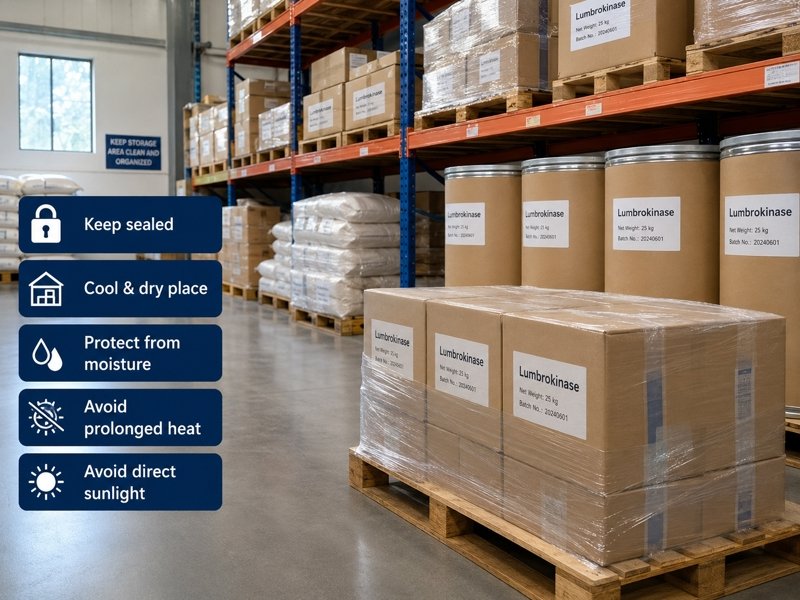
Warehouse Storage After Delivery
International transport planning is only effective when post-delivery storage is also controlled.
Keep Packages Sealed Until Needed
Unopened packages should remain properly sealed in accordance with their packaging arrangement.
Do not open all bags simply for visual inspection when there is no operational reason to do so.
Store in a Cool, Dry Area
The warehouse should protect the product from:
- prolonged heat;
- excess humidity;
- moisture;
- direct sunlight.
The product area should be clean, dry and suitable for ingredient storage.
Avoid Unnecessary Exposure During Partial Use
When part of a package is used, the remaining material should be resealed appropriately and returned to suitable storage promptly.
Repeated unnecessary opening and long exposure in humid processing areas should be minimized.
Use Warehouse Procedures That Preserve Traceability
The warehouse should maintain clear identification of:
- product name;
- batch number;
- receiving date;
- package status;
- inventory movement.
For repeat purchasing, clear warehouse traceability also helps buyers separate logistics issues from batch or formulation questions.
Common Mistakes and Misunderstandings
Mistake 1: Treating Lumbrokinase Like an Ordinary Stable Commodity Powder
The dry powder format can create a false impression that transport conditions do not matter.
Lumbrokinase should instead be handled as an enzyme-sensitive ingredient, with attention to sealed packaging, moisture protection and suitable storage.
Mistake 2: Leaving Sealed Packages in Hot or Humid Areas for Prolonged Periods
Sealed packaging is important, but it does not justify poor warehouse placement.
Avoid prolonged storage in loading areas, hot vehicles, damp rooms or direct sunlight.
Mistake 3: Opening the Packaging Before Storage Conditions Are Ready
Prepare the inspection and storage area before opening any package that genuinely needs to be opened.
Unnecessary early opening creates avoidable exposure.
Mistake 4: Asking for a Shipping Price Without Providing the Destination
A meaningful international shipping arrangement requires at least:
- quantity;
- destination country;
- often the city or postal code;
- preferred shipping arrangement.
Shipping method, destination, quantity, packaging and DDP service can all affect the quotation.
Mistake 5: Not Confirming Consignee Information Before Dispatch
An incorrect telephone number or incomplete address can create problems when the courier or customs representative needs a quick response.
Confirm all details before the shipping label is created.
Mistake 6: Confusing Production Lead Time With Total Delivery Time
Supplier preparation, international transit, customs clearance and local delivery are separate stages.
They should not be presented as one guaranteed delivery period.
Mistake 7: Ignoring Possible Customs Clearance Delays
Even an express shipment may be inspected.
Buyers should prepare documentation and remain available to respond to customs or courier requests.
Mistake 8: Assuming DDP Is Available for Every Destination
DDP availability is destination-specific.
Confirm the actual route before ordering.
Mistake 9: Failing to Inspect the Packaging After Delivery
Receiving inspection provides an opportunity to document visible damage, moisture signs or seal problems immediately.
Waiting several days can make transport-related issues more difficult to investigate.
Allworms Supply Notes for International Lumbrokinase Orders
Allworms Bio-Tech supports international B2B supply of earthworm-derived lumbrokinase ingredients.
For shipping and storage planning:
- DHL shipping may be used for suitable international shipments.
- DDP shipping may be available for selected destinations.
- Shipping arrangements depend on destination, quantity, packaging and local delivery conditions.
- COA and specification sheets can be provided for available batches.
- Small bulk order details should be confirmed before shipment.
- Suitable sealed packaging should be used to reduce moisture exposure during transport and storage.
- Standard order preparation lead time is usually 7–15 days after payment.
- International transit, customs clearance and local delivery should be considered separately from order preparation time.
Product information also identifies lumbrokinase as an enzyme-sensitive material and recommends cool, dry storage, avoiding prolonged high temperature and humidity, and minimizing unnecessary exposure.
For B2B planning, the practical sequence is:
Confirm product and quantity → confirm packaging → check destination requirements → choose shipping arrangement → prepare documents → dispatch → monitor customs progress → inspect on receipt → transfer to suitable storage.
FAQ
1. How should lumbrokinase be stored?
Lumbrokinase should be kept in sealed packaging and stored in a cool, dry place. Buyers should protect it from prolonged exposure to heat, moisture, humidity and direct sunlight. The receiving warehouse should be prepared before delivery so the shipment can be inspected and transferred to suitable storage promptly.
2. Is lumbrokinase sensitive to heat and humidity?
Lumbrokinase is an enzyme-sensitive material, so prolonged or uncontrolled exposure to high temperature and humidity may increase quality risk. This does not mean every brief temperature fluctuation automatically destroys the product. The practical approach is to reduce unnecessary exposure through suitable packaging, shipping planning and proper storage.
3. Can lumbrokinase be shipped by DHL?
Yes. DHL shipping may be used for suitable international shipments, depending on the destination, quantity, packaging format and local service conditions. Buyers should confirm the actual arrangement before dispatch.
4. Is DDP shipping available for lumbrokinase?
DDP shipping may be available for selected destinations. It should be confirmed case by case because availability can depend on the destination country, shipment quantity, route, package and local delivery conditions.
5. How should buyers prepare for lumbrokinase customs clearance?
Before shipment, confirm the consignee details, destination requirements and applicable shipment documents. The buyer should also remain available to respond to courier or customs requests. COA and specification documents can support product information review where relevant, but buyers should separately confirm any destination-specific import requirements.
6. What should buyers check after receiving a lumbrokinase shipment?
Check the outer carton, inner package seals, visible moisture or leakage signs, product labels, batch information and package count. Confirm the supporting batch documents and move the shipment promptly to a suitable cool and dry storage area. Visible transport damage should be documented and reported promptly.
7. Is lumbrokinase lead time the same as total delivery time?
No. Order preparation lead time, international transit, customs clearance and local delivery are separate stages. Allworms’ standard preparation lead time is usually 7–15 days after payment, while actual transport and customs timing depend on the shipment arrangement and destination.

Planning international lumbrokinase shipping and storage?
Send your quantity, destination country, packaging requirement and preferred shipping method to confirm DHL options, DDP availability, documentation and shipping arrangements.
This product is supplied as a B2B ingredient. Final formulation suitability, dosage, labeling, health claims, and regulatory compliance should be evaluated by the buyer according to the intended market and finished product use.