
Lumbrokinase Activity Grade Options: What B2B Buyers Should Confirm Before Ordering
Selecting a lumbrokinase activity grade requires more than asking a supplier for the highest available activity number. Before requesting a sample, quotation, or bulk order, B2B buyers should define the required activity grade and confirm how that activity is measured and reported.
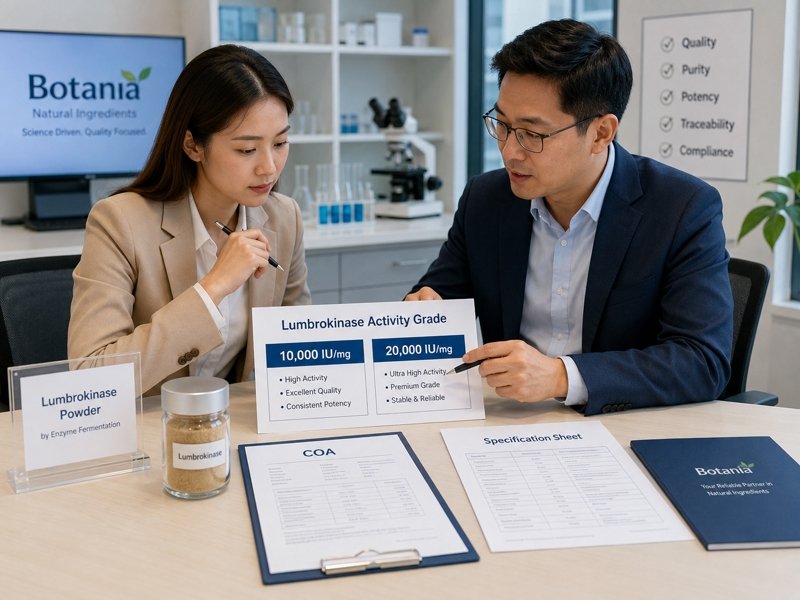
Lumbrokinase may be discussed in grades such as 10,000 IU/mg, 20,000 IU/mg, or higher activity upon request. However, the stated number should always be reviewed together with the activity unit, assay method, reporting basis, specification sheet, COA, batch number, and actual batch availability.
This purchasing process is especially important for supplement brands, nutraceutical companies, ingredient distributors, formulation developers, and research-related buyers preparing for sample testing or a 10–25 kg order. The objective is not simply to obtain a high activity value. It is to approve a clearly defined, testable, and commercially supportable lumbrokinase specification.
Quick Answer: How Should Buyers Confirm a Lumbrokinase Activity Grade?
A lumbrokinase activity grade should be confirmed through the stated activity unit, assay basis, specification sheet, batch-specific COA, sample evaluation, and actual bulk batch availability.
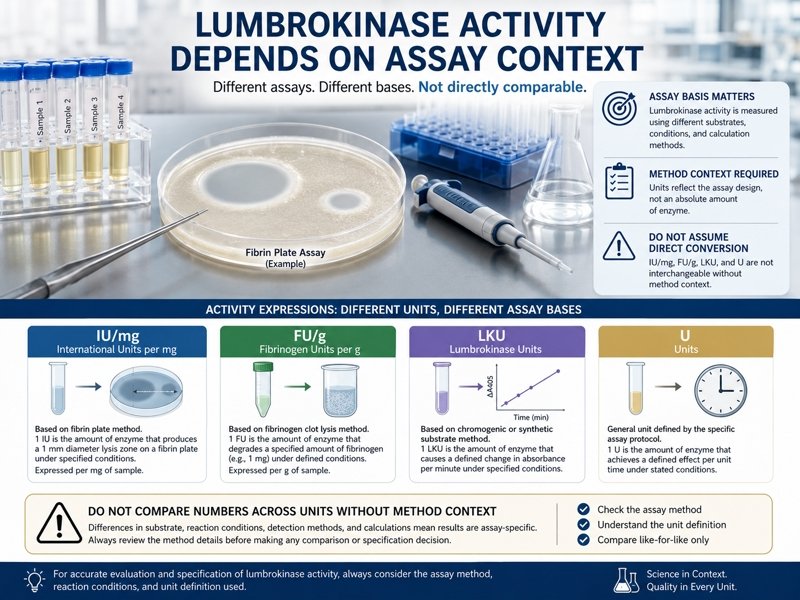
Buyers may discuss 10,000 IU/mg, 20,000 IU/mg, or higher activity options with a supplier. However, IU/mg, FU/g, LKU, and U should not be treated as directly interchangeable without understanding the testing method and reporting basis.
Before approving a bulk order, buyers should confirm that the actual available batch meets the agreed activity grade and request the corresponding batch COA.
Why Lumbrokinase Activity Grade Matters for B2B Buyers
Lumbrokinase is an earthworm-derived fibrinolytic enzyme ingredient considered for dietary supplement, nutraceutical, enzyme formulation, and research-related applications.
For B2B buyers, the activity grade may affect:
- Raw material qualification
- Formula calculations
- Supplier comparison
- Internal quality requirements
- Third-party laboratory testing
- Product documentation
- Labeling and compliance review
- Purchasing cost
- Sample approval
- Repeat-order consistency
Different buyers may therefore request different grades. One project may be designed around a 10,000 IU/mg specification, while another may require 20,000 IU/mg or a higher activity option.
The highest number is not automatically the most suitable choice. A useful purchasing specification must match the buyer’s formulation plan, testing system, document requirements, intended order quantity, and future supply conditions.
Buyers who need a general product overview can first review the Lumbrokinase product page before defining their activity-grade requirements.
Activity Grade Is Not Just an Activity Number
A quotation showing “20,000 IU/mg” does not by itself provide enough information for supplier approval.
The buyer should also establish:
- Which activity unit is being used?
- Which assay method produced the result?
- Is the result expressed per milligram of powder, protein, or another reporting basis?
- Is the number a minimum specification or an actual batch result?
- Which batch number appears on the COA?
- Will the sample be taken from an available commercial batch?
- Which method will the buyer or third-party laboratory use?
- Can the supplier support the same agreed specification for the planned bulk quantity?
These questions turn a general activity claim into a usable purchasing requirement.
A supplier specification sheet normally defines the target grade and acceptance requirements. The COA should report the actual result for a named production batch. Buyers should use both documents rather than relying on a single activity number in a quotation or product description.
How to Discuss 10,000 IU/mg, 20,000 IU/mg or Higher Activity Options
The most effective activity-grade discussion follows a defined sequence.
1. Start With the Buyer’s Target Specification
The buyer should first state the required grade whenever possible.
Examples include:
- Lumbrokinase 10,000 IU/mg
- Lumbrokinase 20,000 IU/mg
- A higher activity grade subject to supplier confirmation
- A buyer-specific activity requirement under a defined laboratory method
The target should reflect an actual purchasing or formulation requirement rather than a general preference for the largest number.
2. Confirm the Supplier’s Assay Basis
Ask the supplier how the stated activity is measured.
The discussion should cover:
- Assay method
- Activity unit
- Substrate
- Reference material or standard
- Sample preparation
- Incubation conditions
- Calculation method
- Reporting basis
Buyers who need additional assay background may review Fibrin Plate Assay for Lumbrokinase Activity. For an activity-grade purchase, however, the immediate question is whether the supplier’s reported grade and the buyer’s acceptance method use a sufficiently clear and comparable basis.
3. Request the Specification Sheet and COA
The specification sheet should show the intended minimum or target activity requirement.
The COA should identify the tested batch and report its actual activity result. Buyers should check whether the result meets the target grade before requesting a representative sample or approving a PO.
4. Decide Whether Sample Testing Is Required
A 100 g sample may support:
- Appearance review
- Internal raw material evaluation
- Third-party activity testing
- Assay-method comparison
- Preliminary formulation work
- Supplier qualification
The sample should be linked to a batch number whenever possible. Buyers should also identify the laboratory method they plan to use before comparing their result with the supplier’s COA.
More detailed sample procedures are covered in Lumbrokinase Sample Evaluation.
5. Confirm Commercial Supply Conditions
After sample approval, the buyer should ask whether the agreed activity grade can be supported for the expected order quantity.
This is important when the next purchasing stage may be:
- A 1.5 kg trial order
- A 10 kg pilot or first commercial order
- A 20 kg or 25 kg small bulk order
- A repeat order under the same purchasing specification
The supplier should confirm current batch availability, production status, documentation, lead time, and packaging before the buyer issues a PO.
6. Reconfirm the Actual Batch After a Long Delay
If several weeks or months pass between sample testing and PO placement, the original sample batch may have been sold or allocated.
The buyer should then request the COA for the actual available bulk batch and reconfirm:
- Activity grade
- Activity unit
- Assay basis
- Product specification
- Batch number
- Relevant quality results
- Commercial availability
Sample approval should not be treated as a permanent approval of every future batch.
Practical Discussion of 10,000 IU/mg Lumbrokinase
A 10,000 IU/mg lumbrokinase activity grade may be discussed for certain B2B ingredient requirements, depending on the buyer’s formulation, testing system, documentation needs, and target market.
Before requesting a quotation, the buyer should ask:
- Is 10,000 IU/mg a minimum specification or a typical result?
- Which assay method is used?
- Is the unit reported per milligram of finished powder?
- Is a current batch available?
- Can a COA for that batch be provided?
- Can a sample be supplied from that batch?
- Can the grade be supported for the intended bulk quantity?
The supplier should not be expected to confirm availability based only on an old product description. Activity grade, batch inventory, and documentation should be checked for the current purchasing period.
A 10,000 IU/mg grade should also not be described as medically weaker or less effective. The correct evaluation is whether it meets the buyer’s ingredient specification and formulation requirements.
Practical Discussion of 20,000 IU/mg Lumbrokinase
A 20,000 IU/mg specification may be considered by buyers requiring a higher activity grade for ingredient concentration, formulation design, supplier qualification, or internal documentation purposes.
The buyer should still confirm:
- The supplier’s assay basis
- The exact activity unit
- The specification-sheet requirement
- The actual batch result
- The batch number
- Sample availability
- Future bulk availability
- Lead time and documentation
A statement such as “20,000 IU/mg available” should not replace a current batch review. The buyer should request the relevant COA and confirm whether the actual available lot meets or exceeds the agreed specification.
Higher activity does not automatically mean better finished-product suitability, stronger health effects, or better commercial value. Suitability depends on the complete formulation and purchasing requirement.
Higher Activity Lumbrokinase Upon Request
Higher activity lumbrokinase may be discussed upon request, but these options should be confirmed case by case.
Availability can depend on:
- Buyer specification
- Assay method and reporting basis
- Current batch inventory
- Production or preparation status
- Requested quantity
- Testing requirements
- Documentation requirements
- Packaging
- Lead time
- Destination and shipping arrangement
Higher activity options should therefore not be treated as permanently available standard stock.
The buyer should provide a written target specification and ask the supplier to confirm:
- Whether the requested grade is technically supportable
- Whether a suitable batch is currently available
- Whether sample confirmation is needed
- Which documents can be provided
- Whether additional testing is required
- The applicable price and lead time
- Whether the same grade can be supplied for the intended quantity
Higher activity options should be confirmed case by case. Availability, price, lead time, and documentation may vary depending on the required specification and actual batch situation.
Why FU/g and IU/mg Should Not Be Compared Without Method Context
IU/mg, FU/g, LKU, and U are examples of activity expressions that may appear in supplier documents, buyer inquiries, laboratory reports, or market specifications.
The numerical values may appear easy to compare, but different units may come from different assay systems.
Results can be affected by:
- Assay method
- Fibrin or other substrate characteristics
- Reference standard
- Reagent preparation
- Sample concentration
- Sample dilution
- Extraction or dissolution procedure
- Temperature
- Incubation time
- Lysis-zone measurement
- Calculation model
- Whether the result is reported per gram or per milligram
- Whether it is calculated on a powder, dried, or protein basis
For this reason, a fixed FU/g-to-IU/mg conversion should not be assumed.
A buyer receiving an FU/g requirement from a third-party laboratory should share the relevant method information with the supplier. The supplier and buyer can then determine whether the results are reasonably comparable or whether parallel testing is needed.
Direct conversion may be misleading when the assay systems are not equivalent. Buyers seeking more background on unit expressions can refer to Lumbrokinase Activity Units, but the purchasing decision should remain tied to the actual method used for sample and batch approval.
COA and Specification Sheet Review for Activity-Grade Confirmation
The specification sheet and COA serve different purchasing functions.
Specification Sheet
The specification sheet defines the agreed product requirements, such as:
- Product identity
- Target or minimum activity
- Activity unit
- Appearance
- Moisture
- Ash or residue on ignition
- Heavy-metal limits
- Microbiological requirements
- Storage conditions
Certificate of Analysis
The COA reports the test results for a specific batch.
For activity-grade approval, buyers should review:
- Product name
- Batch number
- Activity specification
- Actual activity result
- Activity unit
- Assay method, if listed
- Manufacturing date, if available
- Expiry or retest date, if available
- Moisture
- Ash or residue on ignition
- Relevant heavy metals
- Relevant microbiological results
- Storage statement
A COA without a clear batch number cannot reliably identify the lot being offered. Likewise, a specification sheet does not prove that a particular batch has been tested and released.
The Lumbrokinase COA Review provides a more detailed line-by-line explanation. For activity-grade purchasing, the main objective is to verify that the available batch meets the agreed grade under the stated assay basis.
Lumbrokinase Activity Grade Confirmation Checklist
| Confirmation Item | What Buyers Should Ask | Why It Matters |
|---|---|---|
| Target activity grade | Is the requirement 10,000 IU/mg, 20,000 IU/mg, or another grade? | Gives the supplier a clear quotation and sampling target |
| Activity unit | Is the result stated in IU/mg, FU/g, LKU, U, or another unit? | Prevents comparison of numbers with different meanings |
| Assay method | Which method is used to determine activity? | Activity values depend on the testing system |
| Reporting basis | Is the activity reported per mg of powder, protein, dried material, or another basis? | Clarifies what the numerical grade represents |
| COA | Can the supplier provide the COA for the offered batch? | Confirms the actual result of a specific lot |
| Specification sheet | What is the target or minimum release requirement? | Defines the agreed purchasing standard |
| Sample testing | Can a representative sample be supplied for evaluation? | Supports buyer verification before commercial approval |
| Third-party lab method | Which method will the buyer’s laboratory use? | Helps explain differences between supplier and buyer results |
| Actual batch availability | Which batch is currently available for the proposed order? | Prevents approval based on expired or unavailable inventory |
| Sample-to-bulk specification consistency | If the batch changes, will the new batch meet the same agreed specification? | Maintains purchasing requirements without requiring the same batch number |
| Order quantity | Is the planned order 1.5 kg, 10 kg, 20 kg, 25 kg, or another quantity? | Activity-grade availability may depend on required volume |
| Lead time | Is the grade in stock or does it require preparation or production? | Affects purchase planning and launch timing |
| Documentation requirements | Are COA, specification sheet, assay information, origin documents, or other files required? | Allows the supplier to confirm document support before payment |
Sample Confirmation Before Bulk Order Approval
A sample should be evaluated against the intended purchasing requirement, not simply tested without a defined acceptance standard.
Before testing, the buyer should document:
- Target activity grade
- Activity unit
- Supplier assay method
- Buyer laboratory method
- Sample batch number
- Storage and handling conditions
- Acceptance criteria
- Planned bulk quantity
If the buyer’s laboratory reports a different numerical result from the supplier COA, both parties should first compare methods rather than immediately concluding that one result is incorrect.
The review may include:
- Confirming sample identity and batch number
- Reviewing sample storage and transportation
- Comparing activity units
- Comparing assay methods
- Comparing sample preparation
- Checking substrate and reference standards
- Reviewing reporting and calculation bases
- Considering repeat or cross-laboratory testing when appropriate
This process helps distinguish a genuine specification concern from a method-related difference.
Sample-to-Bulk Specification Consistency
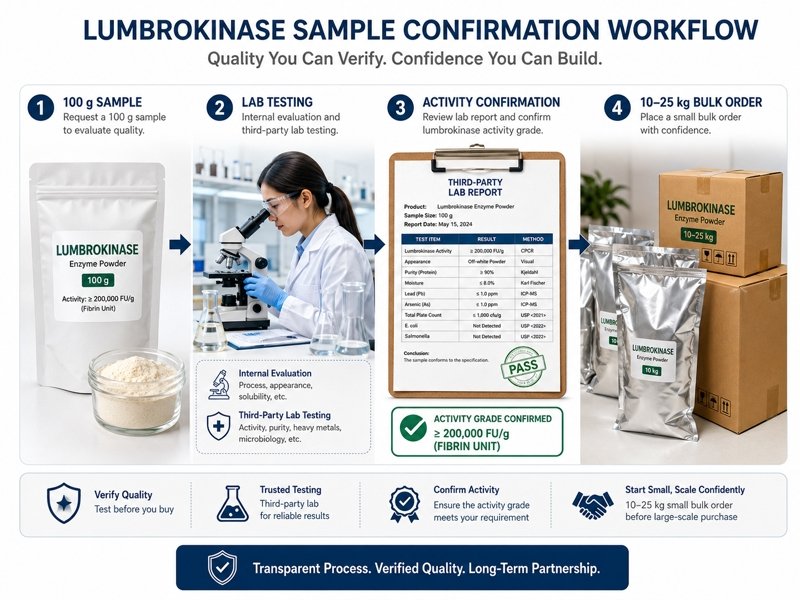
Sample-to-bulk specification consistency means that the bulk material should meet the activity grade and product requirements approved during supplier qualification.
It does not always mean that the sample and bulk order must have the same batch number.
For example, a buyer may test a 100 g sample and delay its PO for several months. During that period, the tested batch may no longer be available.
The buyer should then:
- Ask which batch will actually be supplied
- Request the COA for the actual bulk batch
- Confirm that the new batch meets the agreed activity grade
- Verify that the same relevant assay basis is used
- Compare other required specification items
- Clarify meaningful differences before shipment
The buyer may accept a different batch number if the new lot meets the approved specification and internal purchasing requirements.
However, the original sample approval should not be used as automatic approval for an unreviewed future lot.
Confirming the Actual Batch Before a 10–25 kg Order
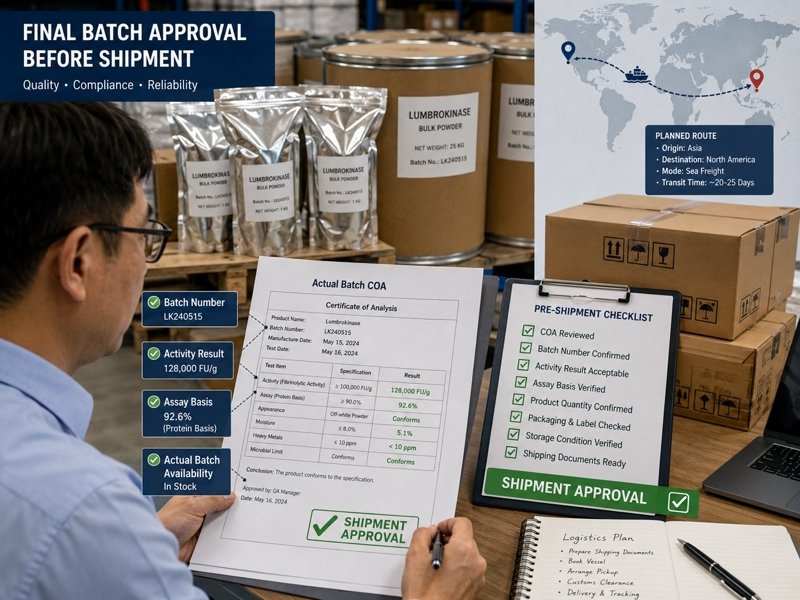
Once a buyer is ready for a 10–25 kg lumbrokinase bulk order, the activity-grade discussion should move from a general product specification to the actual material being supplied.
Before PO placement or shipment, confirm:
- Intended order quantity
- Agreed activity grade
- Activity unit
- Assay basis
- Actual available batch number
- Actual batch COA
- Specification sheet
- Packaging format
- Lead time after payment
- Destination
- Shipping method
- Document requirements
A buyer planning this purchasing stage can also review Buying 10–25 kg Lumbrokinase Powder for the broader pre-order process.
The main activity-grade question remains: does the batch that will actually be shipped meet the agreed specification under the confirmed assay basis?
What Buyers Should Provide Before Requesting Activity Grade Options
A supplier can provide a more useful answer when the inquiry contains more than “Please quote high-activity lumbrokinase.”
Buyers should provide:
- Target activity grade, such as 10,000 IU/mg or 20,000 IU/mg
- Preferred activity unit, if required
- Intended application category
- Planned sample testing method
- Whether third-party testing will be used
- Required specification or acceptance limit
- Required documents
- Initial sample quantity
- Expected bulk quantity
- Destination country and postal code
- Expected purchase timeline
- Whether a 10–25 kg order is planned after approval
When the buyer only provides a quantity, the supplier may not know which activity grade, test basis, documentation package, or available batch should be quoted.
Common Buyer Mistakes When Selecting an Activity Grade
Asking Only for the Highest Grade
The highest reported number may not match the buyer’s formulation, assay method, budget, or commercial supply needs.
Assuming Higher Activity Always Means Better Suitability
Higher activity is an ingredient specification difference. It does not automatically guarantee better formulation performance or stronger health effects.
Comparing FU/g and IU/mg Directly
These values may come from different test systems and should not be converted or ranked without method context.
Ignoring the Assay Method
An activity grade cannot be interpreted reliably without understanding how the result was generated.
Requesting a Quotation Without a Target Specification
A quantity and destination are not enough for a technically useful lumbrokinase quotation.
Reviewing a COA Without Checking the Batch Number
The COA should identify the sample or bulk lot being evaluated.
Approving a Sample Without Discussing Future Bulk Supply
The buyer should confirm whether the approved activity grade can be supported for the expected commercial order.
Assuming the Sample Batch Will Remain Available
Inventory can change during long evaluation periods. The actual bulk batch should be reconfirmed before purchase.
Failing to Review the Actual Bulk Batch COA
The tested sample COA should not replace the COA for a different batch that will be shipped later.
Choosing Only by Price
A lower price may not provide value if the assay basis, actual batch result, sample support, or documentation is unclear.
Allworms Supply Notes for Activity-Grade Buyers
Allworms is part of the manufacturer-side earthworm-derived ingredient supply system and supports overseas market development and international sales. For available lumbrokinase batches, a COA and specification sheet can be provided.
Lumbrokinase activity grades such as 10,000 IU/mg and 20,000 IU/mg may be discussed according to assay basis, specification, and batch availability. Higher activity options may also be discussed upon request, subject to actual requirements and availability.
A 100 g sample may be available for qualified B2B buyers before bulk approval, while the buyer usually pays international sample freight. The standard MOQ is usually around 1.5 kg, depending on specification, packaging, and destination.
Small bulk quantities such as 10–25 kg may be discussed after the activity requirement, sample status, actual batch, and documents have been confirmed. Standard lead time is usually 7–15 days after payment. DHL may be used for suitable shipments, while DDP door-to-door shipping may be available for selected destinations.
These conditions should be reconfirmed for the requested activity grade and current batch before PO placement.
FAQ About Lumbrokinase Activity Grade
1. What activity grades are available for lumbrokinase?
Lumbrokinase may be discussed in different activity grades according to the buyer’s specification, assay basis, order quantity, and actual batch availability. Options such as 10,000 IU/mg and 20,000 IU/mg may be discussed, while higher activity grades require case-by-case confirmation.
2. Can buyers request 10,000 IU/mg lumbrokinase?
Yes. Buyers may request a 10,000 IU/mg grade for suitable B2B ingredient requirements. They should confirm the assay method, specification sheet, available batch, batch COA, sample options, and intended bulk quantity.
3. Can buyers request 20,000 IU/mg lumbrokinase?
A 20,000 IU/mg activity grade may be discussed with the supplier. Availability should be confirmed through the current batch information, assay basis, COA, specification sheet, sample status, and planned order quantity.
4. Are higher activity grades available upon request?
Higher activity options may be discussed upon request, but they are not automatically available for every order. Availability, price, testing, documents, and lead time depend on the required specification and actual batch or production situation.
5. Can FU/g and IU/mg be directly converted?
A fixed direct conversion should not be assumed. FU/g and IU/mg may be generated under different assay systems, substrates, standards, preparation procedures, calculations, and reporting bases.
6. Why does the assay method matter for activity grade?
Enzyme activity is a method-dependent measurement. Different laboratory methods can produce different numerical results from the same or similar material. The method must therefore be reviewed together with the activity unit and grade.
7. Should buyers request a sample before a bulk order?
Sample evaluation is advisable when activity verification, third-party testing, formulation screening, or supplier approval is required. A 100 g sample may be suitable for initial B2B evaluation, depending on the planned tests.
8. What COA information should buyers check for activity grade?
Buyers should check the product name, batch number, activity specification, actual activity result, activity unit, assay method if listed, manufacturing date, expiry or retest date, and relevant quality results.
9. Does the bulk order need to use the same batch as the sample?
Not necessarily. If the original sample batch is no longer available, the buyer can review the COA for the actual bulk batch and confirm that it meets the agreed activity grade, assay basis, specification, and purchasing requirements.
10. What should buyers confirm before ordering 10–25 kg?
Before ordering 10–25 kg, confirm the activity grade, activity unit, assay method, specification sheet, actual batch COA, sample-testing status, batch availability, packaging, lead time, destination, and shipping conditions.
Contact Allworms to discuss 10,000 IU/mg, 20,000 IU/mg, or higher activity options and request the available-batch COA, specification sheet, sample support, lead time, and shipping information.
Share your target lumbrokinase activity grade, preferred activity unit, sample-testing plan, intended quantity, destination, and document requirements.
Compliance Note: This product is supplied as a B2B ingredient. Final formulation suitability, dosage, labeling, health claims, and regulatory compliance should be evaluated by the buyer according to the intended market and finished product use.
One comment on “Custom Activity and Specification Options for Lumbrokinase”
Comments are closed.