
A practical lumbrokinase COA review helps a small supplement brand decide whether a sample or available production batch is suitable for further evaluation. This review should involve more than confirming that the supplier has issued a Certificate of Analysis.
Buyers should examine whether the document identifies the correct product and batch, reports the relevant activity result and assay method, includes appropriate physical and quality parameters, and matches the material being offered. This becomes especially important when a brand has a limited internal quality team and depends on supplier documents, third-party laboratories, or contract manufacturers for technical review.
Lumbrokinase is an earthworm-derived fibrinolytic enzyme ingredient considered for dietary supplements, nutraceutical formulations, enzyme products, and research-related applications. Because enzyme activity results depend on the reporting unit and test method, reviewing the COA requires both document verification and technical context.

Quick Answer: How Should a Small Brand Review a Lumbrokinase COA?
Small supplement brands should review a lumbrokinase COA by checking the product name, supplier information, batch number, manufacturing date, expiry or retest date, activity result, activity unit, assay method, appearance, moisture, ash, heavy metals, microbiology, storage conditions, and approval statement.
The COA should match the sample or actual bulk batch being supplied. Buyers should also confirm that the reported results meet the agreed specification and that the activity number can be understood in the context of the stated assay method.
Why Lumbrokinase COA Review Matters for Small Supplement Brands
Larger supplement companies may have dedicated quality assurance, regulatory, laboratory, and procurement teams. A smaller brand may rely on one purchasing manager, product developer, contract manufacturer, or external laboratory to review ingredient documents.
This makes a structured COA review especially valuable.
A COA is normally a batch-specific quality document. It reports the test results or compliance status associated with a particular batch. By comparison, a product specification sheet defines the supplier’s target requirements or acceptance criteria.
The distinction can be summarized as follows:
- The specification sheet explains what the product is expected to meet.
- The COA explains what the identified batch actually reported.
For a more detailed explanation of these two documents, buyers can refer to Lumbrokinase COA vs Specification Sheet.
A supplier should not be approved only because it can provide a document titled “Certificate of Analysis.” The buyer still needs to confirm that the COA is clear, product-specific, batch-specific, relevant to the intended purchase, and consistent with the agreed purchasing requirements.
1. Product Name and Supplier Information
The first step in a lumbrokinase COA review is confirming what material the document covers.
Check the following information:
- Product name
- Supplier or manufacturer name
- Product description, source, or grade if listed
- Country of origin if relevant
- Whether the COA matches the product in the quotation
- Whether the document relates to the sample or available bulk batch
The product name should be specific enough to identify the material. For example, “Lumbrokinase Powder” is clearer than a broad description such as “enzyme powder” or “earthworm extract.”
The buyer should also confirm that the activity grade shown on the COA corresponds to the grade being offered. A COA for one lumbrokinase grade should not automatically be used to approve a quotation for a different activity grade.
The Lumbrokinase product page may provide general product positioning and available supply information, but the COA remains the document that should identify the specific tested batch.
Questions to Ask the Supplier
- Is this COA for the exact product grade in the quotation?
- Does it belong to the sample batch?
- Does it belong to a currently available production batch?
- Will the same batch be supplied if an order is placed now?
- Can the supplier issue the actual bulk batch COA before shipment?
2. Batch Number
The batch number connects the COA to a defined production or inventory batch. It is one of the most important traceability items on the document.
During sample evaluation, the buyer should compare:
- The batch number printed on the sample label
- The batch number shown on the COA
- Any batch reference in the supplier’s sample documentation
These details should be consistent.
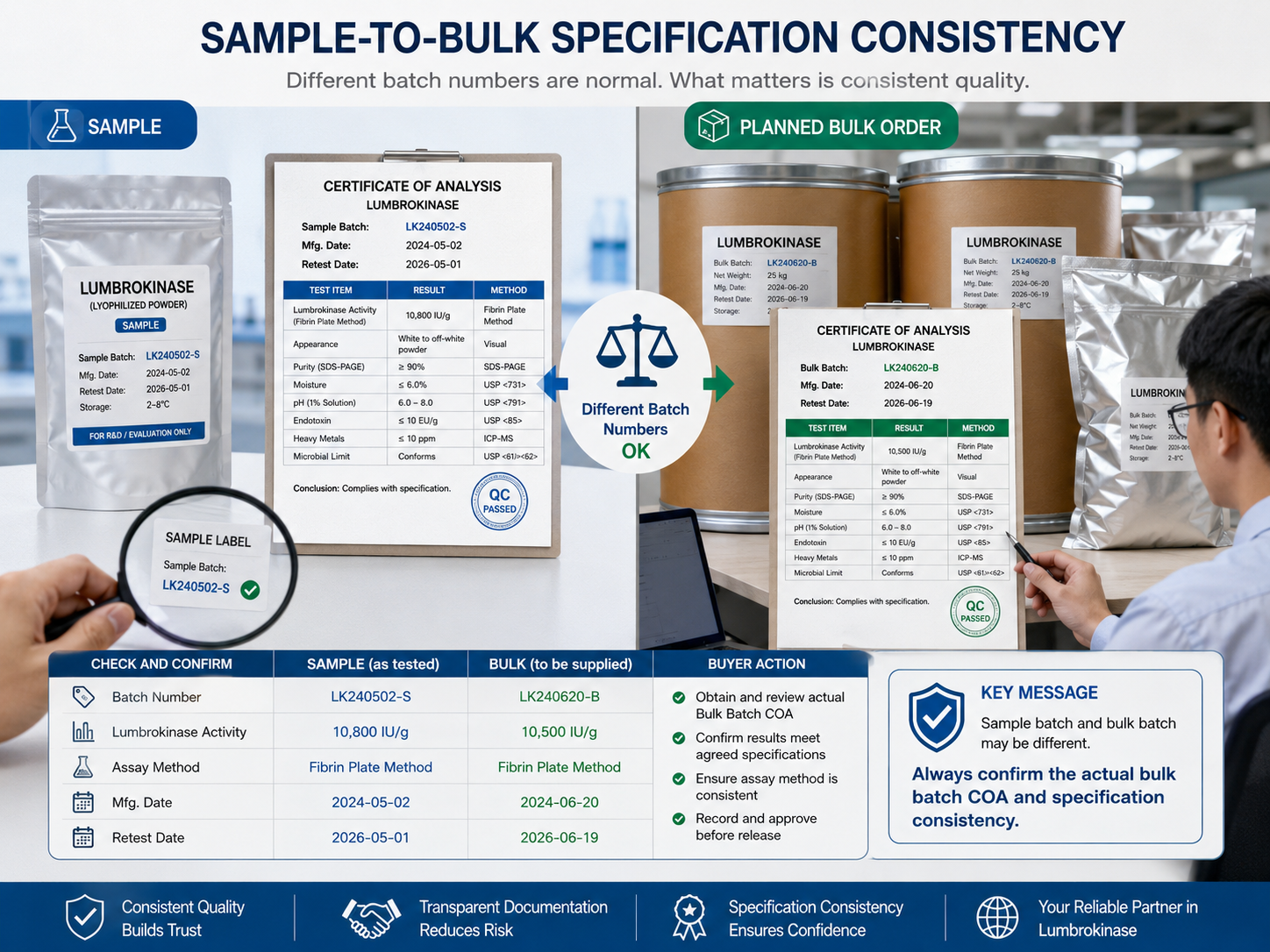
However, an approved sample does not guarantee that every later order will use the same batch number. If the buyer completes testing and waits several weeks or months before placing a purchase order, the original sample batch may have been sold, allocated, or replaced by a newer batch.
In that situation, the buyer should not automatically reject the new batch simply because its number is different. Instead, the buyer should request the COA for the actual bulk batch and confirm sample-to-bulk specification consistency.
This means checking whether the proposed bulk batch meets the same agreed purchasing criteria as the approved sample, even when the batch numbers differ.
Practical Batch Review Questions
- Does the sample batch number match the COA?
- Is the original sample batch still available?
- Which batch number will be used for the proposed bulk order?
- Can the actual bulk batch COA be reviewed before shipment?
- Does the new batch meet the agreed activity and quality specification?
The Lumbrokinase Sample to Bulk Order article provides additional context on supplier approval after sample testing, while this article remains focused specifically on reviewing the batch documents.
3. Manufacturing Date and Expiry Date
A lumbrokinase COA may show:
- Manufacturing date
- Production month
- Expiry date
- Best-before date
- Retest date
- Approval or release date
Not every supplier uses the same terminology or document layout. Buyers should review whichever date information is provided and ask for clarification when the format is incomplete.
Why the Manufacturing Date Matters
The manufacturing date helps a buyer evaluate:
- The age of the available inventory
- The time remaining for storage and formulation
- Whether the material fits the production schedule
- Whether the sample was taken from a recent or older batch
- Whether a delayed purchase may require a newer batch
A small brand may receive a sample, conduct third-party testing, complete formulation work, and place a purchase order months later. By that time, the available inventory may have a different manufacturing date.
The buyer should therefore confirm the date of the actual available batch before issuing the purchase order.
Why the Expiry or Retest Date Matters
The expiry or retest date helps the buyer assess:
- Remaining shelf life
- Warehouse turnover
- Planned production dates
- Expected finished-product inventory
- Whether additional incoming inspection is appropriate
Buyers should not assume a standard shelf life unless it is stated in the supplier’s current specification or batch documentation.
A COA example provided by Allworms includes the product name, batch number, manufacturing month, expiry month, activity result, assay method, moisture, heavy metals, microbiology, storage instructions, and a batch conclusion.
4. Activity Result and Activity Unit
Lumbrokinase is supplied as an enzyme ingredient, so activity is usually one of the main purchasing parameters.
The COA may include:
- A minimum activity specification
- The actual reported result
- A compliance statement such as “Conforms”
- An activity unit
- A dry-basis or protein-basis qualification
During the COA review, buyers should confirm:
- What activity level was agreed?
- What result appears on the COA?
- Does the result meet the stated specification?
- Which activity unit is used?
- Is the unit compatible with the buyer’s requirement?
- Does the result need clarification before comparison?
Possible activity expressions may include IU/mg, FU/g, LKU, or U. These are examples of reporting systems, not automatically interchangeable measurements.
A COA showing a high numerical value should not be considered superior without confirming how that value was produced and expressed.
Example of a Clear Activity Entry
A clear activity section may show:
- Specification: ≥20,000 IU/mg
- Result: >20,000 IU/mg
- Assay method: Fibrin plate assay
This presentation connects the acceptance requirement, result, unit, and method. It does not eliminate the need for technical review, but it gives the buyer a more understandable basis for evaluation.
5. Assay Method
The activity number and assay method should be reviewed together.
Enzyme activity is method-dependent. Differences in substrates, standards, incubation conditions, calculation methods, sample preparation, and laboratory procedures can produce different numerical results.
Buyers should ask:
- Which assay method was used?
- Was a fibrin plate assay used?
- Was another fibrinolytic activity method used?
- Does the supplier use an internal method, pharmacopoeial method, or external laboratory method?
- Does the buyer’s laboratory use the same method?
- If the methods differ, how should the results be interpreted?
- Can the supplier provide an assay method summary or testing basis?
A detailed supplier method may include preparation of fibrinogen, thrombin, agarose plates, reference solutions, sample solutions, incubation conditions, lysis-zone measurement, and calculation against a standard curve.
This does not mean a small brand needs to reproduce the full assay internally. It means the buyer should understand enough of the reporting basis to avoid comparing unrelated activity values.
For more technical background, buyers may review Fibrin Plate Assay for Lumbrokinase Activity.
6. Appearance
Appearance is normally a basic physical quality check.
A lumbrokinase COA may describe the material as:
- Pale yellow powder
- Yellowish-brown powder
- Light yellow to brown powder
- Powder with a characteristic odor
The exact wording may vary by supplier specification.
Buyers should compare:
- The COA appearance description
- The actual sample color
- The powder form
- Odor, when relevant
- Any visible clumping
- Unusual darkening or discoloration
- Signs of moisture exposure
- Visible abnormal changes after transport
Minor natural color variation may occur in earthworm-derived powders, but the sample should still be reasonably consistent with the documented description.
An appearance check cannot confirm enzyme activity, identity, or safety. It is simply one part of the incoming material review.
7. Moisture
Moisture is relevant to powdered enzyme ingredients because excess humidity can affect handling, powder condition, storage stability, and packaging performance.
Buyers should check:
- Whether moisture or loss on drying is listed
- The stated limit
- The reported batch result
- Whether the powder arrives dry and free-flowing
- Whether the inner packaging is properly sealed
- Whether there are signs of humidity exposure
A result should be compared with the specification provided for that product. Buyers should not apply a limit from another supplier or another ingredient without confirming that it is relevant.
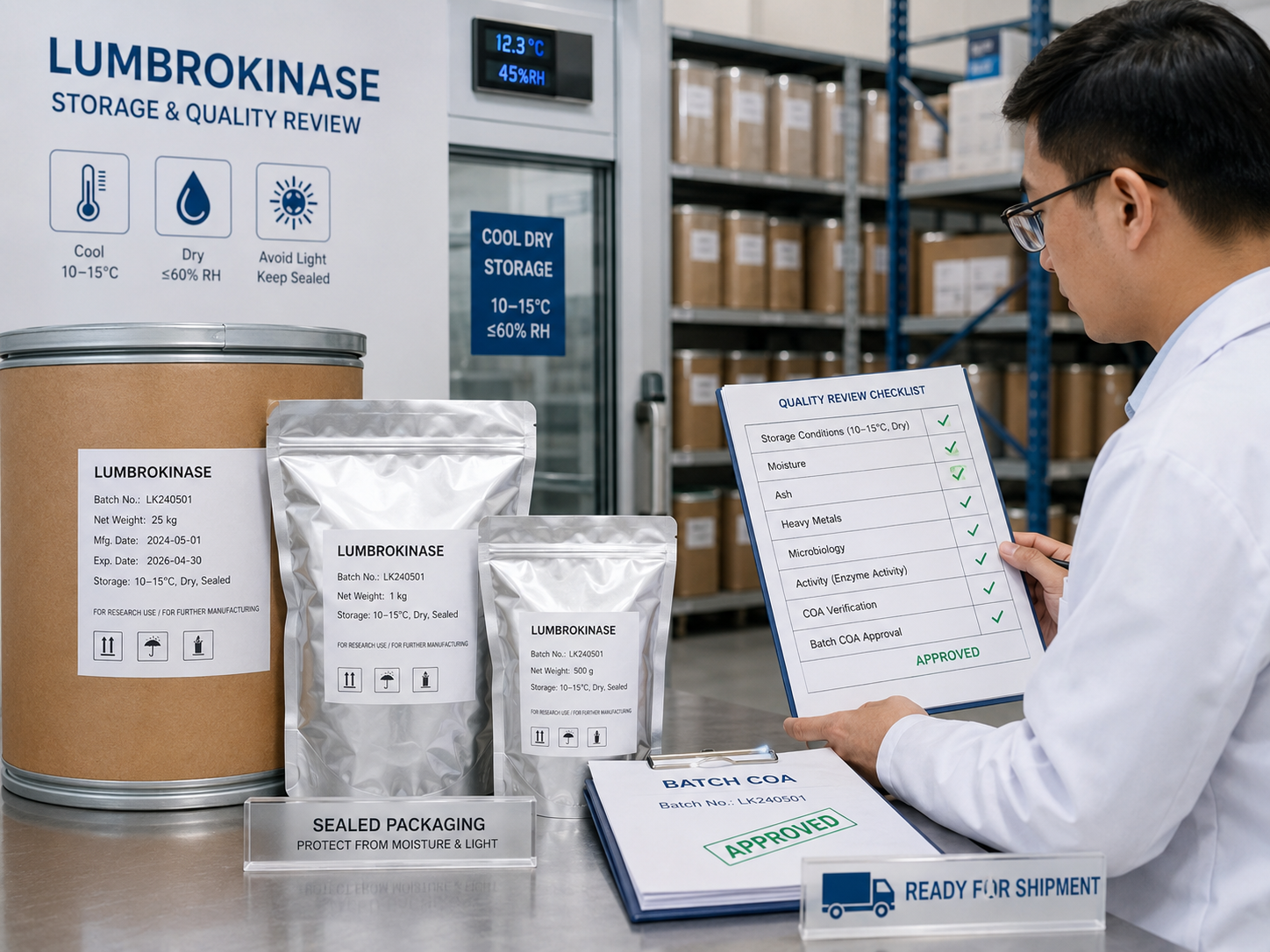
After receipt, lumbrokinase should generally remain sealed and stored under cool and dry conditions. Repeated opening, humid warehouse conditions, damaged inner packaging, and prolonged exposure to ambient moisture should be minimized.
8. Ash
Ash, sometimes reported as residue on ignition, may appear as a routine composition or quality parameter for powder ingredients.
The buyer does not need to overinterpret this value.
The practical review is to confirm:
- Whether ash is included in the specification
- Whether an actual result is reported
- Whether the result meets the stated limit
- Whether the terminology is clearly explained
- Whether missing or unclear information requires supplier confirmation
Ash should not be treated as a stand-alone medical, safety, or efficacy indicator. It is one quality parameter that should be considered together with the overall specification and batch documentation.
9. Heavy Metals
Heavy metal information may be needed for supplier qualification, raw-material risk assessment, contract-manufacturer review, or target-market compliance.
A COA may list individual elements such as:
- Lead
- Arsenic
- Cadmium
- Mercury
The actual panel may vary according to the supplier specification and buyer requirements.
Buyers Should Check
- Which heavy metals are included
- The specification for each listed element
- Whether the result is numerical or stated as “Conforms”
- Whether the result meets the specification
- Whether the test units are clear
- Whether the buyer’s intended market requires a different panel
- Whether finished-product testing will also be required
A numerical result can provide more information than a general compliance statement, but either format may appear on a supplier COA.
Buyers should not assume that one supplier’s heavy-metal panel automatically satisfies every market. Final compliance should be evaluated according to the destination, formulation, serving level, finished-product category, and local rules.
10. Microbiology
Microbiology results may form part of the incoming quality review for dietary supplement ingredients.
Depending on the supplier specification, a COA may include items such as:
- Total plate count or total aerobic count
- Yeast and mold
- Coliforms
- Salmonella
- Staphylococcus aureus
- Other pathogen-related items
Not every supplier will list the same panel. The required items may also depend on the buyer’s contract manufacturer, internal standards, finished-product type, and destination market.
Practical Review Questions
- Which microbiological items are tested?
- Are actual counts reported or only compliance statements?
- Are the units clear?
- Does the panel match the agreed specification?
- Does the contract manufacturer require additional tests?
- Will the finished product require separate microbiology testing?
The buyer should avoid assuming that all lumbrokinase suppliers use identical microbial specifications.
11. Storage Conditions and Packaging Information
Storage instructions may appear directly on the COA or in the accompanying specification sheet.
Typical handling points may include:
- Keep tightly sealed
- Store in a cool and dry place
- Protect from moisture
- Protect from direct sunlight
- Avoid prolonged heat exposure
- Use suitable warehouse controls after delivery
Prolonged or uncontrolled exposure to heat and humidity may increase quality risk and should be minimized through suitable storage and handling.
If packaging information appears on the COA or quotation, buyers should verify:
- Inner bag type
- Net weight per bag
- Number of bags
- Outer carton or drum
- Seal condition
- Whether the packaging format is suitable for the intended order quantity
A small supplement brand purchasing 10–25 kg may prefer smaller sealed inner packs to reduce repeated opening and moisture exposure during production.
12. COA Approval, Signature or Conclusion
Some COAs include formal release information such as:
- Batch conclusion
- “Conforms” statement
- Approval date
- Authorized signature
- Quality-control confirmation
- Quality-assurance approval
- Company stamp
These items can help show that the document has completed the supplier’s internal release process.
However, buyers should not assume that every supplier uses the same layout. An electronic COA may have a digital approval field, while another document may include a handwritten signature or quality department stamp.
The practical question is whether the document appears complete, traceable, and formally issued for the identified batch.
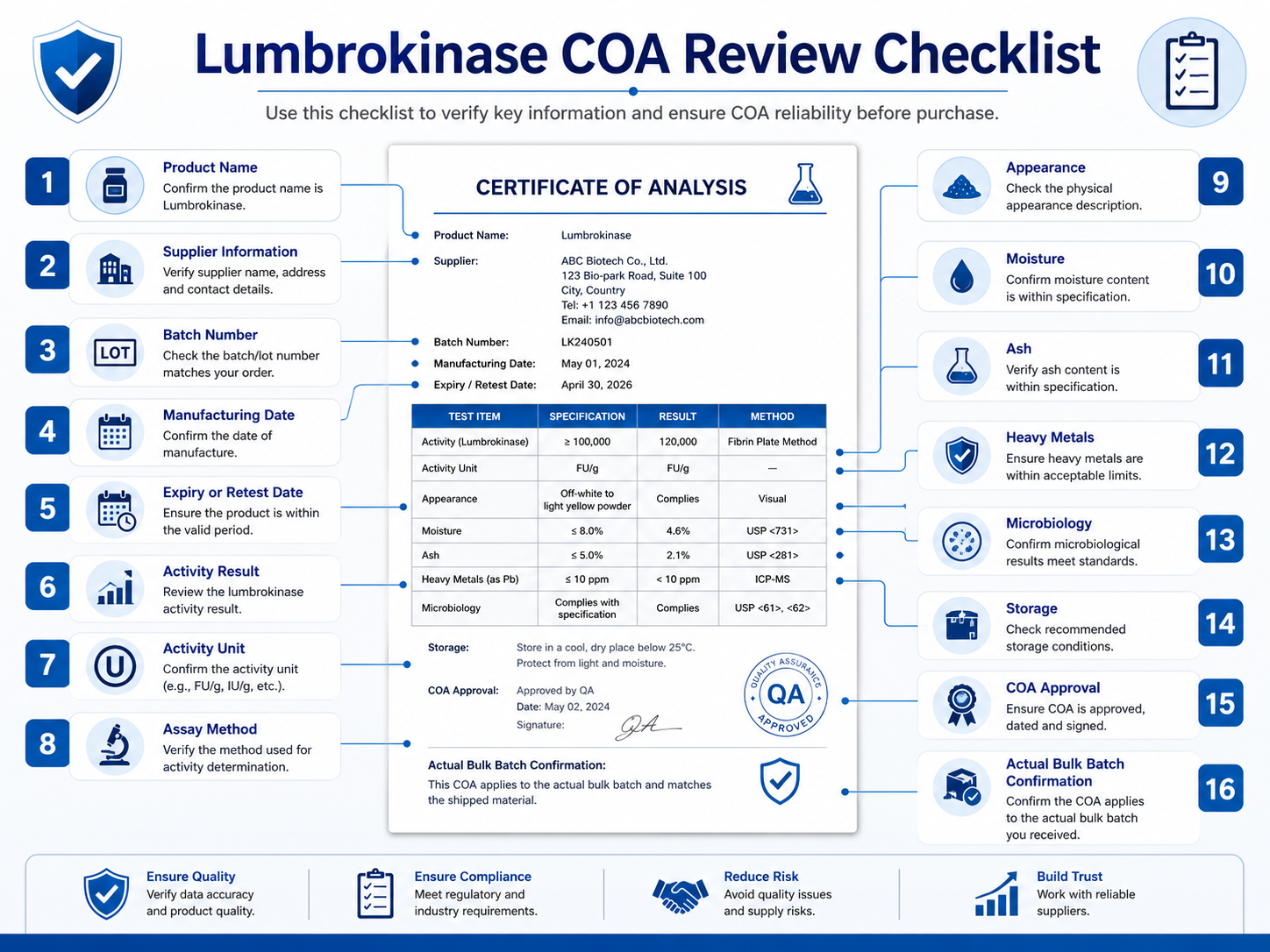
Lumbrokinase COA Review Checklist for Small Supplement Brands
| COA Item | What Buyers Should Check | Why It Matters |
|---|---|---|
| Product name | Confirm the document clearly identifies lumbrokinase and the correct grade | Prevents approval of an unrelated enzyme or product |
| Supplier information | Check supplier or manufacturer name and document origin | Helps verify who issued the COA |
| Batch number | Match the COA with the sample or proposed inventory batch | Connects results to a specific batch |
| Manufacturing date | Confirm when the batch was produced | Supports freshness and inventory planning |
| Expiry or retest date | Check remaining usable or review period | Supports formulation and warehouse planning |
| Activity result | Compare the result with the agreed minimum | Confirms whether the batch meets the purchasing specification |
| Activity unit | Identify IU/mg, FU/g, LKU, U, or another expression | Prevents unsupported comparisons |
| Assay method | Confirm the testing method and reporting basis | Gives context to the activity value |
| Appearance | Compare the documented description with the actual material | Helps identify visible shipment or storage abnormalities |
| Moisture | Compare the result with the stated specification | Relevant to powder handling and storage risk |
| Ash | Review the result against the stated limit | Provides a routine composition-related quality check |
| Heavy metals | Review listed elements, units, limits, and results | Supports supplier and regulatory assessment |
| Microbiology | Check the tested panel and compliance status | Supports ingredient quality review |
| Storage | Confirm cool, dry, sealed handling instructions | Helps reduce heat and humidity exposure |
| COA approval or conclusion | Look for a release conclusion, signature, approval, or quality statement | Helps confirm formal batch release |
| Actual bulk batch confirmation | Request the COA for the batch that will actually ship | Prevents reliance on an outdated sample COA |
Before Approving a Sample Based on COA
A COA review normally comes before or alongside physical and laboratory sample evaluation.
Before approving a lumbrokinase sample, confirm that:
- The COA batch number matches the sample label.
- The product name and activity grade match the sample requested.
- The activity result and activity unit are understood.
- The assay method is clear enough for the planned evaluation.
- The sample was stored and transported appropriately.
- The buyer has defined which items will be checked internally.
- The buyer knows whether a third-party laboratory will test activity, identity, heavy metals, microbiology, or other parameters.
- Differences between the supplier’s method and the buyer’s laboratory method are recognized before comparing results.
The COA is a starting point for evaluation, not a substitute for the buyer’s quality process. The next steps can be planned using the more detailed Lumbrokinase Sample Evaluation guide.
Before Approving a Bulk Order Based on COA
Before approving a bulk order, the buyer should move from reviewing the sample document to reviewing the batch that will actually be supplied.
Confirm:
- Whether the original sample batch is still available
- Which actual batch number will be supplied
- Whether a newer batch has been allocated
- Whether the supplier can provide the actual bulk batch COA
- Whether that batch meets the agreed specification
- Whether its manufacturing and expiry dates support the inventory plan
- Whether the activity grade and assay method match the approved requirement
- Whether the packaging format is suitable
- Whether storage and transport conditions are acceptable
- Whether pre-shipment document approval is required
A different bulk batch number is not automatically a problem. The critical issue is whether the actual batch has been reviewed and meets the agreed purchasing requirements.
The buyer should never assume that sample approval automatically approves all future batches.
Common Lumbrokinase COA Review Mistakes
Assuming Any COA Is Sufficient
A generic or outdated COA may not represent the sample or actual batch being offered.
Ignoring the Batch Number
Without a batch number, the buyer cannot reliably connect the reported results to the physical material.
Reviewing Activity Without the Assay Method
An activity result has limited meaning when the reporting method is unknown.
Comparing Activity Units Without Method Context
IU/mg, FU/g, LKU, and U should not be compared as though the numbers are automatically interchangeable.
Ignoring Manufacturing and Expiry Dates
An acceptable activity result does not answer whether the batch fits the buyer’s production and inventory schedule.
Assuming the Sample Batch Will Remain Available
Inventory can change during a long evaluation period. The actual bulk batch should be reconfirmed before purchase.
Accepting a Newer Batch Without Reviewing Its COA
A new batch may still be suitable, but it should be reviewed against the approved specification.
Ignoring Moisture and Storage Instructions
Poor handling after delivery can create avoidable quality risks even when the batch passed initial release testing.
Assuming Heavy Metal and Microbiology Panels Are Universal
Test items and limits can vary by supplier, product specification, contract manufacturer, and market.
Selecting Only by Price
A lower quotation may offer limited batch documentation, an unclear assay basis, or an unsuitable activity specification. Price should be reviewed together with COA clarity, batch traceability, testing information, and supply conditions.
Allworms Supply Notes for COA Review and Small Bulk Purchasing
Allworms is part of the manufacturer-side earthworm-derived ingredient supply system and supports overseas market development and international sales.
For available lumbrokinase batches, a COA and specification sheet can be provided for review. Buyers can use these documents to check the product grade, batch information, activity result, assay method, dates, quality parameters, and storage requirements before approving a sample or order.
A 100 g sample may be available for qualified B2B buyers, while the buyer usually pays international sample freight. Standard MOQ is usually around 1.5 kg, depending on specification, packaging, and destination.
Small bulk quantities such as 10–25 kg may be discussed according to activity grade, available batch, packaging, and shipping destination. Standard lead time is usually 7–15 days after payment. DHL may be used for suitable international shipments, and DDP door-to-door shipping may be available for selected destinations.
Before shipment, buyers may request confirmation of the actual supplied batch and its corresponding COA.
For general product and ordering questions, buyers may also review the FAQ page.
FAQ
1. What Should Small Supplement Brands Check on a Lumbrokinase COA?
Check the product name, supplier information, batch number, manufacturing date, expiry or retest date, activity result, activity unit, assay method, appearance, moisture, ash, heavy metals, microbiology, storage conditions, and batch approval statement. The COA should also match the sample or actual bulk batch being discussed.
2. Why Is the Batch Number Important on a Lumbrokinase COA?
The batch number connects the document to a particular production or inventory batch. It allows the buyer to verify that the sample label, test results, and supplied material refer to the same batch.
3. Why Should Lumbrokinase Activity Be Reviewed with the Assay Method?
Activity values depend on how the test is performed. Different laboratories may use different substrates, standards, incubation conditions, and calculation methods. An activity number should therefore be interpreted together with its assay method and reporting unit.
4. Does the COA Need to Match the Sample Batch?
Yes. When a sample is sent for evaluation, the sample batch number should match the batch number on the accompanying COA. This allows the buyer to connect the reported results to the material being tested.
5. What If the Original Sample Batch Is No Longer Available?
The supplier may propose another available batch. The buyer should request the COA for that actual batch and confirm that it meets the agreed specification. Sample and bulk batch numbers do not always need to be identical, but sample-to-bulk specification consistency should be reviewed.
6. Should Buyers Check Moisture and Ash?
Yes. Moisture can be relevant to powder handling, packaging, humidity exposure, and storage. Ash is a routine composition-related quality parameter that should be compared with the supplier’s stated specification when included.
7. Should Buyers Review Heavy Metals and Microbiology?
Yes. Buyers should confirm which tests are listed, whether results meet the specification, and whether the intended market or contract manufacturer requires additional testing. Test panels may vary between suppliers.
8. Is COA Review Enough Before Placing a Bulk Order?
Not by itself. COA review should be combined with specification review, sample evaluation where appropriate, supplier qualification, confirmation of the actual bulk batch, packaging review, storage planning, and any testing required by the buyer or target market.
Need help with a lumbrokinase COA review before sample approval or a small bulk purchase?
Share your target activity specification, intended quantity, sample-testing status, destination, and document requirements. Allworms can provide available batch information, COA, specification sheet, sample support, lead time, and suitable shipping options.
This product is supplied as a B2B ingredient. Final formulation suitability, dosage, labeling, health claims, and regulatory compliance should be evaluated by the buyer according to the intended market and finished product use.