
When a supplement brand or ingredient distributor requests a lumbrokinase sample, the discussion often begins with activity grade, sample quantity, and COA availability. However, one of the most important technical questions may remain unanswered: which assay method will be used to evaluate the sample?
A supplier may report activity in IU/mg using its established method, while the buyer’s internal or third-party laboratory may report FU/g, LKU, U, or another activity expression. Differences in substrate, reference standard, incubation conditions, buffer, sample preparation, dilution, calculation method, and reporting basis can produce results that are difficult to compare directly.
For this reason, lumbrokinase assay method requirements should be communicated before testing begins—not only after an unexpected result appears.
Quick Answer: What Should Be Confirmed Before Lumbrokinase Testing?
Lumbrokinase assay method requirements should be discussed before sample testing because IU/mg, FU/g, LKU, U, and other activity expressions cannot be simply compared or converted without understanding the underlying method.
Before sending a sample to an internal or third-party laboratory, buyers should confirm the substrate, reference standard, incubation time, incubation temperature, buffer system, sample preparation, dilution method, calculation method, reporting unit, reporting basis, and relevant COA and specification details.
The goal is not necessarily to make every laboratory use the same method. The goal is to understand the method gap before interpreting the results.
Why Lumbrokinase Assay Method Requirements Matter for B2B Buyers
Lumbrokinase is an earthworm-derived fibrinolytic enzyme ingredient considered for dietary supplement, nutraceutical, enzyme formulation, and research-related applications.
Unlike moisture, ash, or heavy metal testing, enzyme activity testing depends strongly on the analytical system. Two laboratories may test the same material and report different numerical values because they use different assay conditions or calculation approaches.
This can affect:
- Sample acceptance
- Supplier qualification
- Activity grade confirmation
- COA interpretation
- Specification agreement
- Formulation planning
- Purchasing approval
- Repeat-order consistency
- 10–25 kg small bulk order decisions
Buyers reviewing the Lumbrokinase product page should therefore treat the activity number and its assay basis as connected information rather than two separate purchasing details.
Stage 1: Before Requesting a Lumbrokinase Sample
A technically useful sample request should include more than:
“Please send a sample and COA.”
Before requesting a sample, the buyer should explain why the material will be tested and what type of decision the result will support.
Information Buyers Should Share Before Requesting a Sample
The buyer should communicate:
- Target activity requirement
- Preferred activity unit, when required
- Intended testing method, when already known
- Whether testing will be conducted internally or by a third-party laboratory
- Whether the laboratory follows a fixed protocol
- Whether the expected result will be reported in IU/mg, FU/g, LKU, U, or another format
- Whether the sample is for preliminary screening, formulation development, supplier approval, or future purchasing
- Intended order quantity after successful evaluation
- Destination country
- Required documentation
- Expected testing and purchasing timeline
- Whether a 10–25 kg small bulk order is planned after sample approval
This information helps the supplier understand whether the buyer needs a general evaluation sample or a sample connected to a specific activity grade and purchasing requirement.
For example, a buyer planning an initial formulation study may only need to confirm identity, appearance, documentation, and general activity performance. A buyer qualifying a supplier for a 25 kg commercial purchase may require more detailed method information and stronger sample-to-bulk documentation control.
Stage 2: Before Reviewing the Supplier COA
The supplier COA should be reviewed before the sample is submitted to a laboratory.
The buyer should check:
- Reported activity result
- Activity unit
- Assay method, when listed
- Batch number
- Manufacturing or testing date
- Specification sheet
- Whether the reported method supports the stated activity grade
- Whether the COA corresponds to the supplied sample batch
- Whether the document represents an available batch or only a typical reference
The COA and specification sheet serve different purposes.
A COA reports the actual test results for a particular batch. A specification sheet defines the target limits or acceptance criteria that the product is expected to meet.
Buyers who need a more detailed document review can refer to Lumbrokinase COA Review, but the main question at this stage is simple:
Does the activity value on the sample COA have a clearly identified unit, method, batch, and reporting basis?
Information Buyers Should Request Before Lab Testing
Before the sample leaves the buyer’s control, request:
- COA for the sample batch
- Current specification sheet
- Activity unit
- Assay method
- Batch number
- Sample label information
- Storage instructions
- Available assay method description
- Clarification of whether the activity is reported on powder weight, protein basis, dry basis, or another basis
- Confirmation that the supplier can discuss method differences if the buyer’s laboratory reports another unit
The documentation should be reviewed before testing, not reconstructed after a discrepancy occurs.
Stage 3: Before Sending the Sample to an Internal or Third-Party Laboratory
This is the most important communication stage.
Before submitting the sample, the buyer should ask the laboratory exactly how the activity test will be performed.
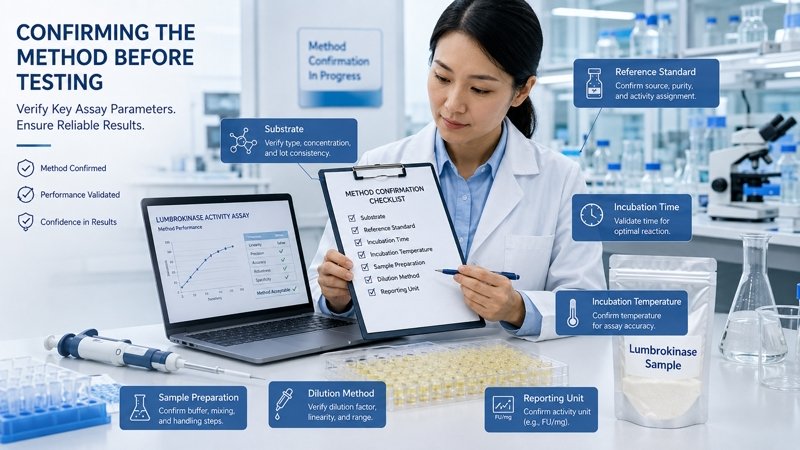
Confirm the Laboratory’s Assay Method
The buyer should ask:
- Which assay principle will be used?
- Which substrate will be used?
- Which enzyme standard or reference material will be used?
- What buffer system will be used?
- What is the incubation time?
- What is the incubation temperature?
- How will the sample be prepared?
- How will the sample be diluted?
- How will the reaction result be calculated?
- Which activity unit will be reported?
- What is the reporting basis?
- Has the method been validated or qualified for this type of enzyme material?
- Does the laboratory have experience testing lumbrokinase or similar fibrinolytic enzyme ingredients?
- Can the final report include sufficient method details?
A laboratory may have a well-established fibrinolytic enzyme test but still use conditions that differ from the supplier’s method.
That does not automatically make either method incorrect. It means the results may answer different analytical questions or produce values that are not directly comparable.
Why Testing Without Method Confirmation Creates Risk
Suppose the supplier COA reports IU/mg using a fibrin plate assay, while the buyer’s laboratory reports FU/g using another substrate, standard, incubation period, and calculation method.
The buyer may receive a result that appears numerically much lower or higher than the COA. Without reviewing the methods, the buyer may assume:
- The sample does not meet specification
- The supplier overstated activity
- The laboratory made an error
- The sample lost activity in transit
- The units can be converted using a simple formula
Any of these conclusions may be premature.
Testing first and asking about the method later makes the evaluation process slower, more expensive, and more likely to result in disagreement.
For additional background on one commonly used analytical approach, buyers can review Fibrin Plate Assay for Lumbrokinase Activity. The purpose here, however, is not to require every laboratory to use a fibrin plate method. It is to identify the method before the result is interpreted.
Stage 4: Communicating Method Differences Before Testing
When the supplier reports IU/mg and the buyer’s laboratory plans to report FU/g, LKU, U, or another expression, the method gap should be discussed before testing begins.
Buyers and suppliers should clarify:
- Are the methods based on the same assay principle?
- Is the substrate the same?
- Is the reference standard the same?
- Are the incubation conditions comparable?
- Is the buffer system comparable?
- Is the sample prepared in the same way?
- Are dilution ranges selected in the same manner?
- Is the calculation method comparable?
- Is the result reported per gram of powder, per milligram of material, per milligram of protein, on a dried basis, or on another basis?
- Is the buyer expecting a direct unit conversion that may not be valid?
Why Units Alone Are Not Enough
IU/mg, FU/g, LKU, and U are labels attached to activity results, but the unit label does not describe the complete test system.
The value may depend on:
- Substrate composition and concentration
- Standard preparation
- Standard curve design
- Reaction or lysis endpoint
- Incubation duration
- Incubation temperature
- Buffer pH and ionic conditions
- Sample extraction or dissolution
- Dilution range
- Blank correction
- Mathematical calculation
- Powder-weight or protein-basis reporting
Therefore, buyers should not apply a fixed FU/g-to-IU/mg conversion unless a scientifically justified relationship has been established for the same materials and sufficiently comparable methods.
The Lumbrokinase Activity Units article provides more context about the unit systems. For sample qualification, however, the practical rule is that units should always be reviewed together with the assay method.
Stage 5: What to Ask the Supplier Before Testing
A buyer can send the following technical questions to the supplier:
- What activity unit is reported on the COA?
- What assay method is used?
- Is a fibrin plate assay used?
- What is the reporting basis for the activity result?
- Is the result based on powder weight, protein content, dried basis, or another basis?
- Can you provide the current specification sheet?
- Does the sample COA correspond to the supplied sample batch?
- Can you provide a summary of the assay conditions?
- Which standard or reference material is used?
- If our laboratory reports FU/g, LKU, U, or another unit, can you help us identify the method differences?
- If our result differs from the COA, which method details should be compared first?
- Is the sample batch still available for a possible bulk order?
These questions do not mean the supplier must automatically accept the buyer’s laboratory result as the only correct value.
They create a framework for comparing technical information if the results differ.
Stage 6: What to Ask the Buyer’s Laboratory Before Testing
The buyer should also send clear questions to the internal or third-party laboratory:
- What method will you use for lumbrokinase activity testing?
- What activity unit will be reported?
- Which substrate will be used?
- Which standard or reference material will be used?
- What buffer and test conditions will be applied?
- What incubation time will be used?
- What incubation temperature will be used?
- How will the sample be prepared?
- How will the sample be diluted?
- How will the result be calculated?
- What will be the reporting basis?
- Is the method validated or qualified for this type of enzyme material?
- Does the laboratory have previous experience with lumbrokinase?
- Can full method details be included in or attached to the final report?
- Can the laboratory explain how its result should be compared with supplier COA data generated under a different method?
A report containing only a number and unit may not provide enough information for supplier approval.
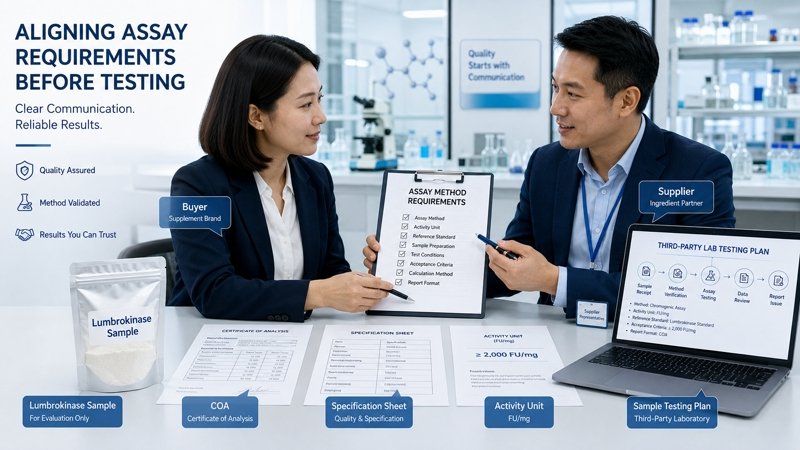
Lumbrokinase Assay Method Communication Checklist
| Communication Point | What to Ask | Why It Matters |
|---|---|---|
| Supplier COA activity unit | Is the result reported in IU/mg, FU/g, LKU, U, or another unit? | Identifies how the supplier expresses activity |
| Supplier assay method | Which analytical method generated the COA result? | Links the activity number to its test system |
| Buyer laboratory method | Which method will the internal or third-party lab use? | Shows whether the two results will be comparable |
| Substrate | Which substrate and concentration are used? | Different substrates may produce different responses |
| Standard or reference | Which standard or reference material is used? | Standard selection affects calibration and calculated activity |
| Incubation time | How long is the reaction or plate incubated? | Activity response may change with reaction duration |
| Incubation temperature | At what temperature is the test performed? | Enzyme reaction rate is temperature-dependent |
| Buffer or test conditions | What buffer, pH, salt, and other conditions are used? | Reaction conditions influence enzyme performance |
| Sample preparation | How is the powder dissolved, extracted, or conditioned? | Preparation affects the amount of measurable enzyme activity |
| Dilution method | What dilution series and linear range are used? | Incorrect or different dilution ranges may distort results |
| Calculation method | How is activity calculated from the analytical response? | Different equations and corrections can change the reported value |
| Reporting basis | Is the result based on powder weight, protein, dry matter, or another basis? | Results with different bases should not be directly compared |
| Lab report format | Will the report include the method, conditions, unit, and basis? | Supports transparent technical review |
| Discrepancy review process | What information will be compared if results differ? | Prevents immediate blame or rejection |
| Bulk order approval impact | Which activity grade and assay basis will apply to purchasing? | Connects sample testing with commercial specification approval |
Why Substrate and Standard Must Be Clarified
Substrate and standard are two of the most important method variables.
Substrate
A fibrinolytic assay measures enzyme response against a selected substrate system. Differences in substrate source, preparation, concentration, purity, and plate composition can change the measurable response.
Even when two laboratories describe their tests as fibrin-based, the systems may not be identical.
Standard or Reference Material
The standard establishes the reference against which the sample response is calculated.
Two methods using different reference materials, reference activities, preparation procedures, or standard curves may produce different numerical results.
A buyer should therefore avoid comparing two activity numbers solely because both reports use an enzyme activity unit.
Why Incubation Conditions Affect Activity Results
Enzyme activity is measured under defined reaction conditions.
Incubation time and temperature can influence:
- Reaction rate
- Lysis-zone development
- Endpoint selection
- Standard-curve response
- Sample linearity
- Calculated activity
Buffer pH, ionic strength, and salt conditions can also affect enzyme behavior and substrate interaction.
For this reason, a laboratory report stating only “activity tested” is not enough for a detailed discrepancy review.
Stage 7: If the Laboratory Result Differs From the Supplier COA
A different test result should trigger a structured method review before immediate supplier rejection.
Possible causes include:
- Different assay principles
- Different units
- Different substrates
- Different standards or reference materials
- Different incubation times
- Different incubation temperatures
- Different buffer systems
- Different sample preparation
- Different dilution methods
- Different calculation methods
- Different reporting bases
- Sample storage or transport conditions
- Documentation or batch mismatch
- Laboratory variability
- Genuine product quality issues
The supplier should not automatically blame the laboratory, and the buyer should not automatically assume that the supplier COA is incorrect.
Practical Discrepancy Review Process
- Confirm the sample identity.
- Confirm the sample batch number.
- Confirm that the COA corresponds to the tested batch.
- Review storage and handling before testing.
- Compare the supplier COA unit with the laboratory report unit.
- Compare the assay principles.
- Compare the substrates.
- Compare the standards or reference materials.
- Compare incubation time and temperature.
- Compare buffer and reaction conditions.
- Compare sample preparation and dilution.
- Compare calculation methods.
- Compare reporting bases.
- Ask both the supplier and laboratory for clarification.
- Consider repeat testing or cross-laboratory testing when necessary.
The Lumbrokinase Sample Evaluation article covers broader sample checks. In an activity-result discrepancy, however, the first technical task should be to determine whether the supplier and laboratory measured activity using sufficiently comparable systems.
Common Buyer Mistakes and Misunderstandings
1. Requesting a Sample Without Explaining the Testing Purpose
A screening test, formulation test, supplier qualification test, and commercial batch approval test may require different levels of documentation and method control.
2. Assuming IU/mg and FU/g Can Be Directly Converted
A unit conversion is not reliable when the assay principle, substrate, standard, conditions, calculation, or reporting basis differs.
3. Comparing Reports Without Checking the Substrate
Two methods may both evaluate fibrinolytic activity but use different substrate systems.
4. Ignoring the Standard or Reference Material
The standard is central to how the activity value is calculated.
5. Ignoring Incubation Conditions
Different incubation times and temperatures can produce different analytical responses.
6. Ignoring Sample Preparation and Dilution
The way the sample is dissolved, extracted, mixed, and diluted can influence measurable activity.
7. Rejecting a Supplier After One Different Result
A different result may indicate a method mismatch, handling issue, documentation problem, laboratory variation, or genuine quality issue. Method review should come first.
8. Assuming the Laboratory and Supplier Methods Are Automatically Comparable
Even reputable laboratories may use different protocols designed for different reference systems.
9. Approving a Bulk Order Without Confirming the Assay Basis
The agreed activity grade should be connected to a documented or understood assay basis.
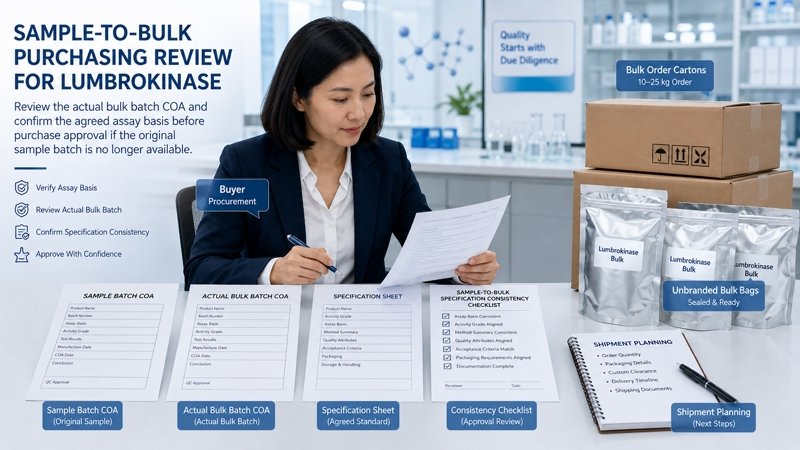
10. Failing to Review the Actual Bulk Batch COA After a Delay
The sample batch may no longer be available when the purchase order is placed. Buyers should review the actual bulk batch documentation before approval.
Stage 8: Connecting Assay Method Communication to Bulk Order Approval
Assay method communication is not only a laboratory issue. It affects commercial purchasing.
Before approving a 10–25 kg order, the buyer should confirm:
- Agreed activity grade
- Agreed or understood assay basis
- Current product specification
- Actual available bulk batch
- COA for the actual bulk batch
- Whether the bulk batch meets the agreed specification
- Whether the activity result uses the expected reporting basis
- Packaging requirements
- Lead time
- Shipping conditions
This process supports sample-to-bulk specification consistency.
Sample-to-bulk specification consistency does not mean that the sample and bulk order must always have the same batch number. It means the actual bulk batch should meet the activity grade, assay basis, specification, documentation, and purchasing requirements agreed during the evaluation process.
When the Original Sample Batch Is No Longer Available
There may be a long gap between sample testing and purchase order placement.
During that period:
- The original sample batch may have been sold
- A new production batch may have become available
- The activity result may be generated under the same supplier method but for a different batch
- The buyer’s internal requirements may have changed
In this situation, the buyer should review the COA for the actual bulk batch and confirm:
- Activity grade
- Activity unit
- Assay basis
- Specification compliance
- Batch number
- Available quantity
- Purchasing requirements
The buyer may also request a retention sample or new pre-shipment sample when commercially justified.
For broader document checks, buyers can consult the FAQ page together with the product and technical articles integrated above.
Allworms Supply Notes
Allworms is part of the manufacturer-side earthworm-derived ingredient supply system and supports overseas market development and international sales.
For available lumbrokinase batches, a COA and specification sheet can be provided. Activity may be discussed using grades and units such as IU/mg, while buyers or their laboratories may use FU/g, LKU, U, or another format. These values should be reviewed together with the assay basis and testing conditions rather than treated as directly interchangeable.
A 100 g sample may be available for qualified B2B buyers before bulk order approval, with international sample freight usually paid by the buyer. The standard MOQ is usually around 1.5 kg, depending on specification, packaging, and destination.
Small bulk orders such as 10–25 kg may be discussed according to activity requirement, available batch, packaging, and destination. Standard lead time is usually 7–15 days after payment. DHL may be used for suitable international shipments, and DDP door-to-door shipping may be available for selected destinations.
Before arranging sample evaluation, buyers are encouraged to share their intended assay method, expected activity unit, laboratory information, and future order plan.
FAQ
1. Why should the assay method be discussed before lumbrokinase sample testing?
The supplier and buyer’s laboratory may use different substrates, standards, incubation conditions, sample preparation procedures, calculations, or activity units. Discussing these variables before testing helps the buyer understand whether the final laboratory result can be compared directly with the supplier COA.
2. Can lumbrokinase IU/mg and FU/g be directly converted?
Not necessarily. A fixed conversion should not be assumed without confirming that the two results are based on sufficiently comparable assay principles, substrates, standards, incubation conditions, sample preparation, calculations, and reporting bases. The same caution applies to LKU, U, and other activity expressions.
3. What should buyers ask a third-party laboratory before testing?
Buyers should ask which assay method, substrate, reference standard, buffer system, incubation time, incubation temperature, sample preparation, dilution method, calculation, reporting unit, and reporting basis will be used. The laboratory should also be asked whether method details can be included in the final report.
4. What should buyers do if the laboratory result differs from the supplier COA?
First confirm sample identity, batch number, storage, unit, assay method, substrate, standard, incubation conditions, sample preparation, dilution, calculation, and reporting basis. After both parties clarify the method details, repeat testing or cross-laboratory testing may be considered when necessary. One different result should not automatically lead to supplier rejection.
5. How does assay method confirmation affect 10–25 kg bulk order approval?
It helps the buyer define the agreed activity grade and understand the assay basis used for purchasing. If the original sample batch is unavailable when the PO is placed, the buyer should review the COA for the actual bulk batch and confirm that it meets the agreed activity grade, specification, assay basis, and purchasing requirements.
Planning lumbrokinase sample testing?
Share your target activity requirement, preferred activity unit, intended laboratory method, sample testing plan, expected order quantity, destination, and document requirements. Allworms can discuss the available batch COA, specification sheet, assay method, activity unit, sample arrangement, actual batch availability, lead time, and shipping before evaluation begins.
This product is supplied as a B2B ingredient. Final formulation suitability, dosage, labeling, health claims, and regulatory compliance should be evaluated by the buyer according to the intended market and finished product use.