Choosing an earthworm protein powder manufacturer requires more than comparing a product description and price per kilogram. For supplement brands, nutraceutical companies, functional food manufacturers, ingredient distributors and formulation teams, supplier approval should consider how the manufacturer controls raw materials, manages production, documents quality and supports the transition from sample evaluation to commercial purchasing.
A reliable supplier should be able to explain what is being supplied, provide relevant specification and batch documents, confirm actual available material, and communicate clearly about samples, MOQ, packaging, lead time and shipping.
The objective is not to find the supplier making the strongest claims. It is to determine whether the manufacturer can provide the product, documentation and purchasing support required for your specific B2B project.
Quick Answer: How Should Buyers Evaluate an Earthworm Protein Powder Manufacturer?
A reliable earthworm protein powder manufacturer should be evaluated through raw material control, production capability, specification and COA documentation, protein content, moisture, ash, heavy metals, microbiology, sample support, packaging, MOQ, lead time, batch communication and small bulk order support.
Buyers should not select a manufacturer only by price, website description or a high protein percentage. Supplier reliability becomes clearer when documents, samples, actual available batches and commercial supply information can be checked together.
Why Manufacturer Evaluation Matters for Earthworm Protein Powder Buyers
Manufacturer evaluation begins before a purchase order is issued.
A sample may need laboratory or formulation testing. Purchasing teams may need documents for internal supplier approval. A small trial order may later develop into repeat purchasing. Each stage depends on information received from the supplier.
A weak supplier evaluation can create problems such as:
- Testing a sample without knowing its specification or batch identity.
- Approving a product description rather than an actual specification.
- Discovering packaging or MOQ limitations after evaluation.
- Receiving a bulk batch without reviewing its batch documentation.
- Delaying procurement because basic documents cannot be supplied promptly.
For detailed product-level information before beginning supplier screening, buyers can first review the Earthworm Protein Powder product page.
1. Manufacturer Background and Supply Role
The first audit question is not simply, “Are you a factory?”
Buyers should understand how closely the supplier is connected to raw material sourcing, production, quality documentation and available inventory.
Useful questions include:
- Is the supplier connected with the production operation?
- Can it explain the general manufacturing process at ingredient level?
- Can it provide a specification sheet and batch COA?
- Can it confirm which batch is currently available?
- Can it coordinate questions between the buyer and production or quality teams?
- Can it support communication from sample evaluation through bulk purchasing?
Manufacturers and trading companies can both serve B2B buyers. The more useful distinction is whether the supplier can provide reliable technical information, batch documentation and purchasing coordination instead of only forwarding a product name and quotation.
2. Audit Raw Material Control
Earthworm protein powder quality begins before powder preparation.
Buyers should ask about the source of the earthworm raw material, selection and cleaning procedures, raw material handling and how consistency is managed between production runs.
Where traceability information is available, buyers can also ask what batch or production records connect incoming material with finished production.
The purpose is not to demand unsupported claims of complete traceability. It is to establish whether the manufacturer understands and controls the raw material entering its process.
This is particularly relevant when a buyer is evaluating long-term supply rather than purchasing a single sample.
3. Review Production and Processing Capability
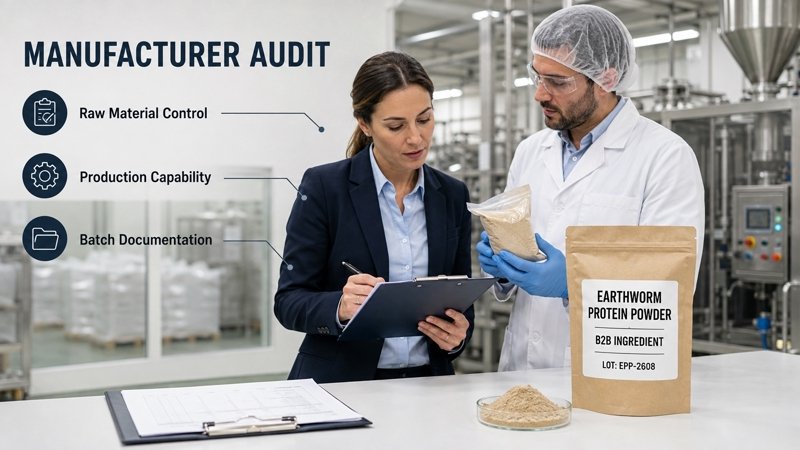
A reliable earthworm protein powder factory should be able to describe its general production flow without turning the discussion into proprietary process disclosure.
At ingredient level, the buyer should be able to understand the main stages, such as raw material selection, cleaning, processing, drying, milling or powder preparation, packaging and batch documentation.
The audit should focus on whether the operation is capable of producing the required ingredient consistently and supporting the expected purchasing volume.
For buyers considering several earthworm-derived ingredients, the Earthworm-Derived Ingredients Comparison also helps distinguish Earthworm Protein Powder from Earthworm Peptide Powder and Lumbrokinase before evaluating the relevant manufacturing requirements.
4. Request the Specification Sheet Before Supplier Approval
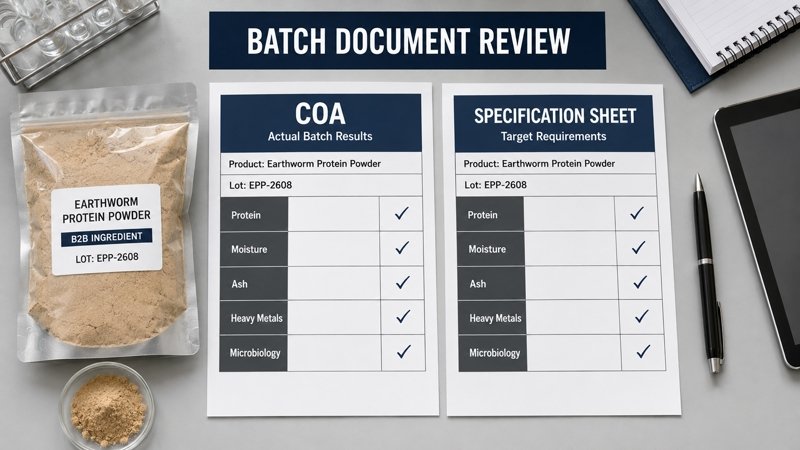
A specification sheet tells the buyer what the product is intended to meet.
Depending on the specification, it may include:
- Protein content
- Appearance
- Moisture
- Ash
- Heavy metals
- Microbiological limits
- Packaging information
- Storage conditions
- Shelf life or related information where listed
This document should be reviewed against the buyer’s own formulation and purchasing requirements.
An important distinction is that the specification sheet normally describes target requirements, while the COA reports results for a particular batch. A professional supplier evaluation therefore should not treat these documents as interchangeable.
5. Check the COA and Actual Batch Documentation
COA availability is another manufacturer audit point.
Where an available batch has already been produced, buyers should ask whether a batch-specific COA can be supplied. Review the product name and batch number first, then examine relevant results such as protein, moisture, ash, heavy metals and microbiology.
Manufacturing date and expiry or retest information should also be checked where these items are included.
Most importantly, determine what material the document represents. A COA from an unrelated historical batch is less useful for a purchasing decision than documentation for the sample or actual material being offered.
For a detailed document-level review, see Earthworm Protein Powder COA Review.
6. Evaluate Protein Content in Context
A high protein percentage alone does not establish manufacturer reliability.
Buyers should review protein content together with the specification basis, testing method where relevant, moisture, ash, heavy metals, microbiology, appearance and formulation requirements. If amino acid profile information is important to the intended application, it can also be requested and evaluated separately where available.
Higher protein content is not automatically better for every formulation.
The more important procurement question is whether the offered specification meets the buyer’s requirements and whether the manufacturer can support consistent, documented supply against that specification.
7. Assess Sample Support
Sample handling gives buyers an early opportunity to assess both the ingredient and the supplier.
Before testing, ask:
- Is a sample available?
- What quantity can be provided?
- Which batch does the sample represent?
- Is supporting COA information available?
- Which specification should be used for comparison?
- Is the same batch expected to remain available when purchasing begins?
Sample support may be available for qualified B2B buyers. Testing should be planned against defined acceptance criteria rather than simply receiving powder and deciding whether it “looks acceptable.”
The Earthworm Protein Powder Sample Evaluation article covers the laboratory and purchasing checks in more detail.
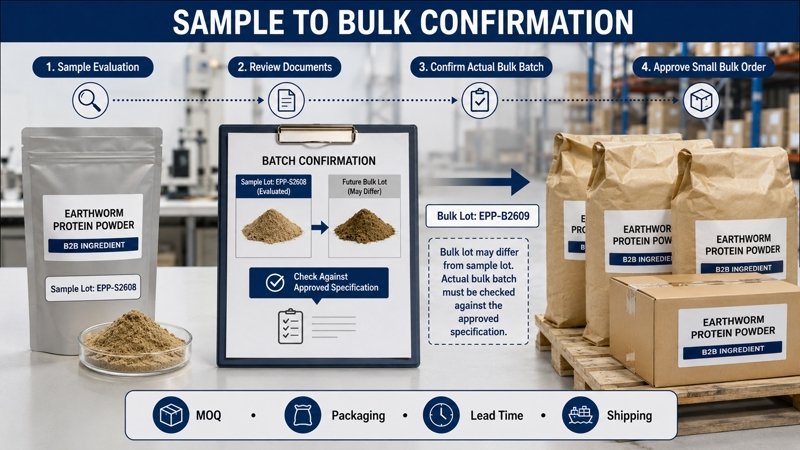
8. Confirm Sample-to-Bulk Specification Consistency
This is one of the most important supplier-approval steps.
If a buyer tests a sample and places a purchase order several weeks or months later, the original sample batch may no longer be available. That does not automatically indicate a supply problem.
Instead, ask whether the proposed bulk material is from the same or a newer batch.
If a newer batch will be supplied, review the COA and specification information for the actual bulk batch before shipment. The objective is sample-to-bulk specification consistency, not necessarily identical batch numbers.
An approved sample also should not be interpreted as a permanent guarantee covering every future batch. Repeat purchases should continue to use appropriate batch-level checks.
9. Review MOQ, Small Bulk and Repeat Supply Capability
Supplier reliability also has a commercial side.
Before approval, buyers should clarify:
- MOQ
- Trial order quantity
- Small bulk order support
- Repeat order planning
- Packaging format
- Current batch availability
- Lead time
- Payment coordination
- Shipping arrangements
This is especially important for small and mid-sized supplement brands. A manufacturer capable of very large production volumes may still be unsuitable if its MOQ, packaging or purchasing process does not match the buyer’s current stage.
Conversely, sample availability is not enough if the supplier cannot explain how the project would progress into a practical bulk order.
10. Check Packaging, Storage and Shipping Support
Packaging should be discussed before the purchase order rather than after production is ready.
Confirm the available packaging format and whether it is appropriate for receiving, warehousing and production handling at the buyer’s facility. Storage conditions should also be documented and communicated.
For international orders, clarify the destination, quantity and required shipping method early. Courier, air freight or other arrangements may vary according to quantity and destination.
DDP door-to-door shipping may be discussed for selected destinations where applicable.
These details do not replace product quality evaluation, but they show whether the supplier can support the complete purchasing process.
11. Use Communication Quality as an Audit Point
Supplier communication is itself useful evidence during evaluation.
Consider how clearly and consistently the supplier answers questions concerning:
- Specifications
- COA requests
- Samples
- Available batches
- Packaging
- Lead time
- Shipping destination
- Required documentation
Response speed matters, but clarity matters more.
For small and mid-sized buyers, clear responses can be as important as a small price difference because incomplete answers generate additional emails, internal clarification and purchasing delays.
A useful test is to send several specific procurement questions together. A supplier that answers only the price question but ignores batch, documentation and packaging questions is providing information about its service capability before an order is ever placed.
Earthworm Protein Powder Manufacturer Evaluation Checklist
| Evaluation Area | What Buyers Should Ask | Why It Matters |
|---|---|---|
| Manufacturer background | What is your connection with production and quality control? | Shows depth of supplier support |
| Raw material control | How are earthworm raw materials sourced, handled and selected? | Quality begins before processing |
| Production capability | Can you explain the general production flow and capacity? | Supports supply assessment |
| Specification sheet | Can you provide the current product specification? | Defines target requirements |
| COA | Is a batch-specific COA available? | Provides actual batch results |
| Protein content | What protein specification is offered? | Must fit buyer requirements |
| Moisture | What requirement/result applies? | Relevant to powder quality and storage |
| Ash | Is ash included in specification or COA? | Provides another composition control point |
| Heavy metals | Which limits/results are documented? | Important for buyer quality review |
| Microbiology | Which microbiological parameters are checked? | Supports ingredient acceptance review |
| Sample support | What sample and supporting documents are available? | Enables pre-purchase evaluation |
| Batch confirmation | Which batch will actually be supplied? | Connects approval with purchased material |
| MOQ | What is the minimum practical order? | Determines commercial fit |
| Packaging | What packaging formats are available? | Affects handling and storage |
| Lead time | Is material available or must it be produced? | Supports purchasing schedules |
| Shipping support | Which options apply to the destination? | Helps plan landed procurement |
| Communication quality | Are technical and commercial questions answered clearly? | Reduces purchasing delays |
| Repeat supply support | How are later batches and repeat orders handled? | Important for supply continuity |
Common Mistakes When Approving a Manufacturer
Several shortcuts can weaken an earthworm protein powder sourcing decision.
The most common are choosing only by price, assuming all suppliers offer equivalent material, or focusing exclusively on protein percentage.
Buyers should also avoid:
- Accepting a product description without checking COA and specification documentation.
- Ignoring moisture, ash, heavy metals and microbiology.
- Failing to identify the sample batch.
- Assuming the sample and future bulk order must—or will—have the same batch number.
- Skipping review of the actual available batch before shipment.
- Leaving MOQ, packaging and lead time discussions until late in the project.
- Confusing Earthworm Protein Powder with Earthworm Peptide Powder or Lumbrokinase.
Supplier approval is strongest when product, documents, batch information and purchasing conditions support the same purchasing decision.
Allworms Supply Notes
Allworms is part of the manufacturer-side earthworm-derived ingredient supply system and supports overseas market development and international sales. For available Earthworm Protein Powder batches, COA and specification information can be provided for B2B review.
Sample support may be available for qualified buyers. MOQ, lead time, packaging and shipping options depend on specification, quantity, packaging requirements, destination and available batch conditions.
Buyers preparing an internal supplier evaluation can also review the FAQ page for general information about documentation, samples, MOQ, bulk orders and international supply.
FAQ
1. How can buyers choose a reliable Earthworm Protein Powder manufacturer?
Evaluate raw material control, production connection, specification and COA availability, batch communication, sample support, quality parameters, MOQ, packaging, lead time and repeat supply capability. Price should be considered as one factor rather than the entire supplier decision.
2. What documents should buyers request before approving a manufacturer?
Start with the product specification sheet and relevant batch COA. Depending on the project, buyers may also request packaging, storage, product and batch information needed for their internal supplier review.
3. Is higher protein content always better?
No. Protein content should be evaluated against the intended application and agreed specification together with moisture, ash, heavy metals, microbiology, appearance, documentation and other relevant formulation requirements.
4. Should buyers confirm the actual bulk batch after approving a sample?
Yes. The sample batch may no longer be available when the purchase order is placed. If another batch will be supplied, review the actual bulk batch information and COA against the approved specification before shipment.
5. How can small bulk buyers reduce Earthworm Protein Powder sourcing risk?
Define the required specification early, review supplier documents, test a representative sample where appropriate, clarify MOQ and packaging, and confirm the available batch, lead time and shipping arrangement before purchase.
Evaluate an Earthworm Protein Powder Manufacturer Before Approval
Share your target protein specification, intended application, sample needs, expected quantity, destination, document requirements and packaging expectations.
Request the COA, specification sheet, available batch information, sample support, MOQ, lead time, packaging and shipping options from Allworms before supplier approval.
This product is supplied as a B2B ingredient. Final formulation suitability, dosage, labeling, claims, and regulatory compliance should be evaluated by the buyer according to the intended market and finished-product use.
4 comments on “How to Choose a Reliable Earthworm Protein Powder Manufacturer: A B2B Buyer’s Guide”
Comments are closed.