Why one quote looks cheap — until it doesn’t
If you’ve sourced botanical extracts, collagen, or specialty proteins before, you already know the game: two suppliers can both say they sell “earthworm protein powder,” yet the real product value can be very different.
That’s especially true here.
Earthworm protein powder is not a commodity ingredient in the usual sense. It sits in a niche category where raw material handling, process control, protein level, batch consistency, and testing standards all shape the final quote. In other words, the price is never just about the powder in the bag. It reflects the whole chain behind it.
And honestly, that’s where many buyers get tripped up.
A lower price may come from lower protein content, looser impurity control, weaker traceability, or less stable raw material sourcing. A higher price may reflect tighter processing, better microbiological control, or a more consistent upstream supply. The trick is knowing which part of the quote is paying for real value — and which part is just sales talk.
What is earthworm protein powder, exactly?
Earthworm protein powder is a protein-rich ingredient processed from selected earthworms through steps such as raw material selection, cleaning, hydrolysis, centrifugal filtration, low-temperature drying, milling, and packaging. In the product material you uploaded, it is positioned for dietary supplements, functional foods, and animal nutrition, with a typical protein specification of ≥65% and a two-year shelf life under proper storage.
Earthworm material has been reported as protein-rich, and after extraction the purified protein fraction can reach much higher purity than raw dried material. One study reported dried raw material at about 60.34% protein, while the extracted earthworm protein reached about 96.03% protein with fat reduced to 0.98%.
That gap matters for pricing. A minimally processed powder and a more refined protein ingredient are not the same product, even if both get called “earthworm protein powder” in casual sourcing conversations.
First things first: there is no single market price
For wholesale buyers, earthworm protein powder pricing is usually quote-based rather than openly listed. That’s normal for specialty ingredients. The final number depends on specification, order volume, packaging, compliance needs, and delivery terms.
So the better question is not, “What is the price per kilo?”
It’s this: “What factors are causing this supplier’s number to be higher or lower than another’s?”
That question gets you much closer to a useful buying decision.
1. Raw material sourcing sets the floor
This is where pricing starts.
If a supplier has a stable upstream supply chain, the quote is usually more predictable. We specifically highlights “stable upstream supply chain” and “controlled production process” as part of the value proposition.
Why does that matter so much?
Because earthworm-derived ingredients are only as stable as the raw material behind them. When supply is fragmented, seasonal, or loosely managed, prices swing. When sourcing is integrated or tightly controlled, suppliers can offer better batch continuity and a steadier quote.
Feasibility material on breeding also shows how upstream economics can shift. In that model, costs are affected by greenhouse investment, seed stock, labor, equipment, high-temperature management, and operating capital. It also notes that summer heat can reduce output or even stop production for part of the year.
That’s a useful reminder: if raw earthworm availability is stressed by weather, farm management, or scaling limits, the wholesale price of downstream protein powder won’t stay still.
What buyers should ask
Ask whether the supplier relies on spot purchasing, contract farming, or its own managed breeding base. The answer tells you a lot about future pricing stability.
2. Protein content changes the price — sometimes more than buyers expect
This one seems obvious, but it’s often misunderstood.
A powder with higher usable protein content usually costs more per kilogram. But the smarter way to look at it is cost per kilogram of actual protein, not cost per kilogram of powder.
For example, if one offer is cheaper but comes with lower protein content, higher ash, or more carrier material, you may end up paying more to hit your formulation target. That “cheap” quote stops looking cheap pretty fast.
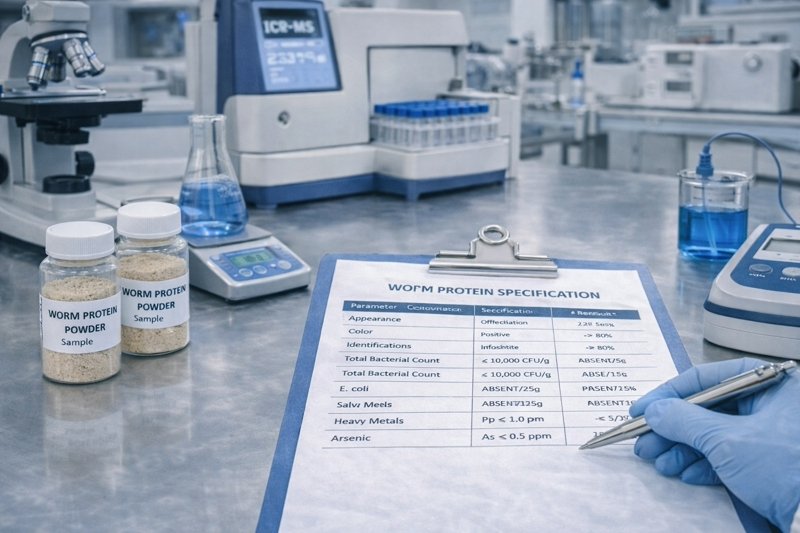
In our product sheet, the standard commercial specification lists:
- Protein: ≥65
- Moisture: 7.18
- Ash: 5.6
- Arsenic: ≤0.5
- Cadmium: ≤2 mg/kg
- Mercury: ND
- Salmonella: ND
Those numbers are part of the price story. A supplier offering tighter specs, or a higher protein level than the basic commercial grade, is not selling the same thing.
3. Production complexity adds real cost
Here’s the thing: buyers sometimes focus on the powder and ignore the process. That’s a mistake.
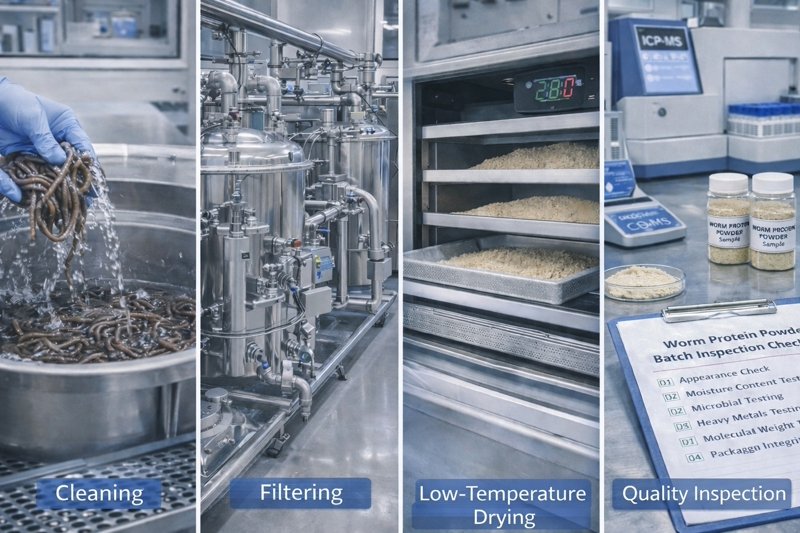
A controlled production route that includes raw material selection, cleaning, hydrolysis, filtration, low-temperature drying, sterilization, and packaging.
The process in similar terms: selection, removal of soil and impurities, secondary cleaning, mechanical washing/hydrolysis, centrifugal filtration, low-temperature drying, pulverizing, sterilization, and packaging.
Every added control point has a cost.
Low-temperature drying, for example, is not there for decoration. It supports product stability and helps protect ingredient quality. Filtration and separation steps help reduce unwanted matter. Sterilization adds another layer of safety and process control. Put simply, the more disciplined the manufacturing line, the less likely you are to get a bargain-basement price.
And that’s okay. In B2B ingredients, a quote should reflect the process behind the spec sheet.
4. Testing and compliance can move the quote more than packaging does
Some buyers treat testing as a box to tick. Experienced buyers know better.
Now think about how that affects cost:
- More test items mean more lab expense
- Tighter release standards increase rejection risk
- Export markets may need extra documents
- Some buyers want third-party verification, not just an in-house COA
So when one supplier gives a lower quote, ask what testing is actually included.
Because a quote without adequate testing support is like buying industrial machinery without asking whether the motor is inside. It may look complete, but something important is missing.
5. MOQ changes the economics
Wholesale pricing almost always rewards volume. Nothing new there.
But with earthworm protein powder, MOQ matters in a few specific ways:
- Smaller orders reduce production efficiency
- Packaging costs weigh more heavily on each kilo
- Batch setup and QC costs are spread over fewer units
- Export paperwork becomes less efficient
If a buyer wants a pilot order, custom pack size, and special testing — but only a few kilograms — the price per kilo will rise. That does not mean the supplier is expensive. It means the order structure is.
So yes, bigger orders usually get better pricing. Not always dramatically better, but enough to matter.
6. Packaging format affects freight, handling, and loss risk
Packaging sounds minor until you start shipping globally.
Our product shows a standard pack format of 1.5kg/bag, 9kg/carton. That’s useful, but real-world pricing still shifts based on:
- Inner bag material
- Moisture barrier quality
- Export carton strength
- Labeling requirements
- Bulk drum or carton preference
- Whether the buyer wants retail-ready or industrial bulk packaging
The more customized the packaging, the less likely you are to get the lowest unit price.
And here’s a little industry truth: cheap packaging can become expensive after transit damage, moisture pickup, relabeling work, or customs delays.
7. Application grade matters more than the product name
But not every batch should be treated as interchangeable.
A buyer sourcing for human health products will usually want stricter documentation, cleaner processing expectations, and tighter contaminant control than a buyer using the material for feed or broader industrial nutrition use. Those demands show up in the quote.
So when comparing prices, make sure both suppliers are quoting the same intended grade. Otherwise, you’re comparing apples to, well, worms.
8. Customization nearly always adds cost
Custom specs sound attractive, and sometimes they’re worth every cent.
But they cost money.
Examples include:
- Higher protein target
- Different mesh size
- Tighter moisture range
- Custom microbial limits
- Private label support
- Tailored packaging size
- Special document sets
- Buyer-specific acceptance standards
None of that is “free service.” It becomes part of the price.
This is why a standard spec is usually the most cost-efficient option for first orders. Once the commercial relationship is stable, buyers can decide which custom elements truly matter.
9. Logistics terms can make one quote look better than another
A supplier may offer a lower price, but that number may be EXW or FOB. Another may quote CIF or DDP-style delivery support. On paper, the first quote looks better. In reality, it may not be.
When reviewing wholesale offers, check:
- Incoterm
- Port or airport
- Export packing
- Insurance
- Duties and taxes
- Who handles customs documentation
- Whether samples and production orders follow the same shipping logic
The headline price is never the whole story.
10. Supplier stability has a price — and usually a benefit
A reliable supplier is rarely the absolute cheapest. That’s normal.
We repeatedly stress stable supply, consistent batch quality, controlled processing, and technical support. Those points are not just marketing language. For B2B buyers, they reduce hidden cost.
Why?
Because unstable supply creates real downstream damage:
- reformulation delays
- stockouts
- missed launch windows
- failed pilot batches
- inconsistent sensory performance
- regulatory headaches
Honestly, a low price that causes rework is not a low price at all.
So, what should buyers compare in a quote sheet?
Here’s a clean way to evaluate wholesale offers.
Check the spec, not just the number
Protein, moisture, ash, microbiology, heavy metals, shelf life, and storage should be clear.
Check the process story
Is the product made through controlled selection, cleaning, hydrolysis, filtration, low-temperature drying, and sterilization — or is the process vague?
Check supply continuity
Can the supplier explain raw material stability and batch-to-batch consistency?
Check what testing is included
COA only? Third-party testing? Market-specific compliance support?
Check order structure
MOQ, sample policy, standard pack size, and lead time all affect real landed cost.
Check application fit
Supplement-grade expectations are different from feed-grade expectations.
A quick note on “cheap” versus “cost-effective”
These are not the same thing.
Cheap earthworm protein powder may work for some low-risk projects. No need to pretend otherwise. But for nutraceutical, functional food, pharmaceutical-adjacent, or premium health product development, cost-effective usually means:
- stable protein spec
- predictable supply
- clean process control
- solid testing support
- fewer surprises after purchase
That’s the balance smart buyers aim for.
Final thought: price follows risk
That’s really the heart of it.
When you buy earthworm protein powder wholesale, you are paying for more than protein content. You are paying for raw material control, process discipline, testing depth, packaging reliability, supply continuity, and commercial predictability.
So the right question is not, “Who is cheapest?”
It’s: “Which supplier gives me the best balance of spec, consistency, and total landed value for my application?”
That’s the question that protects margins. And saves headaches.
FAQs
1. What affects earthworm protein powder wholesale price the most?
The biggest factors are raw material stability, protein content, production process, microbiological and heavy metal testing, MOQ, packaging format, and shipping terms. For most B2B buyers, spec quality and supply consistency matter more than the headline price.
2. Does higher protein content always mean higher earthworm protein powder price?
Usually, yes. A higher protein specification often needs better raw material selection and tighter process control. Still, buyers should compare cost per kilogram of usable protein, not just the quoted price per kilogram.
3. Why do two earthworm protein powder suppliers offer very different quotes?
Because they may be quoting different grades, testing standards, packaging formats, or delivery terms. One supplier may include stricter quality control and export documentation, while another may only be quoting a basic bulk ingredient.
4. How can I reduce earthworm protein powder bulk purchase cost without hurting quality?
Start with a standard specification, order in practical wholesale volume, avoid unnecessary customization on the first order, and compare landed cost instead of ex-factory price alone. That usually gives the best value.
5. What should I ask before buying earthworm protein powder in bulk for supplements or nutraceuticals?
Ask for protein specification, moisture and ash values, microbiological limits, heavy metal data, production process summary, packaging details, shelf life, MOQ, COA sample, and shipping terms. Those points reveal whether the quote is truly comparable.
One comment on “Earthworm Protein Powder Wholesale: Pricing Factors Explained”
Comments are closed.