
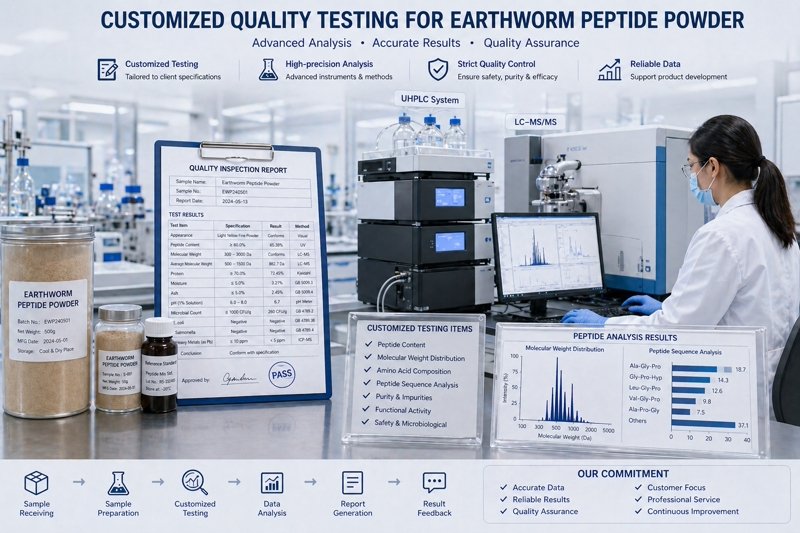
When buyers ask about earthworm peptide powder, the first question is often simple: “What’s your standard spec?”
Fair question.
But in real B2B sourcing, the better question is usually: “Can this specification match my finished product?” Because a capsule brand, a functional drink company, a cosmetic supplier, and a pharmaceutical ingredient distributor don’t always need the same peptide profile. They may all buy earthworm peptide powder, yes, but they don’t always need the same powder.
That’s where custom specifications come in.
Earthworm peptide powder is commonly produced from earthworm protein through controlled enzymatic hydrolysis and drying. Allworms’ product positioning describes it as a small-molecule, non-enzymatic bioactive peptide ingredient made through enzymatic hydrolysis and spray drying, with stable use in powders, capsules, beverages, and advanced nutrition systems.
Sounds technical. But here’s the thing: customization is not just a “nice extra.” For serious brands, it can decide whether the ingredient runs smoothly in production—or becomes a headache on the factory floor.
Why Custom Specs Matter More Than Buyers First Expect
Let’s be honest. Many ingredient buyers start with price.
Then the samples arrive.
Then R&D tests solubility. Procurement checks the COA. Regulatory asks about heavy metals. Production asks if the powder clumps. Marketing asks whether the ingredient can support the product story. Suddenly, the “same” earthworm peptide powder becomes not so simple.
A standard specification may work well for general supplement capsules. But for a beverage powder, you may care more about solubility, odor control, and particle size. For a tablet, flowability and compression behavior matter. For a cosmetic concept, color and sensory profile may become more important than protein content alone.
That’s why custom earthworm peptide powder specifications help buyers match the raw material to the real-world product—not just to a line on a quotation sheet.
For example, Allworms’ current earthworm peptide powder specification includes protein ≥65%, peptide content >30%, moisture data, ash data, selenium, heavy metal indicators, and microbiological testing items such as aerobic plate count, molds and yeasts, coliforms, Salmonella, and Staphylococcus aureus. These are the foundation. Custom work builds from there.
First Things First: Protein Content Isn’t the Whole Story
Protein content matters. Of course it does.
A higher protein level often gives buyers a clearer nutritional positioning. It also helps when the ingredient is used in functional foods, peptide drinks, capsules, or powder blends. But protein content alone doesn’t tell the whole story.
Earthworm peptide powder is not just “protein powder with a fancy name.” It’s a peptide-based ingredient. That means buyers often need to look at:
- Total protein
- Peptide content
- Molecular weight distribution
- Solubility
- Moisture
- Ash
- Heavy metals
- Microbial limits
- Odor and color
- Processing stability
See the difference? Protein tells you what’s inside. Peptide profile tells you how the ingredient may behave.
Research on earthworm protein digestion has shown that enzymatic or gastrointestinal digestion can increase the proportion of smaller peptide fractions. In one study, the proportion of small molecules below 1 kDa increased after simulated gastrointestinal digestion, suggesting that processing has a strong influence on peptide distribution.
For B2B buyers, that matters. A small-molecule peptide ingredient may be easier to position for absorption-focused formulas, while a broader peptide profile may suit general nutrition blends.
Molecular Weight: The “Hidden Dial” in Peptide Customization
If earthworm peptide powder were a sound system, molecular weight would be one of the main dials. Turn it one way, and you get a lighter peptide profile. Turn it another way, and you get a broader material that may behave differently in taste, solubility, and application.
Many buyers ask for “low molecular weight peptides,” but not everyone defines that the same way. Some may want a large share below 3 kDa. Others may focus on below 1 kDa. Some only need a general hydrolyzed peptide product with stable batch control.
Honestly, this is where supplier communication saves time.
A useful discussion may sound like this:
“What application are you developing—capsules, tablets, drink powder, liquid beverage, cosmetic formula, or research material?”
That one question can prevent a lot of back-and-forth.
Studies on earthworm protein-derived ACE inhibitory peptides found that the <3 kDa fraction showed stronger ACE inhibitory activity than higher molecular weight fractions in that experimental model. This does not mean every product should chase the lowest molecular weight possible. But it does show why molecular weight distribution is an important technical parameter when buyers compare peptide ingredients.
Peptide Content: Not Just a Number on the COA
Peptide content can be adjusted based on processing conditions, hydrolysis level, filtration, and drying control. For buyers, this is often one of the most important custom specification points.
A general supplement brand may accept a standard peptide content. A premium nutraceutical brand may ask for a higher peptide content. A distributor supplying several product lines may request a balanced specification that is easier to sell across multiple customer types.
You know what? Sometimes the “highest” spec is not always the most practical spec.
A very narrow or highly processed peptide profile may increase cost, affect taste, or require longer production planning. A balanced peptide specification may give better value for bulk procurement. That’s not a contradiction—it’s just how ingredient sourcing works. The best choice depends on the product goal.
For earthworm peptide powder, Allworms’ listed product information includes peptide content above 30% as part of its standard specification framework. For custom orders, buyers can discuss target peptide content based on application, MOQ, and testing method.
Solubility: The Beverage Buyer’s Quiet Obsession
For capsule buyers, solubility may be nice to know.
For beverage buyers, it can be everything.
Functional drinks, instant powder sachets, stick packs, and ready-to-mix formulas all need a powder that behaves well in water or other systems. Nobody wants floating particles, sediment lines, or a gritty mouthfeel. That’s when earthworm peptide powder moves from “ingredient” to “formulation partner.”
Custom solubility requirements may include:
- Better dispersion in water
- Reduced sediment
- Finer particle size
- Lower odor intensity
- Improved mixing with sweeteners, fibers, minerals, or botanical extracts
Earthworm peptide powder is often positioned as suitable for beverages and powder blends due to its small molecular peptide profile and non-enzymatic stability. Still, final testing in the buyer’s own formula is always smart. A peptide powder may behave beautifully in plain water but differently in a formula containing citric acid, magnesium, collagen, plant extracts, or flavor systems.
Small detail. Big difference.
Non-Enzymatic Specification: Why It Matters for Stable Formulas
Here’s a point that formulators really care about: earthworm peptide powder is different from enzyme ingredients.
Allworms’ product material states that its earthworm peptide powder does not contain active enzymes and is positioned as a non-enzymatic peptide ingredient. Spray drying is described as a key step for stability and shelf-life.
That matters because enzymes can be sensitive. They may lose activity during heat, humidity, compression, shipping, or formulation. Peptides are usually easier to handle in many product systems.
For buyers, a non-enzymatic peptide specification may support:
- More predictable formulation behavior
- Easier use in capsules and powder blends
- Better stability during normal processing
- Less concern about enzyme activity loss
- Broader application flexibility
This is especially useful when a brand wants the story of earthworm-derived bioactive peptides but does not want the complexity of an active enzyme ingredient like lumbrokinase.
Color, Odor, and Sensory Control: The Unsexy Details That Sell Products
Let’s talk about the elephant in the room.
Earthworm-derived ingredients can have a special odor. Product specs may describe the smell as a special fishy smell. That doesn’t mean the ingredient is poor quality. It means formulators must treat sensory control seriously.
For capsules, odor is often manageable through capsule shell choice, packaging, and dosage form design. For beverages or powders, odor masking becomes more important.
Custom sensory requirements may include:
- Lighter color range
- More uniform powder appearance
- Lower odor intensity
- Finer powder texture
- Better compatibility with natural flavors
Think of it like coffee roasting. The raw material has its own character. The final experience depends on how it’s processed, blended, packed, and presented.
For buyers serving premium consumer markets, sensory details are not minor. They can influence repeat purchase.
Particle Size and Flowability: Small Powder, Big Production Impact
If you’ve ever watched a filling line stop because powder doesn’t flow properly, you know this part matters.
Particle size affects blending, filling, compression, dissolution, dusting, and packaging. A powder that looks fine in a sample bag may behave differently in a 25 kg or 100 kg production batch. That’s why manufacturers and contract packers often care about particle size more than brand teams expect.
Custom particle size can help with:
- Capsule filling
- Sachet filling
- Tablet blending
- Powder drink mixing
- Reduced dust during handling
- More uniform batch blending
For wholesalers and distributors, offering multiple particle size ranges can also help serve different downstream clients. One customer may need fine powder. Another may prefer better flow.
Same ingredient family. Different physical behavior.
Moisture and Ash: Boring? Maybe. Important? Absolutely.
Moisture content can affect shelf life, clumping, microbial risk, and flowability. Ash content reflects mineral residue and overall composition. These numbers may not sound exciting, but procurement teams and QC departments check them closely.
Allworms’ listed earthworm peptide powder data includes moisture and ash values as part of the specification set. In bulk trade, buyers may request tighter moisture control depending on shipping distance, storage conditions, climate, and dosage form.
For example, a buyer shipping to Southeast Asia or the Middle East may pay close attention to moisture-proof packaging because heat and humidity are not friendly to peptide powders. A European buyer may focus more on documentation and regulatory review. A U.S. supplement brand may ask for microbial limits and heavy metal data before sample approval.
Different markets. Different pressure points.
Heavy Metals and Microbiology: Where Trust Is Built
For dietary supplement, nutraceutical, pharmaceutical ingredient, and cosmetic buyers, safety testing is not decoration. It’s the backbone of trust.
Custom specifications may include tighter limits for:
- Lead
- Arsenic
- Cadmium
- Mercury
- Total plate count
- Yeasts and molds
- Coliforms
- Salmonella
- Staphylococcus aureus
Allworms’ earthworm peptide powder product information lists heavy metal and microbiological indicators, including arsenic, cadmium, lead, mercury, aerobic plate count, molds and yeasts, coliforms, Salmonella, and Staphylococcus aureus.
For brands, these tests are not just about passing inspection. They protect the brand’s reputation. One failed batch can cost more than a slightly higher ingredient price. Painful, but true.
This is why buyers should request a recent COA, confirm the test method, and make sure the specification matches the target market.
Packaging Customization: The Quiet Hero of Shelf Life
Packaging may not sound glamorous, but it protects everything you paid for.
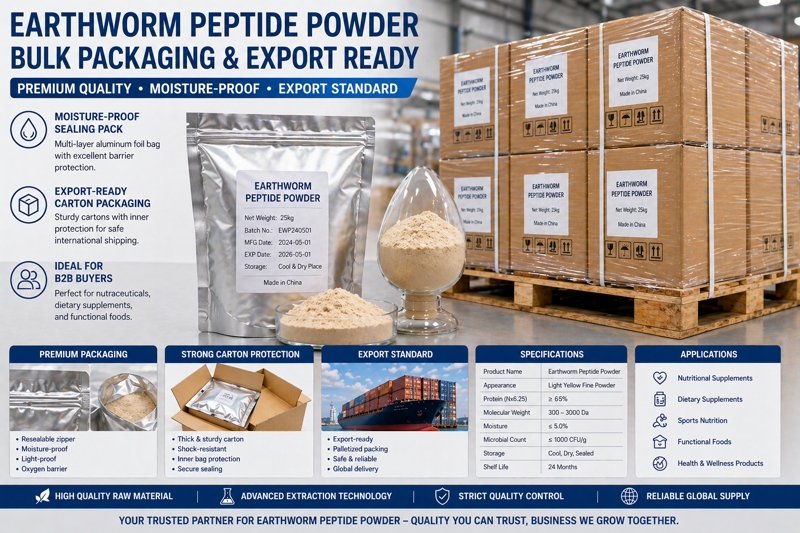
Earthworm peptide powder is commonly supplied in sealed packaging such as 1 kg bags and 10 kg cartons, according to Allworms’ product information. For larger or repeated orders, packaging can often be discussed based on shipping route, warehouse conditions, and production use.
Common packaging requests may include:
- 1 kg aluminum foil bags for sampling or small-batch production
- 5 kg or 10 kg bags for contract manufacturers
- Carton packaging for export
- Moisture-resistant inner lining
- Private label or neutral label options
- Batch number and production date labeling
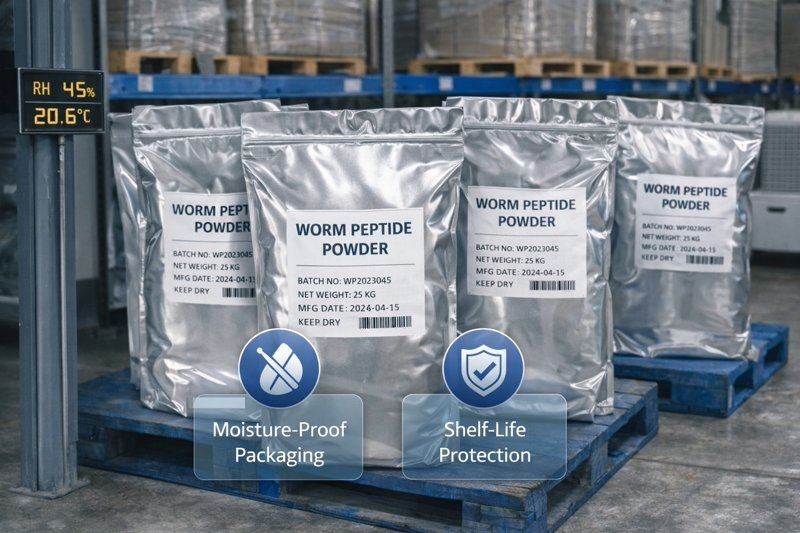
For international buyers, packaging is part of risk control. Long-distance shipping, customs delays, warehouse humidity, and seasonal heat can all affect powder condition. A good package is like a raincoat for your ingredient. Not fancy, but you’ll be glad it’s there when the weather turns.
Application-Based Custom Specifications
Now let’s make it practical.
For Dietary Supplement Capsules
Capsule manufacturers usually care about flowability, odor control, microbial safety, and consistent active composition. A standard earthworm peptide powder may work well, but buyers may request finer particle size or adjusted bulk density for smoother filling.
Recommended focus:
- Stable peptide content
- Good flowability
- Consistent color
- Low moisture
- Microbial compliance
- COA per batch
For Functional Beverages
Beverage buyers are more demanding on solubility and sensory profile. Even a technically good peptide powder can fail if taste or sediment is poor.
Recommended focus:
- Low molecular weight peptide profile
- Better water dispersibility
- Fine particle size
- Odor control
- Low microbial count
- Compatibility testing with flavors and acids
For Powder Sachets and Stick Packs
Stick packs need good flow and low clumping. The ingredient also has to blend evenly with sweeteners, fruit powders, fibers, vitamins, or minerals.
Recommended focus:
- Controlled particle size
- Low moisture
- Good blending behavior
- Stable peptide content
- Moisture-proof packaging
For Cosmetic Ingredient Suppliers
Cosmetic suppliers may care about color, odor, solubility, and documentation. The intended use—cream, serum, mask powder, or beauty drink—will decide the actual spec.
Recommended focus:
- Light color preference
- Fine particle size
- Odor management
- Heavy metal control
- Microbial safety
- Application testing
For Pharmaceutical Ingredient Buyers and Research Use
Pharmaceutical ingredient buyers and research teams usually request tighter documentation and clearer test methods. They may ask for specific peptide range, batch traceability, method validation, or additional safety data.
Recommended focus:
- Clear molecular weight distribution
- Defined peptide content
- Heavy metal and microbial reports
- Batch traceability
- Regulatory support documents
- Stability information
Please note: use in pharmaceutical products depends on local regulations and finished product claims. Ingredient suitability should be reviewed by the buyer’s regulatory team.
Manufacturing Control: Where Custom Specs Are Really Made
Custom specifications are not created by changing a number on paper. They come from manufacturing control.
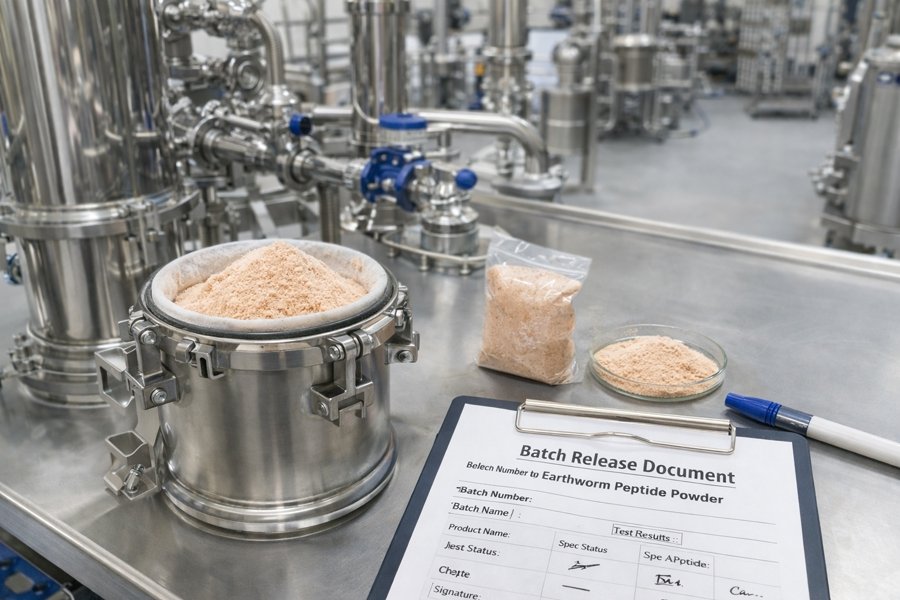
Allworms’ product information describes a controlled process that includes raw material selection, enzymatic hydrolysis, filtration and purification, spray drying, sterilization, and packaging. Each step can influence the finished specification.
Raw material quality affects protein composition. Hydrolysis affects peptide profile. Filtration affects purity and distribution. Spray drying affects stability, powder form, and storage behavior. Packaging protects the final material.
It’s a chain. If one link is weak, the final batch may suffer.
That’s why buyers should not only ask, “Can you meet this spec?” They should also ask, “How do you control this spec batch after batch?”
How Buyers Should Request a Custom Earthworm Peptide Powder Spec
A clear inquiry saves time. A vague inquiry creates guesswork.
Instead of saying, “Send me your best price for earthworm peptide,” buyers can say:
“We are developing a capsule / beverage / sachet / cosmetic product. Please provide earthworm peptide powder with protein ≥65%, peptide content target range, molecular weight information, heavy metal and microbiology data, packaging options, MOQ, lead time, and sample availability.”
Much better.
A strong custom spec request should include:
- Target application
- Required protein content
- Required peptide content
- Preferred molecular weight range
- Solubility needs
- Particle size needs
- Country or region of sale
- Packaging size
- Annual demand estimate
- Required documents: COA, spec sheet, MSDS, flow chart, allergen statement, etc.
This helps the supplier recommend the right specification instead of guessing in the dark.
Custom Specs Are Also About Commercial Fit
Here’s a mild contradiction: custom specs are technical, but they’re also commercial.
A very tight specification may look impressive, but it may raise cost, lengthen lead time, or require larger MOQ. A more balanced spec may be better for early-stage product development. For growing brands, the right choice is often not the most extreme spec—it’s the spec that supports quality, cost, production, and market timing together.
That’s the sweet spot.
For wholesalers and dealers, this matters even more. You may need a specification that is attractive to several buyer types, not just one. In that case, a stable standard spec with room for custom adjustment can be easier to sell.
Final Thought: A Good Spec Makes Buying Feel Safer
Custom earthworm peptide powder specifications are not about making the product sound fancy. They’re about making it usable.
Usable in capsules. Usable in beverages. Usable in powder blends. Usable in cosmetic concepts. Usable for long-term procurement.
And for global brands, that’s the real point. They don’t just need a powder. They need a powder that behaves, tests well, ships safely, and fits the finished product.
If your formula has special requirements, ask for the specification early. It’s much easier to design the right raw material before production than to fix the wrong one after the batch is already made.
FAQs
1. Can earthworm peptide powder specifications be customized for different applications?
Yes. Earthworm peptide powder specifications can be adjusted for capsules, tablets, functional beverages, powder sachets, cosmetic formulas, and nutraceutical blends. Common custom points include peptide content, molecular weight distribution, solubility, particle size, packaging, and testing requirements.
2. What molecular weight range is suitable for earthworm peptide powder?
The suitable molecular weight range depends on the finished product. Low molecular weight earthworm peptide powder is often preferred for absorption-focused supplements and beverage formulas, while broader peptide profiles may be suitable for general nutrition products.
3. Is earthworm peptide powder the same as lumbrokinase?
No. Earthworm peptide powder is a non-enzymatic peptide ingredient, while lumbrokinase is an active fibrinolytic enzyme. Earthworm peptide powder is usually easier to formulate in capsules, powders, and beverages because it does not rely on enzyme activity.
4. What quality documents should buyers request for custom earthworm peptide powder?
Buyers should request a product specification sheet, COA, heavy metal testing, microbiology report, production flow chart, MSDS, and storage information. For regulated markets, additional documents may be needed based on local supplement, food, cosmetic, or pharmaceutical ingredient requirements.
5. Can bulk earthworm peptide powder be packed with private label or custom packaging?
Yes, bulk earthworm peptide powder can often be supplied in different packaging formats, such as 1 kg bags, 10 kg cartons, or moisture-resistant export packaging. Private label or neutral label options may be discussed based on order quantity and buyer requirements.
One comment on “Custom Specifications Available for Earthworm Peptide Powder”
Comments are closed.