
For earthworm peptide powder, logistics and storage are not side issues. They’re part of product quality. A clean COA, stable peptide profile, and good specification sheet all matter, but if the powder sits in a humid warehouse, gets exposed to heat, or arrives with unclear customs documents, the buyer may still have a headache.
And nobody wants that. Not the supplement brand waiting to run a pilot batch. Not the cosmetics manufacturer planning a peptide serum concept. Not the distributor trying to keep retail clients happy.
Here’s the thing: earthworm peptide powder is a functional ingredient, not a common commodity powder. It is usually produced through controlled enzymatic hydrolysis and spray drying, resulting in a stable, non-enzymatic peptide ingredient suitable for capsules, powders, beverages, and advanced formulations . That stability is a real advantage, but it still needs proper logistics and storage discipline.
Let’s walk through it in a practical way.
First, Know What You’re Shipping
Before talking about cartons, customs, and cold storage, buyers should understand the product form.
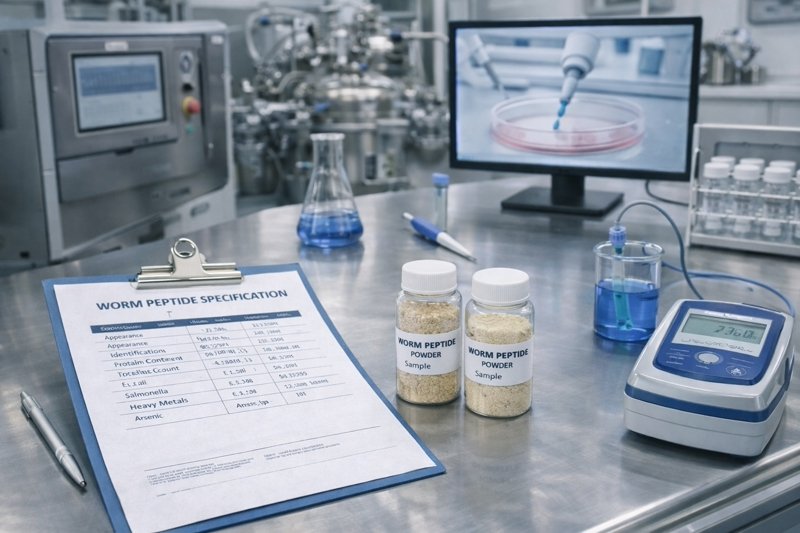
Earthworm peptide powder is generally a light yellow to brown powder with a distinct natural odor. It is not the same as lumbrokinase. It is not positioned as an active enzyme. In fact, a key point for formulators is that earthworm peptide powder is a non-activity enzyme peptide ingredient, which makes it easier to handle in many finished-product systems than enzyme-based materials .
That sounds small, but it matters.
Enzyme products are more sensitive to heat, moisture, and processing stress. Peptide powders, after spray drying, tend to be more stable. They can work in capsules, sachets, powder blends, tablets, and some beverage systems, depending on the formula. The product profile commonly includes protein content above 65%, peptide content, controlled moisture, ash, heavy metal limits, and microbiological testing .
So what does that mean for logistics?
It means the powder doesn’t usually need frozen transport. It also means buyers still need moisture-proof packaging, clean handling, sealed cartons, and clear documentation. Stability is not an excuse for careless shipping. It’s more like a good umbrella: useful, but you still don’t leave it in a storm for a week.
Packaging: The Quiet Hero of International Delivery
Packaging does a boring job. A very important boring job.
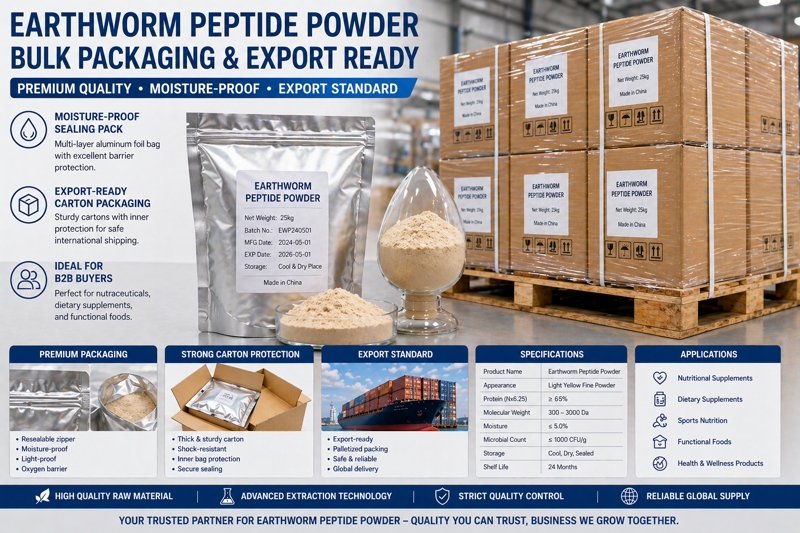
For earthworm peptide powder, the standard export package often uses a sealed inner bag and outer carton. A common format is 1.5kg per bag and 9kg per carton, though bulk buyers may request custom packing depending on their production line, sampling needs, or warehouse rules .
Good packaging should protect against four main enemies:
- Moisture
- Air exposure
- Odor transfer
- Rough handling during transport
Moisture is the big one. Peptide powder can clump if exposed to humidity. Even when the product remains usable, clumping creates trouble during weighing, blending, sieving, and capsule filling. For contract manufacturers, that means slower production. For distributors, it means customer complaints. For brands, it means awkward questions from their production partner.
A strong export carton should be clean, dry, and firm. Inner bags should be heat-sealed or tightly closed. If the product is shipped in smaller trial quantities, the sample bottle or foil bag should still be sealed well enough to survive courier handling. We’ve all seen what can happen to small parcels in transit. They travel like tourists with no sleep.
Documents: Not Glamorous, But Customs Loves Them
For international logistics, documents can move a shipment smoothly—or stop it cold.
Typical documents for earthworm peptide powder shipments may include:
- Commercial invoice
- Packing list
- COA
- Product specification sheet
- MSDS or SDS
- Certificate of origin, when requested
- Microbiology and heavy metal testing data
- Shipping label and airway bill
For B2B ingredient buyers, the COA is especially important. It should match the batch being shipped, not a random old test report. Buyers should check that the product name, batch number, manufacturing date, expiry or retest date, protein content, moisture, heavy metals, and microbiological data are clearly listed.
Honestly, customs officers don’t care about beautiful marketing language. They care about classification, declared value, invoice details, product description, and whether the shipment makes sense.
For samples, declared value is usually low, but it still needs to be reasonable. For bulk orders, the invoice should be consistent with payment records and packing details. Any mismatch can slow clearance.
And here’s a small but useful tip: describe the product clearly as an ingredient raw material. Avoid vague terms. “Earthworm peptide powder for nutraceutical formulation testing” is clearer than “health powder.” Clear words reduce confusion.
Sample Shipping: Small Package, Big First Impression
The sample shipment is often the first physical contact between supplier and buyer. It may be only 100 g, but it carries a lot of weight.
A buyer may judge the supplier by:
- How fast the sample is prepared
- Whether the package looks clean
- Whether documents are attached
- Whether the powder matches the specification
- Whether the supplier gives tracking details quickly
- Whether customs issues are explained before they happen
For earthworm peptide powder, samples are commonly shipped by express courier such as DHL, UPS, or FedEx, depending on destination, buyer preference, and current carrier conditions.
You know what? A sample doesn’t need fancy packaging, but it must look professional. A sealed sample bag, label, COA, and clear tracking number say: “We know what we’re doing.”
That’s the message buyers want to receive before they place a bulk order.
Bulk Shipping: Air Freight, Sea Freight, or Courier?
Bulk shipments need more planning than samples.
For small commercial orders, express courier can still work. It’s faster, simpler, and easier to track. For medium-volume orders, air freight may be a better balance between cost and speed. For larger orders, sea freight can reduce shipping cost, though it takes longer and requires stronger attention to moisture protection.
There is no one perfect shipping method. It depends on the order size, urgency, destination country, importer capability, and whether the buyer wants door-to-door delivery.
For example:
Courier shipping works well for samples and small urgent orders.
Air freight works well for medium orders where speed still matters.
Sea freight works better for larger planned purchases where cost control matters.
A supplement manufacturer preparing a launch batch may prefer air freight. A wholesaler stocking inventory for several months may prefer sea freight. A cosmetics lab testing peptide concepts may only need a small courier sample.
Different buyer, different rhythm.
Customs Clearance: Don’t Leave It to Luck
International buyers should confirm import requirements before placing the order. This is especially true for ingredients used in dietary supplements, nutraceuticals, functional foods, pharmaceutical ingredient research, or cosmetics.
Earthworm peptide powder may be treated differently depending on the destination market and final application. Some countries may view it as a food ingredient, some as a supplement raw material, some as an animal-derived ingredient, and some may require extra review.
So before shipping, supplier and buyer should confirm:
- Product description for customs
- HS code suggestion
- Required documents
- Importer registration, if needed
- Whether the buyer has a broker
- Whether DDP, DAP, FOB, or CIF terms are preferred
- Whether any animal-derived ingredient restrictions apply
Let me explain the trade terms quickly.
With DDP, the supplier handles delivery and customs duties to the buyer’s door, where available. With DAP, the supplier ships to the destination, but the buyer handles duties and import clearance. With FOB or CIF, the buyer usually has more control over freight and customs.
For many first-time buyers, DDP feels easier. For experienced importers, DAP or air cargo through their broker may be more practical.
The point is not which term sounds better. The point is choosing the one that avoids surprises.
Storage Conditions: Cool, Dry, Sealed — Yes, It’s That Simple
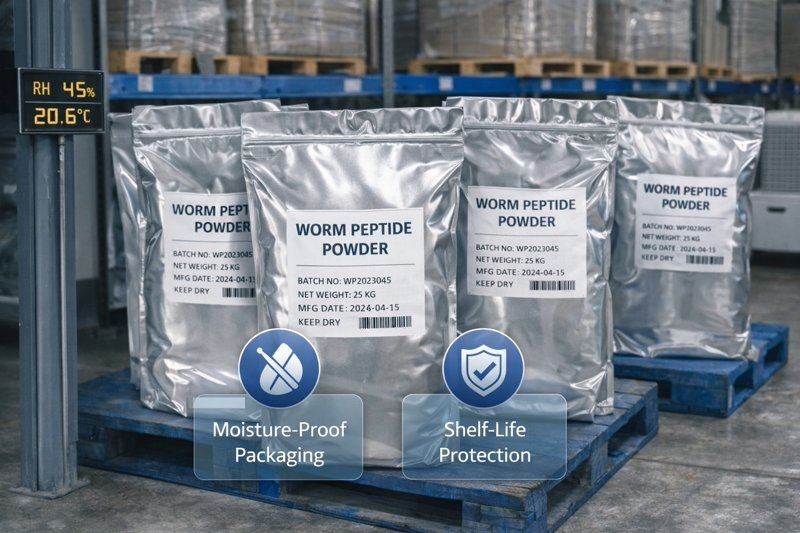
Earthworm peptide powder should be stored in a cool, dry place, with a typical shelf life of two years under proper storage conditions .
That sentence is simple. Living by it takes discipline.
The storage room should be:
- Dry
- Clean
- Away from direct sunlight
- Away from strong odors
- Protected from pests
- Kept at stable room temperature
- Managed with first-in, first-out stock rotation
Moisture control deserves special attention. Peptide powders are often hygroscopic to some degree, meaning they can absorb moisture from the air. Once opened, the bag should be resealed quickly. If the buyer uses only part of a bag, the remaining powder should not sit open beside a production line for hours.
It sounds obvious, but in busy factories, obvious things get missed.
For brands using earthworm peptide powder in capsules or sachets, storage before blending is just as important as storage after finished product packaging. Raw material quality can be damaged before production even starts.
What About Temperature During Shipping?
Most earthworm peptide powder shipments do not require cold-chain logistics. That’s one reason peptide powder is easier to ship than many sensitive enzyme ingredients.
Still, high heat should be avoided when possible.
Summer shipping can bring higher temperature exposure in trucks, airports, ports, and warehouses. Winter shipping can bring delays, condensation risk, and customs slowdowns around holidays. Tropical destinations add another layer: humidity.
So while normal shipping is acceptable, suppliers should avoid letting cartons sit outdoors or in damp storage before dispatch. Buyers should inspect packages promptly after arrival and move them into proper storage.
Think of it like coffee beans. They don’t need a freezer truck, but you wouldn’t leave them open in a steamy kitchen either.
Odor Control: A Small Detail That Buyers Notice
Earthworm-derived ingredients can have a special natural odor. Product documents may describe the smell as a characteristic fishy or natural odor . This is normal, but logistics should prevent odor transfer.
That means packaging should be sealed well, and the powder should not be stored near fragrances, solvents, essential oils, spices, or strong-smelling chemicals. In cosmetics and supplement manufacturing, odor matters. A raw material with unwanted external odor can complicate formulation work.
For beverage applications, odor masking may be part of formulation development. For capsules or tablets, it may be less of a concern. Either way, clean storage helps keep the ingredient predictable.
Why Stable Peptide Profiles Matter in Global Supply
Earthworm peptide powder is valued not just because it comes from an unusual natural source, but because it offers a peptide-based functional profile. Research has shown that earthworm protein digestion products can release bioactive peptides; one Food Chemistry study identified thousands of peptide sequences and screened several antioxidant peptides with notable activity .
For B2B buyers, this research background supports interest in earthworm-derived peptides. But commercial success still depends on repeatable production. A buyer doesn’t just need a “good sample.” They need the next batch, and the batch after that, to behave in a similar way.
That’s why controlled hydrolysis, spray drying, batch testing, and proper logistics fit together like gears in a machine. If one gear slips, the final product may suffer.
Warehouse Handling for Distributors and Wholesalers
Distributors often hold stock longer than manufacturers. That makes warehouse management important.
A distributor should keep earthworm peptide powder in original sealed packaging until sale or repacking. If repacking is needed, it should be done in a clean, controlled area with suitable labeling and lot tracking.
Important warehouse habits include:
- Keep cartons off the floor
- Avoid stacking too high
- Keep away from wet walls or open doors
- Record receiving date and batch number
- Use FIFO inventory control
- Check carton condition after arrival
- Avoid mixing different batches without documentation
It’s not glamorous work. But it protects margin. One damaged carton can cost more than the time saved by careless storage.
For Manufacturers: Check Before Production
Before adding earthworm peptide powder to a finished product formula, manufacturers should check the batch against internal requirements.
Look at:
- Appearance
- Odor
- Solubility or dispersibility
- Protein content
- Peptide content
- Moisture
- Heavy metals
- Microbiology
- Allergen or animal-origin declarations, if required
- Regulatory suitability for the target market
For beverages, solubility and taste masking need extra attention. For capsules, flowability and bulk density may matter more. For tablets, compression behavior becomes important. For cosmetic ingredient systems, odor, color, dispersion, and compatibility should be checked early.
No ingredient exists in isolation. It has to behave inside a formula.
Seasonal Logistics: The Calendar Can Be Sneaky
Shipping schedules often get squeezed around holidays, trade shows, port congestion, and year-end inventory cycles.
For international buyers, the safest approach is to plan orders before urgent inventory pressure appears. That sounds like plain advice, but it’s worth repeating. Plan early. Plan early.
For example, buyers preparing for Q4 supplement sales should not wait until the last minute to order raw materials. Summer heat may affect warehouse handling. Autumn trade fairs may tighten shipping schedules. Winter holidays can slow customs and courier delivery.
A good supplier will communicate lead time clearly. A good buyer will share forecast needs early. That cooperation makes the whole supply chain calmer.
And calm supply chains are underrated.
Buyer Checklist Before Placing an International Order
Before confirming a purchase, B2B buyers should ask the supplier for the following:
- Current specification sheet
- Recent COA
- Packaging format
- Shelf life and storage condition
- Sample availability
- MOQ
- Lead time
- Shipping method options
- Customs document list
- Batch traceability information
- Whether custom molecular weight or specification requests are available
For bulk earthworm peptide powder supply, it’s also smart to confirm whether the supplier can support repeat orders, not just a one-time shipment. A launch order is nice. A stable supply relationship is better.
What Makes Logistics Easier for Earthworm Peptide Powder?
Compared with some sensitive bioactive ingredients, earthworm peptide powder has several practical advantages.
It is stable as a dried powder. It is non-enzymatic. It can be packed in manageable carton sizes. It can be shipped by express courier, air freight, or sea freight depending on quantity. It can be stored in cool, dry warehouse conditions without frozen transport.
That’s good news.
But good logistics still depends on human care: sealed bags, clean cartons, accurate documents, reasonable declarations, and proper storage after arrival. Fancy science can’t fix a wet warehouse.
Final Thought: Logistics Is Part of Quality
When buyers compare earthworm peptide powder suppliers, they often start with protein content, peptide content, price, and MOQ. Fair enough.
But logistics and storage deserve the same attention.
A reliable supplier should know how to pack the product, prepare documents, arrange sample delivery, support bulk shipping, and explain storage conditions clearly. A reliable buyer should prepare import requirements, check local regulations, and store the powder correctly after arrival.
That’s how good ingredients stay good.
Earthworm peptide powder may be a small-molecule ingredient, but the supply chain around it is not small at all. It touches farms, production lines, laboratories, warehouses, customs offices, freight networks, and final product factories. Each step matters. Each step protects the powder.
And when every step is handled well, the buyer gets what they actually ordered: a stable, clean, usable peptide ingredient ready for serious formulation work.
FAQs
1. What is the best way to ship earthworm peptide powder internationally?
For samples and small urgent orders, express courier is usually practical. For medium or bulk orders, air freight or sea freight may be more cost-effective. The best international shipping method for earthworm peptide powder depends on order size, destination, customs requirements, and delivery urgency.
2. Does earthworm peptide powder need cold-chain shipping?
Usually no. Earthworm peptide powder is a spray-dried, non-enzymatic peptide ingredient and can normally be shipped under standard dry cargo conditions. However, it should be protected from high heat, moisture, direct sunlight, and long exposure in uncontrolled warehouses.
3. How should bulk earthworm peptide powder be stored after delivery?
Bulk earthworm peptide powder should be stored in a cool, dry, clean place, away from sunlight, moisture, pests, and strong odors. After opening, the inner bag should be resealed quickly to reduce moisture absorption and clumping risk.
4. What documents are needed for importing earthworm peptide powder?
Most buyers request a commercial invoice, packing list, COA, specification sheet, SDS or MSDS, and product label information. Depending on the destination country, customs may also request a certificate of origin, animal-origin statement, or additional ingredient compliance documents.
5. What packaging is suitable for earthworm peptide powder wholesale orders?
Common wholesale packaging for earthworm peptide powder includes sealed inner bags and export cartons, such as 1 kg per bag and 10 kg per carton. Buyers can request custom packaging based on production needs, sampling plans, warehouse handling, and distributor requirements.

Get High-Absorption Peptide Ingredients Now
Request free sample (100g available)