
If you work in supplements, nutraceuticals, functional foods, or ingredient sourcing, you’ve probably noticed something lately: buyers want protein ingredients that do more than hit a number on a spec sheet. They want a story. They want differentiation. And, frankly, they want something that doesn’t look like the same whey-soy-pea loop repeated for the hundredth time.
That’s where earthworm protein powder starts to get interesting.
It sounds unconventional. It is unconventional. But that’s also part of its commercial appeal. Earthworm protein has been studied as a high-protein raw material with functional-food potential, and published work points to protein levels in the rough range of 60% to over 70% in earthworms, with good essential amino acid composition and potential as a food resource. In one study, the earthworm sample contained 70.05% protein on a dry-weight basis, while another paper notes that earthworm protein has been recognized as a new food resource in China since 2009.
For beverage developers and protein blend manufacturers, that matters. A lot.
Because the real question is not, “Can earthworm protein powder be used?” The better question is, “Where does it make the most sense, and how do you position it so it works technically and commercially?”
Let me explain.
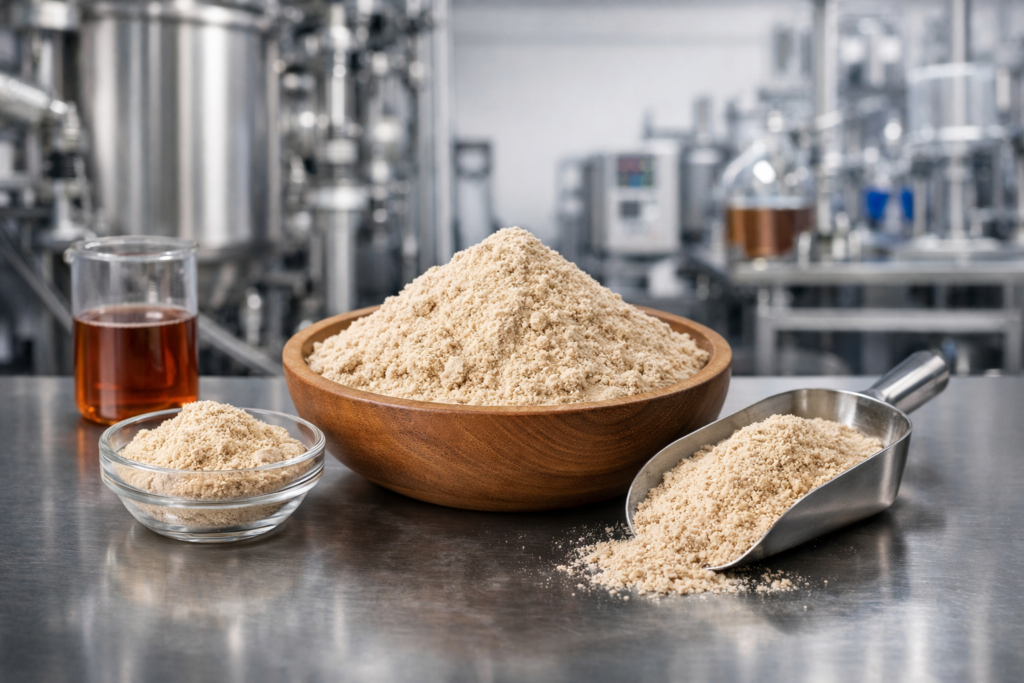
Why brands are paying attention
Earthworm protein powder sits at an unusual intersection: alternative protein, functional ingredient, and specialist raw material.
On the nutrition side, the case is straightforward. Earthworm-derived materials are consistently described as protein-rich, and one immunomodulatory study describes earthworms as rich in protein and a good source of edible insect protein, citing protein levels of 54.6% to 71% in dry matter for Eisenia foetida.
On the functional side, it gets more interesting. Published studies on earthworm protein and hydrolysates have identified antioxidant, ACE-inhibitory, and immunomodulatory peptide potential after digestion or hydrolysis. The 2024 Food Chemistry paper specifically says its work lays a scientific foundation for the application of earthworm protein as a food resource in functional foods.
That doesn’t mean every finished beverage can or should make bold health claims. It does mean formulators and product managers have a credible scientific base for discussing earthworm protein as a multifunctional protein ingredient for future-facing product concepts.
And that’s a big difference.
A commodity protein competes on price, solubility, and grams per serving. A differentiated protein ingredient competes on narrative, novelty, and formulation flexibility too. Sometimes that’s the margin-maker.
So why functional beverages?
Because beverages are where consumers now expect convenience to meet function. They want protein, yes, but they also want energy, recovery, wellness, beauty support, gut balance, and “something extra” they can feel good about buying.
Internal source material on earthworm peptide applications already points to functional drinks as a logical food format, noting potential use in juices and tea-based drinks, alongside broader health-food development.
That makes sense for three reasons.
First, beverage formats are fast-moving. Brands can test niche concepts in powdered sachets, ready-to-mix drinks, shots, and high-protein wellness beverages without building an entire category around a single ingredient.
Second, the story is cleaner in a blend. Earthworm protein powder does not have to carry the whole product alone. In practice, it can serve as a specialty component inside a broader protein system.
Third, peptide-rich or hydrolyzed forms often fit beverage logic better than coarse, heavy proteins. One study found that after simulated gastrointestinal digestion, small molecular weight fractions below 1 kDa rose from 44.80% to 80.19%, while fractions above 5 kDa dropped from 29.17% to 1.52%, suggesting strong conversion toward smaller peptides.
That kind of small-peptide profile is exactly why formulators start thinking: “Could this behave better in functional drink systems than a standard dense protein flour?” It’s not magic. But it is promising.
Why beverages are tricky but promising
Now for the honest part.
Earthworm protein powder in beverages is promising, but it is not plug-and-play.
If you’re working on RTD protein shakes, clear protein drinks, dairy alternatives, or powdered blends, you already know the usual headaches: sedimentation, haze, taste masking, mouthfeel, heat stability, emulsification, and consumer acceptance. And with a novel animal-derived protein, those questions get sharper.
Internal production material shows that earthworm protein powder can be produced through a process including selection, cleaning, hydrolysis, centrifugation and filtration, low-temperature drying, milling, sterilization, and packaging. It also lists earthworm, corn starch, and maltodextrin as production materials in that process description.
That tells us two useful things.
One, the ingredient can be prepared in a powder form suited to industrial handling.
Two, not every earthworm protein powder on the market will be the same. Carrier systems, drying method, and processing details may affect flowability, dispersibility, flavor, and protein concentration in the finished ingredient. Honestly, that’s true for every specialty protein, but here it matters even more.
So, for beverages, success usually depends on choosing the right positioning:
1. Powdered wellness beverages
This is probably the easiest starting point. Sachets, stick packs, and canister blends give formulators more room to work with flavor systems, sweeteners, functional fibers, and companion proteins.
2. Protein-plus botanical blends
Earthworm protein powder can be combined with familiar matrices such as cocoa, coffee, matcha-style profiles, grains, or fruit systems. That helps reduce the “novel ingredient shock” while giving buyers a premium formulation angle.
3. Active nutrition blends
Not the mainstream sports aisle, at least not at first. More likely, niche active-wellness or recovery blends where buyers care about specialty ingredients, peptide content, and product storytelling.
4. Functional shots and concentrated formats
Smaller serving sizes can reduce taste and texture pressure. Sometimes less volume means fewer problems. Not always, but often enough to matter.
How to use it in protein blends
Here’s the thing: earthworm protein powder may be most commercially useful not as a solo hero, but as a strategic co-star.
That’s actually good news.
Blending lets manufacturers manage sensory performance, protein economics, and positioning all at once. A mixed protein system can combine a base protein for bulk nutrition with earthworm protein powder for novelty and functional differentiation.
You could think about it in a few practical ways:
A specialist layer in a multi-protein formula
Use a familiar foundation protein for texture and cost control, then add earthworm protein powder as a smaller, high-value inclusion. This is often the smartest route for early-market products.
A peptide-forward concept
The science around earthworm-derived hydrolysates is one of the stronger parts of the category. In the antioxidant study, simulated gastrointestinal digestion produced a hydrolysate with 22.91% degree of hydrolysis and 79.19% soluble peptide content. In the autolysate study, the reported values were 22.38% and 77.92%.
That suggests a useful distinction for product developers:
- Earthworm protein powder may fit higher-protein blend concepts
- Earthworm peptide or hydrolysate formats may fit more functional, beverage-friendly positioning
Not the same job. Not the same label story. And definitely not the same formulation behavior.
A low-fat protein enrichment angle
One source document on food innovation describes earthworm peptide as a high-protein, low-fat natural component suitable for products like protein bars and other better-for-you foods, while the antioxidant paper reported purified earthworm protein at 96.03% protein and only 0.98% fat after extraction.
That low-fat angle can be useful in powdered blends where oil management and shelf stability are part of the brief.
What the science suggests about functional positioning
This is where marketers sometimes get carried away. Better not to.
The current research supports potential in several areas, but most responsible B2B communication should frame these as ingredient research directions or functional-food development potential, not as guaranteed end-product effects.
A few relevant examples:
Earthworm protein hydrolysates showed antioxidant potential after digestion, and researchers identified peptide sequences with strong activity, including AFWYGLPCKL, WPWQMSLY, and GCFRYACGAFY.
A separate study identified seven novel ACE inhibitory peptides from earthworm protein digestion products, with SSPLWER and RFFGP showing the strongest activity among the tested peptides.
Another study found earthworm protein autolysates produced immunomodulatory peptide candidates and described the work as laying a foundation for applying earthworm protein in functional foods.
For beverage and protein blend development, this opens a few clean positioning lanes:
- cardiovascular wellness concept development
- antioxidant-forward nutrition products
- advanced peptide nutrition
- premium functional protein blends
- novel animal protein innovation platforms
That’s already a lot to work with.
Formulation points that really matter
If you’re a supplier, wholesaler, or manufacturer, buyers will usually care about six things before they care about your storytelling.
1. Protein level and specification consistency
Published data vary depending on species, raw material state, and processing method. That’s normal, but buyers will still expect batch-to-batch control.
2. Form selection: protein vs peptide
This is a major one. If the target is a protein blend, whole protein powder may be the better fit. If the target is a functional beverage, hydrolyzed or peptide-rich formats may have a clearer technical argument.
3. Taste and aroma management
Novel proteins live or die here. A technically impressive ingredient with poor flavor handling won’t get repeated orders. No one in procurement says that out loud at first, but they’re thinking it.
4. Solubility and suspension
Especially for beverages. Internal application material itself notes that extraction efficiency, stability, and maintaining original sensory quality remain challenges that still need work.
5. Regulatory fit by market
This is country-specific and product-specific. Ingredient suppliers need clean documentation and careful market review before pushing beverage or food applications across regions.
6. Claim discipline
Very important. Earthworm-derived materials are interesting because the science is growing. That is not a license to overstate. Strong B2B positioning sounds more credible when it stays measured.
Where earthworm protein powder may fit best right now
Not every market is ready at the same speed.
The most realistic early opportunities are probably these:
Specialty nutraceutical powders where novelty and functionality matter more than mass appeal.
Protein blend systems for brands that want a differentiated inclusion ingredient rather than a commodity base.
Functional beverage premixes where peptide-rich formats can be paired with fruit, tea, botanical, or wellness concepts.
Cross-category innovation projects for manufacturers serving supplements, pharmaceuticals, and functional-food clients under one ingredient platform.
That last one matters more than people think. A versatile ingredient story can create sales across categories even before one mass-market hit product arrives.
A quick word on perception
Yes, some buyers will hesitate at first. Of course they will.
But niche ingredient categories often begin that way. What looks unusual in year one can look commercially clever in year three, once the specs are cleaner, the story is sharper, and a few solid product launches prove the concept.
Earthworm protein powder has one big advantage here: it is not being introduced as a random novelty. It is being explored as a protein-rich material with functional-food potential, peptide generation potential, and multiple researched bioactivity directions.
That gives manufacturers something much more useful than hype. It gives them a platform.
Final thoughts
Earthworm protein powder in functional beverages and protein blends is not a mass-market ingredient story yet. But it is a serious B2B ingredient story.
For protein blends, it offers product differentiation, a premium narrative, and room for specialty positioning. For functional beverages, the better opportunity may sit with hydrolyzed or peptide-rich forms, especially where brands want a “protein plus function” concept rather than a plain macro play.
That’s the contradiction, and it’s worth saying clearly: earthworm protein powder is still niche, yet that niche quality is exactly what may make it commercially attractive.
Not for everyone. Not for every formula. But for the right buyer, in the right format, with the right technical support? It could be a very smart move.

FAQs
1. Can earthworm protein powder be used in functional beverages?
Yes, earthworm protein powder can be considered for functional beverage development, especially in powdered drink mixes and concentrated wellness formats. Peptide-rich or hydrolyzed forms may be even more suitable where solubility, dispersibility, and bioactive positioning are priorities.
2. Why is earthworm protein powder attractive for protein blends?
Earthworm protein powder is attractive for protein blends because it brings a high-protein profile, essential amino acid value, and a differentiated ingredient story that stands apart from standard plant and dairy proteins.
3. Is earthworm protein powder better as a full protein or as a peptide ingredient?
It depends on the application. Full protein powder may suit fortified blends and high-protein formats, while earthworm peptides or hydrolysates may fit functional beverages and advanced wellness products more naturally because small peptides are a key part of the current research base.
4. What formulation issues should manufacturers check first?
Manufacturers should look closely at protein specification, carrier system, taste profile, suspension behavior, and processing method. Internal production material also shows that ingredient composition can include carriers such as corn starch and maltodextrin, so formulation fit should be checked carefully.
5. What health-oriented product concepts are most relevant for earthworm protein ingredients?
The most relevant long-tail product concepts include antioxidant functional beverages, cardiovascular wellness protein blends, peptide nutrition powders, and specialist functional-food formulations. That direction is supported by research on antioxidant, ACE-inhibitory, and immunomodulatory earthworm-derived peptides.