
Earthworm Protein Powder Particle Size: Why It Matters in Supplement Formulation
An Earthworm Protein Powder sample can meet its analytical specification and still raise questions on the production floor. It may distribute unevenly in a blend, cling to a transfer surface, or feed differently from the material used during development. Particle characteristics are one possible contributor to those observations.
For a formulator, the useful question is not “What is the best mesh size?” It is: Do this powder’s particle characteristics work in our formula, equipment, and manufacturing process? Answering that question requires more than a single size designation. It calls for an assessment of the particle-size distribution, observations of powder behavior, and a comparison between the approved sample and material intended for production.
Buyers can begin with the available Earthworm Protein Powder product information, then define which physical properties their own process needs to control. A particle-size requirement should reflect an observed manufacturing need rather than an assumed universal target.
What does “particle size” tell a formulator?

Particle size describes the dimensions of powder particles as determined by a stated measurement method. Particle-size distribution describes the range and relative proportions of sizes within the material. That distinction matters because a powder rarely consists of particles that are all the same size.
A single nominal value may summarize a test result, but it cannot show the full range of particles present. Two powders with similar reported nominal sizes may have different amounts of fine or coarse material. They may therefore handle differently, even before they are mixed with other ingredients.
The formulator should ask what a reported value represents. Was the material measured, or was it described by the sieve used in processing? Was the tested sample representative of the batch? What procedure was used, and were agglomerates handled consistently? These questions help the buyer interpret the information without assuming that different reports mean the same thing.
No current particle-size distribution should be attributed to Allworms without verified measurements for the relevant material. Where those data are unavailable, a representative sample can be evaluated against the intended manufacturing process.
Mesh size is not the whole particle-size picture
A mesh designation commonly refers to a sieve or screen. It can be useful when describing a processing or screening step, but it does not automatically describe every particle in the finished powder. How a reported mesh designation relates to a particular batch depends on the sieve procedure and the meaning assigned to the result.
For example, a statement about material passing a screen answers a different question from a measured particle-size distribution. The former concerns passage through a specified screen under defined conditions. The latter aims to describe sizes across a sampled population. Neither should be substituted for the other without knowing how the results were obtained.
When comparing supplier information, request the measurement or sieving method alongside the reported result. Do not treat a mesh label as a guaranteed description of blending, flow, or filling performance.
How can particle characteristics affect blending?
During blending, Earthworm Protein Powder must distribute within a mixture containing ingredients that may differ in size, shape, density, and handling behavior. Differences in particle characteristics can influence how readily the materials mix and whether they remain distributed during later handling.
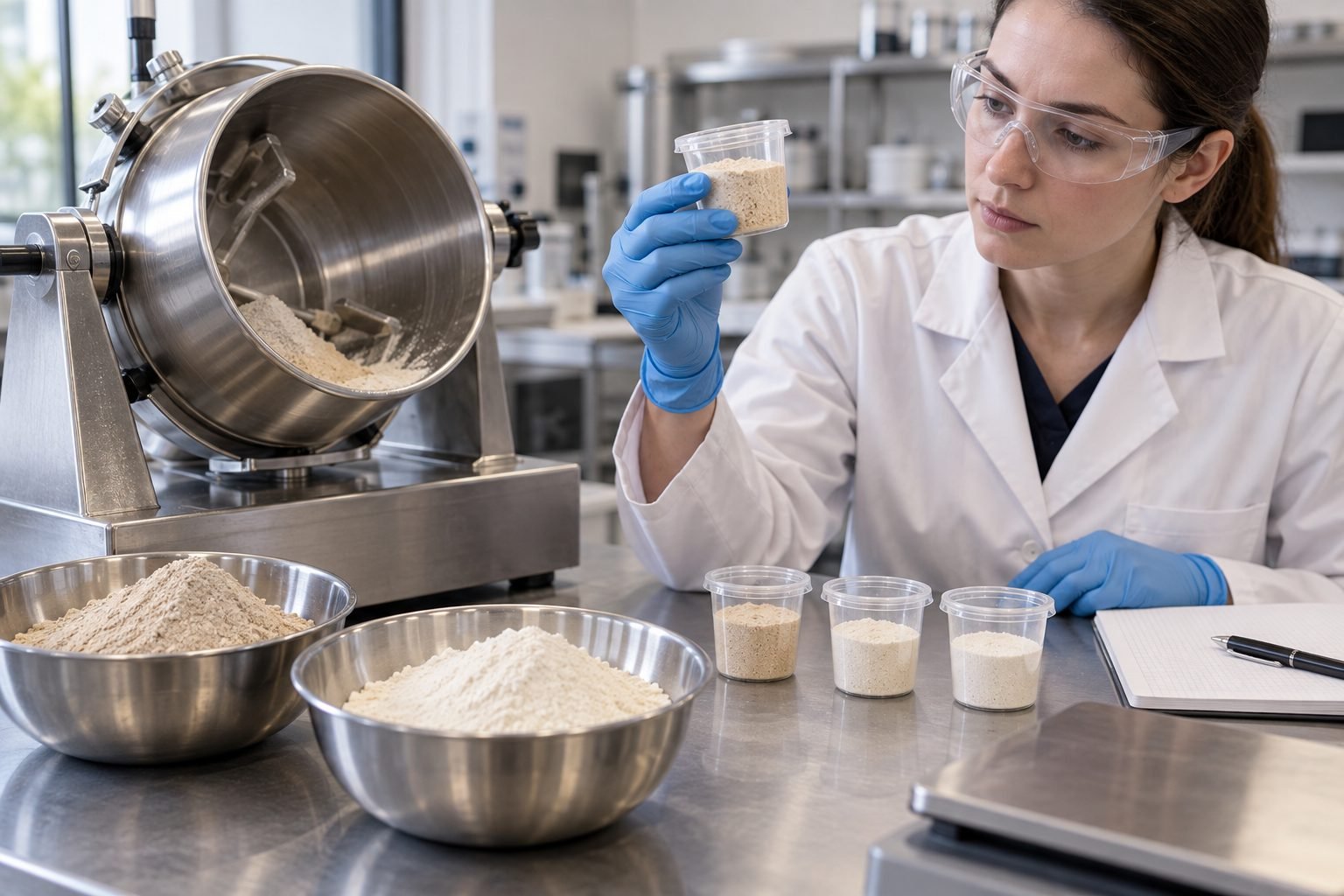
A formulator should examine the powder in the actual formula, rather than judge it solely as a standalone ingredient. A particle profile that handles acceptably by itself may behave differently when combined with a much coarser or finer component. Mixing time, order of addition, equipment, and batch scale can also affect the outcome.
Particle size and blend uniformity are separate questions. A reported particle-size result cannot establish that the finished blend is uniform. If uniform distribution matters to the product, evaluate the complete blend using an appropriate sampling and testing approach. Record where samples were taken and whether the blend changed after transfer, rather than relying only on an observation immediately after mixing.
For the broader decisions involved in solid dosage development, see Earthworm Protein Powder for Capsule and Tablet Formulations: What Developers Should Evaluate. This article addresses the narrower particle-size question within that evaluation.
Particle size and segregation risk
A blend that appears satisfactory in the mixer may change during discharge, transfer, vibration, or feeding. Components with different physical characteristics can separate under some conditions. Particle-size differences may contribute, but they do not establish that segregation will occur; density, particle shape, cohesion, equipment design, and process conditions can also matter.
The relevant test is whether the intended blend remains suitable through the steps it will actually encounter. A development team can compare observations or samples before and after transfer, at different container locations, and during a representative feeding or filling trial. If a problem appears, investigate its cause before changing a particle-size requirement.
This approach avoids a common mistake: specifying a finer powder simply because segregation has been observed. A change in size may alter other handling properties, and the full blend needs to be retested after any change.
Does a finer powder flow better?
Not necessarily. Particle size can be related to powder flow, but a particle-size result is not a flowability result. Fine material may be more cohesive under some conditions; coarser material may present different feeding or separation issues. Moisture exposure, agglomeration, particle shape, and the equipment surface can change what happens in practice.
Observe the powder during weighing, scooping, discharge, transfer, and feeding. Note any sticking, dust generation, bridging, uneven movement, or material left behind. If flow is a critical process requirement, use a relevant test and verify behavior in the intended equipment or a representative setup.
Bulk density is another related physical property. It may help a developer assess volume and equipment filling, but it does not replace particle-size or flow evaluation. Keep the measurements distinct so that a result for one property is not used as unsupported proof of another.
What matters during feeding and filling?
Particle characteristics can become more consequential when a process moves from hand handling to equipment feeding. A bench blend that pours acceptably from a small container may behave differently in a hopper, feeder, or filling system. Movement and vibration can also change the arrangement of particles within a blend.
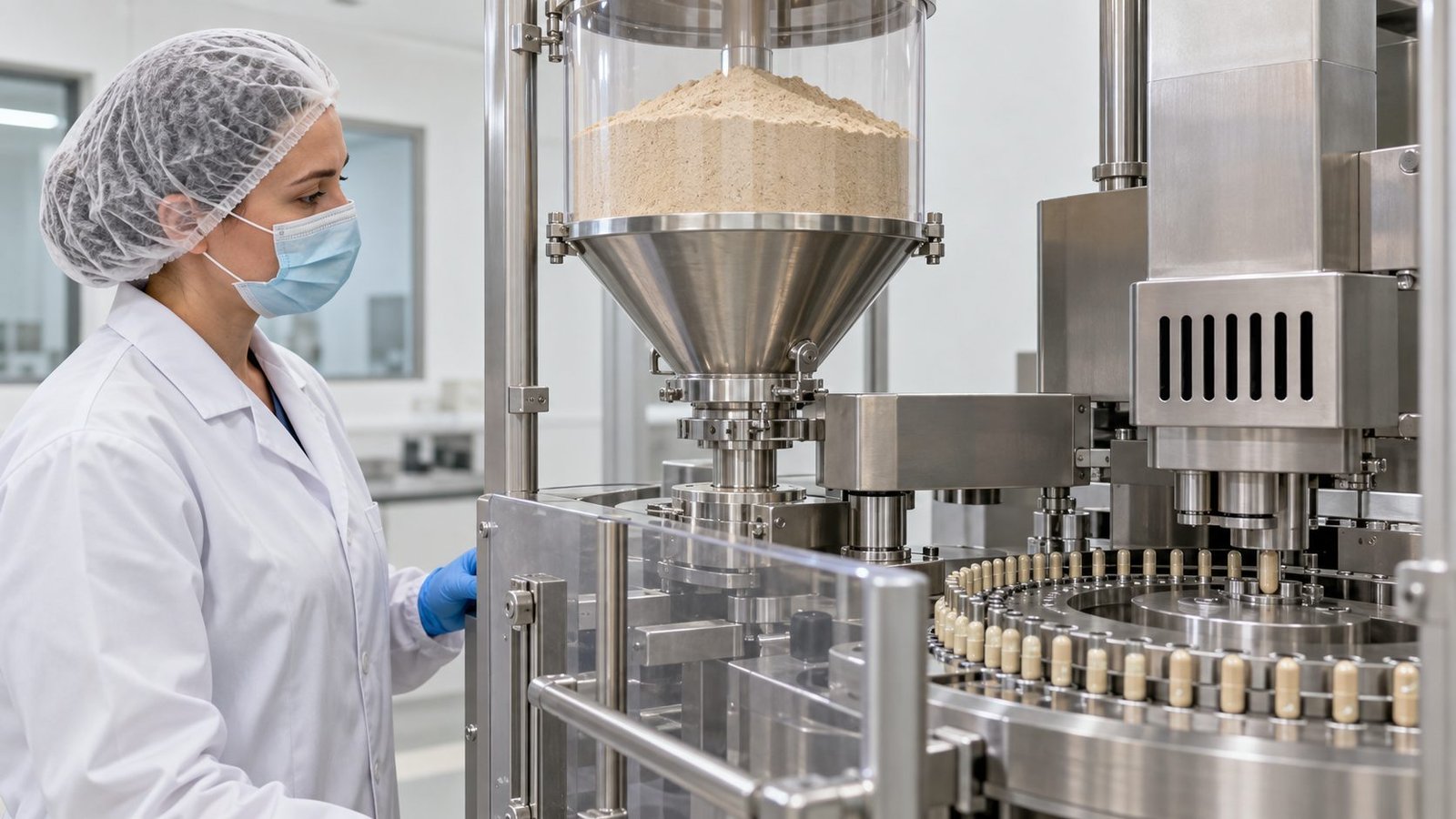
For capsule development, observe how the complete blend reaches and fills the machine, then evaluate the relevant fill results. For tablet development, examine blend feeding and die filling as part of the wider compression trial. The appropriate acceptance criteria belong to the finished formulation and process; Earthworm Protein Powder particle size alone cannot establish either dosage form’s suitability.
Record the conditions under which a trial succeeded or failed. The same powder may appear different when the blend composition, equipment setup, or handling conditions change. Documentation makes later sample-to-bulk comparisons more meaningful.
A practical particle-size evaluation table
| Evaluation question | What to check | What the result can support |
|---|---|---|
| What was reported? | Whether the value describes a measurement, sieve result, or nominal designation; the method used | Correct interpretation of supplier data |
| Is the sample representative? | Batch identity, sampling approach, visible agglomerates, and handling before testing | Confidence in applying results to the supplied material |
| How does the powder blend? | Distribution in the complete formula under the planned mixing conditions | Identification of blending concerns requiring further testing |
| Does the blend separate? | Observations or samples after discharge, transfer, vibration, and feeding | Assessment of segregation under relevant process conditions |
| How does it move through equipment? | Discharge, sticking, bridging, dust, and feeding consistency | Process-specific handling assessment |
| Does production material compare with the approved sample? | Results using the same method, plus repeat observations in the formula | A basis for investigating meaningful differences before approval |
This table is a planning tool, not a universal specification. The team should select tests according to the process and define acceptance criteria from its own development results.
How to test a sample before setting a requirement
Start by identifying the proposed sample batch and the process it is meant to represent. Ask for any verified particle-characteristic information and its method. Inspect the sample for visible variation or agglomeration, then obtain a measurement if particle size is likely to affect the intended process.
Next, test the material in the proposed formula. Document the blending conditions and observe what happens during transfer and feeding. If the team identifies a manufacturing issue, determine whether particle characteristics are contributing alongside other physical and process variables. A useful trial records both the measurement and the behavior it was intended to explain.
Where a numeric particle-size criterion would affect purchasing or release decisions, establish it only after enough relevant material has been evaluated. State the method, sampling basis, and decision rule clearly. A number chosen before formulation testing may be too restrictive to serve a purpose—or may fail to control the behavior that prompted it.
For a wider review of analytical purchasing parameters, consult Key Specifications to Look for When Sourcing Earthworm Protein Powder. Particle-size criteria should be added where they serve a demonstrated formulation or manufacturing need.
Compare the approved sample with the commercial batch
An approved sample is most useful when its identity and test conditions can be connected to the later order. Confirm whether commercial material will come from the evaluated batch. If it comes from another batch, compare the agreed particle characteristics using the same method where practical.
A difference in a reported result does not automatically mean the new material will fail. Equally, matching nominal numbers cannot guarantee matching manufacturing behavior. Review both the measurement and a relevant handling or formulation trial when the process is sensitive to this property.
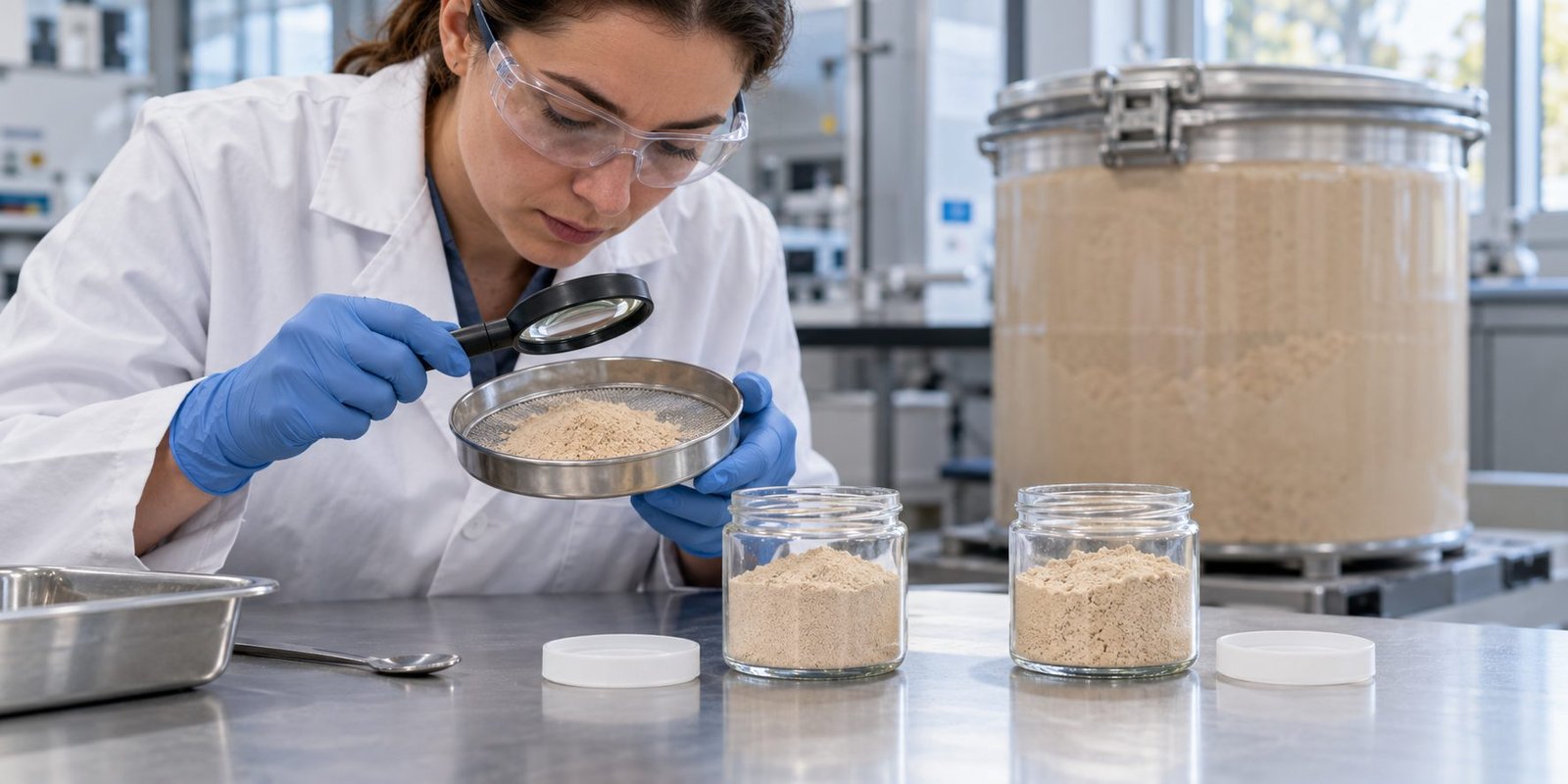
Record the sample result, batch identifier, test method, observations in the formula, and any agreed acceptance criteria. When commercial material arrives, check whether it remains within those requirements and whether process observations reveal a meaningful change. For the wider repeat-supply decision, see Earthworm Protein Powder Batch Consistency: What Buyers Should Compare.
If particle data are unavailable or a purchasing requirement is still being developed, agree with the supplier which material will be tested and how differences will be discussed before release. The Allworms FAQ page provides general information on specifications, samples, and supplier documentation.
FAQ
Why does Earthworm Protein Powder particle size matter?
It may influence how the powder blends, moves, and feeds in a particular process. Its practical importance depends on the complete formulation and equipment, so it should be assessed alongside observed manufacturing behavior.
Is finer Earthworm Protein Powder always better?
No. Finer material is not automatically easier to blend, transfer, or fill. Test the relevant powder and finished blend under conditions that represent the intended process.
What is the difference between mesh size and particle-size distribution?
A mesh designation relates to a sieve or screen under a stated procedure. A particle-size distribution describes the range and proportions of particle sizes measured in a sample. The two reports should not be treated as interchangeable without their methods.
Does particle size determine powder flow?
No. It can contribute to flow behavior, but moisture, particle shape, cohesion, agglomeration, and equipment conditions may also affect movement. Evaluate flow separately when it matters to production.
Can particle-size differences cause segregation?
They may contribute to segregation when ingredients are mixed and then transferred or fed. Their effect must be evaluated within the complete blend; a size difference alone does not prove that separation will occur.
What particle size is best for capsule filling?
There is no universal value for Earthworm Protein Powder. The appropriate requirement depends on the formula, capsule-filling equipment, and results from representative trials.
Should particle size be compared between a sample and a bulk batch?
Yes, when it was relevant to sample approval or process performance. Use comparable methods and review manufacturing behavior as well as reported values.
Should particle size appear in a purchasing specification?
Include a defined criterion when development work shows that controlling it is necessary. Specify the test method and acceptance basis so both buyer and supplier can interpret the requirement consistently.
Conclusion
Particle size is one part of Earthworm Protein Powder’s physical profile. Its value to a buyer lies in explaining and controlling behavior in a specific blend and process, rather than identifying a universal ideal number. Measure what matters, test the complete formulation, and verify that commercial material remains suitable against the approved sample.

Review Your Earthworm Protein Powder Specification And Physical-Property Requirements?
Evaluate a representative sample in your intended manufacturing process.